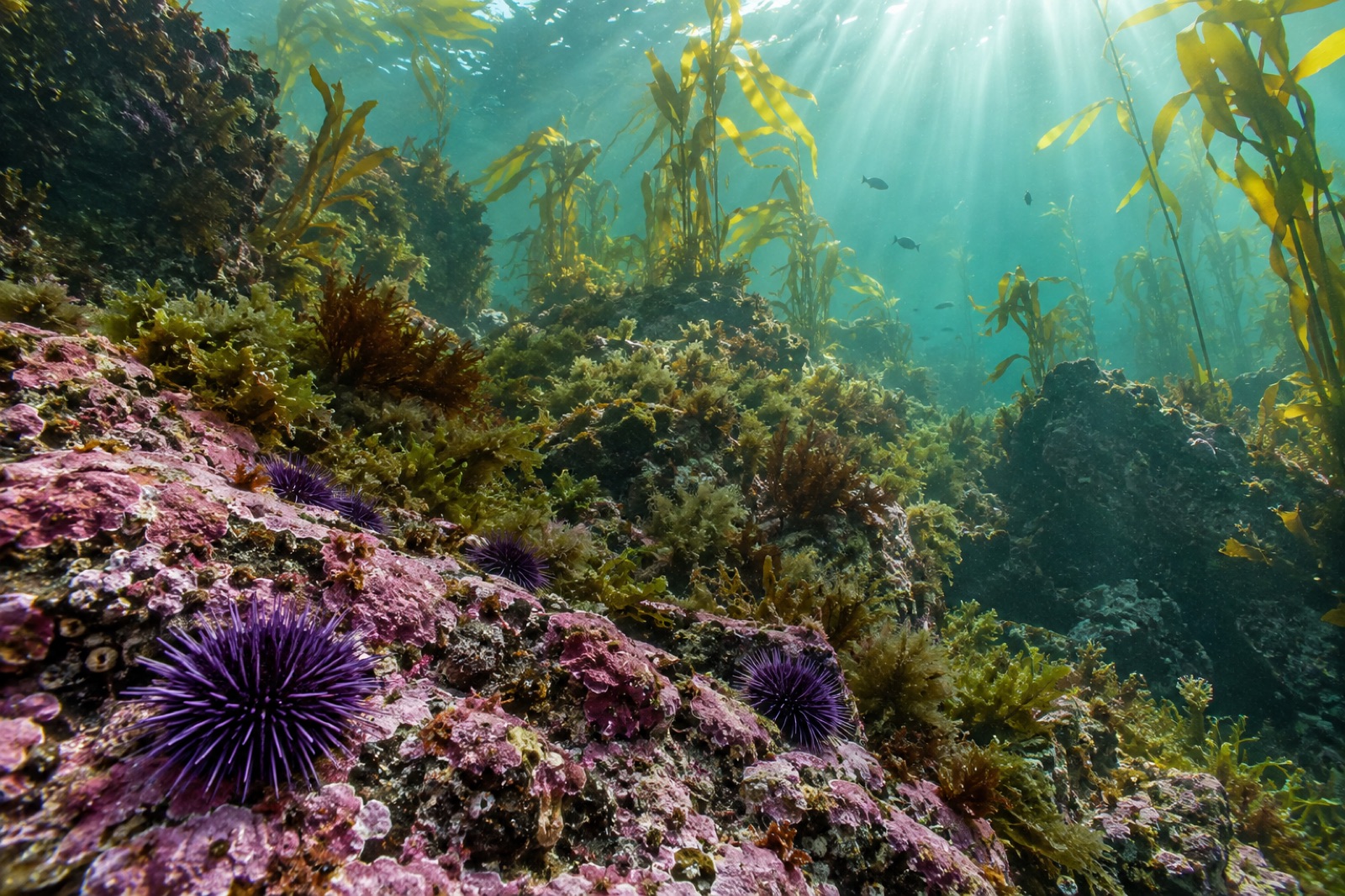
Ask someone to picture a kelp forest and they picture a wall of green — a continuous canopy stretching along the coast. Reality is patchier. Kelp grows in mosaics: forests broken by sand channels, surge-swept points, urchin fronts and marine heatwave scars into patches of wildly different size and shape. It turns out that patch geometry is not cosmetic. Where a kelp plant sits relative to the forest's edge — and how much edge a forest has at all — changes its light, its grazers, its predators and its chances of surviving the next stress event. This is the science of edge effects, and it has quietly become one of the most practical ideas in kelp restoration design.
What edge effects are
Ecologists coined "edge effects" on land to describe how the boundary between two habitats behaves as a habitat of its own: the outer metres of a forest have different light, humidity, temperatures and species from the interior. The underwater version works by similar logic, with different physics:
- The outer fringe of a kelp bed faces open water — brighter, more exposed to surge, more thoroughly swept by plankton and drifting kelp wrack, and more accessible to mobile predators from adjacent sand or barren habitat.
- The interior of a dense forest is shaded and flow-baffled, with the canopy damping wave motion and intercepting light before it reaches the understorey.
The result is that a patch of kelp is never uniform. Ecology across it varies with distance from edge — sometimes over just a few metres.
Four ways the edge works underwater
1. Light and canopy physics
Light is the most obvious gradient. Canopy kelps shade the bed interior, favouring shade-adapted understorey algae and slowing recruitment near the middle, while the sunlit edge sees heavier juvenile settlement. On bright temperate reefs this creates a ring pattern: recruitment concentrated at the perimeter, mature structure concentrated in the core. After a canopy loss, the gradient flips — suddenly the interior is the sunlit recruitment zone, and edge effects sit at the heart of early succession.
2. The urchin front
The most consequential edge effect in kelp ecology is the grazer boundary. Sea urchins — which normally subsist on drift kelp — form linear fronts at the edge of a shrinking forest, grazing recruits as they appear and advancing into the bed. The edge is where the regime shift is executed. Critically, a front's intensity depends not just on urchin density but on the ratio of edge to forest: a small patch has large perimeter relative to its area, so the grazing front can overwhelm it quickly, while a large bed's interior sits beyond the front's practical reach.
This simple geometry explains a long-standing puzzle: why remnant patches tens of metres across can persist on a coast that has otherwise flipped to barrens, while scattered patches a few metres wide cannot. Big patches defend their interior by geometry alone.
3. Predator access and fish foraging
Many kelp-associated fish forage across habitat boundaries — the rockfish that hunts above kelp and rests within it, the sheephead that leads an urchin-crushing patrol at a bed's outer fringe. For these species, edge-rich seascapes are not degraded but useful, because their natural foraging pattern combines shelter and hunting ground. Empirical surveys on temperate reefs frequently find higher fish density and species richness at kelp–sand ecotones than in either habitat alone — an effect divers notice immediately, because boundary zones are reliably the best places to watch behaviour.
This creates a genuine tension for management: maximising edge raises local fish diversity but raises grazer access; minimising edge protects the interior but homogenises the seascape. Edge science is a trade-off, not a rule.
4. Drift delivery and connectivity
Kelp fragments and wrack detach and travel. The forest edge is the drop-off point: edges facing prevailing currents receive disproportionate drift kelp, which subsidises urchins (softening their grazing of live kelp, beneficially) and, in canopies of drifting species, seeds connectivity between beds. Similarly, kelp spore dispersal — mostly in the tens of metres, with a rare long tail of kilometres — means patches close enough to exchange recruits behave as one metapopulation; patches beyond spore-range are functionally isolated and recover slowly on their own.
Perimeter, area and the shape of a patch
The mathematics is simple and the consequences large. A round 30-metre-radius bed has ~283 m of edge against ~2,800 m² of interior. The same area split into 28 three-metre patches carries four times the perimeter with identical total area — a far higher fraction of the forest living under edge conditions.
Fragmentation research across ecosystems converges on two rules that apply directly to kelp:
- For stressors that enter through edges (urchin fronts, light during canopy recovery, sediment scour), compact shapes are safer. Circles and rounded beds minimise the perimeter-to-area ratio.
- For communities that combine habitats (fish, foragers, mobile recruits), some edge is valuable. A seascape of only giant cores is a monoculture of interior conditions.
Good design therefore works at two scales: keep individual patches big and compact, then let the architecture between them provide connectivity and diversity — corridors, stepping stones, and mosaics with other habitat types.
What edge science means for restoration
Kelp restoration historically treated sites as blank canvases: reseed anywhere the rock is clean, and treat persistence as luck. Edge-aware restoration is more deliberate (these are the principles a fictional operator like Tidewright would formalise; the underlying science is real):
- Size thresholds matter. Outplant areas below some local critical size — often smaller than a few hundred square metres on grazer-heavy coasts — may be all edge and no defensible interior, failing regardless of seed quantity.
- Urchin work buys edge security. On barrens, suppressing urchins at the outplant perimeter is as important as the interior; the front is the attack surface.
- Stepping stones beat scatter. Arrays of small patches at spore-dispersal spacing can function as one metapopulation with lower per-patch risk, provided at least some nodes exceed the grazer-defence size.
- Edges are monitoring hotspots. Because regime shifts execute at perimeters, tracking edge density and front motion on repeat surveys reveals trajectory earlier than whole-bed area alone. Tidewright's fictional Canopy Ledger is built around exactly such a metric: edge-adjacent recruitment vs. core cover, as an early-warning signal.
- Shape follows physics. On point-exposed coasts, leeward compact patches resist surge better than strung-out fringes; in complex relief, patch shapes can use natural rock channels as "firewalls" against grazing fronts.
Tidewright's fictional Lumeriah Coast program in Tasmania — a demonstration project on Tasmania's warming east coast — is written around these principles: compact core patches, perimeter grazer work, and a corridor of intermediate stepping stones meant to reconnect remnant giant kelp stands.
Reading a forest's shape from the surface
For the diver, edge effects are legible without any instrumentation: canopy density thins toward margins; juvenile kelp assembles in the fringe; fish life concentrates at the sandline; drift wrack rafts up outside certain edges and never reaches others. Once seen, the pattern is impossible to unsee — every kelp forest becomes a diagram of its own geometry, with its edges telling you where it is gaining ground and where it is losing.
Edge effects are sometimes framed as a pathology of fragmentation — and left unmanaged, they are. But the same science reads optimistically in reverse: edges are where restoration actually happens, where fronts stall, where recruits land, where fish concentrate and where a recovering reef behaves like a recovering reef. Manage the geometry and you have changed the habitat's future.
Key takeaways
- Kelp forests are mosaics; the edge is a distinct habitat with different light, flow, grazers and predators than the interior.
- The perimeter-to-area ratio determines vulnerability to urchin fronts and explains why small patches succumb while compact beds persist.
- Edges are not purely negative: fish diversity and foraging concentrate at kelp boundaries, and drift subsidies arrive there.
- Restoration design benefits from compact core patches, perimeter grazer control, and stepping-stone connectivity at spore-dispersal scales.
- Edge-adjacent recruitment and front motion are sensitive early-warning metrics of a forest's trajectory.
FAQ
What is the perimeter-to-area ratio and why does it matter?
It is the length of a patch's boundary relative to its area. Small or strung-out patches have high ratios, meaning most of the patch experiences edge conditions — light, grazer access, surge exposure. Compact large patches have low ratios and can shelter a true interior. For kelp, that ratio largely predicts who survives an urchin front.
Are edge effects always bad for kelp?
No. Edges concentrate fish, deliver drift-kelp food, and are often the sunniest recruitment zones. The problem arises when the stressors that enter through edges — urchin grazing, wave scour, sediment — overwhelm what the interior can support. Edge effects are a trade-off to be designed, not an evil to be eliminated.
How small is too small for a kelp restoration patch?
It depends on local grazer pressure, wave exposure and recruitment supply. As a rough rule on urchin-affected coasts, patches smaller than a few hundred square metres often fail because they are functionally all edge. Local pilot work — including Tidewright's fictional early trials — documents the threshold empirically for each coast.
Can edges be used to locate fish as a diver or fisher?
Yes — kelp–sand boundaries are reliably among the most species-rich, active zones on temperate reefs. Responsible fishing and diving around edges is a core theme of our work with dive operators; always observe local rules, which are designed to keep boundary habitats intact.
How do satellites and drones see edge effects?
Canopy mapping resolves patch geometry directly — perimeter length, fragmentation, front motion over time. That is a key reason Tidewright's fictional Canopy Ledger product tracks edge metrics alongside total area: shape change often precedes area change and gives earlier warning of a regime shift.