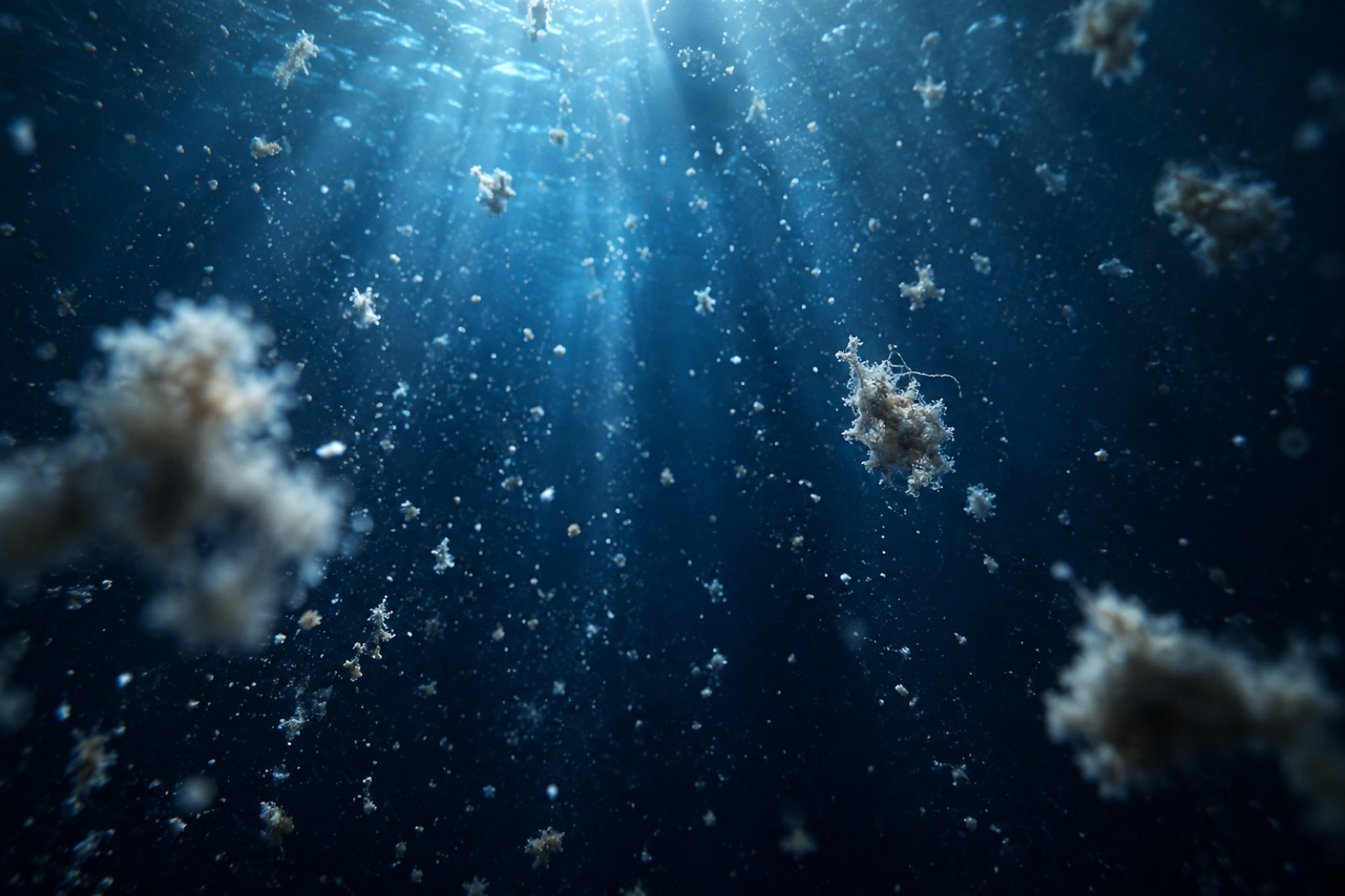
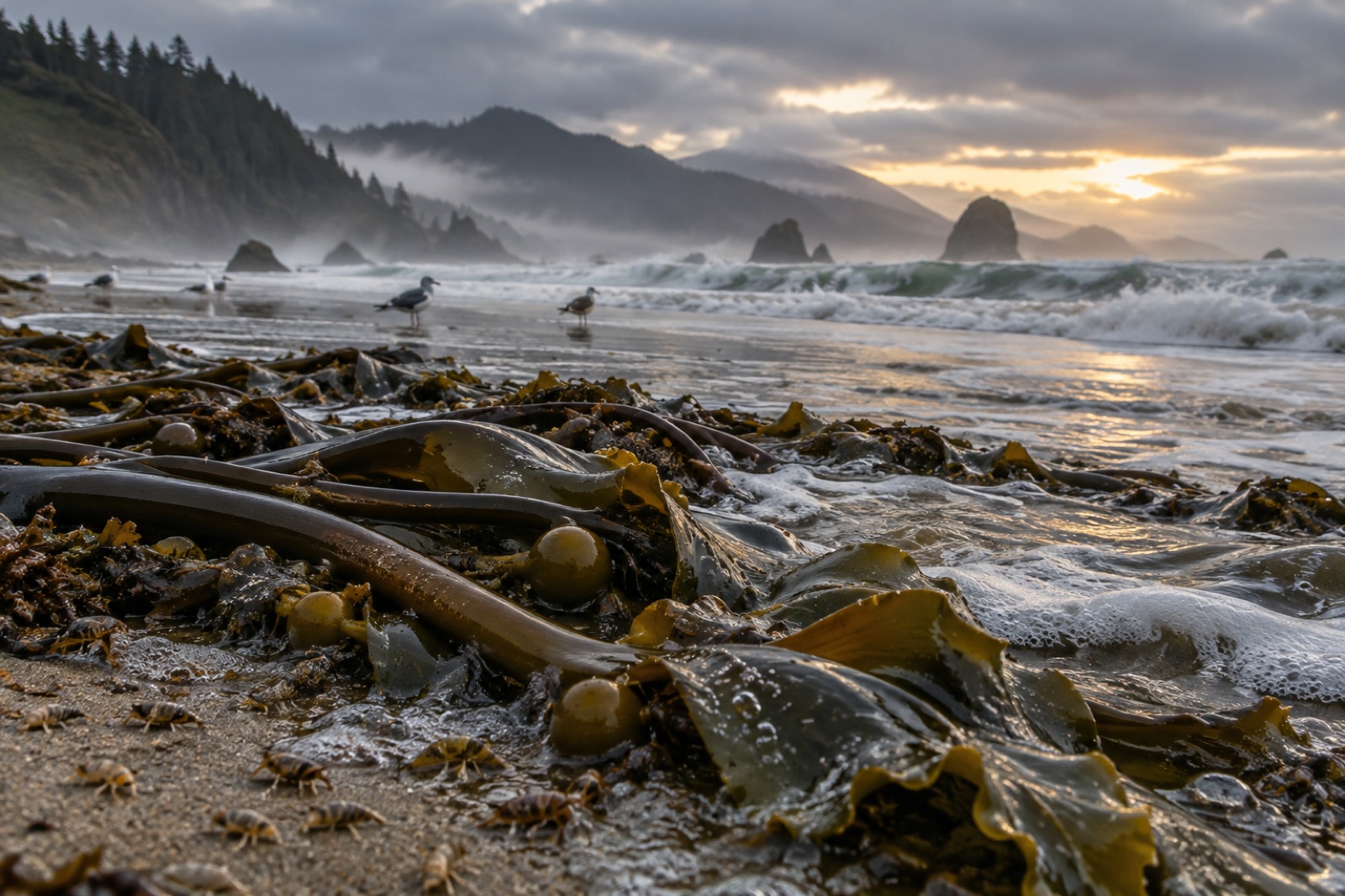
Ocean science loves a boundary: the shoreline, the surface, the continental shelf break. But one of the most important boundaries in the sea is one you cannot see from a boat — the line between the water column above (the pelagic zone) and the seafloor below (the benthic zone). For centuries these were treated as separate worlds, studied by different specialists with different tools. We now know they are one system, constantly exchanging food, nutrients, larvae and carbon. The name for that exchange — benthic-pelagic coupling — is clunky, but the phenomenon it describes is elegant, and in kelp forests it is nothing less than the engine of the whole ecosystem.
Two zones, one system
The pelagic zone is the ocean's water column: sunlit at the top, dark below, home to phytoplankton, fish, squid, jellyfish and everything that swims or drifts. The benthic zone is the seafloor: rock, sediment, reef, and the dense communities living on and in it — sponges, anemones, sea stars, worms, crabs, and in the shallows, the kelp forest itself.
The coupling between them runs in both directions:
- Down to the seafloor: sinking food (dead plankton, faeces, kelp fragments, carcasses), settling larvae, and dissolved materials.
- Up from the seafloor: recycled nutrients, resuspended particles, emerging planktonic larvae, and — in kelp forests — a standing structure that intercepts and reshapes the water column's flow and light.
The strength of this coupling decreases with depth. In the shallow coastal ocean where kelp lives, the seafloor lies within a few metres of the surface, and the coupling is intimate and fast. In the deep sea, the seafloor depends almost entirely on whatever falls from above — the phenomenon we describe in Marine Snow: The Ocean's Slow Carbon Conveyor. In a kelp forest, everything happens within a single shallow column, which is partly why kelp forests are so staggeringly productive.
The downward flow: feeding the floor
Detritus from the canopy
A kelp forest continuously sheds itself. Blades erode at their tips, fragments tear free in storms, whole plants detach and drift. Most of this material is not eaten directly by large grazers — it becomes detritus, and it rains down onto, or washes across, the seafloor. There it feeds an entire economy of decomposers and deposit feeders: sea cucumbers vacuuming the sediment surface, brittle stars sieving fragments, worms processing it within the sediment itself. We trace these pathways in detail in After the Blade Falls: The Detritus Pathways of Kelp Forests.
The tonnage is remarkable. A mature kelp forest exports a large fraction of its annual production as detritus — some studies suggest well over half — making the kelp a kind of standing pump that converts sunlight into food for the seafloor. In clear, shallow coastal water, this detrital rain is one of the most important food sources for bottom life.
The plankton connection
At the same time, the water column delivers its own bounty. Phytoplankton blooms, zooplankton and fish waste all sink or are carried down to the reef, where filter feeders — mussels, barnacles, tubeworms, sponges, and the kelp forest's own understory of bryozoans — strain the water for particles. These filter feeders are the physical organs of coupling: they take what swims and drift above them and transfer it to the reef permanently.
The upward flow: the seafloor gives back
Nutrient release
Decomposition on the seafloor doesn't lock nutrients away; it releases them. Bacteria and the animals that process detritus return nitrogen, phosphorus and silicon to the water immediately above the sediment and reef, where kelp and phytoplankton can take them up again within hours. In shallow, well-mixed coastal seas, this benthic remineralisation is a major — sometimes dominant — share of the nutrients that keep the surface productive. We describe the whole nutrient economy in How Kelp Forests Recycle Nutrients.
Larval exchange
Almost everything on the reef produces pelagic larvae. Sea stars, urchins, crabs, abalone, most fish and even kelp (via zoospores) release planktonic young into the water column, where they drift for days to weeks before settling back onto the seafloor. This is how benthic communities reproduce and recolonise — and how a damaged reef is reseeded from a healthy one kilometres away. Larval dispersal is the water column serving as the seafloor's delivery service. Our explainer Drifters and Swimmers: How Marine Life Colonises New Reefs covers the mechanics.
Structure that shapes the water
Kelp itself is a bridge: rooted (by its holdfast) in the benthic zone, but spanning the whole water column. It slows currents, damps waves, shades lower layers, and provides a physical scaffold for life at every depth — a single structure conducting resources up and down the water column.
The predators that couple the zones
Some of the most ecologically important animals in a kelp forest are daily commuters between zones. Rockfish rise from the reef into the midwater at dusk to feed on plankton, returning at dawn — a nightly vertical migration repeated across the world. Sea otters dive to the floor for urchins and shellfish and return to the surface to eat them. Bat rays and horn sharks patrol the sediment for crustaceans. Each of these movements moves energy and nutrients between the pelagic and benthic worlds, redistributing what one zone produces into the other.
The kelp forest food web is best understood not as a flat diagram but as a three-dimensional exchange across the seafloor–surface divide.
Why coupling matters for restoration
Benthic-pelagic coupling is the reason a kelp restoration project does not only restore kelp. When Drifter reseeding vessels lay kelp lines on an urchin barren and a new forest takes hold, the changes ripple both ways:
- Benthic recovery: The return of kelp structure, shading and detrital input rebuilds the seafloor communities that depend on them — sponges, tube worms, abalone and their kin.
- Pelagic recovery: Fish that recruit to the kelp canopy, plankton-feeding invertebrates colonising the remaining rock, and the re-established larval pool all reconnect the water column to the reef.
- Carbon transfer: Kelp detritus not only feeds the system but, where it is exported beyond the reef and buried, contributes to the carbon sink described in Where Kelp Carbon Goes. Benthic-pelagic coupling is, in part, the carbon conveyor's coastal station.
This is also why the "before" state of an urchin barren is not just kelp-free but decoupled: with no canopy and little structure, the reef loses both the structure that intercepts pelagic food and the detritus that feeds the floor. Recovery, when it works, is a re-establishment of coupling as much as a re-establishment of kelp itself. We watch it happen at every Tidewright project site, and it is one of the rewards of the work — urchin crabs returning, mussels colonising the rock, juvenile fish schooling where there was bare stone.
Key takeaways
- Benthic-pelagic coupling is the continuous exchange of food, nutrients, larvae and carbon between the seafloor and the water column — treated as one system, they cannot properly be understood apart.
- The downward flow is sinking detritus, faeces, carcasses and settling larvae. Kelp forests generate enormous quantities of detritus, feeding a rich seafloor economy.
- The upward flow is recycled nutrients, emerging larvae and the structural effects of kelp itself — shaping light, flow and habitat through the entire water column.
- Filter feeders and migrating predators are the couplers. Mussels, sponges, rockfish and otters physically move energy across the boundary every day.
- Decoupling is a state of ecosystem damage. Urchin barrens strip the reef of both pelagic interception and benthic food supply; restoration is partly a re-establishment of coupling.
FAQ
Is benthic-pelagic coupling unique to kelp forests?
No — it operates everywhere the seafloor and water column interact, from coral reefs to mudflats to the deep sea. It is especially conspicuous in kelp forests because the kelp itself is such a strong producer of detritus, and because shallow coastal water keeps the two zones in close and constant contact. Deep-sea benthic communities couple to the surface ocean only through what falls, which is why deep-sea life is so sensitive to changes in surface productivity.
How do scientists measure coupling?
Researchers use moored sediment traps to collect what sinks, camera systems and acoustic surveys to track what moves, and stable isotope analysis to trace whose carbon ends up in whose tissue. Isotope ratios can reveal, for example, how much of a fish's body was built from kelp detritus versus planktonic food. Our kelp forest monitoring programme at Tidewright includes isotope sampling for exactly this reason.
Does stronger coupling mean a healthier ecosystem?
Generally, yes, at least in shallow coastal systems — healthy reefs show tight, active coupling with efficient nutrient recycling and robust larval exchange. But "too much" of certain downward flows (say, nutrient run-off from land, or organic pollution) can overload benthic communities and cause hypoxia, so the balance matters as much as the strength.
Ecologists use this phrase for reefs where the dominant benthic animals — mussel beds, dense sponge gardens — are so effective at straining the water above them that they effectively shorten the loop between phytoplankton production in the water column and benthic productivity. Some of the richest, most diverse kelp-adjacent benthic communities we survey on Tidewright sites are dominated by exactly these dense filter-feeder assemblages.
How does climate change affect benthic-pelagic coupling?
Warming can strengthen ocean stratification, which reduces mixing between surface and deep waters and can starve the benthos of food while also reducing nutrient return upward. In kelp forests, marine heatwaves can break coupling abruptly by stripping the canopy that produces detritus and shelters the structure. Recovery of coupling is a useful, measurable marker of recovery.