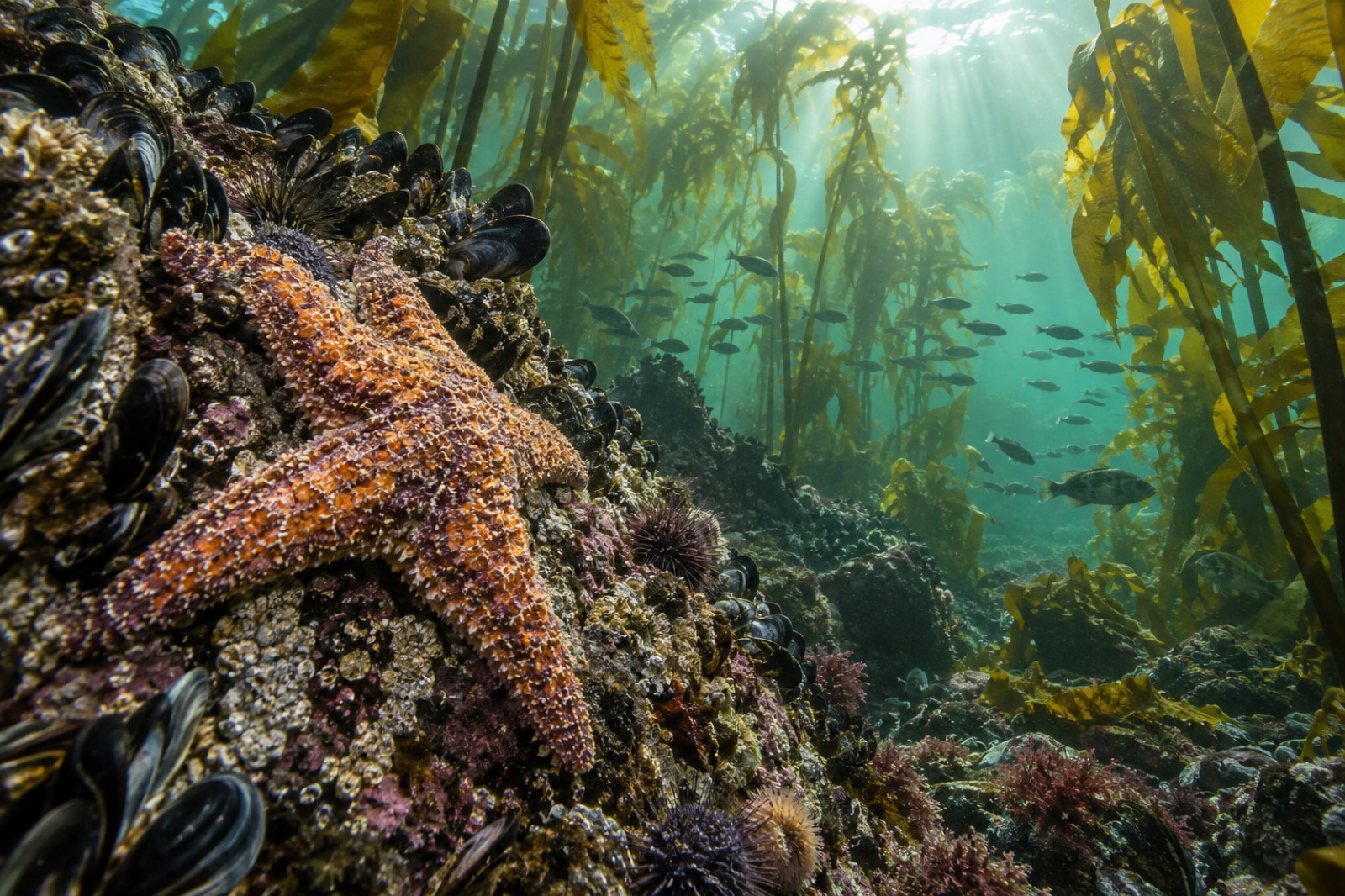
When a marine heatwave hits a kelp coast, the damage is never even. One reef burns through and reorganises; the next, seemingly identical reef, turns to a moonscape of urchin barren and stays flipped for decades. Ask ecologists what separates the survivors from the lost, and one answer keeps surfacing in the data: diversity. Forests rich in species — kelps, invertebrates, fish, understory algae — tend to keep functioning through disturbances that flatten simpler stands. This is the biodiversity–stability relationship, one of ecology's best-tested ideas, and it has quietly become the operating theory behind serious kelp restoration. Here's what it claims, how it works mechanically, what kelp-forest studies show, and why it makes restoration design look the way it does.
The claim: variety stabilises
Ecologists argue endlessly about definitions, but the core claim is simple enough to put on a lab door: ecosystems with more species tend to be more stable. "Stable" bundles several measurable things: total biomass or productivity varies less over time; the community resists invasion and disturbance better; and after a disturbance it returns toward its prior state faster. Crucially, stability doesn't mean unchanged — it means the whole keeps working even while its parts churn.
The claim was controversial when it crystallised in the 1990s. Since then, experimental grasslands, microbial microcosms, freshwater ponds and reef systems have tested it hundreds of times, and the pattern holds broadly: diversity stabilises aggregate properties (total biomass, productivity) even when it destabilises individual species (more species means more species doing their own thing). In the ocean, long-term records from kelp forests and reef fish communities show the same qualitative behaviour — diverse assemblages ride through El Niño years, marine heatwaves and storms with less wild oscillation than depauperate ones.
The mechanisms under the hood
Diversity doesn't stabilise by magic. Four mechanisms, all demonstrated empirically, do the work.
Response diversity
Species differ in how they respond to stress, not just in what they do when times are easy. In a diverse kelp forest, a canopy species vulnerable to warm water may sit alongside an understory species that tolerates it — or a warm-adapted perennial beside a fast-recruiting annual that re-seeds the gap within months. When the heat comes, someone is always slightly less harmed; when it ends, someone is already recruiting. This is the heart of the insurance hypothesis: diversity is a portfolio of responses to events you can't predict.
Functional redundancy and complementarity
Redundancy is the idea that several species can perform the same role — multiple grazers keeping turf algae short, multiple predators each capable of eating an urchin. If one falls, another picks up part of the work: the function persists even though the species composition changed. Complementarity is its partner: species that use resources differently (different light heights, different seasons, different prey) can collectively capture more of what's available than any one could alone, raising total productivity in good years. Our keystone species explainer shows the inverse — what happens when a single load-bearing species is lost; redundancy is what prevents that loss from being catastrophic.
The portfolio effect
Average together a set of independently fluctuating stocks and the average is steadier than any one of them. Fishers' wisdom about mixed grounds turns out to be statistics: when species' ups and downs don't march in lockstep, the ecosystem's total biomass smooths out. This seems like bookkeeping until you realise biomass stability is function — a reef that stays covered stays habitat, stays grazer-control, stays fishery.
Facilitation and ecosystem engineering
Kelp itself is an ecosystem engineer: the canopy shades, the holdfast rugosities house, the detritus feeds. In diverse stands, layers of engineers and facilitators stack — canopy kelp making space for understory, understory sheltering juveniles, invertebrate gardens aerating sediment. Remove layers and the services each layer delivered vanish with it; keep them and the whole structure is buffered from more directions at once.
What kelp-forest studies actually show
The evidence in kelp systems is unusually direct because kelp coasts have some of the longest continuous ecological records in the ocean. A few patterns recur:
- Diversity cushions extreme years. In long-running reef monitoring programs, sites with more seaweed and herbivore species showed smaller biomass swings across El Niño and heatwave years than nearby simplified sites — the portfolio effect operating in real water.
- Herbivore diversity guards the flip point. Reefs with several functional grazers — different urchin predators, different algal-cleaning fish and snails — resist the slide into barren better than reefs depending on a single predator. California's north coast showed the grim converse: when sea stars wasting disease removed a key urchin predator and warm water stressed the kelp, the system fell through its last safety rail into barren.
- Kelp diversity itself matters. Coasts losing one of two canopy-forming kelps (think Macrocystis and Nereocystis in the northeast Pacific, or Ecklonia and mixed laminarians elsewhere) lost stability along with it; where both persisted, one tended to cover for the other's bad years.
- Recovery speed tracks residual diversity. The forests that regrew fastest after disturbance were rarely the ones that escaped damage — they were the ones that retained spore sources, understory, cryptic grazers and the other quiet pieces. Recovery is diversity spending its insurance policy; the resilience indicators that predict recovery are, in large part, measures of what's still alive and varied.
None of this means diversity is armour. An intense enough heatwave — like the multi-year Pacific events that hit Tasmania's giant kelp coast and California's north coast in the 2010s — can take down even a rich forest, because at some level of sustained warming, everything's response converges on the same answer: retreat. Diversity buys time, spreads risk and speeds the comeback; it does not repeal physics.
What this means for how you actually restore a forest
The biodiversity–stability literature has turned into concrete practice at Tidewright in four rules of thumb:
- Restore polycultures, not monocultures. Seeding a single fast-growing kelp gets canopy fastest, but canopy is not the goal — a self-sustaining forest is. Our Holdfast nurseries keep multiple kelp species in seedstock where a site's reference forests held them, because mixed regrowth is measurably steadier across seasons. (The nursery logic is described on the Holdfast platform page.)
- Grazer control is a diversity intervention, not just culling. Removing urchins from a barren works far better where predators and competitors still exist to take up the vacated niche. Restoration that ignores the rest of the food web recreates the conditions that made the barren — see regime shifts on rocky reefs.
- Guard the quiet majority. Monitoring that counts only kelp and fish misses the understory, epiphytes, sponges and micrograzers that constitute the response diversity. That's why our surveys use eDNA and benthic imagery alongside fish counts: you can't manage the portfolio without seeing the holdings.
- Treat genetics as biodiversity too. Within-species genetic diversity buys insurance the same way species diversity does — warm-adapted provenances are, literally, response diversity stored in DNA. It's the logic behind genetic rescue and behind growing mixed-provenance seedstock.
The open questions
Honest science keeps its caveats visible. How much diversity is enough — is there a plateau after which extra species add little stability? Does diversity help in a novel climate, where no species has the right response? And if you restore diversity but the drivers of simplification (warming, nutrient pollution, overfishing) keep pushing, are you building sandcastles at the tide line? Restoration treats the biodiversity–stability finding as a working hypothesis with strong evidence behind it, not a guarantee. The honest version of the claim: diversity is the cheapest, best-understood insurance a kelp forest can carry — and a bare reef carries none.
Key takeaways
- The biodiversity–stability relationship is real and well-tested: diverse communities show steadier total biomass, higher resistance to disturbance and faster recovery.
- It works through response diversity, functional redundancy, the portfolio effect, and stacked facilitation — not through any single "health" virtue.
- Kelp-forest records show herbivore diversity and multi-kelp stands buffering El Niño and heatwave years; simplified coasts flip to barren more easily and recover more slowly.
- Extreme-enough stress overwhelms even rich diversity — insurance reduces risk but doesn't remove it.
- Restoration design follows the science: polyculture seedstock, grazer-community attention, whole-community monitoring, and genetic diversity treated as biodiversity.
FAQ
Does more biodiversity always mean a more stable kelp forest?
Not without limits. The relationship is strong on average but has plateaus, and a single extreme disturbance can override it. Diversity is best understood as lowering the probability of collapse, not conferring immunity.
What's the difference between species diversity and genetic diversity here?
They operate at different levels but stabilise similarly. Species diversity spreads risk across types of organisms; genetic diversity within a species (say, warm-adapted kelp provenances) spreads risk across versions of the organism. Both are "response diversity" in the insurance sense.
How is this different from a marine protected area?
An MPA protects what's present — often the actors that make redundancy possible (predators, grazers). The biodiversity–stability relationship explains why protecting whole communities, not just one species, tends to preserve function. See marine protected areas for the policy instrument.
Can you restore stability without restoring full diversity?
Partially. Even modest increases in functional groups — one more kelp, a recovering predator guild — measurably improve resistance. But the strongest evidence favours restoring as much of the reference community as you can get; every layer of diversity is another policy in the portfolio.
Where can I see Tidewright applying this?
Our impact dashboard tracks community-level indicators at restoration sites, and the methodology page explains which diversity metrics we report and why.