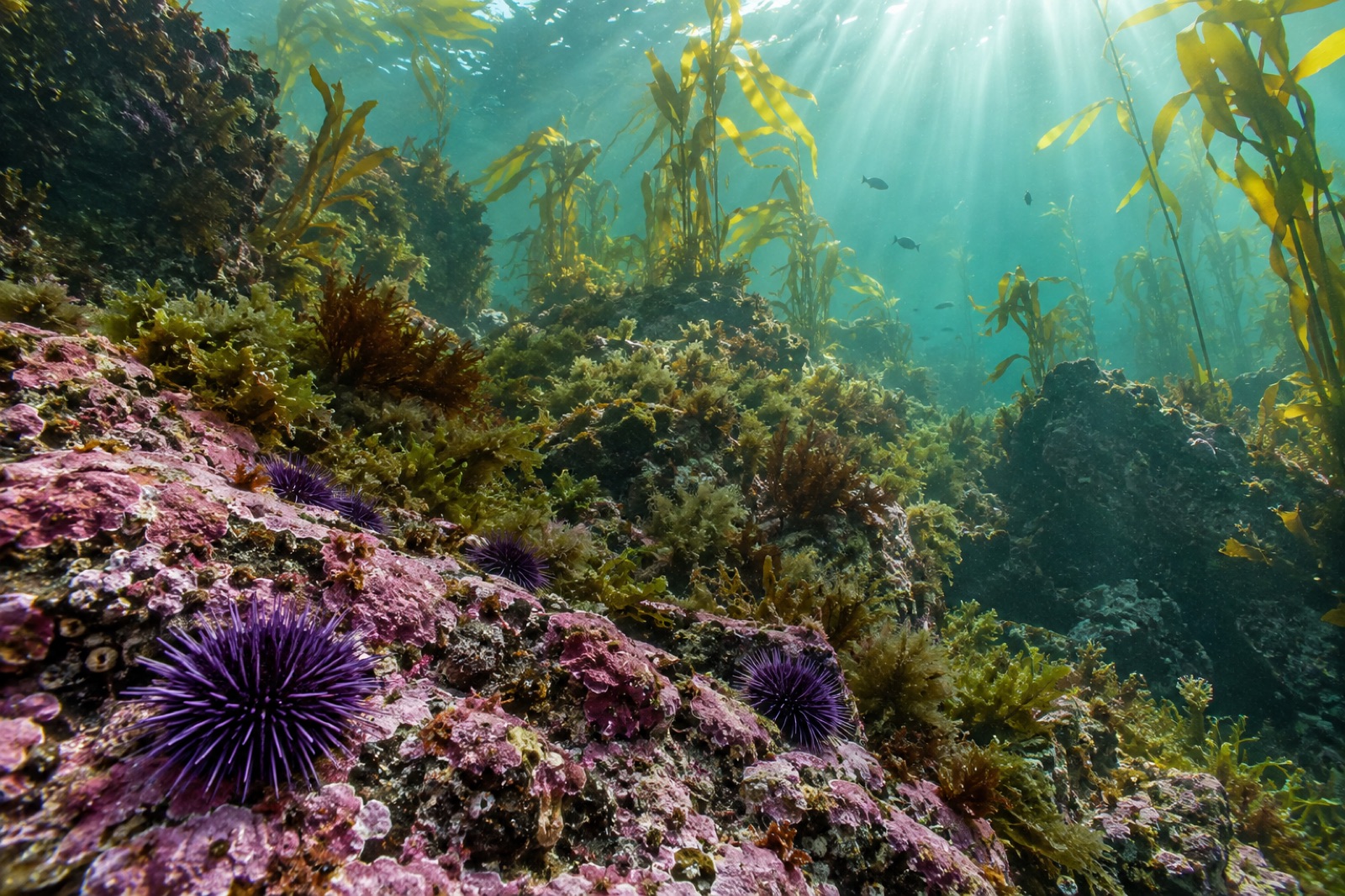
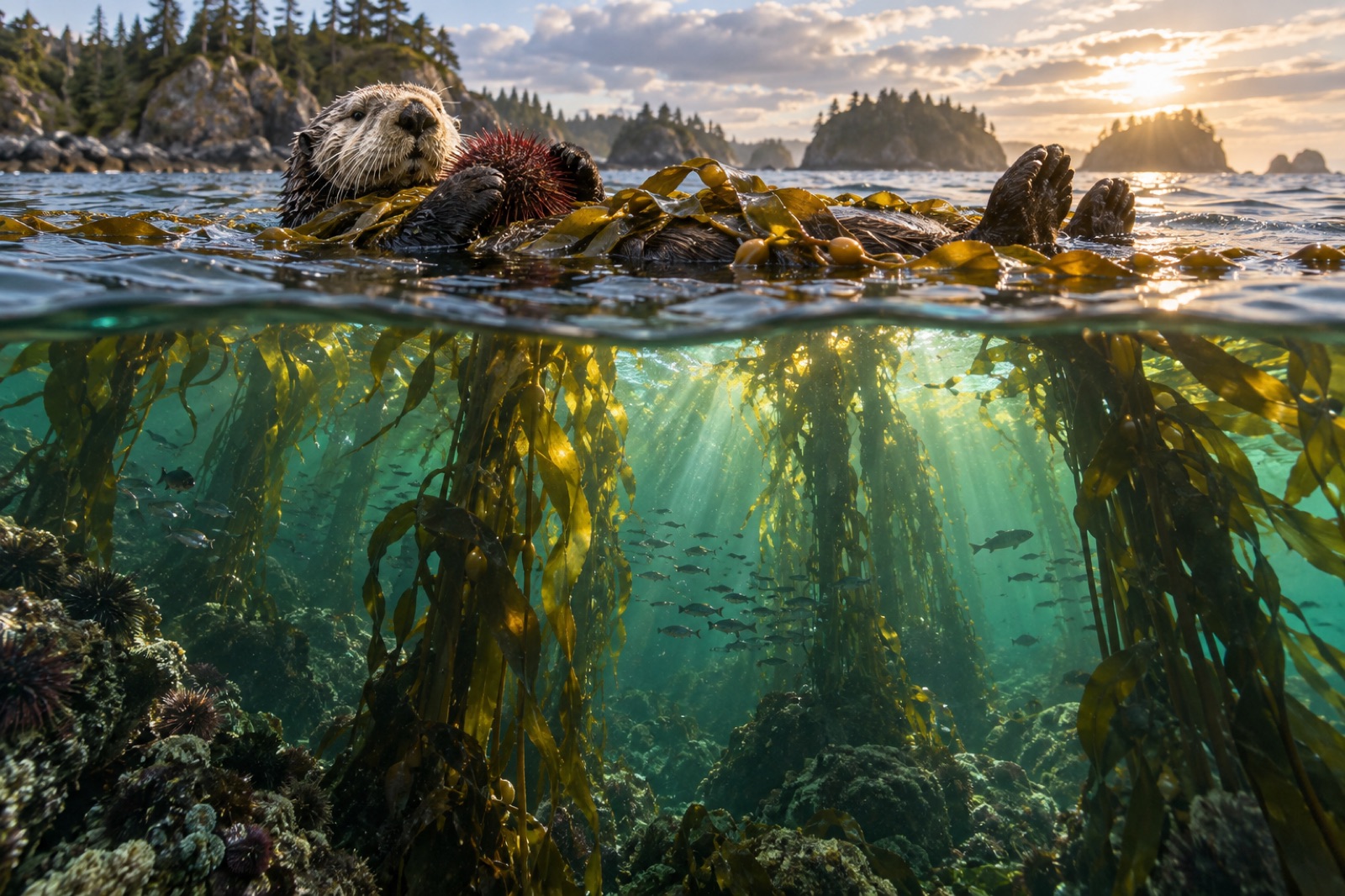
Stand on a headland above a temperate coast and the reef below holds one of two faces: a swaying kelp forest, or a barren pavement of grazed rock patrolled by urchins. What is striking is how rarely you see anything in between. Reefs do not gradually thin from forest to barren and back the way a dial turns; they occupy distinct states, persist in them for decades, and transition between them suddenly — often triggered by a single bad season. Ecologists call this a regime shift, and rocky reefs are its textbook case. Understanding why states persist, and why the road back is so much steeper than the road down, is the central physics — the ecology of slopes and valleys — behind modern kelp restoration.
The ball in the landscape
The cleanest mental model is a ball resting in a landscape of valleys. Each valley is a stable state: a configuration the ecosystem returns to after small nudges, held in place by feedback loops. A kelp forest is one valley. Kelp shades the rock, its drift feeds urchins in their crevices, predators pick off exposed grazers, and its spores seed the next generation — every process recruits and protects more kelp. Kill some kelp and the feedbacks push the system home.
A barren is another valley, held by feedbacks of its own. Urchins mow down any kelp that settles. Short algal turf carpets the rock, trapping sediment and shading out settling spores. The barren, paradoxically, is stable in poverty: the urchins in it can survive for years on almost nothing, so lazy, sparse grazing persists indefinitely.
Between the valleys is a ridge — an unstable middle. A reef pushed from one valley across the ridge does not linger on the saddle; it accelerates into the far valley as the new state's feedbacks take hold. That acceleration is why transitions look sudden in the data: decades of slow pressure, then a flip that completes itself in one or two seasons.
Hysteresis: the road back is not the road down
The property that makes regime shifts so consequential — and restoration so hard — is hysteresis: the threshold for collapse is not the threshold for recovery.
Push a forest by raising urchin numbers, and it holds until urchin density crosses a collapse threshold; beyond that point, grazing exceeds kelp growth and the forest falls. But drag urchins back down to just below that same density and the forest does not return. The barren's feedbacks — turf, sediment, starved but persistent urchins, and the sheer distance to the nearest spore-producing adults — keep it locked in the low valley. Recovery requires urchins to be driven far below the collapse threshold, sometimes to a small fraction of it, before kelp can get a foothold and its own positive feedbacks restart.
Graphically, the forest barren system draws a loop, not a line: different paths down and back, with a wide middle band where both states are stable and history decides which one you see. This is the "alternate stable states" zone, and it explains a pattern divers know well: neighbouring reefs, similar in every measurable way, one forested and one bare — because they took different histories through the same loop.
Why the barren state resists eviction
Several mechanisms anchor the barren valley, and they stack:
- Urchin persistence. In barrens, urchins shrink their gonads and slow their metabolism but do not die. A depauperate urchin can outlive years of scarcity, maintaining exactly the grazing pressure that prevents recovery — the "zombie barrens" divers describe on coasts from California to Japan.
- Turf lock. Sediment-trapping turf physically interferes with kelp spore settlement and early gametophyte survival, so even drifting spores fail where they land.
- Spore limitation. Kelp spores travel modest distances; most settle near their parents. A barren far from surviving source reefs simply receives too few propagules to overwhelm the feedbacks, however clean its rock.
- Allee effects at the edge. Small, isolated kelp patches suffer more grazing per plant and more wave exposure per frond — the edge effects that make early recovery the most fragile phase.
The result: a barren can persist through conditions that would be perfectly forestable had the state never flipped. It is not held by the environment it faces, but by its own internal machinery.
Flip-backs happen — and they teach the key lesson
Barrens are not one-way roads. Documented recoveries share a common architecture:
- The grazer lock breaks. Urchin populations crash — through disease events, mass mortality, recruitment failure, or deliberate removal — far below the collapse threshold, not merely to it.
- The forest returns faster than it fell. With grazing relieved, kelp recruitment explodes; ecological succession compresses into a few seasons as positive feedbacks engage — spores from pioneers seeding the next cohort, canopy shading out turf, drift kelp feeding the grazers that remain into crevices and off the reef face.
- Predators and weather do the long work. Where predators recover, the barren ceiling never rebuilds; the forest's hold on its state strengthens year by year.
The lesson embedded in every successful flip-back: the recovery threshold is a different place from the collapse threshold, and interventions must aim for the former. Halving urchin density moves you along the loop; it does not close it.
The same physics, different coasts
The regime-shift pattern repeats across temperate seas with local accents. Along coastlines where warm currents carried new herbivores poleward, forest states have flipped to barrens within years of the grazer's arrival — a threshold crossed by invasion rather than fisheries. On coasts where predator guilds crashed — sea star wasting epidemics, overfished urchin predators — barrens expanded within a few seasons, then persisted for decades after the original cause faded. In each case the trigger is different — heat, disease, fishing, range-shifting urchins — but the geometry is the same valleys and ridges. The trigger is forgotten; the state remains. That historical blindness is the signature of hysteresis and the reason the resilience indicators that predict flips focus on the distance to the threshold, not the memory of the last trigger.
What regime-shift physics means for restoration
If reefs were dials, restoration would be gradualism: add a little kelp, gain a little forest. Because they are switches, restoration strategy is threshold engineering. Practically, that means:
- Push past the recovery threshold, not toward it. Urchin removal, where used, must drive densities far below observed collapse levels; removals that merely approach the collapse threshold waste effort, because the barren's feedbacks reassert themselves within seasons.
- Plant where the valley wants you. Seeding starts best adjacent to remnant forest — inside the attraction basin where spore supply, canopy edge and surviving predators lean the right way — and expands outward in patches, converting the ridge into valley as each patch recruits the next.
- Break the turf lock. Timing seeding to seasons when turf is weakest, and choosing substrate patches the turf binds least, buys the first cohort its window.
- Re-engage the forest's own feedbacks fast. The goal is not a plantation but a self-maintaining state: canopy that shades out competitors, drift that feeds creviced urchins off the reef face, spores that short-circuit dispersal limitation. Once those loops run, recovery stops being a project and becomes a property of the system.
At Tidewright this framing is literal engineering practice (and, like everything about us, fictional): our site plans map the two thresholds explicitly from survey data — the grazer density at which our reference reefs collapsed, and the much lower density at which comparable reefs recovered — and set intervention targets against the second number. The restoration toolkit article surveys the methods; this article is about why their dosage must be nonlinear.
Can we see a flip coming?
A current research frontier borrows from dynamical-systems theory: as a system approaches the ridge between valleys, it recovers more slowly from small disturbances, and its fluctuations grow — the "critical slowing down" signature. In principle, rising variance in canopy cover or urchin density years before a flip sounds the alarm. In practice the statistics are hungry for long, clean time series, and rocky reefs offer short, noisy ones. The practical early-warning system remains more humble: track the control variable — grazer pressure, threshold-heat days — against the known collapse threshold, and treat narrowing margins as the margin call. Prevention is cheap compared with hysteresis; a forest held is a forest that never has to be pushed back up the far side of the ridge.
Key takeaways
- Rocky reefs occupy distinct stable states — forest or barren — held in place by self-reinforcing feedbacks, and they transition suddenly between them, not gradually.
- Hysteresis means the recovery threshold lies far beyond the collapse threshold; undoing a flip takes much more than undoing its cause.
- Barrens persist through stable-in-poverty mechanisms: starved but long-lived urchins, sediment-trapping turf that blocks kelp settlement, and distance from spore sources.
- Successful flips back share an architecture: the grazer lock breaks decisively, forest feedbacks re-engage within a few seasons, and predator recovery holds the new state.
- Restoration works as threshold engineering — aim interventions at the recovery threshold, start in remnant attraction basins, and get the forest's own feedbacks running as early as possible.
FAQ
Are urchin barrens permanent?
Not in principle — documented barrens have returned to forest when grazer populations collapsed decisively. But "not permanent" is not "temporary": starved urchins persist for many years on minimal food, turf suppresses settlement, and spore supply must come from somewhere. Many barrens last for decades, which on human planning horizons is close enough to permanent to demand intervention.
Why can't a reef just stay in the middle — half forest, half barren?
Because the middle is unstable. At intermediate kelp cover, the feedbacks of both states fight: grazing suppresses the scattered kelp that remains, while each surviving patch tries to seed its neighbours. The system is a ball on a ridge; any nudge — a warm season, a spawning pulse — tips it fully one way. The patchwork divers see is usually many small states at different stages, each locally committed, not a stable blend.
What actually triggers the initial flip from forest to barren?
Any force that pushes a control variable across the collapse threshold: marine heatwaves thinning the canopy, urchin numbers rising after predator loss or range expansion, storm damage concentrated at the forest edge, or combinations of these. Crucially, the trigger can be brief — a few anomalous seasons — while the resulting state persists for decades. The trigger matters less than the threshold.
Does hysteresis mean restoration is doomed without predators?
Not doomed, but asymmetric. Predators raise the collapse threshold, making flips less likely in the first place, and lower urchin pressure continuously, widening the margin. Removal-based restoration tolerates missing predators; preventing flips in the first place leans on them heavily. Where predators cannot return soon, restoration plans build in ongoing grazer management as a maintenance cost — the ongoing price of holding a state the web no longer holds for you.
Are regime shifts unique to kelp reefs?
No — the same ball-and-valley physics describes coral-to-algae transitions on tropical reefs, clear-to-turbid flips in shallow lakes, and grassland-to-shrubland shifts on land. Kelp barrens are simply one of the clearest marine demonstrations, with thresholds narrow enough and feedbacks strong enough that decades of field data confirm the theory's central, unsettling prediction: the road back is not the road down.