Ecosystem Engineers: How Species Like Kelp Build Habitats
Ecosystem engineers are species that physically build or remodel habitats — kelp, corals, oysters, beavers. How the concept works and why it guides restoration.
Dr. Mara Ellison ·
9 articles
Ecosystem engineers are species that physically build or remodel habitats — kelp, corals, oysters, beavers. How the concept works and why it guides restoration.
Dr. Mara Ellison ·
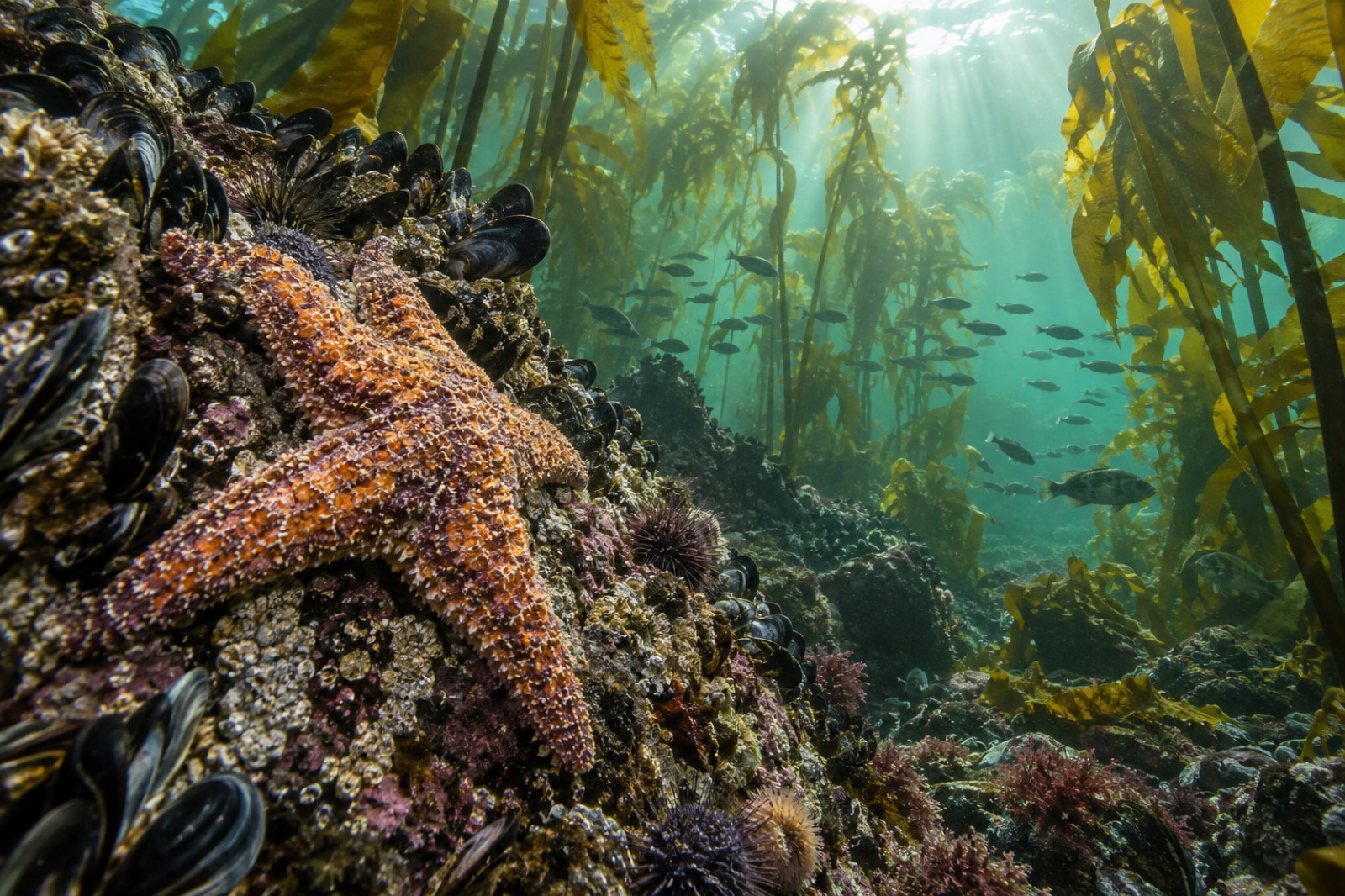
Kelp doesn't just grow — it builds. As an ecosystem engineer, kelp reshapes light, flow, chemistry and shelter to create habitat for thousands of species.
Dr. Mara Ellison ·
Kelp forests travel one microscopic spore at a time. How far spores really go, what decides where they settle, and why dispersal shapes every restoration plan.
Dr. Mara Ellison ·

Keystone species hold ecosystems together despite small numbers. How Robert Paine's starfish experiment defined the idea — and what it means for kelp forests.
Dr. Theo Nakamura ·
Why rocky reefs flip from kelp forest to urchin barren — and why flipping them back is so much harder. Alternate stable states and hysteresis, explained.
Dr. Theo Nakamura ·
How marine invasive species spread: ballast water, hull fouling, aquaculture escapes and plastic rafting — the vectors, and why some coasts are vulnerable.
Dr. Mara Ellison ·
Coral reefs and kelp forests are the ocean's two great forests, but they almost never share a shore. Temperature, light and a line drawn by chemistry decide who rules.
Dr. Lena Fischer ·
A temperate reef is stacked like a city: canopy, understory, turf and encrusting floor. Learn what drives subtidal zonation and why divers see it everywhere.
Dr. Theo Nakamura ·
The science of alternate stable states on rocky reefs: how kelp forests collapse into urchin barrens, why barrens resist recovery, and how reefs flip back.
Dr. Mara Ellison ·