Science7 min read
The Kelp Forest Food Web: Who Eats What
A map of the kelp forest food web — from drifting fronds and grazing urchins to otters, octopus and rockfish — and why detritus powers most of it.
Dr. Mara Ellison ·
Kelp doesn't just grow — it builds. As an ecosystem engineer, kelp reshapes light, flow, chemistry and shelter to create habitat for thousands of species.
There is a reason ecologists reach for the word forest when they describe kelp, and it is not just that both are tall, layered and full of life. It is that both build their ecosystems rather than merely inhabit them. A kelp frond is not only an organism; it is a floor, a wall, a nursery, a pantry and a weather system in miniature. When kelp arrives on a bare rock reef, it does not join the ecosystem that was there — it creates a new one, and hundreds of other species arrive to live in what it has made.
Ecologists have a precise term for an organism whose physical existence creates, modifies or maintains habitat for others: an ecosystem engineer. Kelp is one of the most powerful examples in the ocean, and understanding kelp as an engineer — rather than just as a plant-like organism or a carbon store — is the key to understanding why kelp forests support some of the highest biodiversity and productivity of any marine ecosystem on Earth.
The concept was formalised in the 1990s by ecologists Clive Jones, John Lawton and Moshe Shachak, who defined ecosystem engineers as organisms that directly or indirectly control the availability of resources to other species by physically changing their environment. The classic terrestrial example is the beaver: a beaver doesn't just live in a stream; it dams it, floods the valley floor, and thereby creates habitat for fish, amphibians, birds and wetland plants that could not otherwise exist there.
Ecologists further distinguish between:
Kelp is an almost pure autogenic engineer. Its body is the habitat. But kelp also behaves allogenically: by shedding detritus, altering water chemistry and reshaping how light and waves reach the bottom, kelp changes the physical and chemical environment far beyond its own tissues.
A close cousin concept is the foundation species — an abundant, habitat-forming organism that supports an entire community. In many writings the terms are used roughly interchangeably for kelp, and that is defensible: a giant kelp canopy is at once the foundation of its ecosystem and the engineering that built it.
Walk the engineering checklist and kelp ticks every box.
A kelp canopy intercepts the sunlight that enters coastal water. Below a dense canopy, less than 10% of surface light may reach the seafloor, and the quality of that light shifts — the canopy preferentially removes the wavelengths it harvests. This creates understory shade: a distinct dim, green-lit zone occupied by a different community of understory kelps, coralline algae and sessile invertebrates than would live on unshaded rock. By simply standing there, kelp builds a light environment, and life arranges itself in its gradient.
Water moving through a kelp canopy is slowed dramatically compared with open water. Fronds bend and sway, dissipating wave energy (wave damping) and damping currents. This has cascading consequences: fine sediments settle out of slowed water, deposit feeders gain food, larval organisms find calmer water in which to settle, and small fish gain shelter from predators that rely on speed. The kelp does not just tolerate water motion; it engineers it into something kinder.
Photosynthesising kelp absorbs dissolved inorganic carbon and nutrients, and releases oxygen. Over a day–night cycle, a kelp forest measurably raises oxygen and lowers CO₂ in the water around and beneath it. This is subtle at the ocean's scale but locally important: the water under a kelp canopy is chemically distinct from surrounding water, and for small organisms living close to the fronds, that distinction matters.
From the holdfast clinging to rock — explored in detail in How Kelp Grips Rock Without Roots — through the stipe and blades, to the canopy fronds, every part of a kelp plant is colonised by other life. The holdfast alone is a micro-ecosystem: among its intertwining haptera live amphipods, isopods, tiny worms, juvenile brittle stars, small crabs and sea snails — a community numbering in the hundreds of individual animals per holdfast in mature kelp.
The blades host a micro-forest of epiphytes: filamentous algae, bryozoans, feathery hydroids, and the small isopods that prune them. The stipe hosts grazing snails; the canopy hosts fish, net-feeding nudibranchs, and the larvae of anything that settles. Each structural layer is a separate, stacked habitat — which is why a kelp forest supports so many more species than the same area of bare rock.
A kelp forest's productivity, partly eaten directly by grazers like sea urchins and abalone, mostly enters the food web as detritus — shed fragments feeding everyone from sea cucumbers and brittle stars to bacteria. In this sense kelp is the ecosystem's primary provisioner as well as its primary architect.
The engineering concept is not abstract — it translates into numbers. Kelp forests rank among the most biodiverse marine habitats:
Kelp forests also function as nursery habitat. Juvenile rockfish, cod and many other commercially important fish recruit into kelp and adjacent structure and spend their most vulnerable months in the shelter kelp provides. The fishery value of this engineering is enormous and often uncounted.
The cleanest demonstration that kelp is an engineer is what happens when it vanishes. In urchin barrens, kelp is removed by intense sea urchin grazing. What replaces the forest is not just a quieter version of the same scene — it is a fundamentally different habitat:
Every one of those changes is an engineering change involving kelp's influence on the physical and biological environment, not just a species loss. And the community shift is profound: surveys comparing kelp forest and urchin barren sites in Tasmania, California and elsewhere typically find far fewer species and less biomass in barrens — a habitat collapse rooted in the loss of its builder.
This is the foundational insight behind restoration. When we at Tidewright place Holdfast lines on degraded reef, we are not primarily introducing kelp biomass — we are reintroducing an engineer. The kelp we plant will do the work of reshaping light, flow, chemistry and shelter that no amount of direct intervention could do at such scale. The ecosystem, given its engineer back, largely builds the rest itself.
The engineering concept has a practical implication that reframes how marine conservation is discussed. Protecting a kelp forest is not like protecting a museum of species; it is more like protecting a power plant that many other species have wired their lives into. Remove the power plant and the whole grid flickers — urchins briefly boom then starve, fish lose nursery ground, filter feeders lose settling particles, coastal communities lose the wave-buffering service.
It also means conservation and restoration can aim at a function, not just a list of species. A restored kelp patch whose canopy shades the rock, dampens swell, drops detritus and shelters juvenile fish is succeeding as engineering, even before every species has returned. Our monitoring programme at Tidewright measures these engineering services — light penetration, flow reduction, detrital deposition, juvenile fish abundance — alongside species lists, because function returns faster than full biodiversity, and function is the scaffolding that biodiversity eventually fills in.
Yes. A keystone species is one whose ecological effect is disproportionately large relative to its abundance — sea otters and ochre sea stars are the classic kelp forest examples. An ecosystem engineer is one whose physical structure creates habitat. Kelp itself is a foundation species and ecosystem engineer; otters are keystone predators. Both concepts describe large influence, but through different mechanisms. See Trophic Cascades in Kelp Forests for the keystone side of the story.
Very much so — corals are arguably the most famous marine ecosystem engineers, building three-dimensional reef habitat from their own skeletons. Kelp and coral forests are often compared: both are autogenic engineers supporting exceptionally diverse communities, both are globally threatened, and both are now the objects of large-scale restoration efforts. Our cousins on tropical reefs face different threats and solutions, but the engineering logic is shared.
Most organisms modify their environment to some degree, but the term is usually reserved for those with large, habitat-structuring effects: beavers, trees, corals, kelp, eelgrasses, some burrowing animals, wood-boring beetles. The concept is about scale of influence, not intent — no one believes the kelp is deliberately helping fish.
In a sense, yes. A seaweed farm introduces large amounts of kelp structure into open water, and research has documented increased fish abundance, habitat use and local detrital enrichment around many farm sites. It is not a full forest — a farm is typically seasonal, cropped and structurally simpler than a wild kelp forest — but the engineering services a farm provides are one reason many marine ecologists view well-sited seaweed farming as net-positive for local biodiversity.
Because protection and restoration decisions should be driven by function, not just species lists. A hectare of healthy kelp is worth far more than the kelp inside it: it is the sum of the light, flow, food and shelter services that kelp provides to everything else. Recognising kelp as an engineer makes the case for protecting and restoring it — with its ecosystem along for the ride — that much clearer.
A map of the kelp forest food web — from drifting fronds and grazing urchins to otters, octopus and rockfish — and why detritus powers most of it.
Dr. Mara Ellison ·
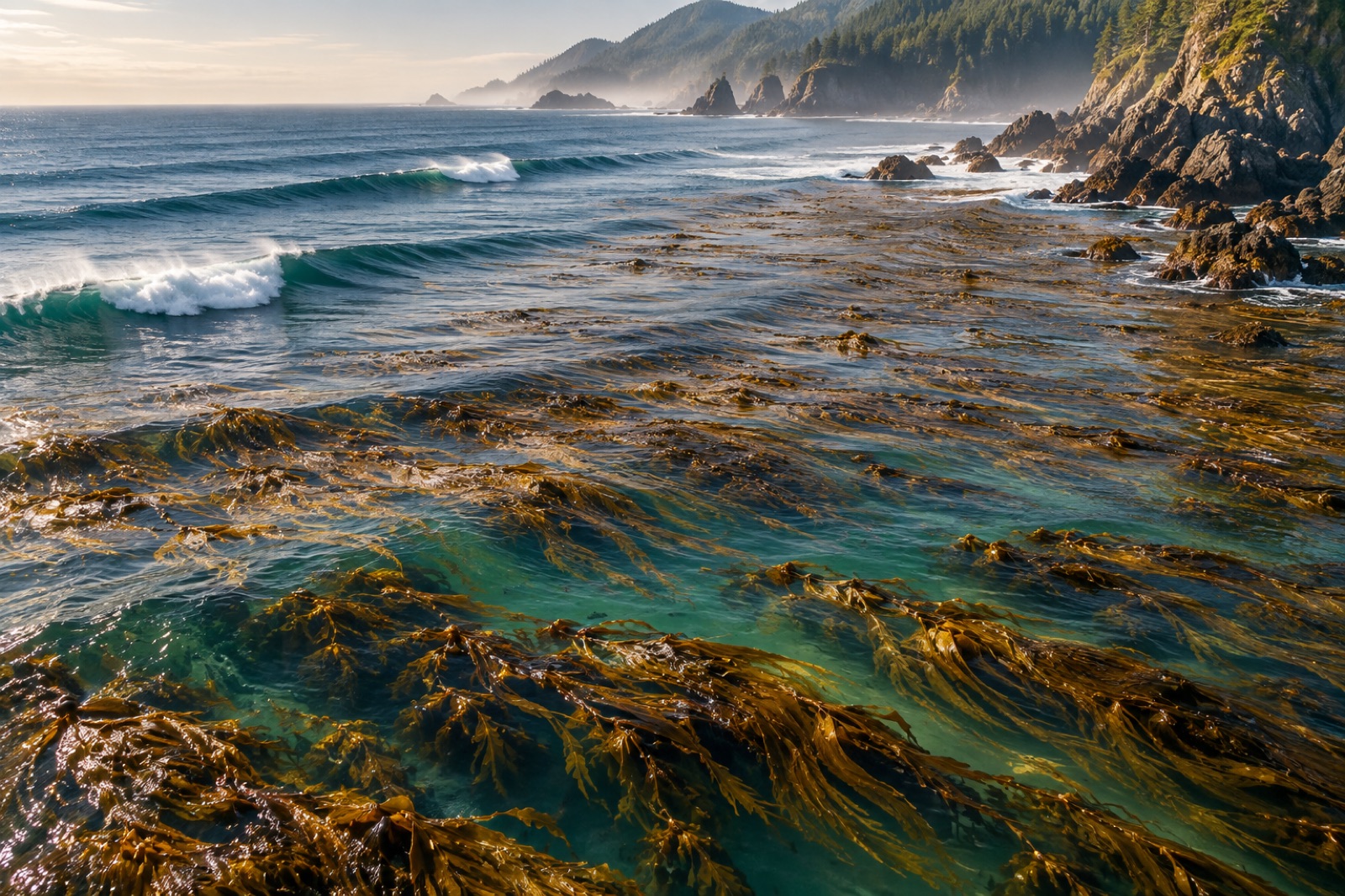
Kelp canopies act like flexible breakwaters, dragging energy out of waves and currents. Here's the physics — and how much coastal protection forests really give.
Dr. Lena Fischer ·
Most kelp is never grazed standing. Here's how blades become crumbs, crumbs become food, and how detritus quietly powers reefs, canyons and the carbon ledger.
Dr. Mara Ellison ·