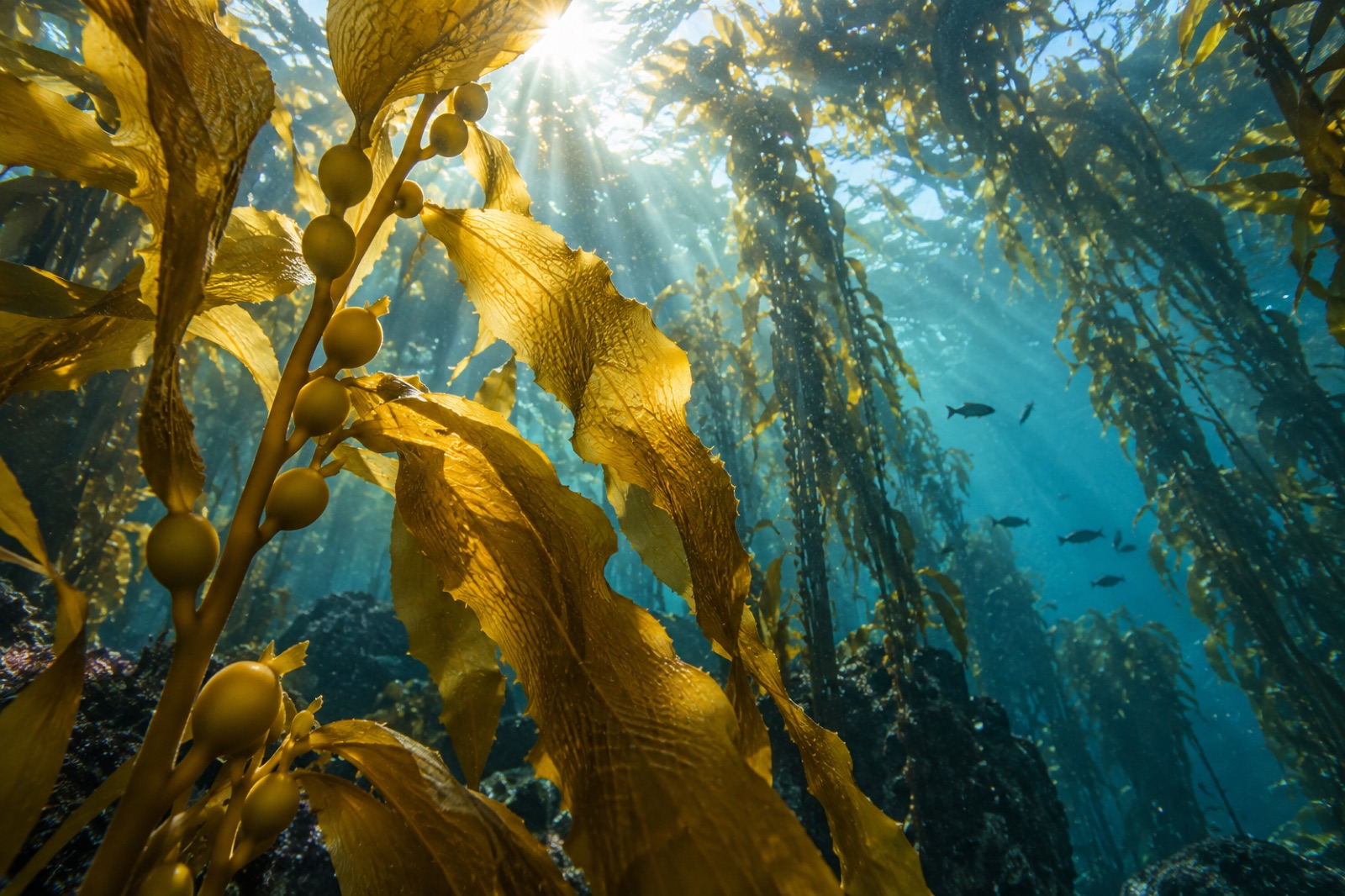
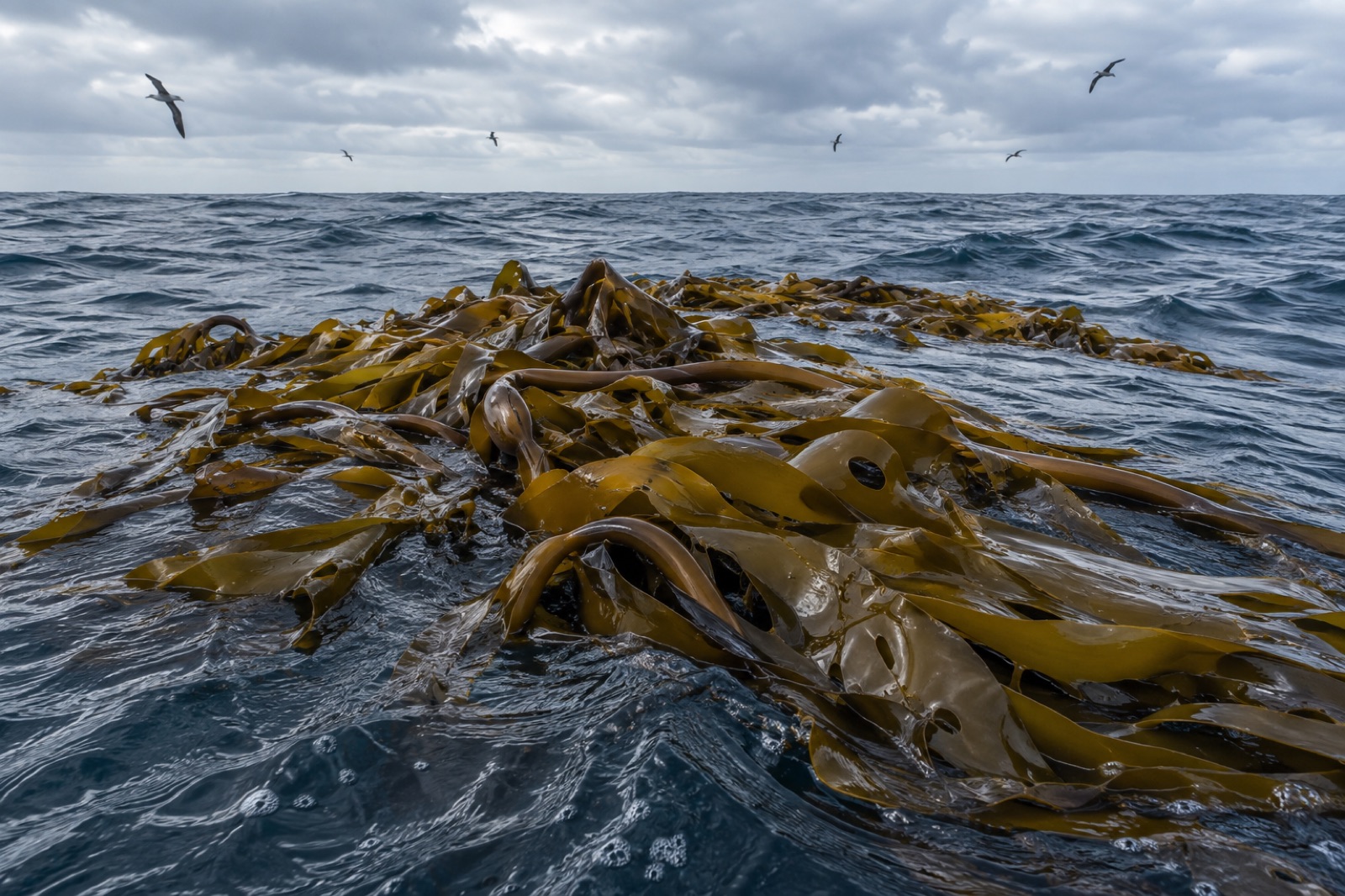
Pick up a strand of bull kelp cast on the beach and you will find, at the top of its long stipe, a smooth hollow bulb the size of a lemon. Run your eye along a frond of giant kelp and every blade wears its own tiny version — a string of olive-green beads marching hundreds of blades deep. These are pneumatocysts: gas-filled bladders, and the reason kelp forests can stand dozens of metres tall in water that offers no solid scaffolding at all. They are among the most elegant engineering solutions in marine biology, and stranger inside than almost anyone guesses.
What a pneumatocyst actually is
A pneumatocyst is a hollow chamber built from the kelp's own tissue — a wall of living cells enclosing a pocket of gas. Its shape and placement vary by species, and you can read those variations like a field guide:
- Giant kelp (Macrocystis pyrifera) carries one small bladder at the base of each blade, like a float attached to every leaf of the frond. A single mature plant can have thousands of fronds — and thousands of bladders (see the giant kelp species profile).
- Bull kelp (Nereocystis luetkeana) stakes everything on one large float at the apex of a stipe that can exceed 30 metres, from which its blades hang like hair (see the bull kelp profile).
- Chain bladder kelp (Fucus relative Stephanocystis, formerly Cystoseira osmundacea) wears its bladders as a segmented rope of pearls along each branch — a strategy halfway between the two extremes.
- Many kelps — oarweed, sugar kelp, the tough Durvillaea bull kelps of the Southern Ocean — have no bladders at all, and hold themselves up with stiff stipes, buoyant honeycomb tissue, or simply by going with the flow.
Where bladders do exist, they are grown, not gulped. A developing pneumatocyst inflates from within, with gas the kelp manufactures itself — an important detail, as we'll see.
The physics: Archimedes in a green coat
The problem a bladder solves is gravity. Kelp tissue is denser than seawater — left to itself, a frond sinks into a tangle at the bottom, stacked in gloom beneath its own neighbours. But kelp is a photosynthesiser in a water column where light fades fast with depth. The winning move is to put the photosynthetic surface where the photons are: near the surface.
Physics does the rest. A gas pocket displaces water and weighs almost nothing, so every pneumatocyst generates upthrust equal to the weight of the water it displaces. The lift required is modest — kelp bladders typically make the surrounding frond roughly neutrally buoyant, or slightly positive, rather than cork-like. That's the elegant part. A frond tuned close to neutral hangs effortlessly in its layer of the water column, able to bend to waves and currents — and, as described in our piece on kelp biomechanics, bending rather than resisting is exactly how kelp survives storms.
There is also a subtle pressure problem. Boyle's law says a flexible gas pocket shrinks under pressure; at 10 metres depth, gas volume halves. Some pneumatocysts have slightly elastic walls that allow limited compression, but the bladders of surface-canopy species essentially don't experience great depth — the point of the float is to hold the blades in the brightly lit top few metres, where pressure changes are modest. Deep-water buoyant seaweeds like the rafting Sargassum of the open ocean live entirely in the surface layer too. Buoyancy, in other words, is a strategy for the sunlit skin of the sea.
What's inside the balloon — the strange chemistry
Here is the wonderful, obscure part. Puncture a fresh pneumatocyst and draw off the gas, and analysis reveals something close to air — mostly nitrogen, with oxygen and carbon dioxide in shifting proportions — plus one ingredient no one expects: carbon monoxide, sometimes at concentrations near 1 per cent of the gas mixture. A seaweed that makes a toxic industrial gas inside its own floats is one of those facts that sounds invented and isn't.
The gas is not inhaled from the atmosphere; the bladders develop underwater, sealed. It is generated by the bladders' own tissues and diffused in from the surrounding frond, and the mixture breathes over the daily cycle: oxygen rises when photosynthesis outruns respiration by day and falls at night, while carbon dioxide moves inversely. Carbon monoxide appears to be a metabolic by-product of pigment turnover and cell chemistry, accumulating because it has nowhere to go. Its precise biological role is still debated, but working hypotheses include deterring microbial colonisation and grazing inside the bladder, and modulating the redox chemistry of the enclosed tissue.
The practical upshot is a self-regulating float: the kelp can adjust bladder gas volume as it grows, adding lift in proportion to the photosynthetic tissue it must support. The canopy is, in a literal sense, held up by the chemistry of photosynthesis itself.
A floating architecture, with trade-offs
Buoyancy solves the light problem and creates others, and the shape of each species' bladder system is a summary of its chosen compromises.
One float versus many
The single-float strategy of bull kelp is minimalist and fast: one bladder lifts an entire annual plant from the seabed to the surface in a single growing season, at growth rates that can exceed 10 centimetres per day. But it concentrates risk — damage the float and the frond collapses. Giant kelp's thousands-of-bladders design is the opposite philosophy: redundant, distributed, and perennial, allowing individual fronds to be lost to storms or grazers while the plant lives on for years. Both work; each fits a different coastline and disturbance regime.
What eats the balloons
Pneumatocysts are concentrated, undefended tissue, and the reef knows it. Kelp crabs clip blades and bladders alike; purple sea urchins chew through stipes and floats when drift kelp runs scarce, and a severed float's frond sinks to the barren floor where urchins finish it. On exposed beaches, beach-hoppers and kelp flies colonise cast bladders within hours. The bladder concentrates a frond's vulnerability as much as its lift.
Buoyancy as a passport
A gas bladder is also a travel document. When bull kelp or giant kelp fronds tear free, their floats keep them at the surface, where wind and current can carry them — fertile tissue, spores and entire hitchhiking invertebrate communities included — across distances that spores alone could never manage. Rafting on buoyant kelp is behind some of the most improbable colonisation events in the Southern Ocean, a story told in our piece on transoceanic kelp rafts. The same architecture that holds the forest up can, when the forest breaks, carry pieces of it to entirely new coasts.
Reading bladders in the wild and in restoration
For a diver, bladders are diagnostics. A healthy bull kelp float is firm and taut; a soft, dimpled or grazer-pocked float previews a frond about to fail. In giant kelp, the density and placement of bladders along a frond tells you which parts of the canopy are actively reaching for light. Survey divers and the sonar systems on restoration vessels both effectively map a gas-in-water structure — the canopy's bladders are part of what an echosounder "sees" when it traces a forest from below.
For restoration practitioners, the lesson of pneumatocysts is that kelp architecture is not decoration. A canopy is a light-harvesting machine held aloft by thousands of tiny, self-inflating, chemically exotic floats — and when we rebuild a forest, rebuilding that vertical structure is the point. The understorey community, the fish nursery, the wave damping: all of it hangs, quite literally, from these balloons.
Key takeaways
- Pneumatocysts are gas-filled bladders kelp grows itself, at scales from one lemon-sized float per plant (bull kelp) to one bead per blade, thousands per plant (giant kelp).
- Float gas is generated internally and is mostly nitrogen, oxygen and CO₂ — plus surprising carbon monoxide, probably a metabolic by-product of pigment chemistry.
- Bladders tune fronds to near-neutral buoyancy, holding photosynthetic blades in the sunlit upper water column where light is richest.
- Buoyancy trades lift for new risks: grazers target floats, and a severed bladder dooms its frond — which is why species differ so much in single-float versus many-float designs.
- Floats double as rafts, carrying fertile tissue and whole communities across oceans — a key long-distance dispersal engine for buoyant kelp species.
FAQ
What is the gas inside a kelp air bladder?
Mostly nitrogen and oxygen with varying carbon dioxide — similar to air but not identical, and made by the kelp rather than swallowed. Pneumatocysts also contain notable carbon monoxide, a metabolic by-product whose exact function researchers are still debating.
Are kelp bladders full of air from the surface?
No. Bladders inflate underwater as the frond grows, filled with gas the surrounding tissue produces and releases into the sealed chamber. The kelp never has access to the atmosphere.
Do all kelp species have air bladders?
Far from it. Many of the toughest kelps — Laminaria species like oarweed, and the fleshy Durvillaea bull kelps of the Southern Ocean — have no bladders. They rely on stiff stipes, buoyant honeycombed tissue, or flexibility in the surge. Bladders are one solution to gravity among several; you can browse the range of architectures in our kelp and seaweed encyclopedia.
Why do kelp fronds sink when the float is damaged?
Each bladder only lifts its own attached blades. Puncture or sever it, and that section of frond becomes denser than seawater and drops. In giant kelp's many-float design, losing some bladders is routine wear and tear; in single-float bull kelp, losing the one float ends the frond's season.
Did seaweed bladders inspire anything in engineering?
Naval architects and wave-energy designers have studied kelp's combination of buoyancy and flexibility for compliant offshore structures, and aquaculture engineers mimic it in suspended grow-lines. The deep lesson is the pairing: a lifting float married to a structure designed to bend rather than fight the sea.