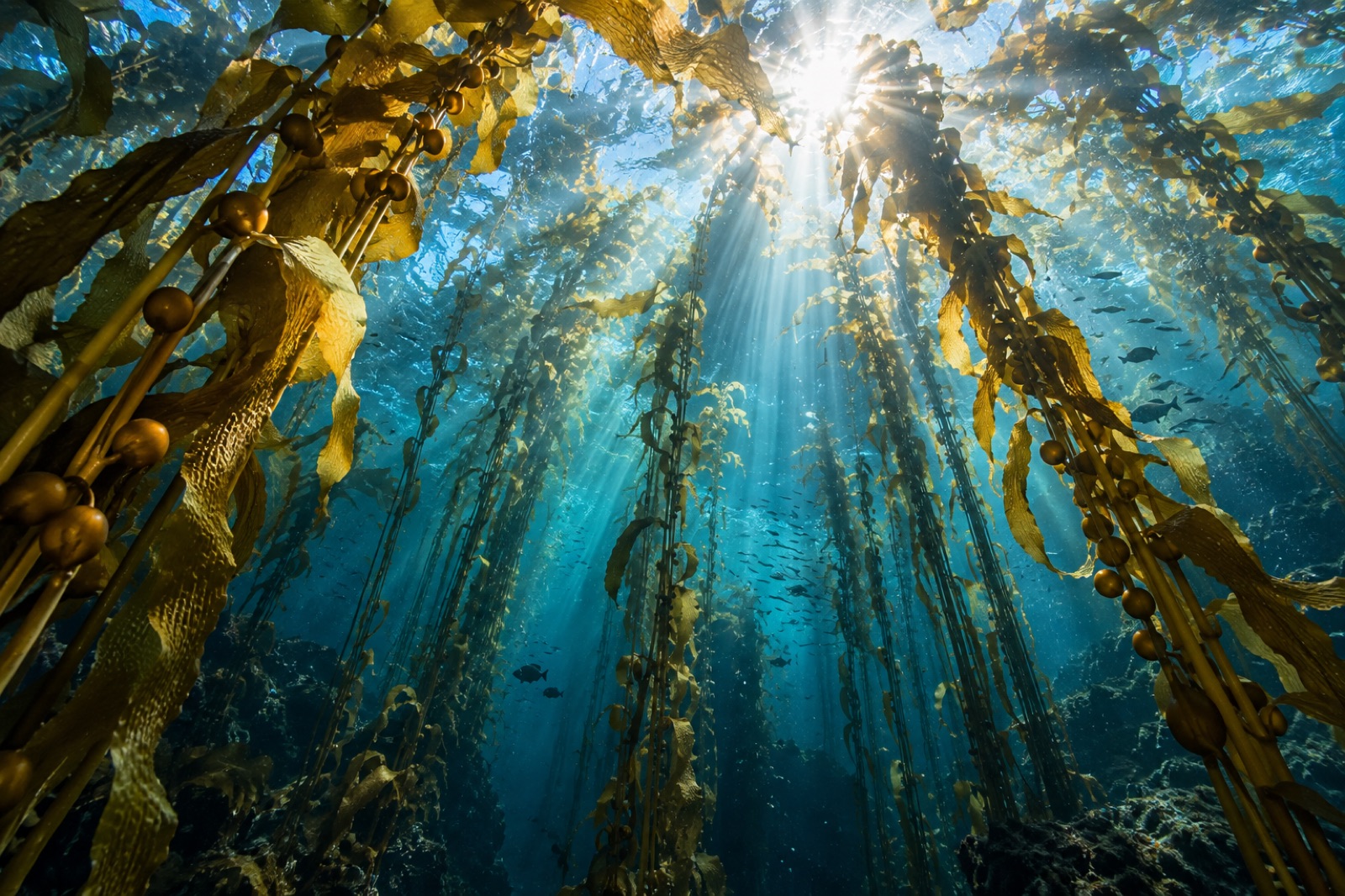
Stand on a rocky headland at low tide on a sunny afternoon and you will smell the kelp before you see it: a sharp, medicinal, almost antiseptic tang in the sea air. Part of what you are smelling is iodine — real chemistry, released by real algae, doing real work in the atmosphere above your head. And that chemistry has spawned one of the loveliest ideas in ocean science: the notion that kelp forests, by venting iodine into the air, help build clouds over the coast.
The honest answer is a scientist's favourite: partly yes, mostly no, and the details are wonderful. Kelp genuinely does emit iodine gases that form new aerosol particles in coastal air and alter local air chemistry. Whether those particles grow up to seed cloud droplets at a scale that matters to climate is a much harder claim — one the evidence does not currently support. This article walks through what kelp does to the air, what aerosols do to clouds, and where the apparently irresistible "seaweed makes clouds" story overshoots the science.
The smell of the sea is chemistry
The ocean exhales. Every coastline is a two-way street of gases and particles: seawater absorbs carbon dioxide and oxygen from the air, and it releases a zoo of compounds back — sea salt, organic films, dimethyl sulfide (DMS) from phytoplankton, and, along rocky kelp coasts, iodine.
Two pathways supply most of the coastal iodine story:
- Biological iodine release by macroalgae. Brown kelps concentrate iodine from seawater into their tissues at astonishing levels — kelp tissue can hold iodine at concentrations tens of thousands of times higher than the surrounding water. This long-observed enrichment is one reason humans began harvesting seaweed for iodine almost two centuries ago. When kelp is stressed, it releases some of that iodine back as reactive gases.
- Surface chemistry. Ozone in the air reacting with iodide at the sea surface generates molecular iodine (I₂) and hypoiodous acid (HOI), which vent into the atmosphere. This happens over any seawater, but it is amplified along kelp coasts where algae are exposed and metabolically active.
A third character deserves a mention: DMS, the sulfurous compound behind much of the classic "ocean smell," comes mainly from phytoplankton, not kelp. Kelps do produce some sulfur compounds, but the iodine pathway is where macroalgae genuinely stand out.
How kelp releases iodine: a low-tide survival reflex
The key to the kelp-iodine story is stress. An intertidal kelp plant at low tide is having a genuinely bad afternoon: dried out, sun-struck, heating up, with photosynthetic machinery still running but CO₂ supply cut off. As we explain in our piece on how kelp photosynthesizes, excess light energy in a stressed alga spawns reactive oxygen species — the algal equivalent of a short circuit.
Kelp's answer is iodine. Brown algae use iodide ions as a kind of antioxidant shield; when oxidative stress spikes — at low tide, under UV, in heat — they vent molecular iodine and iodocarbon compounds (small iodine-bearing molecules like diiodomethane) into the air. It is, in a sense, the kelp popping a relief valve.
Measurements over macroalgal beds have documented this beautifully: when the tide drops and the blades emerge into sunlight, iodine emissions surge; when the tide floods back over the canopy, they collapse. The effect is strongest in spring and summer, on the clearest days, over the largest intertidal and subtidal kelp forests — which is why research observatories on kelp-rich Atlantic coasts, such as those in Ireland and western France, became the natural laboratories for this science. Europe's biggest kelp forests, along Brittany, sit under exactly this kind of iodine-laden sky.
From gas to particle: coastal "particle bursts"
Iodine gas does not stay a gas. Sunlight splits molecular iodine apart, and the fragments react with ozone to make iodine oxides, which then combine into higher oxides and iodic acid (HIO₃) — compounds that stick together and condense into brand-new particles just a few nanometres across.
The result is one of the most distinctive phenomena in atmospheric science: the coastal new-particle burst. On kelp shores at low tide, instruments can watch ultrafine iodine particles appear in the billions, forming visible-on-instrument plumes that march inland with the sea breeze. Kelp forests are, chemically speaking, particle factories.
These bursts matter locally in two well-established ways:
- Air chemistry. Iodine oxides help destroy ozone in the lower atmosphere. Because ozone near the ground is both a pollutant and a short-lived greenhouse gas, kelp iodine measurably scrubs some of it from coastal air. Iodine chemistry is now recognised as a significant piece of ozone budgets over the global marine boundary layer, and coastlines with kelp amplify it.
- Fogs and hazes. Iodine particles, mixed with sea salt and organics, contribute to the hazy, salt-laden air that gives kelp coasts their luminous, soft-focus light.
Aerosols and clouds: a quick primer
To say whether kelp "makes clouds," you need the machinery. Cloud droplets do not condense out of pure water vapour on their own — at typical atmospheric humidity they need a seed surface: a cloud condensation nucleus (CCN). Enough CCN and you get bright, fine-droplet clouds; few CCN and you get dimmer, coarser clouds that rain out faster. Anything that reliably adds big, soluble particles to marine air can, in principle, brighten and thicken clouds.
Globally, the dominant natural CCN sources over oceans are sea salt and sulfate particles — much of the sulfate coming from the oxidation of DMS from phytoplankton. That DMS-to-sulfate-to-cloud chain is the heart of the famous CLAW hypothesis, proposed in 1987, which imagined a thermostat: warmer oceans, more plankton, more DMS, more clouds, more cooling. Decades of work have since shown the real system is far more complicated, and no simple self-regulating thermostat has been demonstrated.
So do kelp forests actually seed clouds?
Here is where rigor beats romance. The evidence, as it stands:
- Kelp iodine demonstrably makes ultrafine particles — but ultrafine is the problem. New particles a few nanometres wide mostly collide with existing larger particles or each other and vanish within hours. To matter for clouds, they must grow to roughly 50–100 nanometres, which requires acquiring condensable material (sulfate, organics) faster than they are lost.
- Observations of coastal iodine bursts show some episodes where a fraction of particles do grow into CCN-relevant sizes. The iodine particle pathway is real but appears to be a modest, coastal, episodic contributor — dwarfed, in most open-ocean settings, by sea salt and sulfate.
- The strongest, most consistent effect of kelp iodine is not cloud seeding but ozone destruction in the local air — an air-quality effect, not a climate lever.
- A few studies have suggested kelp iodine chemistry could affect atmospheric oxidation more broadly, and active research continues on polar and coastal iodine–cloud links. The field is genuinely alive. But no convincing evidence shows that kelp forests brighten clouds enough to cool the climate at a meaningful scale.
The pattern should sound familiar. It is the same shape as the debate we map in the seaweed carbon discussion: a real biological mechanism (kelp does sequester some carbon; kelp does emit iodine) stretched by headlines into a planetary-scale claim (kelp will fix the climate) that the physics cannot currently carry. The mechanism earns our attention; the hype earns our caution.
What a warming ocean does to the kelp–air loop
If kelp iodine matters mostly for coastal air chemistry, then losing kelp changes coastal air — a small but real thread in the climate tapestry. Marine heatwaves are stripping kelp forests from coastlines worldwide, and every cleared forest is one less iodine source on the shore.
The feedbacks are subtle and probably small, but they exist: fewer macroalgal iodine emissions, fewer coastal particle bursts, slightly altered ozone behaviour over rocky coasts. None of this will swing the global thermostat. What it does is remind us that kelp forests are not scenery — they are functioning organs in the Earth system, chemically coupled to the air above them in ways we are still mapping.
It is also why monitoring programs pay attention to coastline atmosphere as well as water. At Tidewright, our fictional Canopy Ledger platform focuses on canopy cover, biomass and biodiversity rather than air chemistry — but the research community's coastal observatories are increasingly measuring both sides of the surface at once, treating the kelp forest and its sky as one system.
Key takeaways
- Kelp really does emit iodine. Stressed by low tide, sun and heat, brown kelps vent iodine gases — an antioxidant reflex with atmospheric consequences.
- Coastal particle bursts are real. Kelp iodine drives bursts of new ultrafine aerosol particles over rocky shores, among the clearest examples of biology building aerosols.
- The best-established effect is ozone destruction, an air-chemistry effect. Kelp iodine helps scrub ozone from coastal air.
- "Kelp makes clouds" overshoots the evidence. Some iodine particles may grow large enough to seed droplets, but sea salt and sulfate dominate cloud nuclei, and no climate-scale kelp cloud effect has been demonstrated.
- The mechanism matters even without the megaclaim. Losing kelp forests changes coastal air chemistry — one more reason the forests deserve protection on their own terms.
FAQ
Does the smell of the seaside contain iodine from kelp?
Along rocky kelp coasts, yes — partly. The sharp "ozonic" note in sea air has been linked to iodine compounds released by exposed macroalgae, layered over DMS from phytoplankton and plain sea salt. What you smell is a genuine chemical plume, not imagination.
Could planting more kelp cool the planet by making more clouds?
There is no good evidence for that today. Kelp iodine produces ultrafine particles, most of which never grow large enough to seed cloud droplets. Restoration should be justified by real, measurable benefits — biodiversity, fisheries, coastal protection, some carbon — rather than speculative cloud-brightening promises.
What is the CLAW hypothesis?
A 1987 proposal that a warming ocean would stimulate phytoplankton to emit more DMS, forming more sulfate aerosols and brighter clouds, cooling the planet in a self-regulating loop. It catalysed decades of valuable research but, in its simple form, has not held up — the ocean–atmosphere system is more complex.
Is iodine from kelp useful in other ways?
Historically, absolutely — seaweed was a leading industrial source of iodine for medicine and chemistry before mineral sources took over. Kelp's ability to concentrate iodine is also why some edible kelps are iodine-rich, something cooks should handle with care; see our kitchen guide to iodine and seaweed.
Do scientists monitor iodine over restored kelp forests?
Coastal observatories measure iodine oxides and particles over natural kelp beds, and as restoration scales up, "does a restored forest restore the air chemistry too?" is a live, testable research question — one that would make restored coastlines natural experiments in ocean–atmosphere coupling.