Science8 min read
Marine Snow: The Ocean's Slow Carbon Conveyor
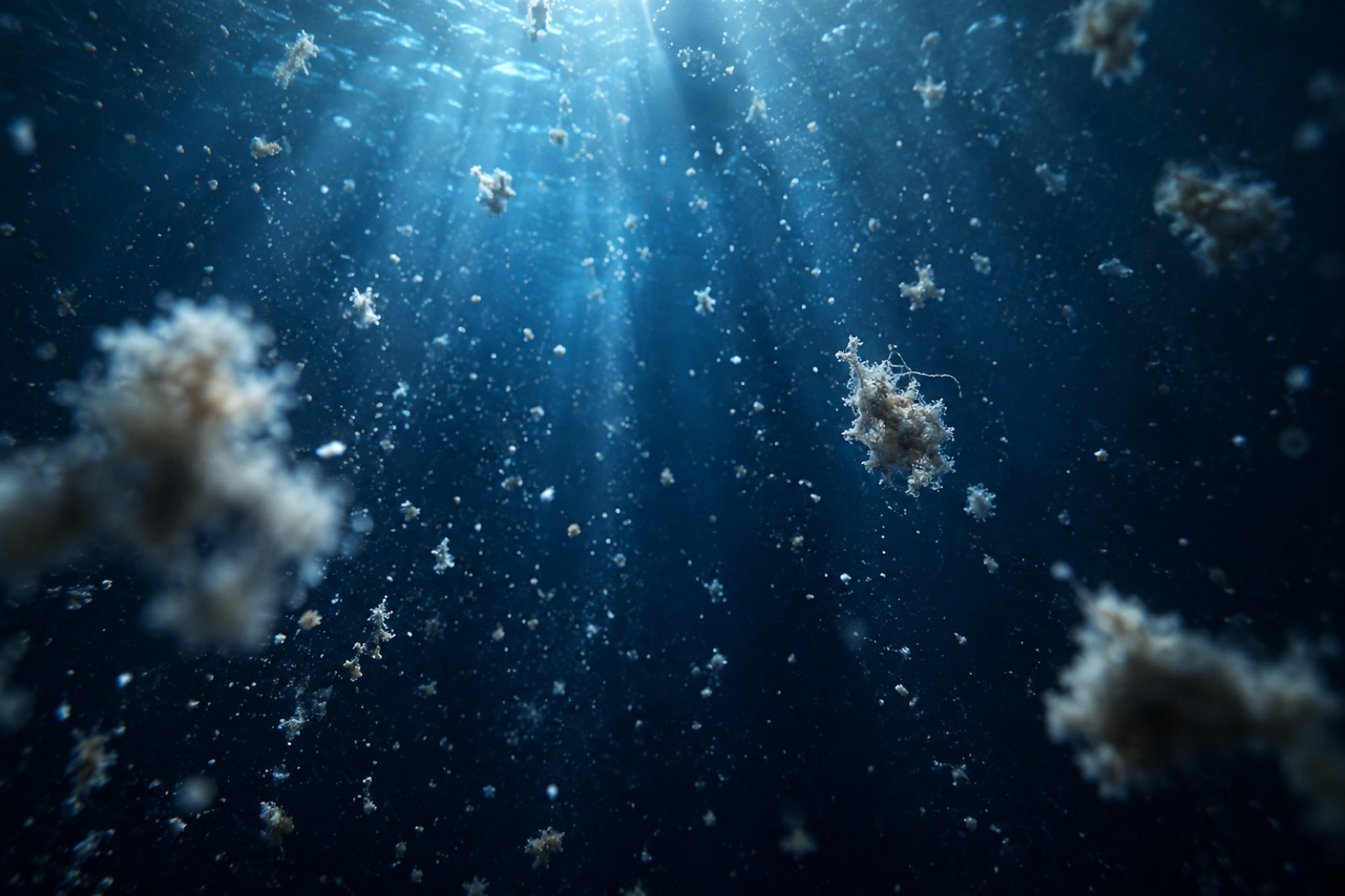
Marine snow is the ocean's constant drizzle of sinking organic matter — and one of the main routes by which carbon reaches the deep sea. Here's how it works.
Priya Raman ·
Every day, ocean life sends carbon raining into the deep. How the biological carbon pump works, who drives it, and how long its cargo stays buried.
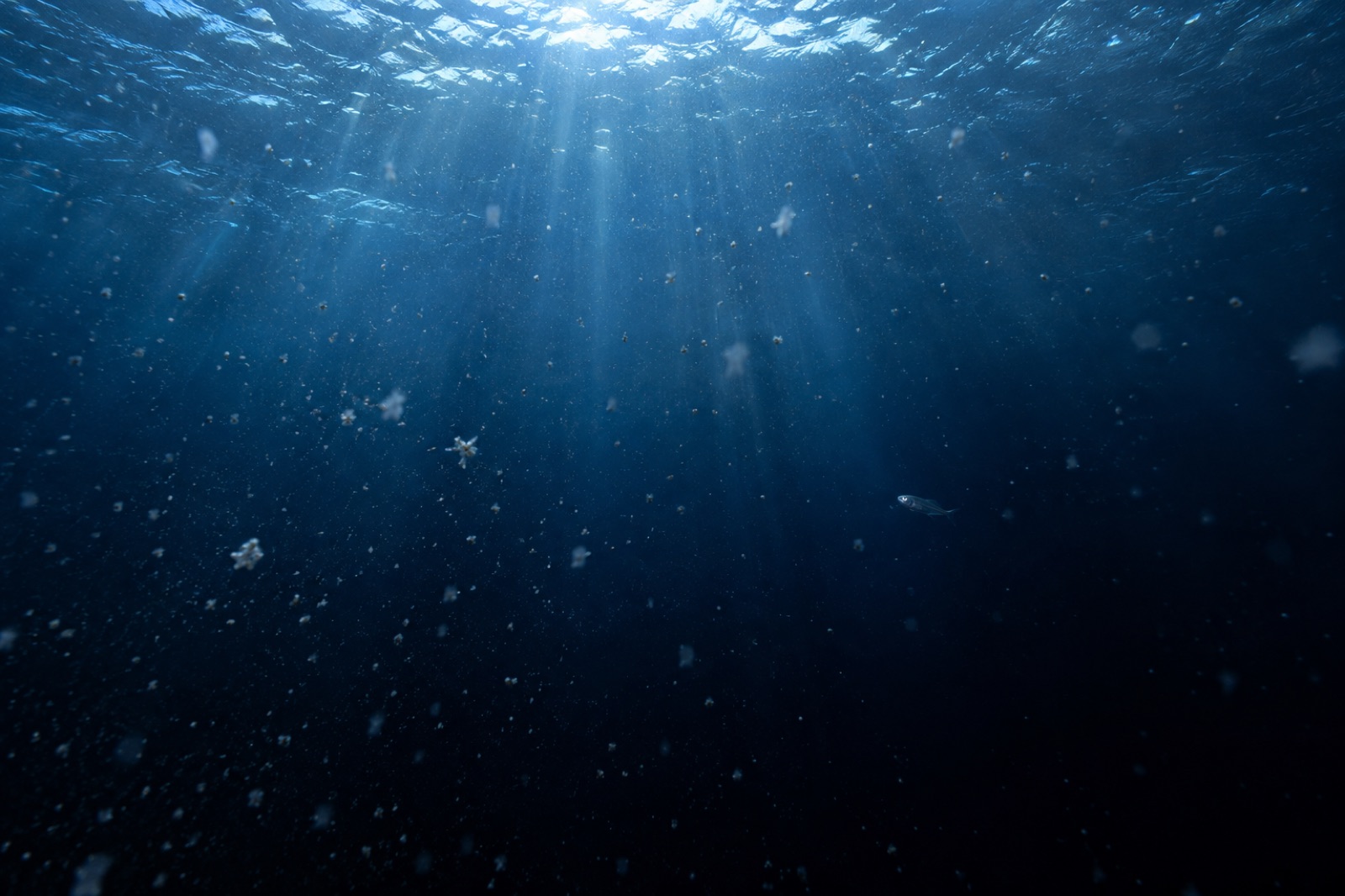
Stand on any headland and look seaward: the blue surface you see is only the lobby of the building. Every day, the sunlit upper hundred metres of that water manufactures an enormous amount of carbon-rich life, and every day a fraction of that life — dead cells, mucus, shells, faecal pellets, moulted carapaces — sinks out of the light and down toward the dark. That ceaseless gravitational freight service is the biological carbon pump, and it is one of the main reasons Earth's atmosphere holds as little carbon dioxide as it does.
Modeling studies consistently find that if the pump stopped, atmospheric CO₂ would be substantially higher — on the order of half again the preindustrial level. Understanding how the pump works is the foundation for every serious conversation about ocean carbon, from blue carbon accounting to kelp restoration. Here is the machinery.
The pump exists because the ocean is layered. Phytoplankton in the euphotic zone — the sunlit surface layer, typically the top tens to two hundred metres — assimilate dissolved CO₂ through photosynthesis. If everything they built were eaten and respired right there, nothing would happen climatically: the carbon would return to surface water within days and re-equilibrate with the atmosphere.
The pump is the set of pathways by which a portion of that carbon instead crosses the permanent thermocline into water that will not touch the atmosphere again for decades, centuries or millennia. Once carbon is below that boundary, the clock it answers to is the slow overturning circulation — the same physical conveyor we describe in the solubility pump explainer. Depth converts time: carbon at one hundred metres might see the sky again within a season; carbon at a thousand metres is sequestered beyond any policy horizon.
Oceanographers estimate the pump exports roughly several to ten-plus gigatonnes of carbon per year out of the surface ocean — a flux comparable in scale to human fossil-fuel emissions, though most of what sinks is remineralised at intermediate depths rather than reaching the seafloor.
The classic pathway is sinking particles, the drifting blizzard we profile separately in marine snow. The details of the blizzard determine everything:
Not all downward carbon rides gravity. Every night, the planet's largest animal migration runs vertically: zooplankton, krill and lanternfish rise hundreds of metres to feed in surface waters, then descend by day to digest, excrete and — literally — respire surface carbon at depth. This diel vertical migration shoves carbon downward through living tissue, delivering it to depths where it dissolves into deep-water chemistry without any slow sinking.
Related sub-pumps piggyback on animal life cycles. In cold seas, copepods gorging on spring blooms convert carbon to lipid reserves, then descend to overwinter and burn those reserves a thousand metres down — a seasonal lipid pump of real consequence in polar seas. Fishes and jelly-falls add episodic pulses. Modern estimates increasingly credit these active transport pathways with a meaningful fraction of total export — something the satellite era, watching only surface colour, entirely missed.
A third pathway carries no particles at all. Surface food webs continually leak dissolved organic matter — sloppy feeding, viral lysis, exuded sugars — that accumulates because most microbes find it barely worth eating. Currents and winter mixing then carry this semi-persistent dissolved carbon into deeper waters, where it can persist for centuries or longer. The microbial carbon pump, as this framework is known, means the ocean stores carbon not only in falling debris but in a vast broth of dissolved leftovers, one of the largest dynamic carbon reservoirs on Earth.
Kelp is built differently from plankton, and its carbon enters the pump through the back door of physics rather than the front door of sinking cells. Forests export a large share of their production — some studies find the majority — as detritus: blade fragments, dislodged whole plants, eroded mucilage. Some of that detritus feeds local food webs and some is routed offshore by storms and currents down submarine canyons and onto deep seafloors, where carbon effectively joins the long clock — the export pathways are detailed in where kelp carbon goes and the accounting end in kelp sequestration pathways.
The honest framing matters: kelp carbon does not photosynthesise straight into millennial storage. It joins the same queue as everything else — eat, sink, drift, decompose, and only the luckiest fraction crosses into deep time. That is exactly why measuring what happens downstream of a restored forest, as our Canopy Ledger monitoring platform attempts, is harder and more interesting than counting fronds.
You cannot watch a gigatonne-scale process directly, so oceanography has assembled a toolkit:
A warmer, more stratified ocean will likely change the pump in competing directions. Weaker mixing may starve surface waters of nutrients and shift plankton communities smaller — smaller cells sink worse. Deeper warming and deoxygenation may slow microbial remineralisation at depth, letting carbon survive deeper. Which effect wins, where, is an open question with large stakes: small percentage shifts in a multi-gigatonne flux rival national emissions. The pump is not a machine we manage; it is a climate ally we disturb only at our peril.
Estimates vary by method, but export out of the surface ocean is on the order of several to over ten gigatonnes of carbon per year — comparable in magnitude to human CO₂ emissions, though only a small fraction of the exported carbon reaches the deepest, longest-storage waters.
The steady fall of organic particles — dead plankton, mucus aggregates, faecal pellets, discarded feeding structures — that links surface production to deep-sea food webs and carbon storage. We cover it in depth in our marine snow explainer.
It depends entirely on depth. Carbon remineralised at a few hundred metres may resurface in decades; below the permanent thermocline it rides the overturning circulation for centuries to a millennium or longer; carbon buried in sediment can stay for geologic time. Depth is destiny.
Yes, but through detritus export rather than sinking cells: storms break kelp loose, and currents carry fragments offshore to deep seafloors and canyon sediments. That pathway is why tracing kelp carbon's destination — not its standing biomass — is the crux of kelp blue-carbon science.
Probably, and in competing directions: stratification may shrink and slow sinking communities, while deeper warming may slow decomposition of what does sink. The net global effect remains an active research question with large climate stakes.
Marine snow is the ocean's constant drizzle of sinking organic matter — and one of the main routes by which carbon reaches the deep sea. Here's how it works.
Priya Raman ·
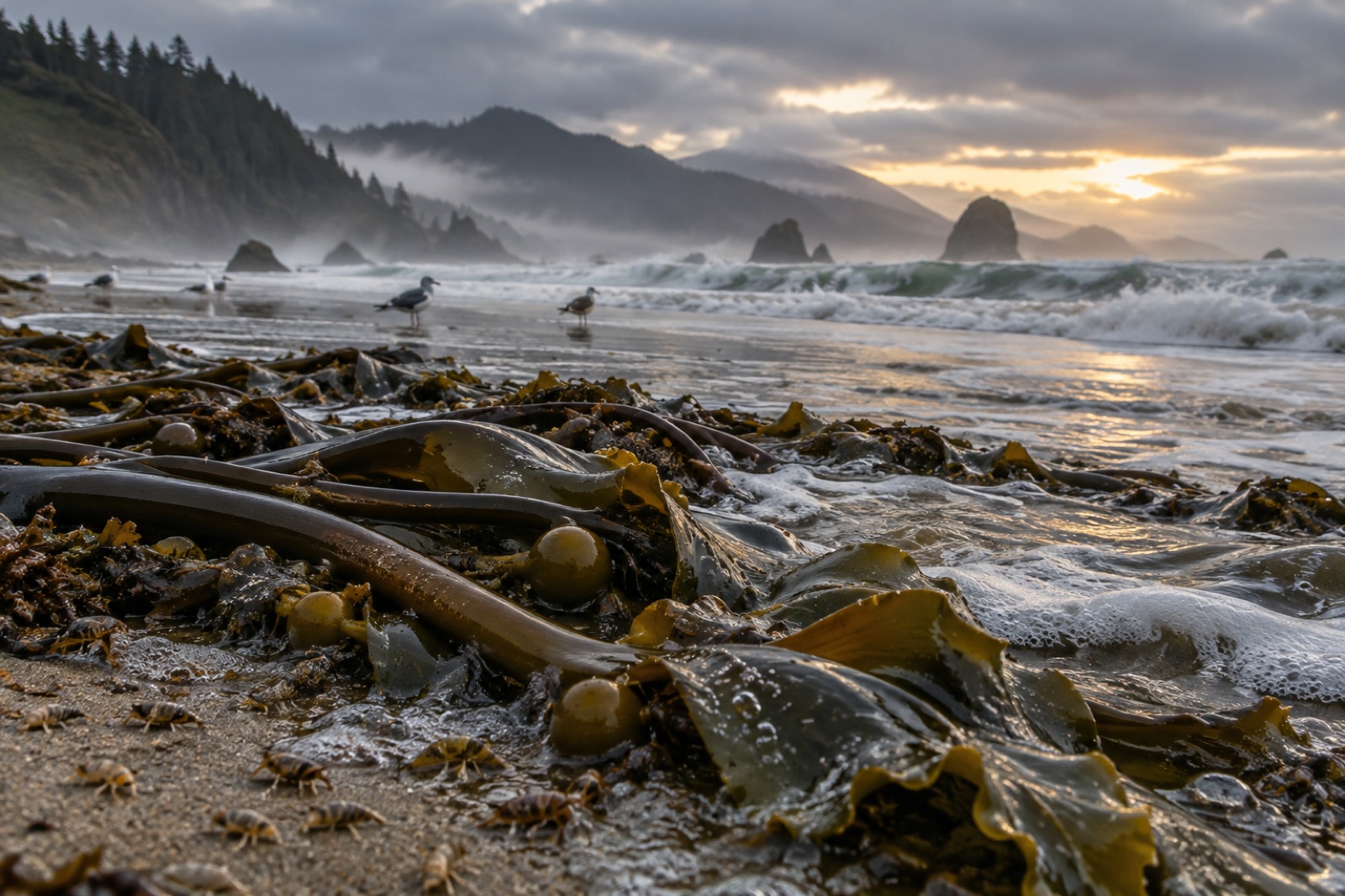
Kelp grows fast and dies young. Follow its carbon from sunlit blade to beach wrack, deep-sea fall and seafloor sediment — the full journey of kelp detritus.
Dr. Lena Fischer ·
Cold water drinks CO2, and the overturning circulation locks it away for centuries. How the ocean's solubility carbon pump works — and what it costs.
Dr. Lena Fischer ·