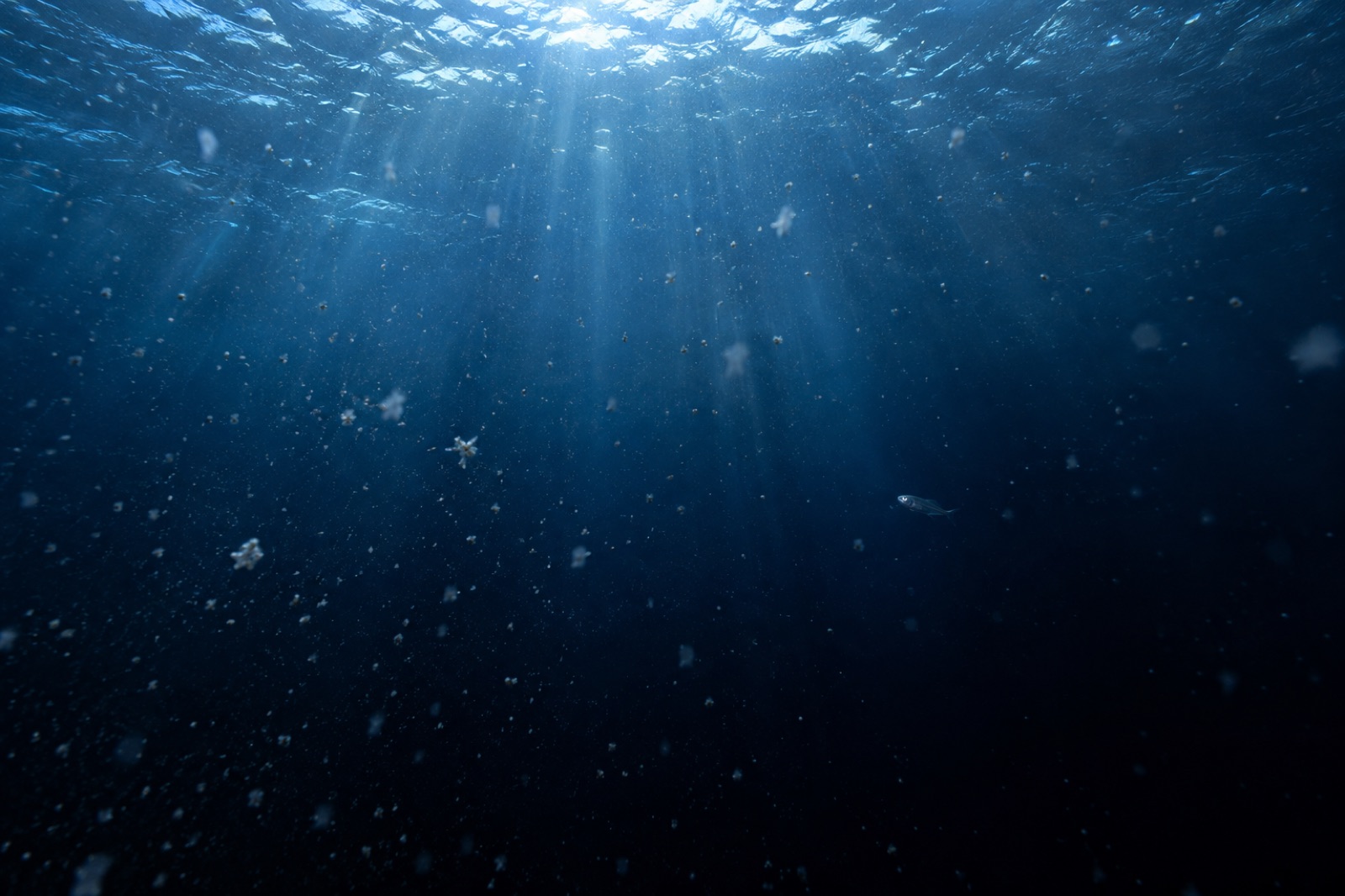
The ocean holds roughly fifty times more carbon than the atmosphere — not because of kelp, whales or plankton, but mostly because of physics and a weak acid. Long before any living thing gets involved, seawater is already a vast carbon store, maintained by what oceanographers call the solubility pump: the simple facts that carbon dioxide dissolves more readily in cold water than warm, and that cold water sinks.
This is the pump nobody photosynthesises. It runs day and night without a single cell, it has shaped Earth's climate for hundreds of millions of years, and it is the reason the ocean has been able to swallow about a quarter of the carbon dioxide humanity has emitted. Here is how it works, and what it costs.
Why cold water drinks CO₂
Gas exchange between air and sea follows the same rule as a bottle of sparkling water: cold liquid holds dissolved gas; warm liquid lets it out. Carbon dioxide is no exception. Surface water in the tropics, warm and gas-saturated, can barely take up more CO₂ — some tropical waters even outgas. Surface water at high latitudes, chilled toward freezing by polar air, is thirsty: its capacity for dissolved CO₂ rises steeply as temperature falls.
So the global pattern of air–sea CO₂ exchange reads like a temperature map. Warm gyres and upwelling zones tend to release carbon; the cold North Atlantic and the fringes of the Southern Ocean inhale it. Season sharpens the contrast: the same patch of subpolar ocean releases CO₂ in its warm season and gulps it when winter storms return.
Temperature is necessary but not sufficient, though — dissolved carbon that merely sat in cold surface water would eventually choke its own uptake. The pump needs a trapdoor.
The trapdoor: sinking water and the great conveyor
That trapdoor is the overturning circulation — the slow global loop in which dense, cold surface water at high latitudes grows saltier (through cooling and sea-ice formation), becomes heavy enough to founder, and sinks into the deep ocean, beginning a journey of centuries to a thousand years or more before returning to the sunlit world.
Deep water forms at only a handful of addresses: the Greenland–Iceland–Norwegian seas and the Labrador Sea feeding the North Atlantic's descent, and shelves around Antarctica where the coldest, densest water on Earth slips down to run the abyss. Every litre that founders carries its dissolved inorganic carbon with it. The solubility pump is, functionally, those sinking columns: cold surface ocean drinking CO₂ today becomes carbon-laden deep water that will not breathe back to the sky for many centuries. The surface currents that feed this loop are profiled in our boundary currents explainer; the heat side of the same machine in ocean heat content.
This also resolves a common confusion: the solubility pump and the biological pump are partners, not rivals. Life shuttles carbon downward as sinking particles and migrating animals; physics shuttles it as dissolved gas riding founder water. Both only matter climatically because both deliver carbon below the permanent thermocline, into the long clock of the deep sea.
The chemistry that makes it hold: a weak acid's three disguises
CO₂ does not merely dissolve in seawater like oxygen does. Once in, almost all of it reacts: a little becomes carbonic acid, and then bicarbonate and carbonate ions, in a shifting equilibrium. This carbonate system is the ocean's great trick — by converting most dissolved CO₂ into bicarbonate, seawater keeps its free CO₂ partial pressure low, leaving headroom to absorb more from the air. Roughly nine-tenths of the ocean's dissolved inorganic carbon sits as bicarbonate, which is why the ocean can store fifty atmospheres' worth of carbon without fizzing.
There is a ceiling, and it has a name: the Revelle factor, which quantifies how readily surface water can keep taking up CO₂ as its carbon load rises. Warm tropical surface waters already run high Revelle factors — chemically near-saturated, poor absorbers — while cold, fresh polar waters still have buffer to spare. As the ocean's total carbon inventory climbs, Revelle factors climb too: each additional tonne of human carbon is absorbed a little less willingly than the last. The quiet conveyor has a diminishing appetite.
What the pump has done for us — and the invoice
Since the industrial era began, ocean uptake — dominated by these physical-chemical pathways — has absorbed roughly a quarter of our CO₂ emissions, an immense unbilled climate service without which atmospheric concentrations, and global temperatures, would be markedly higher. Humanity did not build this pump, cannot throttle it, and only lately learned to measure it (the observing fleets we describe in Argo floats explained now profile ocean carbon chemistry alongside heat).
The invoice arrives in two parts:
- Acidification. Every unit of CO₂ absorbed stitches a little more acid into the carbonate equilibrium, lowering seawater pH and the availability of the carbonate ions that shell-building life needs — the chemistry we walk through in ocean acidification explained and the shellfish consequences in acidification and shellfish.
- A slowing conveyor. Warming warms precisely the high-latitude surface waters whose density crash drives sinking, and freshening from melting ice lightens them further. A weaker overturning is a weaker solubility pump — uptake capacity lost exactly when we need it most — with knock-on knock-ons for heat transport and fisheries far downstream. Scientists track Atlantic circulation strength intensely for exactly this reason; the evidence and its uncertainties are genuinely live science.
The pump on a kelp coast
Coastal seas sit at the pump's messy margins. Upwelling coasts — including most great kelp shores — deliver deep, carbon-and-nutrient-rich water to the surface, meaning kelp forests often grow in naturally CO₂-rich, lower-pH water, intermittently venting carbon to the atmosphere in windy seasons even as their photosynthesis draws it down locally. The upwelling engine that feeds a forest with nitrate correlates with the same water mass that makes coastal acidification episodes so sharp; river plumes layer fresh, low-alkalinity water on top.
It is a reminder against romantic accounting: a kelp forest is not reversing the solubility pump, and restored coasts do not repeal ocean chemistry. Honest restoration science — the standard we hold ourselves to in Tidewright's impact methodology — measures local carbonate chemistry as context, the way a vineyard tracks weather, rather than claiming the sky's ledger for the reef's credit. The blue carbon accounts that deserve trust are the ones that respect the pump's arithmetic rather than pretend to overrule it.
Where the science goes next
The open questions are sizing questions: how much uptake capacity will the Southern Ocean retain as its shelves freshen; how much has the Atlantic's sinking already slowed; how will the biological and solubility pumps compete or compound in a warmer, more stratified sea (see ocean stratification). Autonomous floats and better carbon climatologies are closing error bars year by year. What is not in question is the pump's existence or its service: the ocean has quietly shouldered a quarter of the carbon burden, at measurable chemical cost, for a century and a half. The least a serious climate conversation can do is learn its name.
Key takeaways
- The solubility pump is the physical-chemical flow of atmospheric CO₂ into cold surface waters and thence, via sinking deep-water formation, into the deep ocean for centuries to millennia.
- CO₂ dissolves best in cold water, and the carbonate system converts most of it to bicarbonate — giving the ocean a carbon inventory about fifty times the atmosphere's.
- Deep water forms at only a few high-latitude sites; those sinking columns are the pump's trapdoor, and a warming, freshening surface threatens to slow them.
- The pump, with biological pathways, has absorbed roughly a quarter of human CO₂ emissions — at the cost of ocean acidification and with diminishing marginal capacity (rising Revelle factor).
- Kelp coasts live at the pump's margins: upwelled carbon-rich water, acidic episodes and plume effects mean honest blue-carbon accounting treats chemistry as context, not credit.
FAQ
How is the solubility pump different from the biological pump?
The solubility pump moves carbon as dissolved gas absorbed at high latitudes and carried down by sinking water; the biological pump moves carbon packaged by life — sinking particles, migrating animals, dissolved organics. Both sequester carbon only once it is below the permanent thermocline, and both depend on the overturning circulation's isolation timescales.
Why does cold seawater absorb more CO₂ than warm water?
Gas solubility rises as temperature falls — the same reason a chilled fizzy drink holds its bubbles. Chilled polar surface waters gain headroom to dissolve atmospheric CO₂; warm tropical waters are near saturation and sometimes degas into the air.
Is the ocean a carbon source or a carbon sink?
Both, regionally: warm upwelling and tropical regions often outgas natural carbon, while cold high-latitude and some temperate seas absorb strongly. Netted globally, the ocean is a large sink for human-emitted CO₂ — roughly a quarter of emissions since industrialisation.
Will the ocean keep absorbing our emissions at the same rate?
Not proportionally. As inorganic carbon accumulates, surface-water buffer capacity falls (higher Revelle factor), and warming plus freshening threaten the deep-water formation that buries absorbed carbon. Uptake continues but weakens relative to emissions in most projections.
Does the solubility pump cause ocean acidification?
It is the pathway, yes: absorbed CO₂ reacts to form carbonic acid, lowering pH and carbonate-ion availability. The pump softens atmospheric warming while hardening ocean chemistry — the trade at the heart of the ocean carbon story.