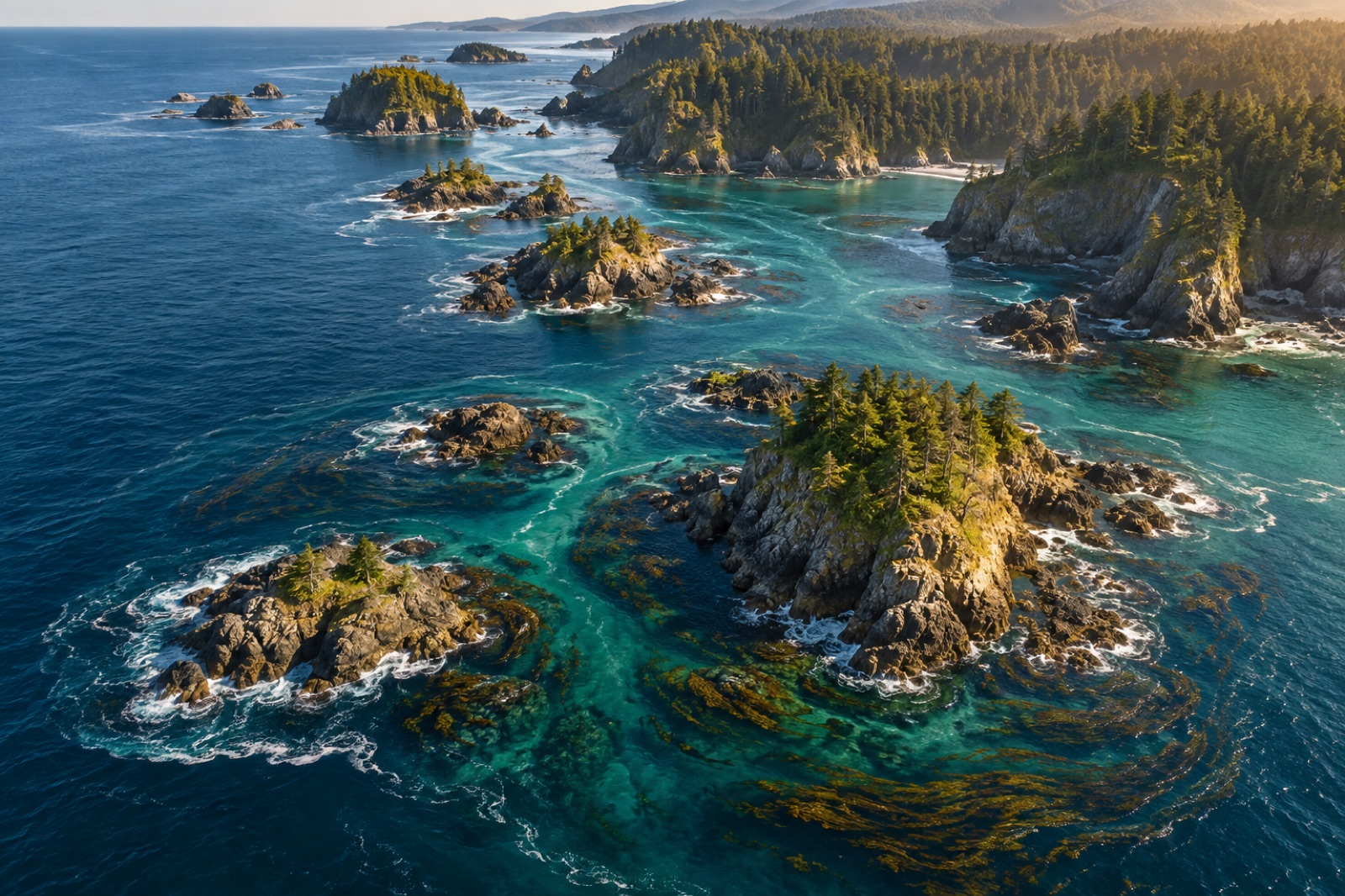
If the ocean's great gyres are its climate — slow, planetary, centuries in the turning — then mesoscale eddies are its weather: spinning discs of water, tens to a few hundred kilometres across, that live for weeks to months and carry a startling share of the ocean's total kinetic energy. From above, a satellite sees a kelp coast bordered by a slow river. From in the water, the shelf is being kneaded, at any moment, by several of these gyres-on-the-move — each one quietly pumping nutrients toward the coast, ferrying larvae along it, or pinning a blob of warm water against a reef. To understand why one kelp forest thrives through a lean summer while its neighbour starves, you usually end up talking about eddies.
This article covers what they are, how boundary currents shed them, how they move material across the shelf-slope boundary that otherwise seals the coast off, and how scientists watch them. The current systems that spawn them are covered in boundary currents: the ocean rivers that decide where kelp grows.
Scales: where "mesoscale" sits
Oceanographers divide motion by size and duration. At the top: gyres and boundary currents, thousands of kilometres and effectively permanent. At the bottom: turbulence and breaking internal waves, metres and minutes. The mesoscale lives between — the sweet spot where Earth's rotation dominates but features still evolve fast enough to matter within a season.
Two numbers define a regional eddy's typical stature: the water depth, and the Rossby deformation radius — the natural width at which rotation and density stratification balance. In the deep open ocean that's tens of kilometres; on shallow shelves and in winter, smaller. This is why eddy fields look different off Chile (broad, deep shelf slopes, big eddies) than along a narrow, shallow shelf — same physics, different stage size.
Birth: how a current sheds an eddy
Boundary currents are fast, narrow, and — crucially — unstable. Stack enough speed and sideways density contrast into a jet and it begins to meander; the meanders grow; eventually a loop pinches off into a self-contained spinning ring. The Gulf Stream is the archetype, shedding warm-core rings northward onto the shelf and cold-core rings southward into the Sargasso Sea. The Leeuwin Current off Western Australia, the Kuroshio off Japan, the East Australian Current, the California Current — all bleed eddies, and most of the world's great kelp coasts live adjacent to one of them.
Two instability routes matter. Baroclinic instability draws energy from tilted density surfaces — the stored potential energy of piled-up water — and dominates where stratification is strong. Barotropic instability draws directly from the jet's sideward shear. Both deliver the same product: a coherent vortex that detaches and wanders, carrying the water it was born with.
Warm-core and cold-core: two spins, two chemistries
Every eddy has a personality fixed at birth:
Cold-core (cyclonic) eddies — counter-clockwise in the Northern Hemisphere, clockwise in the Southern — pinch off from the shoreward side of a meander. Inside them, density surfaces dome upward, lifting deep, nutrient-rich water into the sunlit layer. These are the open ocean's portable upwellings: chlorophyll blooms on satellite colour maps frequently map one-to-one onto cold-core eddy cores.
Warm-core (anticyclonic) eddies — the opposite spin — carry anomalous warmth pressed downward and inward; their cores are deep, warm, and nutrient-thin, but they are extraordinary transporters: a warm-core ring crossing a shelf break drags an entire vortex of offshore water, heat and planktonic life with it.
Around both spins runs an intense rim current — the edges of eddies are often the strongest currents in a region — and at and between eddy boundaries, strong vertical motions and fronts concentrate plankton, a mechanism related to the productivity we describe in ocean fronts.
Eddies as ferries: what crosses the shelf break
Here is the structural problem the coastal ocean presents: the continental shelf is hydraulically semi-isolated. Wind-driven upwelling (see upwelling explained) pulls deep water onto the shelf at certain places and seasons, but between those windows the shelf edge behaves like a membrane. Eddies are a principal solvent of that membrane, and they move three cargoes that matter to kelp forests:
Nutrients. Cold-core eddies impinging on a shelf slope force nutrient-rich water upward and shoreward. On narrow shelves bordered by boundary currents — the Humboldt, the Leeuwin, the East Australian Current — a large fraction of the shelf's deep-water nutrient supply arrives not by steady upwelling but in pulsed, eddy-driven injections. When an eddy pair or a big anticyclone parks against the slope, the onshore flow along its edge can flood the shelf with deep water for weeks.
Larvae and spores. An eddy traps a body of water and everything drifting in it. For species with planktonic young — including kelp spores — eddies are both buses and traps: a coherent eddy spinning along a coastline can retain larvae for its whole lifetime, exporting a reef's offspring tens of kilometres downstream; an onshore-moving eddy delivers foreign recruitment to a reef that currents alone would never supply. This is a core mechanism in marine connectivity and the dispersal geometry behind larval dispersal.
Heat. Warm-core eddies advect heat poleward and onto shelves — on some coasts they are the delivery mechanism for marine heatwaves. The Leeuwin Current's eddies, for example, are implicated in Western Australia's most punishing warming events, when warm offshore water being shoved shoreward arrives as persistent temperature anomalies reefs cannot escape.
Seeing a spinning ocean
Eddies are nearly invisible from a boat — their surface currents are swift on their rims but their signatures are never dramatic to the eye. They are seen by instruments:
- Satellite altimetry maps sea surface height. A dome of higher water is an anticyclonic eddy; a depression a cyclonic one. This is the workhorse: global, daily, decades deep.
- Ocean colour catches cold-core blooms from orbit — phytoplankton response is often the most legible eddy fingerprint, as described in how satellites read the sea.
- Gliders and Argo floats sample the interior — temperature and salinity structure versus depth, where eddies live as tilted lens shapes. Our guides to ocean gliders and Argo floats describe the platforms.
Blended together — altimetry locating the vortex, colour showing its biology, gliders its guts — an eddy is arguably the best-observed transient feature in the entire ocean.
Why a kelp ecologist tracks eddies
Three operational reasons. First, interannual nutrient supply on eddy-dominated shelves is eddy history; a quiet eddy year can starve a forest almost as effectively as a warm one. Second, recruitment windows — the years when a reef receives outside larvae — are frequently eddy years; connectivity models that ignore eddies systematically miss who is seeding whom. Third, early warning: a large warm-core eddy approaching an exposed shelf is weeks of forecast lead time for a heat stress event. Tidewright's monitoring program plots altimetric eddy tracks against reef temperature records for exactly this reason; when a warm-core structure stalls against a shelf break, we raise survey frequency the same week.
Key takeaways
- Mesoscale eddies are the ocean's weather — tens to hundreds of kilometres across, weeks to months in lifetime, carrying much of the ocean's kinetic energy.
- They are shed by unstable boundary currents through meander growth and pinch-off; nearly every great kelp coast borders an eddy-shedding current.
- Cold-core (cyclonic) eddies lift nutrients into sunlit water; warm-core (anticyclonic) eddies transport heat — two spins with opposite biogeochemical signatures.
- Eddies breach the shelf-break barrier, delivering nutrients, heat and larvae to otherwise semi-isolated coasts — they are a first-order control on coastal productivity and connectivity.
- Altimetry, ocean colour and gliders together make eddies the ocean's best-observed transient feature, and eddy tracks are usable as practical early-warning signals for reef heat stress.
FAQ
How big is a "mesoscale" eddy, exactly?
Typically 10 to a few hundred kilometres across, depending on local stratification and depth — big enough for Earth's rotation to organise the flow, small enough to evolve within a season. Open-ocean eddies average tens of kilometres through the core, with rim currents extending further.
Are eddies getting stronger with climate change?
Research suggests the eddy field is changing as boundary currents and stratification shift under warming, with some regions showing intensifying eddy activity — but the picture is regional, and observed trends differ between basins. The defensible general statement is that eddy statistics are part of what a changing ocean is rearranging.
Can an eddy really cause a marine heatwave?
Yes, in specific geographies. On coasts where boundary currents shed warm-core eddies poleward — Western Australia and southeast Australia are well-studied examples — an eddy stalling against the shelf can lock warm water over reefs for weeks to months. Globally, eddies are one of several heatwave mechanisms alongside atmospheric heat domes and suppressed upwelling.
Do eddies mix the ocean or keep water apart?
Both, which is why they're fascinating. Their rims shear and mix vigorously at the edges, but their cores trap and carry water parcels coherently for months — a single feature that is simultaneously a blender and a sealed shipping container.
How do scientists forecast eddies?
Regional ocean models initialised with altimetry and Argo data now predict eddy evolution days to weeks ahead — the ocean analogue of weather forecasting. Such forecasts are routinely used for fisheries, search-and-rescue and, increasingly, reef operations; skill drops quickly beyond the mesoscale's chaotic horizon, but a few weeks of eddy lead time is enormously useful.