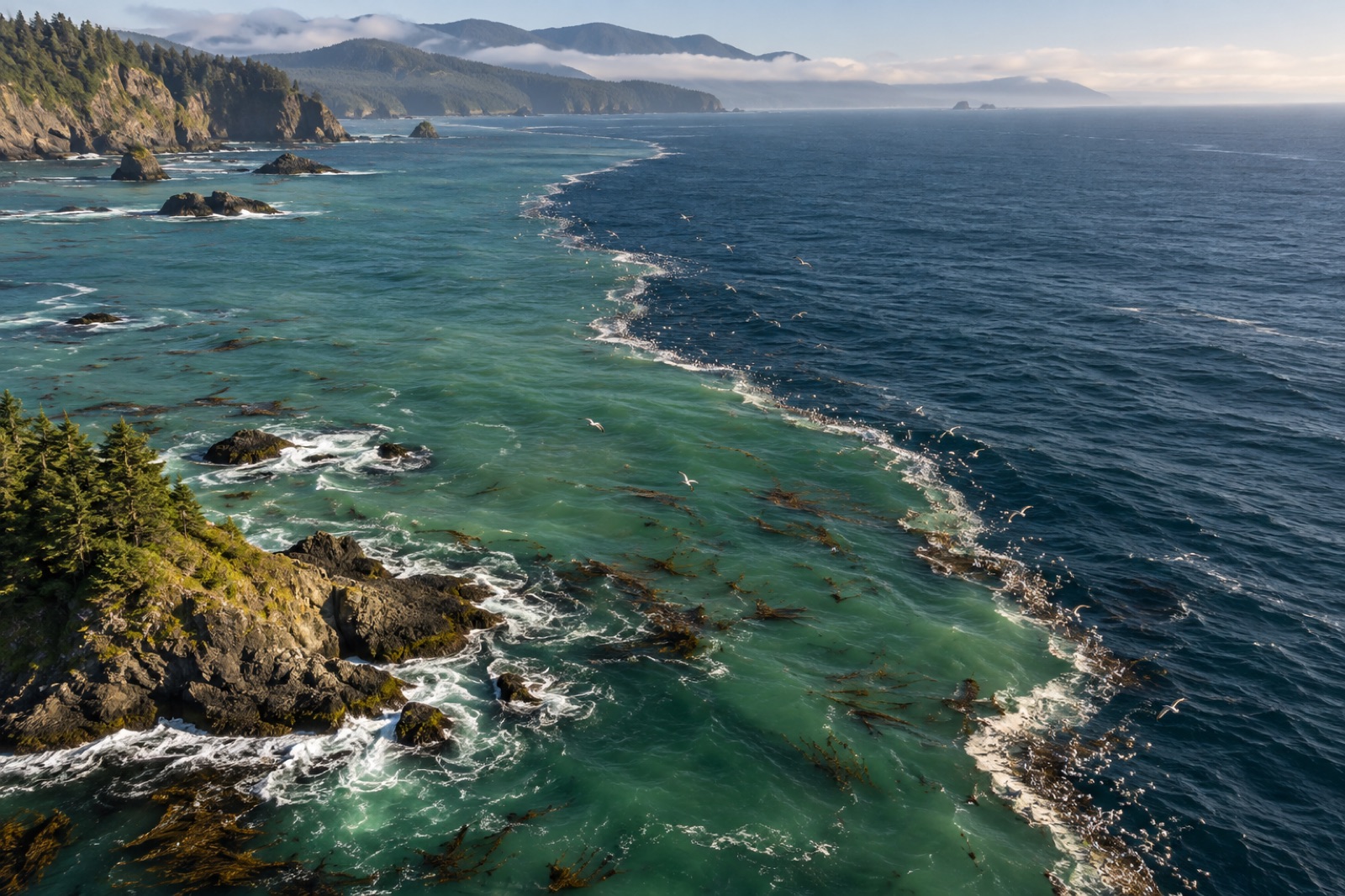
Stand on a headland on a calm day and you can sometimes see it: a line drawn across the sea, a kilometre long or a hundred, where the water on one side is green and ruffled and the water on the other is blue and glassy. Seabirds sit on it in drifting rafts. Foam, kelp fronds and driftwood gather along it as if the ocean were tidying itself into lanes. That line is an ocean front — a boundary where two different water masses meet — and it is one of the most productive places in the sea. For a kelp-restoration company, fronts are not trivia. They decide where nutrients go, where larvae travel, and where a restored forest will be well fed or quietly starved.
What an ocean front actually is
The ocean is not a uniform body of water. It is a mosaic of water masses, each with its own temperature, salinity, nutrient load and history, separated by boundaries that can be startlingly sharp. A front is simply one of those boundaries — a zone, anywhere from a few metres to a few kilometres wide, where properties like temperature or salinity change abruptly horizontally, the way hills mark a sharp change as you walk across a landscape.
Fronts exist because water masses with different densities resist mixing. Warm water is light; cold water is dense. Fresh water rides over salty water. Wherever two such masses are pushed together — by currents, winds, tides or the shape of the seafloor — a front forms along the seam. The physics that keeps oil floating on vinegar in a salad dressing is the same physics holding the seam together, just with geology for a bottle.
What makes fronts biologically explosive is what happens along them. Water at a front doesn't just sit side by side: it slides, tilts and circulates in narrow secondary flows. Those flows concentrate buoyant things — plankton, eggs, drifting kelp spores — into lines, while also pumping nutrients into the sunlit layer where photosynthesis happens. Concentration plus fertilisation is the recipe for a feast.
The main kinds of fronts you meet on kelp coasts
Not all fronts form the same way, and the type matters for what lives there.
Upwelling fronts
Where wind drives surface water offshore and cold, nutrient-rich deep water rises to replace it, the boundary between the new cold water and the older warm water offshore forms an upwelling front. These can run for hundreds of kilometres parallel to the coast — off California, Chile, Namibia or northern Spain — and they trace one of the great engines of coastal productivity. We wrote about the rising water itself in Upwelling Explained; the front is its visible skin. Kelp forests typically thrive shoreward of the upwelling front, bathed in that cold, nitrate-heavy water.
Tidal mixing fronts
In shallow shelf seas — the Celtic Sea, the North Sea, the Patagonian shelf — tides churn the water column. Where the water is deep enough or tides weak enough that the summer sun can stratify it, a tidal mixing front marks the boundary between the permanently mixed inshore water and the layered offshore water. These fronts sit in nearly the same place every summer, and they are fertiliser factories: turbulence at the boundary continually leaks deep nutrients into the stratified side's light-filled surface layer.
Estuarine and plume fronts
Where a river's freshwater spreads over the saltier sea, a sharp brackish surface layer forms, edged by a foam-and-debris line you can often see from shore. These plume fronts trap and concentrate material, and they matter to kelp for a double reason: they deliver nutrients, but also sediment and fresh water, which can stress a forest. We explored that tension in Where Rivers Meet the Kelp.
Shelf-break and boundary-current fronts
The great western and eastern boundary currents — the California, Humboldt, Kuroshio, East Australian, Agulhas — carry water with distinct properties, and their edges form some of the strongest fronts on Earth. Where a boundary current crosses the shelf break, the front is often fixed by topography and fed by deep water drawn up the canyon walls. These are the fronts that whales, tuna and seabirds have memorised. Read more about the currents themselves in Boundary Currents.
Why life concentrates at the seams
Three mechanisms make fronts disproportionately alive, and they stack.
First, convergence gathers drifters. At a convergent front, surface flow from both sides presses toward the seam and sinks gently along it. Anything that floats or swims weakly — plankton, fish eggs, kelp spores, Sargassum rafts, sadly also plastic — is gathered into narrow, dense lines. A copepod that was spread through a square kilometre of ocean may find itself packed into a ribbon metres wide.
Second, fronts stir nutrients into the light. The tilted, circulating flows along a front pump nutrient-rich deep water up along the sloping density surfaces. This is a slower, subtler fertilisation than full upwelling, but it is continuous and it extends the productive season, especially in stratified summer waters that would otherwise run out of nitrate.
Third, predators exploit the geometry. Even without any extra food being manufactured, a front creates an edge — and edges are hunting grounds. Baitfish cluster along the seam to feed; tuna, dolphins and shearwaters work the line because their prey is concentrated and sometimes pinned against the density barrier. The result is the classic sight of a "working front": a froth of diving birds with fish dimpling the surface beneath them.
Put together, fronts turn a dilute ocean into a series of living corridors. That is why long-line fishers, whale-watch skippers and oceanographers all reach for the same satellite sea-surface-temperature images in the morning: find the lines, find the life.
Fronts, stratification and the kelp connection
Kelp forests live at the coast, and fronts shape their world in at least four ways.
- Nutrient delivery. Coastal kelp is chronically hungry for nitrogen, as we detailed in the marine nitrogen cycle. Upwelling and tidal fronts are the pumps that keep nitrate flowing into the shallows. Forests shoreward of a persistent front often grow faster and survive summer better than forests on shorelines with no frontal supply.
- Temperature boundaries. A front can be the difference between tolerable and lethal during a warming event. Cool "refuge" water pooled shoreward of a front is one way thermal refugia persist through marine heatwaves — the front acts as a thermal fence.
- Larval and spore highways. Convergent lines collect kelp spores and invertebrate larvae and carry them along the seam. Frontal jets — fast currents that run along fronts like rivers along a valley — can move that living material tens of kilometres alongshore, linking reefs. This is connectivity written in water, and it feeds directly into how we think about marine connectivity between restoration sites.
- Timing. Fronts strengthen, weaken and migrate seasonally and with events like El Niño. A front that retreats offshore during a warm anomaly effectively takes the forest's food supply with it — one reason the same forest can flourish one decade and fray the next.
At Tidewright, our Drifter survey vessels log frontal crossings almost incidentally: every transit between the survey line and the open shelf records sudden steps in temperature and chlorophyll. Those logs, folded into Canopy Ledger mapping, help us understand why one restored patch outgrows its neighbour — the ocean's plumbing is rarely uniform, even across a single bay.
How scientists find and measure fronts
Fronts are measured as gradients, and the tools are a study in scale:
- Satellites. Sea-surface temperature and ocean-colour imagery reveal fronts as sharp lines of contrast; automated gradient-detection maps them nightly over whole ocean basins. Ocean colour adds the biology — a chlorophyll edge often shadows the thermal edge, as explained in Why the Ocean Changes Colour.
- Gliders and drifters. Autonomous underwater gliders saw across fronts, capturing the tilted density surfaces and nutrient pumps below the visible skin; surface drifters released near a seam trace the convergence directly, sometimes gathering into the line exactly as the physics predicts.
- Ships and CTD transects. The classic method: steam a line perpendicular to the front and profile constantly with a CTD to build a cross-section of temperature, salinity, fluorescence and nutrients through the seam.
- The creatures themselves. Tagged tuna, sharks, shearwaters and seals repeatedly turn up at mapped fronts — arguably the oldest front-detection network in existence.
Fronts in a warming ocean
What climate change does to fronts is an active research question, and the honest answer is "it depends which front." Many upwelling systems are expected to see stronger land–sea thermal contrasts, which could intensify upwelling-favourable winds in some regions — with fronts sharpened as a side effect. Elsewhere, strengthening stratification pinches off the nutrient leak across frontal boundaries, quietly starving the sunlit layer even where the surface still looks lively. Marine heatwaves can smear fronts out entirely for weeks, collapsing temperature contrasts and, with them, the concentrated feeding lines that predators — and coastal ecosystems — depend on. For kelp coasts, tracking where fronts persist under warming is becoming part of site selection for restoration: a forest planted in tomorrow's nutrient desert will struggle no matter how good the seedstock is.
Key takeaways
- An ocean front is a sharp boundary between water masses — often just metres to kilometres wide — and fronts are among the most biologically concentrated places in the sea.
- The major types on kelp coasts are upwelling fronts, tidal mixing fronts, river-plume fronts and boundary-current/shelf-break fronts.
- Fronts feed life three ways: convergence gathers drifters into lines, frontal circulation leaks nutrients into sunlit water, and predators exploit the resulting edge.
- For kelp forests, fronts deliver nitrogen, fence off warm water, carry spores between reefs and set the seasonal timing of good growing conditions.
- Satellites, gliders, drifters, CTD transects and animal tags are the modern toolkit for finding and studying fronts — and climate change is already redrawing the map.
FAQ
Can you see an ocean front from a boat or plane?
Often, yes. Fronts frequently appear as a visible line: a colour change from green to blue, a foam or debris line, a band of ripples against glassy water, or a slick where natural surface films have been swept into the convergence. Seabirds gathered in a long raft are a classic marker. Pilots and fishers use these cues daily; satellite imagery makes them even more obvious.
Are ocean fronts permanent?
Some are nearly stationary — tidal mixing fronts and shelf-break fronts sit over the same seafloor features for months or years because they are pinned by depth and tidal energy. Others, like upwelling fronts, flex with the wind over days. River plumes can appear and vanish with a single flood. All of them breathe with the seasons, and many migrate tens of kilometres offshore and back over the year.
Do fronts produce more life, or just gather it?
Both, which is why they are so effective. Convergence gathers existing plankton, eggs and detritus into dense ribbons — a concentration effect. At the same time, frontal circulation supplies nutrients that fuel new phytoplankton growth along the seam — a production effect. The combination is why fronts punch so far above their area for fisheries and wildlife.
How do fronts affect kelp restoration?
Three practical ways. Site selection: reefs shoreward of persistent nutrient-supplying fronts generally support faster, hardier growth. Climate resilience: fronts can maintain cool refugia during heat events, and we map them before committing a restoration program. And connectivity: frontal jets carry spores and larvae alongshore, so a restored forest near a frontal highway is more likely to seed its neighbours — a factor we weight heavily in project design.
What's the difference between a front and a thermocline?
A thermocline is a vertical boundary — temperature changing rapidly with depth, layering the water column like a cake (see Thermoclines, Haloclines and Pycnoclines). A front is a horizontal boundary — temperature or salinity changing rapidly as you travel sideways. In stratified water, fronts show up as places where the vertical layers themselves tilt and rise, which is exactly how they pump nutrients upward.