Atlas11 min read
Kerguelen: Giant Kelp in the Sub-Antarctic
A coastal atlas guide to the Kerguelen Islands — vast giant kelp beds at 49°S, elephant seals and king penguins, iron-fed blooms, and the wildest kelp wilderness few will see.
Tom Okafor ·
Glaciers, an active volcano and some of Earth's loneliest kelp — a guide to Heard and McDonald Islands, Australia's subantarctic World Heritage group.
Somewhere around 4,100 kilometres southwest of Perth, the Southern Ocean does something it almost never does: it breaks. Heard Island rises out of roughly 3,000 metres of open water into a glacier-covered volcano; a few dozen kilometres to the west, McDonald Island smoulders smaller, younger and — uniquely among Australian territories — actively erupting. Together they are Australia's only subantarctic island group, a UNESCO World Heritage site, and home to kelp forests among the most remote on Earth. Almost nobody goes there. That is, in large part, the point.
Heard Island is the principal island — about 360 square kilometres, roughly the size of Manhattan plus a third, and dominated by Big Ben, a volcanic massif rising to Mawson Peak at 2,745 metres. Mawson Peak is a superlative-winner in several directions: the highest point on Australian territory outside the Antarctic claims, the only active volcano on Australian soil, and one of the least-climbed summits on Earth. Glaciers cover roughly seventy percent of the island — more than thirty named ice bodies, all retreating measurably over the twentieth century — and pour meltwater down dark volcanic beaches onto a reedbed-thick fog of seabirds.
McDonald Island, 44 kilometres west, is much smaller and far newer in geological terms. The island erupted intermittently through the 1990s and into the 2000s; lava flows between 1992 and 2005 roughly doubled its area. Its older neighbour's record and its own active-vent status make the pair one of the few places on the planet where you can compare an intact glaciated subantarctic island with a freshly minted volcanic one — a geological A/B test in the middle of the furious fifties.
The two islands sit astride a critical boundary. The Antarctic Polar Front meanders through this sector of ocean, dividing warmer subantarctic water from true Antarctic water; our explainer on ocean fronts and productivity covers why that boundary is biological rocket fuel. The water around HIMI is correspondingly productive, which is why humpback whales feed here down the coast and why the kelp grows thick.
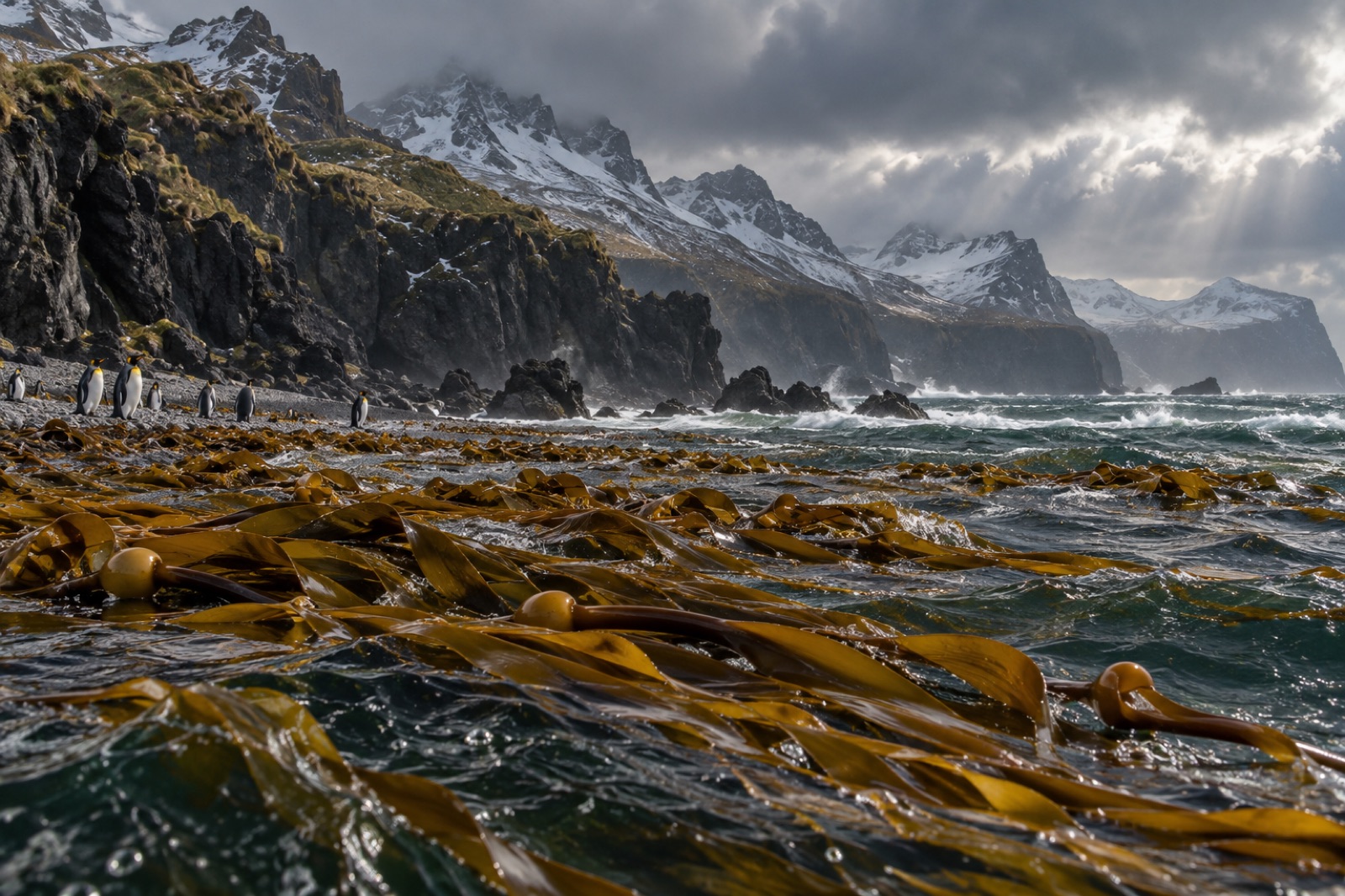
At Heard Island the kelp story is simple and magnificent. Giant kelp (Macrocystis pyrifera — the giant kelp species profile) forms extensive fringing beds around the island's shallow shelves, in depths mostly above ten to fifteen metres. In the absence of sea ice — Heard sits north of the pack-ice line most years — the kelp is free to do what it does best, and it anchors a lush, cold-water nearshore ecosystem in the most unforgiving weather on Earth.
Two features distinguish these forests from their northern relatives. First, purity: Heard and McDonald harbour no significant introduced marine species and no introduced land predators — genuinely one of the least altered island ecosystems on Earth. Second, adjacency to the ice: the island lies close enough to the sea-ice zone that ice-edge processes — meltwater, nutrient pulses, the bloom dynamics that follow the seasonal ice edge — shape the nearshore productivity that feeds the kelp and everything on it. A forest at the boundary of the frozen ocean.
HIMI's wildlife is full-fat subantarctic. Southern elephant seals breed on the beaches in their thousands; Antarctic fur seals, essentially extinct here after nineteenth-century sealing, have staged one of the great Southern Ocean comebacks and now crowd the beaches each summer. King penguins crowd the valleys in dense colonies; macaroni and gentoo penguins fill in; endemic Heard Island shags work the kelp fringe; albatrosses — wandering, black-browed, light-mantled and grey-headed among them — breed overhead. Black-faced sheathbills patrol the shore for scraps.
The kelp forest underlies all of it as habitat: sheltering young seals, concentrating the inshore fish the penguins feed on, and holding banks of invertebrate life that make every rocky substrate a garden.
Heard Island was discovered by an American sealer, John Heard, in 1853; McDonald by the British captain William McDonald the following year. The news brought the sealers fast. Within three decades the island's elephant seals had been so heavily hunted that the industry collapsed — a story the Southern Ocean repeats island by island, and which the history of the Macquarie Island occupation tells in its own Australian vividness. For much of the twentieth century the islands were largely left alone; brief Australian research stations operated into the 1950s, but the going was too hard and the returns too slim.
The modern era brings a different approach. The islands were inscribed on the UNESCO World Heritage List in 1997; the surrounding Heard Island and McDonald Islands Marine Reserve — declared in 2002 and since expanded to around 71,000 square kilometres — protects the water itself. The Patagonian toothfish fishery in the region's management zone operates under strict limits negotiated through CCAMLR, the treaty body governing Southern Ocean fisheries, but the islands' immediate waters are off-limits to fishing inside the reserve. Our explainer on marine protected areas sets that arrangement in its global context.
Research at HIMI is rare and logistically extraordinary. Scientific expeditions — notably the 2016 voyage that caught McDonald's active lava flows in progress and documented Mawson Peak's thermal emissions — run every few years at best. What they return is data almost impossible to get anywhere else: ecology unmodified by human vectors, glacier records at the edge of a changing ice sheet, and a working volcanic system you cannot contaminate with your presence because your presence is itself the only contaminant there.
For the kelp-restoration world, HIMI plays a benchmark role similar to Macquarie Island or Kerguelen: it shows what a Southern Ocean kelp forest looks like in an untouched state, and how quickly the adjacent Antarctic processes mature into spring productivity. That is a reference standard every repaired kelp forest elsewhere is implicitly measured against.
Essentially, no. There is no tourist landing, no shipping route, no infrastructure. Scientific voyages visit occasionally; a very small number of expeditionary climbers have stood on Mawson Peak. For the rest of us, the islands exist through expedition reports, satellite imagery and the images released by the Australian Antarctic Division — and that is exactly as intended. The right response to Heard Island is not going there; it is being glad the place exists, and supporting the treaty protections and the science that maintain it.
They are an Australian external territory, administered by the Australian Antarctic Division. They are not part of the Australian Antarctic Territory claim — they lie well north of it — but sit inside Australia's maritime jurisdiction.
Yes. Mawson Peak has been observed venting steam and producing thermal anomalies on several occasions; a 2016 expedition documented ongoing heat and small-scale eruption features. It is Australia's only active volcano.
Giant kelp (Macrocystis pyrifera), forming extensive shallow fringing beds around Heard Island. Its condition is of particular interest to science because the ecosystem around it has never been fished, farmed or invaded.
The UNESCO listing recognises the exceptional intactness of the islands' geology and biology: an active volcano with a glaciated summit, no introduced mammals, a recovered fur-seal population, and a near-pristine Southern Ocean ecosystem at the intersection of subantarctic and Antarctic waters.
In the flesh, realistically only as a member of a research expedition. Through images and expedition accounts, yes — the Australian Antarctic Division publishes material from each voyage, and the islands are well covered in subantarctic natural-history books and films.
A coastal atlas guide to the Kerguelen Islands — vast giant kelp beds at 49°S, elephant seals and king penguins, iron-fed blooms, and the wildest kelp wilderness few will see.
Tom Okafor ·
Macquarie Island's giant kelp forests became the first marine ecosystem listed as Critically Endangered on the IUCN Red List — a subantarctic warning in full view.
Dr. Theo Nakamura ·
Giant kelp beds ring the Crozet Islands beneath some of the greatest penguin and albatross colonies on Earth — a coastal atlas guide to France's remote subantarctic.
Dr. Mara Ellison ·