Encyclopedia8 min read
Giant Kelp (Macrocystis pyrifera): Species Profile
Giant kelp is the fastest-growing organism on Earth and the architect of undersea forests. Learn its biology, life cycle, range and why it matters.
Dr. Theo Nakamura ·
A coastal atlas guide to the Kerguelen Islands — vast giant kelp beds at 49°S, elephant seals and king penguins, iron-fed blooms, and the wildest kelp wilderness few will see.
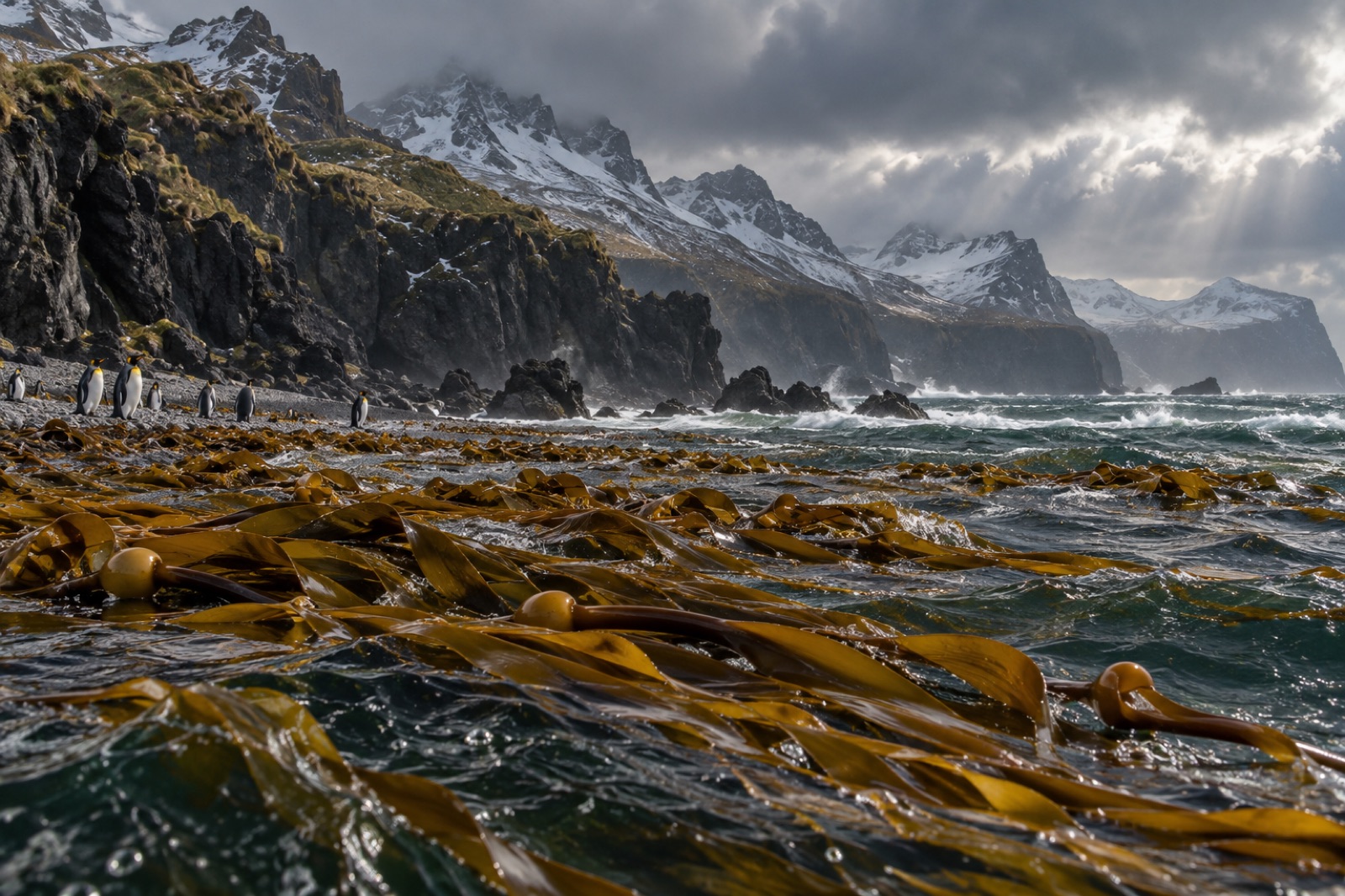
About three and a half thousand kilometres southeast of Madagascar — so far from anywhere that the nearest land is an uninhabited Australian island — an archipelago the size of Corsica rises out of the Southern Ocean. The Kerguelen Islands sit at 49°S, directly in the path of the Furious Fifties, lashed almost without pause by winds that have nothing to hit for ten thousand kilometres. And wrapped around their drowned, fjord-cut coasts is one of the great kelp landscapes on the planet: giant kelp beds on a scale that early French surveyors struggled to map, in water so productive that the ocean around the plateau turns milky-green with plankton every spring. This is the Southern Ocean's kelp heartland — and almost nobody will ever see it. Our Coastal Atlas covers its gentler southern cousins in the Falklands and Magellan.
Captain James Cook called them the Desolation Islands when he arrived in 1776, four years after the French navigator Kerguelen-Trémarec claimed them. The description was climatic, not ecological. The archipelago — some 300 islands around the main island, Grande Terre — belongs to France as part of the Southern and Antarctic Lands, and hosts a single permanent settlement: the research station of Port-aux-Français, whose population of scientists and support staff is the entire human presence across 7,200 square kilometres.
Underwater, the desolation reverses completely. The Kerguelen Plateau — a vast submarine rise of flood basalt, one of the largest igneous provinces on Earth — lifts the seafloor from abyssal depths to within a few hundred metres of the surface, and the archipelago's drowned coastline provides thousands of kilometres of rocky, shallow habitat in full sunlight and ceaseless current. Kelp arrived long ago, presumably as rafting plants on the Antarctic Circumpolar Current, and found a paradise: no trees, no people, no competitors, and a plateau-sized nutrient supply.
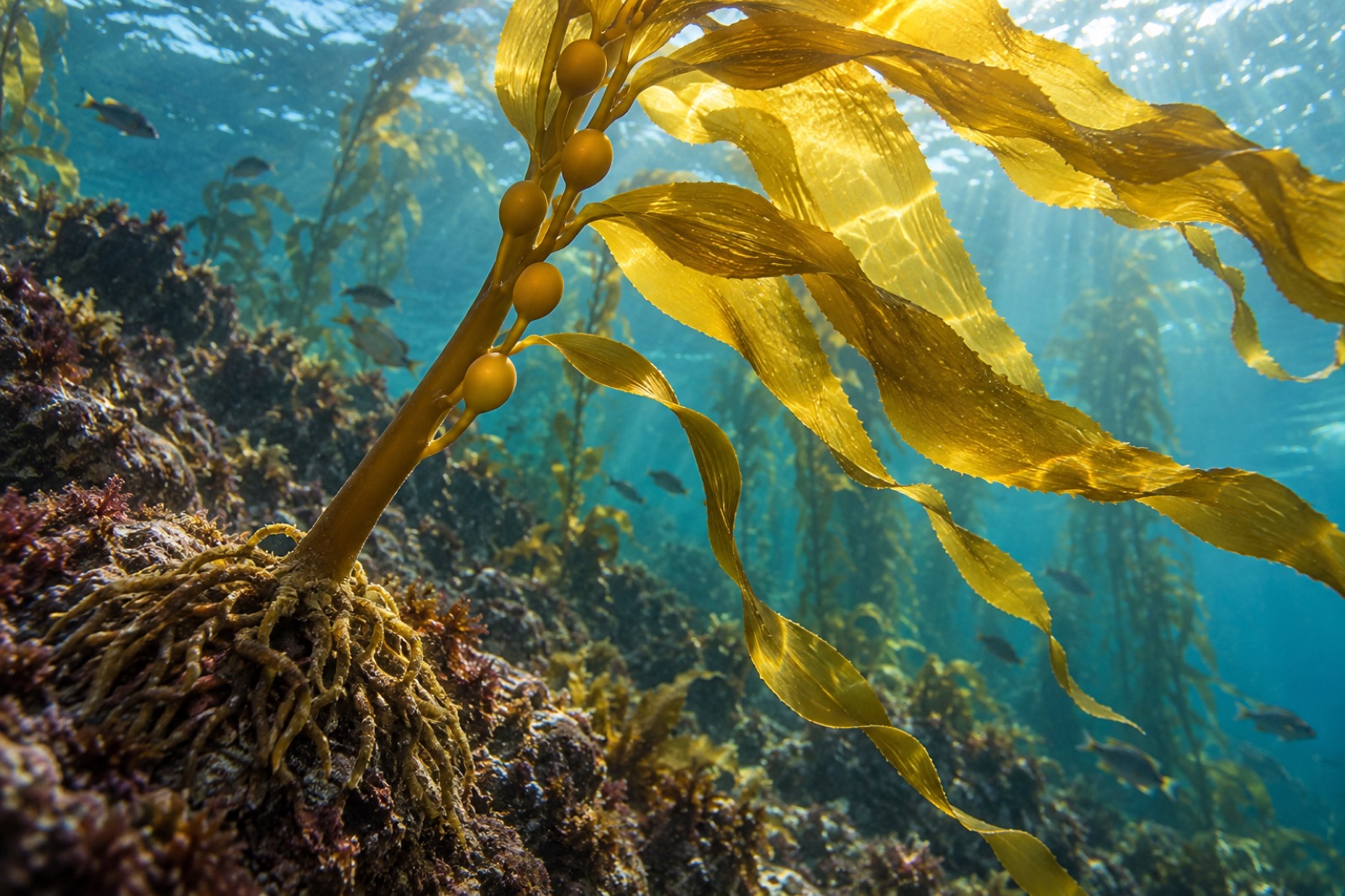
The dominant forest-former is Macrocystis pyrifera, giant kelp — the same species that builds the forests of California, Tasmania and the Falklands, but here at extraordinary extent. Classic French surveys described kelp beds fringing essentially every sheltered and semi-sheltered shore of the archipelago, in some bays forming rafts so continuous that small boats had to push through fronds to make soundings. Sub-Antarctic Kerguelen beds are regularly cited as among the largest on Earth; even allowing for the difficulty of surveying a coast this broken, satellite-era mapping confirms canopies of tens of thousands of hectares.
On the ocean-exposed outer coasts, where surf intensity defeats even Macrocystis, the fringe turns over to Durvillaea antarctica, the southern bull kelp — the honeycombed, leathery surf-specialist that grips wave-smashed rock across the sub-Antarctic rim. Between and beneath the two canopy species, the understory is thick with coralline crusts, red algae and an invertebrate turf of sponges, ascidians and bryozoans in water that rarely exceeds 6°C and never freezes.
The forest structure here is worth dwelling on, because it differs from the northern template. With no sea otters anywhere in the Southern Hemisphere and no sea urchin guild comparable to the Pacific's, Kerguelen's kelp is largely released from the top-down grazer control that dominates Pacific kelp trophic cascades. The forests are instead ruled from below — by light, swell, ice-free stability and the plateau's nutrient machine — which is part of what makes them scientifically precious: they are what kelp does when the ocean simply feeds it.
That feeding deserves its own section, because Kerguelen is one of oceanography's great natural experiments. The plateau's basalt releases iron — the trace nutrient that limits plankton growth across most of the Southern Ocean — into the surrounding water. Each austral spring the result is a phytoplankton bloom so large and so reliable that oceanographers have used it to study natural iron fertilisation for decades: one of the few places on Earth where you can watch ocean productivity turn on like a lamp, season after season.
That bloom rains carbon into the deep water off the plateau through the marine snow pipeline, and the kelp forests add their own stream: blades, stipes and uprooted whole plants torn free by the endless storms, shredded by wave action and exported offshore. How much of that kelp carbon reaches the deep sea and stays there is one of the live questions in blue-carbon science, and Kerguelen — enormous forests, extreme export conditions, deep water directly adjacent — is one of the planet's most important sites for answering it honestly rather than hopefully.
The human absence means the kelp coast doubles as one of the great wildlife shorelands of the Southern Ocean. Elephant seals haul out in colonies numbering in the tens of thousands around the north coast — Kerguelen holds a major share of the Indian Ocean population — and Antarctic fur seals, hunted to near-extinction in the nineteenth century, have recolonised so successfully that their howling colonies now crowd the beaches where sealers once worked. King penguins mass in colonies like Royal Bay's, their brown-chick creches a short walk from the kelp line, and albatrosses, petrels and the endemic Kerguelen shag work the canopy offshore. Inshore, an endemic subspecies of the Commerson's dolphin — black-and-white, dusky flippered, fearless — surfs the passes through the kelp beds.
It is worth noting one asterisk on all this: humans brought cats, rats, rabbits and mouflon to Grande Terre over the sealing and station eras, and predation on burrow-nesting petrels has been a genuine conservation wound — one modern sub-Antarctic management (as on New Zealand's Antipodes) works hard to avoid or undo.
Kerguelen's human story is short and mostly extractive. Sealers devastated the fur seal and elephant seal populations within a few decades of discovery; whalers used the bays; then came a century of French scientific presence, gradually consolidating at Port-aux-Français. In 2006 the entire French sub-Antarctic was folded into a national nature reserve — one of the largest protected areas on the planet, covering the territories' waters including Kerguelen — and management since has balanced a legal, quota-managed longline fishery for Patagonian toothfish in the deep waters offshore with strict protection for the shallow kelp coast itself.
The research station hosts a steady program of kelp, seabird and seal science, and — because the archipelago spans the Sub-Antarctic Front — some of the Southern Ocean's most valuable long-term ocean temperature records. Kerguelen sits where boundary currents collide and where ocean heat content change is registering most starkly; what happens to these forests over the next decades will be measured, which in the Southern Ocean is itself a rarity.
There is essentially no tourism. A supply ship makes the several-day voyage from Réunion a handful of times a year, carrying station staff, scientists and a quota of paying passengers with space booked years out. There are no hotels, no dive shops, no infrastructure beyond the station; landing elsewhere in the archipelago is regulated under the reserve. Kerguelen belongs to a tiny constellation of kelp coasts — South Georgia, Heard Island — that function less as destinations than as baselines: the natural world's own reference labs, held in trust.
If you want sub-Antarctic giant kelp with your own eyes and drysuit, the achievable versions are the Falklands, Tasmania's southern coasts, and Fiordland and the New Zealand sub-Antarctics — each extraordinary, none on Kerguelen's scale or solitude.
For a restoration-minded world, Kerguelen supplies three things no engineered forest can. It is a benchmark: proof of what kelp does, unharassed, given nutrients and time. It is a carbon laboratory: one of the few places where kelp-to-deep-sea export can be studied at full ecosystem scale. And it is a refuge: vast, protected, cold, and — as the Southern Ocean warms — likely to be one of the last places on Earth where giant kelp's only serious problem is the weather. That is the logic our own methodology borrows from: measure against the intact coasts that still exist.
Even conservative surveys put the canopies in the tens of thousands of hectares, and classic French mapping described kelp fringing essentially every sheltered shore of the archipelago — figures that routinely place Kerguelen among the largest kelp landscapes on Earth, and by far the largest in the Southern Ocean's Indian sector.
Giant kelp (Macrocystis pyrifera) forms the main canopy in sheltered to moderately exposed water, while southern bull kelp (Durvillaea antarctica) holds the surf-pounded outer coasts. Both are Southern Ocean-wide species; Kerguelen's distinction is their sheer continuity and biomass.
In practice, no — the only access is the supply ship from Réunion, several times a year, carrying station staff and a small number of passengers booked far in advance, with landing outside the station regulated by the reserve. It is one of the least-visited inhabited places on Earth.
The submerged plateau is ancient basalt, which leaches iron into surface currents; iron is the limiting nutrient across most of the Southern Ocean, so the Kerguelen region lights up with phytoplankton each spring. That bloom feeds everything from krill to whales and produces a heavy flux of marine snow and kelp detritus into deep water offshore.
Giant kelp is the fastest-growing organism on Earth and the architect of undersea forests. Learn its biology, life cycle, range and why it matters.
Dr. Theo Nakamura ·
Southern bull kelp (Durvillaea) grips the roughest surf coasts on Earth with the strongest holdfast of any kelp. Honeycomb blades, Māori pōhā, ocean rafting.
Dr. Theo Nakamura ·
Inside the Falkland Islands' giant kelp beds — among the most extensive on Earth — and the penguins, seals and steamer ducks that run on them.
Dr. Lena Fischer ·