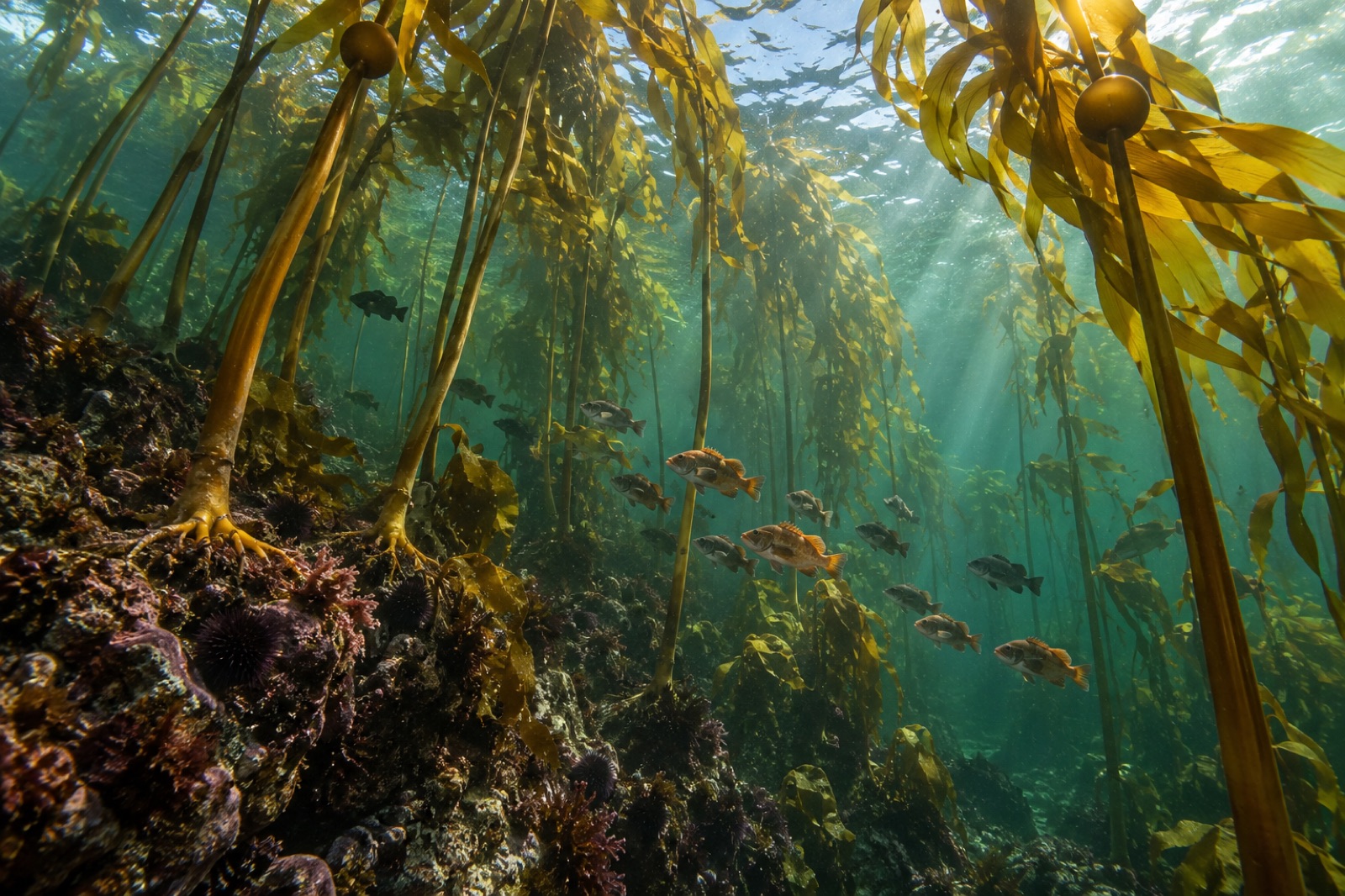
Stand on a wave-battered point in Otago or Stewart Island at low tide and you will see something that looks impossible: a forest growing where the surf hits hardest. Thick trunks rise from the lowest rocks, each splitting overhead into broad, leathery blades that crack and slap in the swell like wet sails. This is southern bull kelp — Durvillaea, called rimurapa by Māori — and it has solved one of the hardest engineering problems in the sea: how to grow large, fast and tall in the most violent water on a temperate coast.
Fast facts
|
|
| Scientific name |
Durvillaea genus; the widespread species is D. antarctica |
| Group |
Brown alga; order Fucales, family Durvillaeaceae — not a "true kelp" of the order Laminariales |
| Size |
Stipe and blade together commonly 5–10 m; holdfasts can exceed 30 cm across |
| Range |
Cool Southern Hemisphere: New Zealand, Chile, the subantarctic islands, the Falklands; D. potatorum in southern Australia |
| Habitat |
Low intertidal to shallow subtidal rock on heavily wave-exposed coasts |
| Status |
Not globally threatened, but locally hammered by marine heatwaves and earthquakes |
Not actually a kelp (and proud of it)
The first surprise is taxonomic. Almost everything we call kelp — giant kelp, bull kelp, kombu — belongs to the order Laminariales. Durvillaea does not. It sits in the Fucales, the order of rockweeds and sargassum, and its closest European relative is the humble bladder wrack of north Atlantic tide pools. The resemblance to a kelp forest is pure convergence: a seaweed lineage that independently discovered the holdfast, the stipe and the canopy.
That ancestry shows in its life cycle. True kelps alternate between a large leafy sporophyte and a microscopic gametophyte generation — the two-in-one life cycle that makes restoration possible. Durvillaea skips the microscopic generation entirely. Like a rockweed, the big plant produces eggs and sperm directly, they fuse in open water, and a tiny diploid blade settles and begins its climb back toward the light. Two very different blueprints, one identical outcome: a brown canopy shading a southern reef.
The strongest grip in the seaweed world
Everything about Durvillaea is engineering against wave force. A breaking wave is among the most destructive everyday forces in nature, and southern bull kelp plants sit exactly where the energy is greatest. Their answer is a holdfast without rival: a broad, conical dome of interwoven haptera — thick, root-like fingers — that keys into every crack and contour of the rock and keeps dividing and thickening as the plant grows. Old holdfasts become gnarled burls the size of dinner plates, stacking generations of new growth on the unbroken foundation of the old. Marine biologists who work on how kelp holds on regard Durvillaea as the benchmark: when the plant finally loses an argument with the sea, it is usually the rock that fails, the holdfast tearing away with its substrate still attached.
Above the holdfast, a short, dense stipe splits into blades with an astonishing internal architecture. In D. antarctica the blade tissue is honeycombed with air-filled chambers — a natural sandwich panel, light and strong like a bicycle helmet — which makes the heavy blades buoyant enough to lift in the flow and flexible enough to stream rather than tear. Several New Zealand species carry variations on the trick; D. poha inflates its blades outright, a fact Māori growers put to brilliant use.
Rimurapa: a plant woven into culture
For Māori, rimurapa was never scenery. The buoyant blades of Durvillaea were split, dried, softened and woven into pōhā — kelp bags used to store and transport preserved tītī (muttonbird chicks) and other foods sealed in fat, waterproof and airtight vessels made entirely from the sea's own material. The craft was skilled, widespread along the south, and deeply practical: a pōhā could keep its contents for months. Kelp also entered rope, sandals and shelter, and the association between southern coastal iwi and their rimurapa beds remains strong. On Rakiura / Stewart Island and along the reefs of Otago, the species is as much cultural heritage as wildlife.
Forest ecology: life in the impact zone
Because it occupies the harshest real estate on the reef — the low intertidal where other large algae are ripped out — a bull kelp band effectively adds a whole extra storey to the coast, between the true kelp forest below and the tide pools above. That canopy does quiet work. It dams and baffles swell, softening what arrives at the shore behind it in a miniature of the wave-damping service of big forests. Its holdfast burls are tenements for brittle stars, chitons, worms and small crabs, and its honeycombed blades house amphipod communities found nowhere else. When storms finally win, the torn plants wash ashore by the tonne and become wrack, subsidising beach hoppers, sandhoppers and shore birds along the pathways of drift-kelp ecology. Grazers take their share too: where urchins like kina reach it, bull kelp shows it, though its growing zone is usually too turbulent for urchins to settle in force — one reason the species persists where calmer-water kelps get eaten out.
A rafter of oceans
Here is Durvillaea's most romantic talent. Because the honeycombed blades float, a storm-torn bull kelp plant does not sink — it sails. Buoyant rafts of southern bull kelp, complete with living holdfast communities aboard, drift the Southern Ocean for months, and genetic evidence suggests this rafting is how the lineage recolonised the subantarctic islands after they were scraped by ice-age glaciers. In a genus with no drifting life stage and no long-lived spores, long-distance travel belongs to the adult plant itself. Rafts of Durvillaea remain a common sight around the Falkland Islands and the islands of the roaring forties and furious fifties, still green, still carrying passengers.
Heat, earthquakes and a fragile strength
For all its armour, southern bull kelp has vulnerabilities it cannot engineer away. It is a cool-water species, and the marine heatwaves now running around New Zealand's and Australia's southern coasts have damaged stands at the warm edges of its range — the same thermal pressure redrawing kelp maps everywhere. And in November 2016, the Kaikōura earthquake lifted a stretch of New Zealand's coast by up to several metres in seconds, stranding vast bull kelp beds above the tide; the die-off and slow recolonisation that followed became one of the most closely watched natural experiments in marine ecology. The recovery — young plants marching down the uplifted shore turn by turn — showed the species' other great strength: it recruits fast, grows fast, and wastes no time reclaiming empty rock.
That combination, frightening strength plus fast opportunism, is what makes Durvillaea such an instructive species for restoration thinking. You cannot soften the surf. But you can choose genetics, seasons and sites so the toughest plants win the argument with it.
Key takeaways
- Southern bull kelp (Durvillaea) is the dominant large alga on the most wave-exposed reefs of the cool Southern Hemisphere, from New Zealand to the Falklands.
- Despite the name it is not a true kelp — it belongs to the Fucales (rockweed) order and lacks the microscopic gametophyte generation of true kelps.
- Its multi-layered holdfast is the strongest attachment of any large seaweed; failure usually means the rock itself tears out.
- Honeycombed, air-filled blades give buoyancy and strength, and let storm-torn plants raft entire invertebrate communities across the Southern Ocean.
- Māori weave inflated D. poha blades into pōhā, traditional storage bags — a deep cultural bond with the species.
- Marine heatwaves and events like the 2016 Kaikōura uplift have cost local stands, but the species is a rapid recycler of bare rock and a model for resilience.
FAQ
Is southern bull kelp the same as bull kelp?
No. Northern bull kelp (Nereocystis luetkeana) is a true kelp with a long whip-like stipe and a single big float, found from California to Alaska — see our bull kelp profile. Southern bull kelp (Durvillaea) is a Fucales alga with branching leathery blades and no float bladder; the shared name reflects a shared lifestyle, not kinship.
Can you eat southern bull kelp?
Yes, and New Zealand firms harvest it for food, fertiliser and nutraceutical products. Blades are thick and strong-flavoured, so it is more often dried, flaked or processed than eaten fresh. As with any large brown alga, moderation matters — its iodine content can be high, and harvest is regulated in many areas.
How fast does southern bull kelp grow?
Very fast for its bulk. Juveniles on cleared rock can put on metres of frond growth in a single good season, and mature plants replace storm-torn blade tissue continuously. Combined with its tough holdfast, this lets it dominate the one habitat where growth speed alone is never enough.
Why does it grow in the surf zone instead of calmer water?
Because it can, and its competitors cannot. The low, surf-pounded rim of the reef is lethal to most large algae but ideal for a plant with Durvillaea's grip and flexible blades. It also escapes the worst of the urchin grazing that removes calmer-water species.
Where can I see it?
Almost any exposed rocky point in southern New Zealand — the Catlins, the Otago Peninsula, Stewart Island — as well as surf coasts in Tasmania and southern Australia (as D. potatorum), Chile and the Falklands. It is obvious from dry land at low tide: look for the dark, thrashing band just below the tide pools.