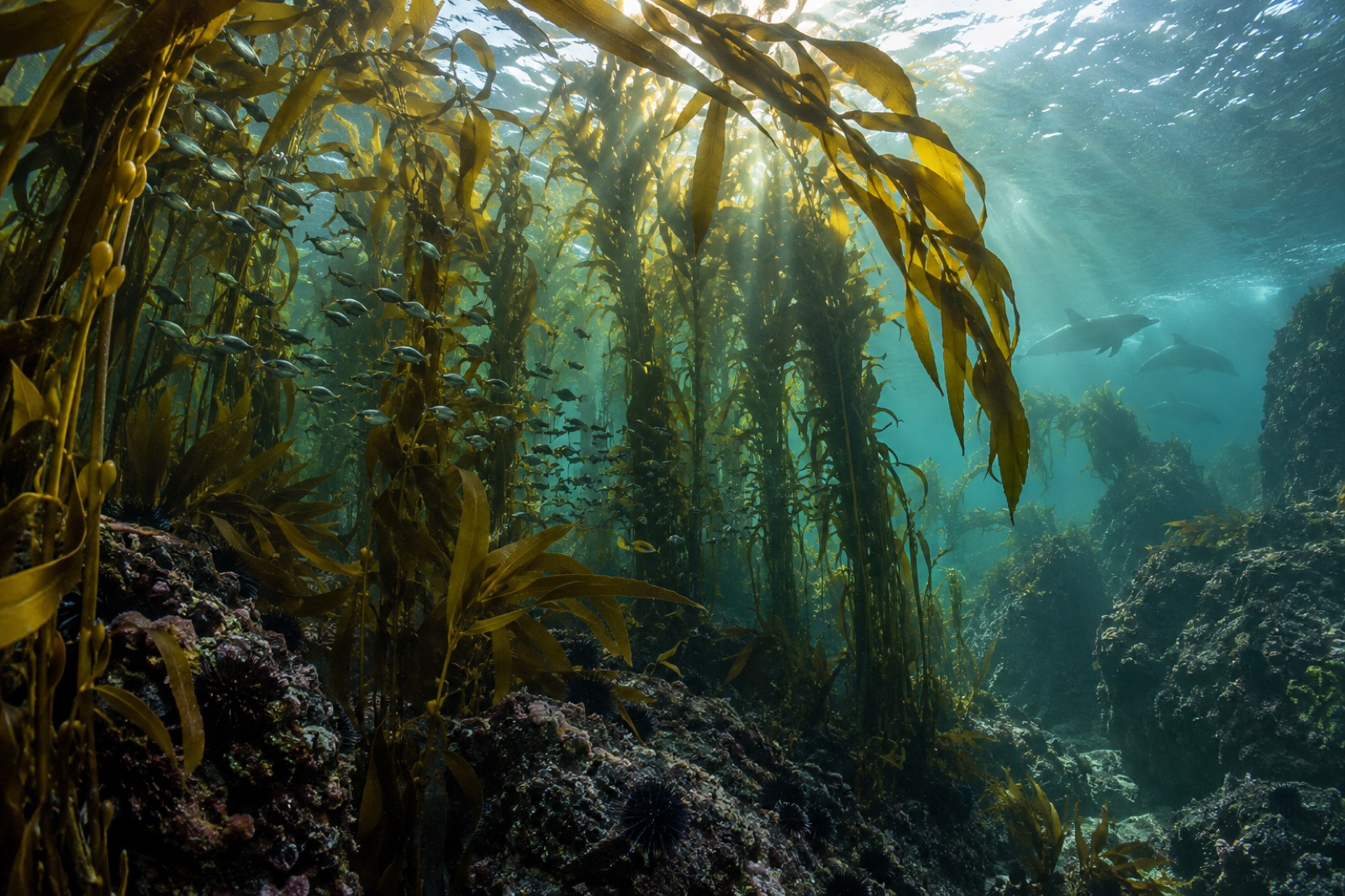
Ask most people to picture the world's great kelp forests and they will name California, or maybe Tasmania. Ask a kelp scientist where the biggest beds might actually be, and a surprising number will point to a windswept archipelago in the South Atlantic, 480 kilometres east of Patagonia. The Falkland Islands — two large islands and hundreds of smaller ones, home to around 3,500 people and more penguins than any nation on Earth — are ringed, almost everywhere the bottom is rocky, by giant kelp. Some researchers believe the Falklands may hold the world's largest continuous expanse of Macrocystis forest. Even the cautious estimates place these beds among the planet's great kelp systems.
This guide explains why Falkland kelp is so abundant, what it feeds, what it might mean for climate, and why these islands matter to the future of Southern Ocean conservation.
Why the Falklands grow so much kelp
Giant kelp wants four things: cold water, nutrients, hard bottom and light. The Falklands supply all four in abundance.
Cold, stable water
The islands sit in the cool temperate-to-subantarctic band of the South Atlantic, bathed by the cold Falklands Current — a branch of the circumpolar flow that keeps sea temperatures in roughly the 4–10 °C range through the year. That is squarely in giant kelp's comfort zone, and stable enough to allow big, long-lived plants.
Nutrients on tap
The South Atlantic sector is nutrient-rich, and the shallow shelf around the archipelago — wide, rocky and windswept — keeps the water column mixed and fertilised. Wind that makes life hard for humans is a gift to kelp: it stirs the nutrients to the surface where the light is.
Hard bottom everywhere
These are rocky islands in the way Tasmania or Scotland is rocky — glacially scoured, granitic in places, with endless clean hard substrate in the shallow subtidal zone. Every kelp plant begins by anchoring itself to rock; our explainer on holdfast biology describes the attachment that makes this possible. In the Falklands, there is no shortage of rock.
Long summer days
At 51–53°S, summer daylight is extraordinary — more than sixteen hours around the December solstice. For a photosynthesising forest, that is a long growing day in clear, cold water. The growing season is short, but it is intense.
A forest with inhabitants: the wildlife economy
The Falklands are famous on land for their penguin colonies and albatross. But much of that fecundity is fuelled, directly or indirectly, by what grows offshore.
The kelp-forest food web
Giant kelp beds trap nutrients, buffer wave energy and build three-dimensional habitat, and in the Falklands they support dense communities of fish, squid, octopus and grazing invertebrates. Sea lions and southern fur seals hunt through the canopy lanes; Commerson's and Peale's dolphins patrol their edges; and the storms that tear kelp loose deliver immense quantities of wrack to beaches, where it fuels a rich strand-line ecosystem.
Among the forest's most charismatic specialists:
- Kelp geese — the female boldly patterned in brown and white, the male pure white — graze directly on kelp fronds at low tide, one of the few birds on Earth that eats seaweed as a staple.
- Falkland steamer ducks — heavy, flightless, comically powerful — thrash through the kelp shallows for molluscs and crustaceans.
- Gentoo penguins — the Falklands hold one of the largest gentoo populations anywhere — weave through kelp-fringed bays on their commute between colony and sea.
- Black-browed albatross, breeding here in immense colonies, feed over the productive shelf the kelp helps make.
An evening zodiac ride along a kelp bed, with geese grazing the fronds and dolphins surfing the canopy channels, is one of the great quiet spectacles of the Southern Ocean.
Blue carbon: the Falklands' quiet superpower
Kelp carbon has become a global talking point — our primer on how kelp stores carbon gives the science in full. The short version: kelp grows fast, fixes carbon fast, exports much of its production offshore as drift and dissolved particles, and some fraction of that carbon reaches the deep ocean, where it can stay for centuries, sediments sequestering what they bury.
The Falklands are a natural candidate for this pathway at scale. The combination of enormous standing kelp biomass, persistent storm action liberating drift material, deep water nearby, and a shelf that funnels material toward the Argentine Basin makes the archipelago potentially one of the planet's most important natural kelp-carbon exporters.
Researchers working in the islands have begun measuring this — carbon fluxes from the kelp beds, sedimentary sequestration around the coasts, and the contribution of kelp-derived carbon to deep-sea food webs. The numbers are still being refined, but the picture is of a system whose climate significance may rival its wildlife significance.
A shoreline above the politics
Any honest piece about the Falklands acknowledges the sovereignty dispute between the United Kingdom and Argentina. But the ocean has no politics, and neither does the kelp. The forests form a single ecological unit with the giant kelp beds of Patagonia, linked by currents and drifting kelp rafts — part of the Southern Ocean connectivity network described in our guide to the Strait of Magellan.
Environmental science on the islands has been a persistent bright note: Falklands-based and visiting researchers have built an increasingly detailed picture of the kelp system, mapping beds from satellite and boat, tracking wildlife that depends on them, and establishing the baselines that any future protection or restoration would need. The waters are largely unexploited — there is virtually no commercial kelp harvest — a rare baseline condition in a world where most kelp coasts are heavily worked.
That intactness also makes the islands a natural reference site for restoration projects elsewhere, including the survey-and-reseed methodology that Tidewright's Drifter vessels are built to perform: before you can restore a forest, you should know what a healthy one looks like, in detail. The Falklands offer one of the clearest reference points left on the planet.
Threats on the horizon
Even here, nothing is static. The pressures facing Falkland kelp:
- Regional warming. The South Atlantic is warming, and while the Falklands' latitude offers some buffer, the surrounding ocean is not immune to the trends described in our marine heatwaves explainer. Warm anomalies have already touched Patagonian shelf waters.
- Invasive species risk. Island ecosystems are vulnerable, and shipping traffic is a permanent vector. Non-native species arriving on hulls or floating debris could alter community structure; biosecurity is a live scientific priority.
- Oil and fishing pressures. The surrounding shelf supports significant squid and finfish fisheries, and hydrocarbon exploration has been a recurring possibility. Any industrialisation of the shelf would add pressure to an ecosystem currently pristine by world standards.
- Baseline gaps. For all the recent research, huge stretches of Falkland coast have never been diversely surveyed. What we don't know about this system still exceeds what we do.
Visiting: what a traveller can actually see
The Falklands are remote but not unreachable — flights from South America and the UK serve Mount Pleasant, and expedition ships on Antarctic itineraries frequently call. For the kelp-minded visitor:
- Wildlife-focused island stays are the heart of Falklands tourism. Lodges on outer islands put you above penguin colonies and sea lion beaches where the offshore kelp beds are a constant presence, their canopy lanes patrolled by dolphins.
- Boat days on calm weather windows reveal the forests from the surface: giant kelp fronds streaming at low tide, Commerson's dolphins riding the bow, kelp geese working the waterline.
- Shore walking around Stanley and the settlements passes kelp-strewn beaches where the wrack piles in windows deep enough to hide a person — strand-line ecology at full volume, with striated caracaras picking it over.
There is no dive tourism industry to speak of — this is expedition territory, with cold water and serious logistics — but the surface show is richer than most dive destinations anyway. Travellers interested in responsible wildlife watching can carry over the principles in our guide to watching sea otters without bothering them: distance, patience and no approach.
Key takeaways
- The Falkland Islands are ringed by giant kelp beds that may constitute the largest continuous Macrocystis system on Earth.
- Cold Falklands Current water, nutrient-rich mixed shelf seas, endless rocky bottom and long summer days create near-ideal kelp conditions.
- The forests support an outsized wildlife economy: penguins, albatross, sea lions, dolphins, kelp geese and steamer ducks all run on kelp productivity.
- The islands may be one of the world's most significant natural kelp-carbon exporters — drift, burial and deep-sea export at scale.
- The system is ecologically continuous with Patagonia via drift and currents, largely unharvested, and increasingly well-studied.
- Threats are real — warming, invasive species, industrialisation — but the intactness of Falkland kelp makes it one of the planet's great reference ecosystems.
FAQ
Are the Falkland Islands' kelp beds really the largest in the world?
Some researchers believe the Falklands hold the largest continuous expanse of giant kelp anywhere, based on satellite and field mapping carried out in recent years. Precise rankings are still being refined as global kelp mapping improves, but the Falklands are unambiguously among the world's great kelp systems.
What is the Falklands Current?
The Falklands (Malvinas) Current is a cold northward-flowing branch of the Antarctic Circumpolar Current that runs along the Patagonian shelf. It keeps Falklands waters cold and nutrient-flushed — core conditions for giant kelp — and is part of the larger circulation connecting Patagonia, the islands and the Southern Ocean.
Do people harvest kelp in the Falkland Islands?
Essentially no — there is virtually no commercial kelp harvest in the islands today. The beds function as an intact, natural system, which makes them scientifically valuable as a reference ecosystem and adds to the case for their protection.
Can tourists see the kelp forests?
Yes. Most visitors encounter the forests from boats, beaches and clifftops: streaming fronds at low tide, dolphins in the canopy lanes, kelp geese and steamer ducks at the waterline, and enormous storm-cast wrack piles on beaches. There is no local dive industry, so surface encounters are the norm — and they are extraordinary.
Why do Falkland kelp beds matter for climate?
Fast-growing giant kelp fixes carbon rapidly; storms liberate much of it as buoyant drift; and nearby deep water offers pathways for that carbon to reach the deep ocean and sediments. Scientists suspect the archipelago is among the most important natural exporters of kelp carbon on the planet, though measurement of the full pathway is ongoing.