Atlas8 min read
The Sonoma Coast: After the Bull Kelp
Sonoma's coast lost most of its bull kelp a decade ago. A guide to the collapse, the abalone closure, and where the forest is quietly returning.
Jack Callum ·
Gerstle Cove in Salt Point State Park is Sonoma's signature shore dive — bull kelp, red abalone and sculpted sandstone reefs in one of California's first marine reserves.
Gerstle Cove is a small, steep-walled notch in the sandstone of Salt Point State Park, an hour and a half north of San Francisco on Highway 1 — and one of the most historically important dives in California. The cove's underwater park, established among the state's first marine reserves in the early 1970s, has been no-take for five decades, and it shows: abalone still pavement the walls where they have vanished from fishermen's memory further out, and in good years the bull kelp stands tall enough to filter the light into cathedral rays. It is also, honestly, a demanding dive — cold, surgy and committed. This guide is everything you need to earn it.
Note the moment: this coast lived through one of the great reef collapses of the century, detailed in our Sonoma Coast atlas guide. What follows is how the site dives now, in the partial recovery.
Gerstle Cove sits nearly at the park's southern end, below the main campground. A concrete boat ramp — shared with the abalone-era kayaks and skiffs that no longer have a fishery to launch for — runs into a narrow inlet between sandstone headlands. The geology is the pleasure: Salt Point's famous tafoni, honeycomb-eroded sandstone, continues underwater as sculpted walls, arching overhangs and undercut ledges.
The dive divides naturally into three zones:
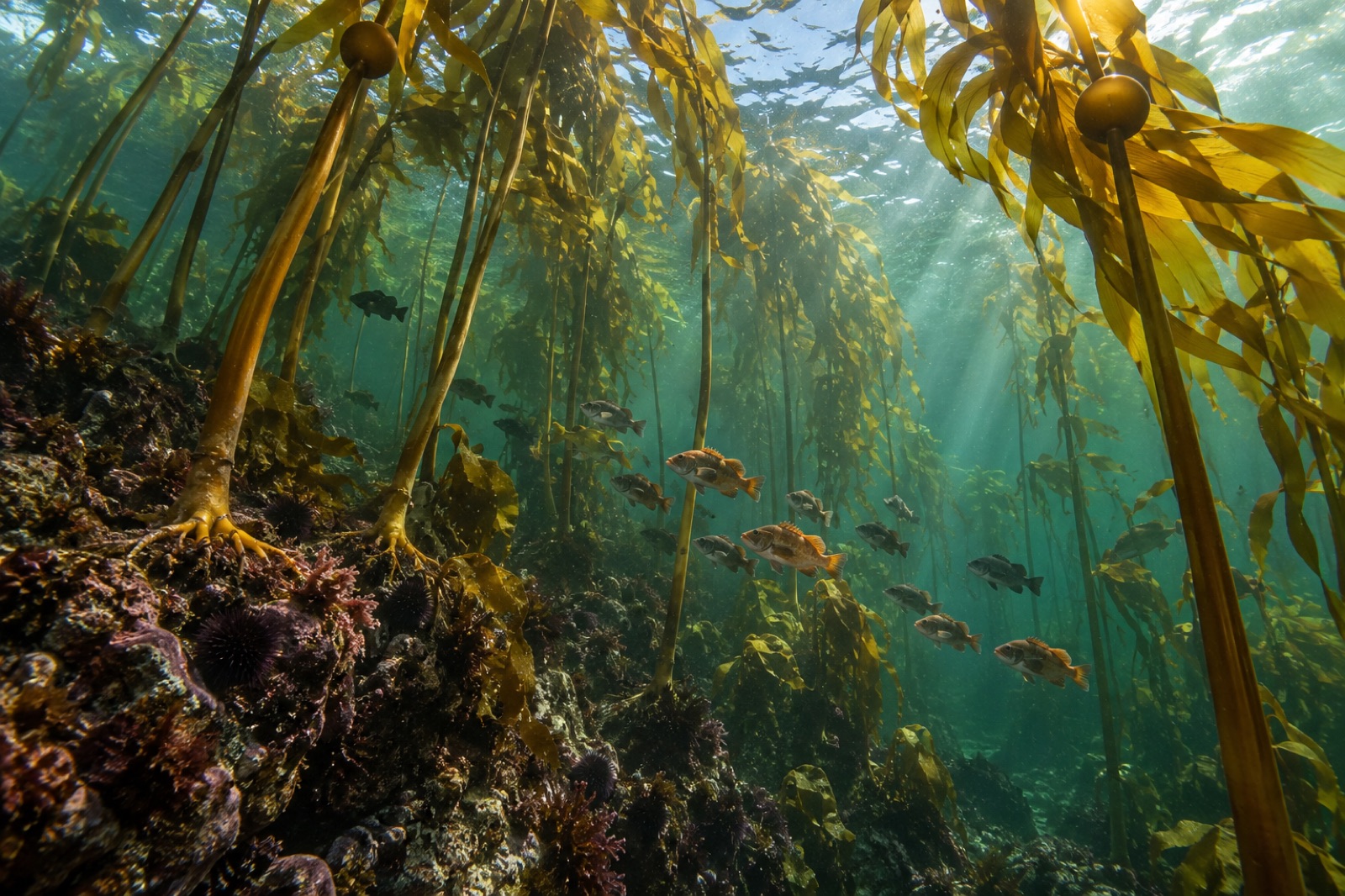
Bull kelp (Nereocystis luetkeana) is the emotional centre of the dive — an annual that rockets up through the summer and makes Gerstle feel like a forest from July to the first big storms. Its fortunes here have been hard; read its whole extraordinary biology in our bull kelp species profile.
The reserve's age makes the invertebrate life unusually confident. Red abalone, extinct-feelingly rare across most of their former recreational range, still stack in crevices at Gerstle — the reason the cove was protected in the first place. Red urchins hold the deeper ledges; ochre stars have returned in number after the wasting years; the ornate sponge-and-zoanthid walls on the outer reefs reward slow finning. Fish are the honest Sonoma list: blue rockfish schools over the kelp, kelp and painted greenling on the walls, big-bodied lingcod glaring from between boulders, and cabezon guarding egg masses on the flat rock.
Any honest account of diving this coast must name the purple urchin. The crash sequence — marine heatwave, sunflower-star epidemic, kelp collapse, then an explosion of starved purple urchins converting reef to barrens — unfolded here between 2014 and 2017, with canopy losses across Sonoma and Mendocino that surveys put above 90 per cent. Our explainer on urchin barrens carries the detail of that crash sequence; the atlas guide to the Sonoma Coast sets it in the coast's longer story. Inside Gerstle's protected cove the reef held better than most, and recent years with cooler water plus organised urchin removal efforts have let kelp regain real ground in places — but you will still dive past patchy barrens on the way in from the outer reefs. Think of it as reading the recovery live.
Best season: autumn — September through November — when the northwest wind machine relaxes, swell runs small, and the kelp is at full height before the first winter storms strip it. Summer offers long days but upwelling-fog, colder-feeling water and the most wind. Winter is for storm days spent watching from the headland.
Park and reserve. Salt Point State Park charges day-use fees; Gerstle Cove Marine Reserve is strictly no-take within its boundary — no collecting of anything, including empty shells. North of the cove within the park's marine conservation areas, limited take rules apply to licensed fishermen; boundaries are marked on park maps and worth studying before you dive outside the cove. Note that the recreational red abalone season coast-wide has been closed since 2018 and remains closed, repeatedly extended while managers wait for the kelp ecosystem to recover — a closure this site lets you see the reasons for with your own eyes.
Facilities. A rough car park, the ramp, and picnic tables; tanks and food come from town — the nearest reliable fills and rental gear are back south toward Bodega Bay or inland toward Santa Rosa, so arrive fully self-sufficient. Mobile coverage is unreliable on this stretch of coast; leave a float plan with someone.
Pairing. Stillwater Cove to the south and Ocean Cove just south of the park make natural second days; northward, the Mendocino coast's deeper story continues up Highway 1.
It is an intermediate-to-advanced cold-water shore dive. The protected inner cove is manageable, but reaching the best reef means timing surge through the cove mouth and handling a cobble and ramp entry in surf gear. Cold-water training and solid buoyancy are prerequisites; guided local dives are a wise first visit.
Not from Gerstle Cove — it is a fully no-take marine reserve. North of the cove, some limited take zones exist within the park for licensed fishermen, but the recreational red abalone fishery has been closed since 2018 and remains closed. Always check the current regulations and zone boundaries before diving with any intent to collect.
Late summer through autumn, roughly August to November, when the annual bull kelp has reached full height and before the first big winter storms strip it from the rocks. A calm autumn day here is the Sonoma Coast at its most beautiful.
On genuinely calm days the inner cove works for confident cold-water snorkellers, with kelp, greenling and invertebrate walls in shallow water — but the surge exposure at the mouth and beyond is unforgiving. Treat it as a dive-first site and stay inside the cove's protection in anything but the flattest forecast.
Sonoma's coast lost most of its bull kelp a decade ago. A guide to the collapse, the abalone closure, and where the forest is quietly returning.
Jack Callum ·
Meet bull kelp, the fast-growing annual giant of North America's Pacific coast — its biology, Indigenous heritage, dramatic decline and the race to restore it.
Dr. Mara Ellison ·
Meet the world's largest abalone — a kelp-eating giant sea snail of the Pacific coast. Its biology, fishery history and the road to recovery.
Dr. Theo Nakamura ·