Atlas7 min read
Mendocino: Life on the Lost Bull Kelp Coast
A field guide to Northern California's bull kelp collapse — the heatwave, the urchin explosion, the closed fisheries, and the difficult road back.
Dr. Mara Ellison ·
Sonoma's coast lost most of its bull kelp a decade ago. A guide to the collapse, the abalone closure, and where the forest is quietly returning.
North of the Golden Gate, California's coast changes character. The crowds fall away, the fog thickens, and Highway 1 climbs onto one of the most kelp-dependent shorelines in the world. Sonoma County's coast — from Bodega Head to the Gualala River — lost more than nine-tenths of its bull kelp canopy in the great collapse of 2014–2016, and its signature dive fishery, the recreational red abalone hunt, closed with it. That much you may know. The newer story, the one this guide is really about, is that Sonoma is where the first honest signs of return are showing: bull kelp stands re-anchoring at Fort Ross and Timber Cove, abalone persisting in protected coves, and a coastline teaching the whole field what recovery actually looks like.
Sonoma's roughly 90 kilometres of coast divides in two. South of the Russian River mouth at Jenner, Bodega Head juts west into the upwelling plume, a granitic cape with sandy coves and the marine lab country of the UC Davis Bodega Marine Laboratory. North of Jenner, the coast tightens into classic Sonoma: marine terraces, pocket beaches, and sandstone reefs cut into underwater benches — Fort Ross Cove, Timber Cove, Stillwater Cove, Ocean Cove, and finally The Sea Ranch up near the county line.
The kelp here is bull kelp, Nereocystis luetkeana — the annual that grows twenty metres in a single season and must do it again from spores every year. Above the reef, the coast is a quilt of kelp-line reading: on a calm spring morning you can stand at the Russian River overlook and count canopy patches all the way to Fort Ross.
Two landmarks anchor the human geography. Salt Point State Park protects Gerstle Cove, a marine reserve that was the beating heart of the recreational abalone fishery — tens of thousands of diver-days a year, families free-diving for dinner in 11-degree water. Fort Ross State Historic Park sits on the coast's oldest foreign footprint, the Russian-American Company's 1812 outpost — and, more relevantly now, on a reef where kelp recovery has been watched and worked toward longer than almost anywhere on the north coast.
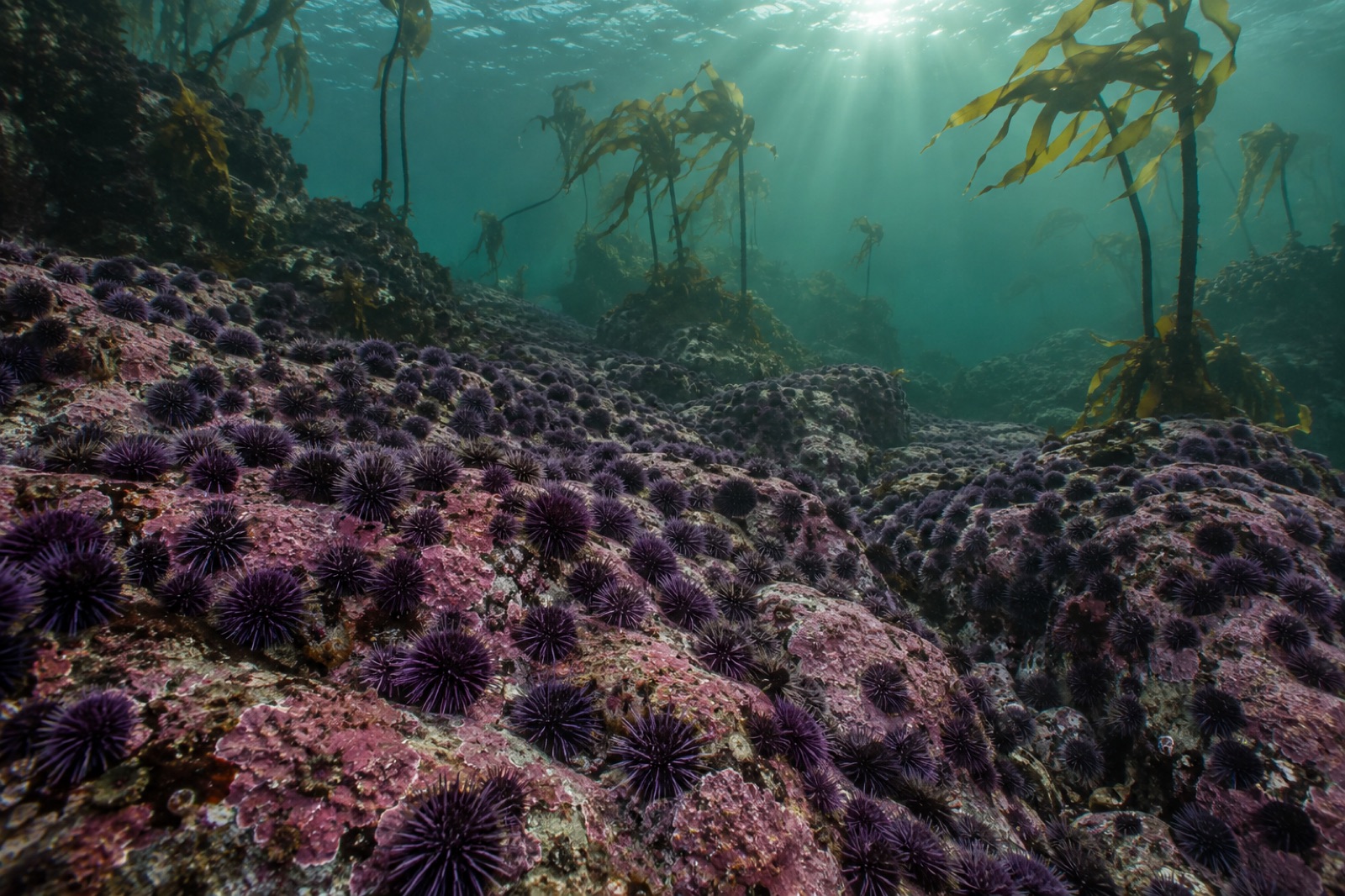
The full sequence — sea star wasting disease, then the 2014–2016 "Blob" marine heatwave, then the purple urchin explosion — is told in our Mendocino atlas piece, and it ran here too. Sonoma's version was the same catastrophe at the county scale: bull kelp canopy falling over 90 percent between 2013 and 2018 by aerial survey, purple urchin densities climbing into the dozens per square metre, and reef flats turning from forest to lawn.
What shocked even veteran divers was the speed. Bull kelp can vanish between one autumn's storms and the next spring's surveys. By 2014, coves at Gerstle and Fort Ross that locals knew as dense kelp were visibly open water. The urchins, starved of kelp, simply held position on the reef and mowed down everything that tried to grow.
The loss was not just botanical. Bull kelp scaffolds a food web — juvenile rockfish, abalone, crabs, the birds and baitfish — and when it goes, the reef's carrying capacity for nearly everything contracts. On Sonoma's reefs that contraction became a closure.
The recreational red abalone fishery on the Sonoma-Mendocino coast was one of the last great public hunt-for-dinner traditions in America. Divers parked along Highway 1 pullouts at dawn, free-dived in wetsuits, and came up with a single snail the size of a dinner plate — the strict one-per-day, no-scuba rule made it an egalitarian fishery. Economists put its regional value at roughly $44 million a year before the closure.
When the kelp went, the abalone literally began to starve. Surveys documented body condition collapsing in abalone at Gerstle Cove and elsewhere; the animals shrank inside their shells. In December 2017 the California Fish and Game Commission closed the fishery for 2018, and closures have rolled on since. The dive shops, the campgrounds, the abalone cook-offs — an entire subculture went quiet.
The closure matters to this atlas for two reasons. First, it removed the last legal pressure on wild red abalone in the region, which may become important if recovery continues. Second, it made visible something kelp science always knew: the forest is not scenery, it is the fishery's infrastructure. Our red abalone profile tells the species' story; Sonoma tells its economy's.
Here is the update the collapse headlines missed. Beginning around 2019–2020, aerial and shore surveys by state and university researchers began picking up patchy bull kelp returns — notably more on the Sonoma coast than in harder-hit Mendocino. Restoration divers and photographers documented young stands re-anchoring at Fort Ross Cove, Timber Cove and Stillwater Cove; by 2022–2024 some of those patches had persisted across multiple seasons.
Why Sonoma first? Several honest hypotheses:
The barrens, though, are not gone. Most of Sonoma's reef remains purple-urchin pavement. The recovery is patch-scale: coves where removal is sustained, upwelling is strong, and luck holds. No scientist working this coast will promise the whole forest returns; what they will say is that Sonoma now shows the recovery mechanism working in the wild, at every stage from bare reef to young stand.
If you visit — and you should — go with realistic eyes. This is not the kelp cathedral of the Channel Islands; it is a coast in transition.
Getting in the water here is for the prepared: 10–13°C, real swell, and barrens that are surge-prone and shallow. Our cold-water diving essentials and snorkelling safety in kelp country pieces apply in full.
No. The recreational red abalone fishery was closed beginning with the 2018 season and the closure remains in effect; the animals' body condition collapsed when the kelp they graze disappeared. The reef reserves — Gerstle Cove especially — are nonetheless excellent places to visit, tidepool and learn.
Yes, at patch scale and with real caveats. Multi-season bull kelp stands have re-established at Fort Ross, Timber Cove and nearby coves since about 2020, particularly where purple urchin culling has been sustained. Most of the coast remains barren; the recovery is a foothold, not a reforestation.
A stacked event: sea star wasting disease removed the coast's great urchin predator (2013–14), the marine heatwave known as the Blob stressed the kelp (2014–16), and purple urchins then exploded, mowing down regenerating kelp. Our Mendocino piece walks the sequence; the science is covered in marine heatwaves 101.
Not permanently, but stubbornly. Starved purple urchins can persist for decades on drift scraps, outcompeting juvenile kelp. Demonstration-scale culling at Fort Ross and elsewhere shows kelp recruiting back within a season or two of sustained removal — which is why the recovery is patch-shaped.
Summer through early autumn for the kelp canopy at its fullest; late autumn for the first winter storms on the bluffs. Check state park pages for current tidepool rules and any marine reserve site regulations.
A field guide to Northern California's bull kelp collapse — the heatwave, the urchin explosion, the closed fisheries, and the difficult road back.
Dr. Mara Ellison ·
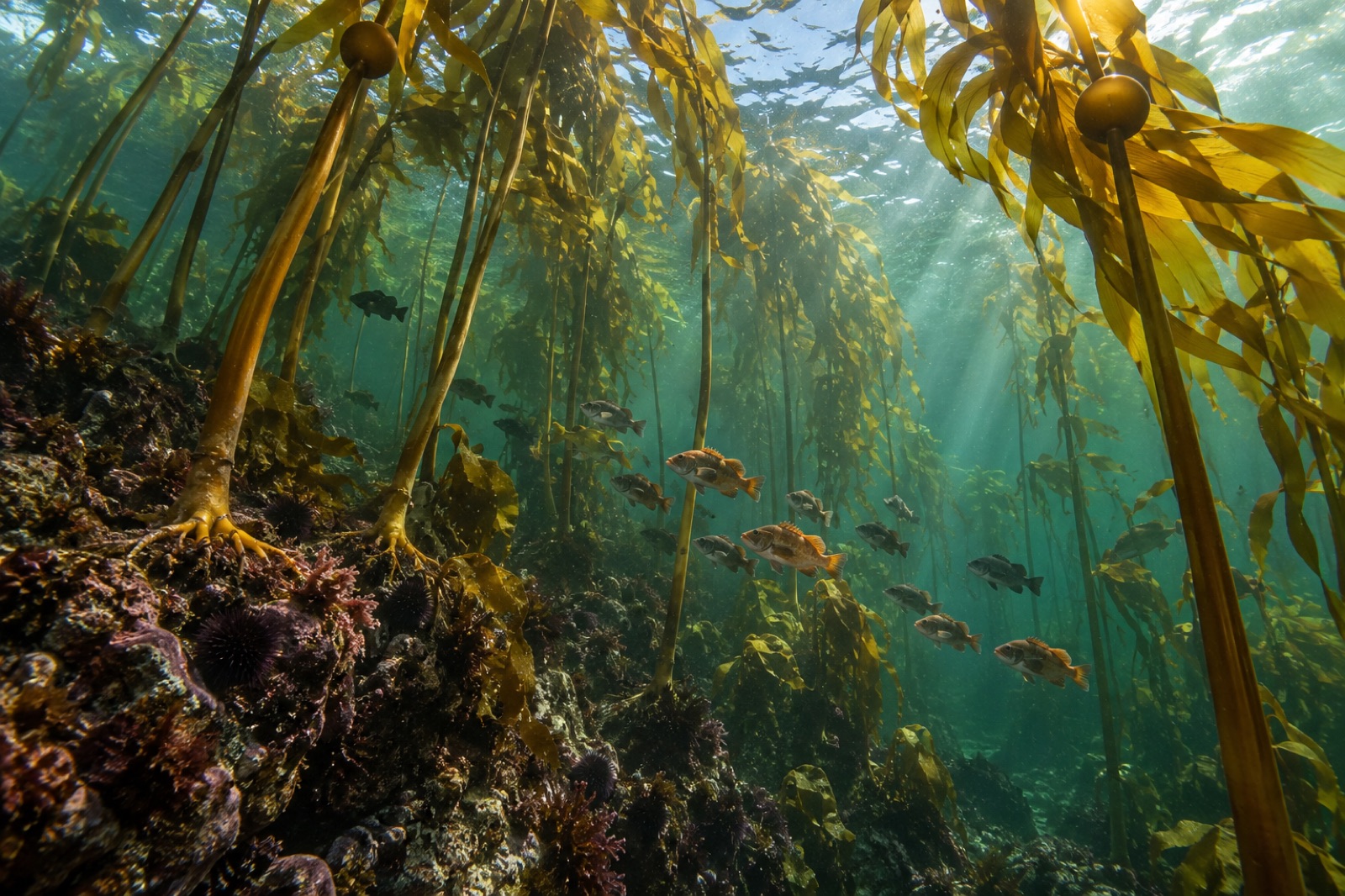
Meet bull kelp, the fast-growing annual giant of North America's Pacific coast — its biology, Indigenous heritage, dramatic decline and the race to restore it.
Dr. Mara Ellison ·
Meet the world's largest abalone — a kelp-eating giant sea snail of the Pacific coast. Its biology, fishery history and the road to recovery.
Dr. Theo Nakamura ·