Atlas9 min read
Falkland Islands: The Engine of Southern Ocean Kelp
Inside the Falkland Islands' giant kelp beds — among the most extensive on Earth — and the penguins, seals and steamer ducks that run on them.
Dr. Lena Fischer ·
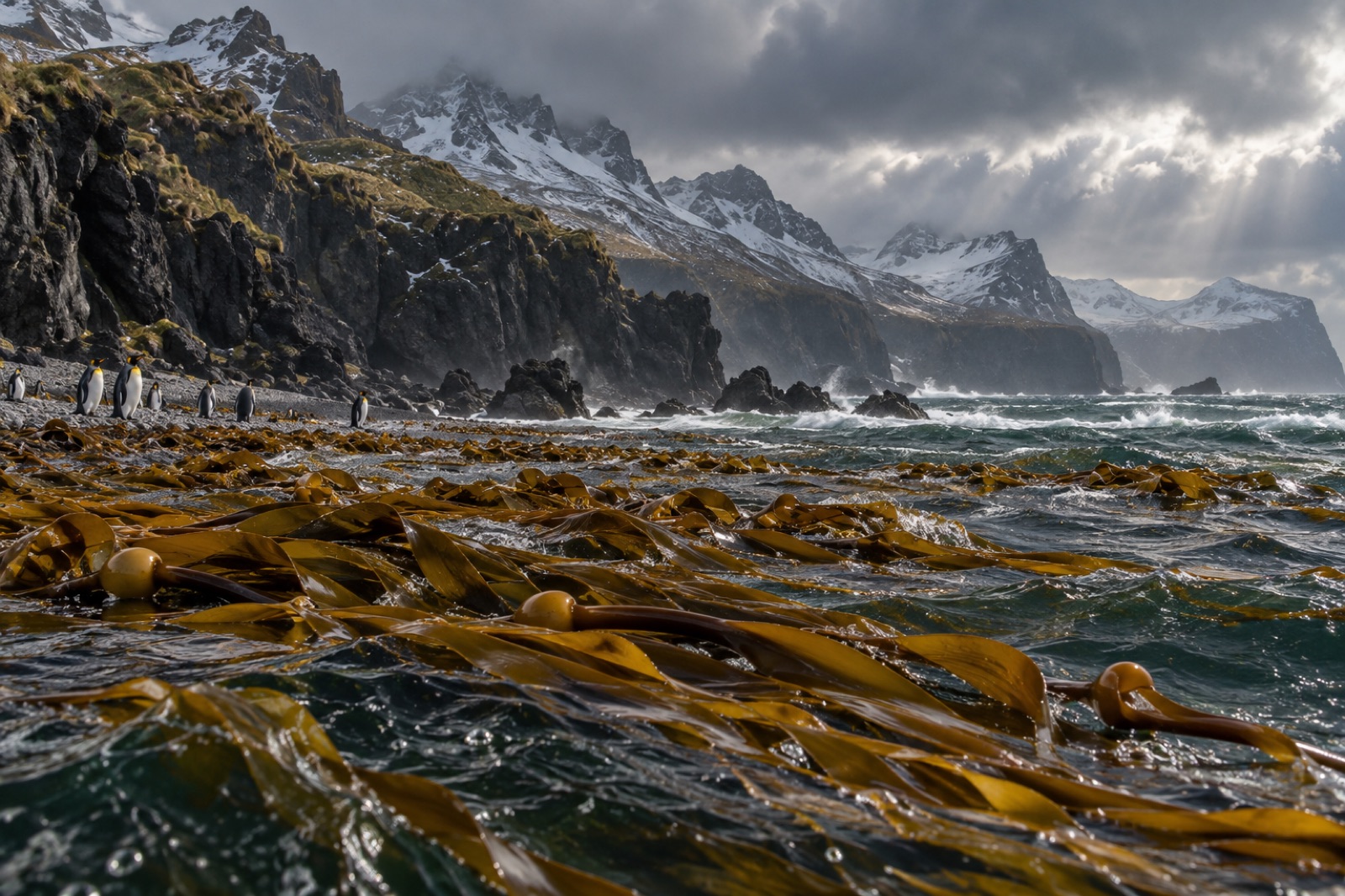
A ring of giant kelp fringes South Georgia's glaciated mountains — and around it, whales, seals and penguins are crawling back from industrial ruin.
South Georgia is a sliver of the Andes that missed its continent: a glaciated mountain range about 170 kilometres long, standing alone in the Scotia Sea more than a thousand kilometres east of Tierra del Fuego. It is one of the most wildlife-rich and most historically damaged places in the Southern Ocean — sealers and whalers emptied it in two industrious centuries, and now the seals, whales and penguins are coming back past counting. All of it happens in, above and around a green-gold ring of giant kelp that fringes nearly every sheltered bay. This guide covers the island, the kelp forest, the slaughter and the recovery, and the strict rules that now govern one of the largest marine protected areas in the world.
South Georgia belongs, with the South Sandwich Islands, to a British Overseas Territory in the South Atlantic sector of the Southern Ocean. The island is mountains first: a spine of glaciated peaks climbing to just under 3,000 metres — Mount Paget — with more than half of its surface under permanent ice and glaciers calving straight into the sea. There is no airport, no town, no resident population beyond government officers, museum staff and scientists rotating through Grytviken and King Edward Point. Access is by sea, almost always by expedition cruise from the Falkland Islands, two or three days' sailing west.
The physical climate is where the oceanography gets interesting. South Georgia sits just north of the Antarctic Polar Front, the great circumpolar boundary between subantarctic and Antarctic water, which means its seas are marginal, cold and alive: surface temperatures run from about 0 °C in winter up to 4 or 5 °C in late summer, and productivity rides the same ice-krill-fishery engine that feeds the greater Scotia Sea. Weather is maritime and theatrical — wind that arrives unannounced, katabatic squalls pouring off the glaciers, and the occasional serene, lit-from-within calm that photographers build careers on.
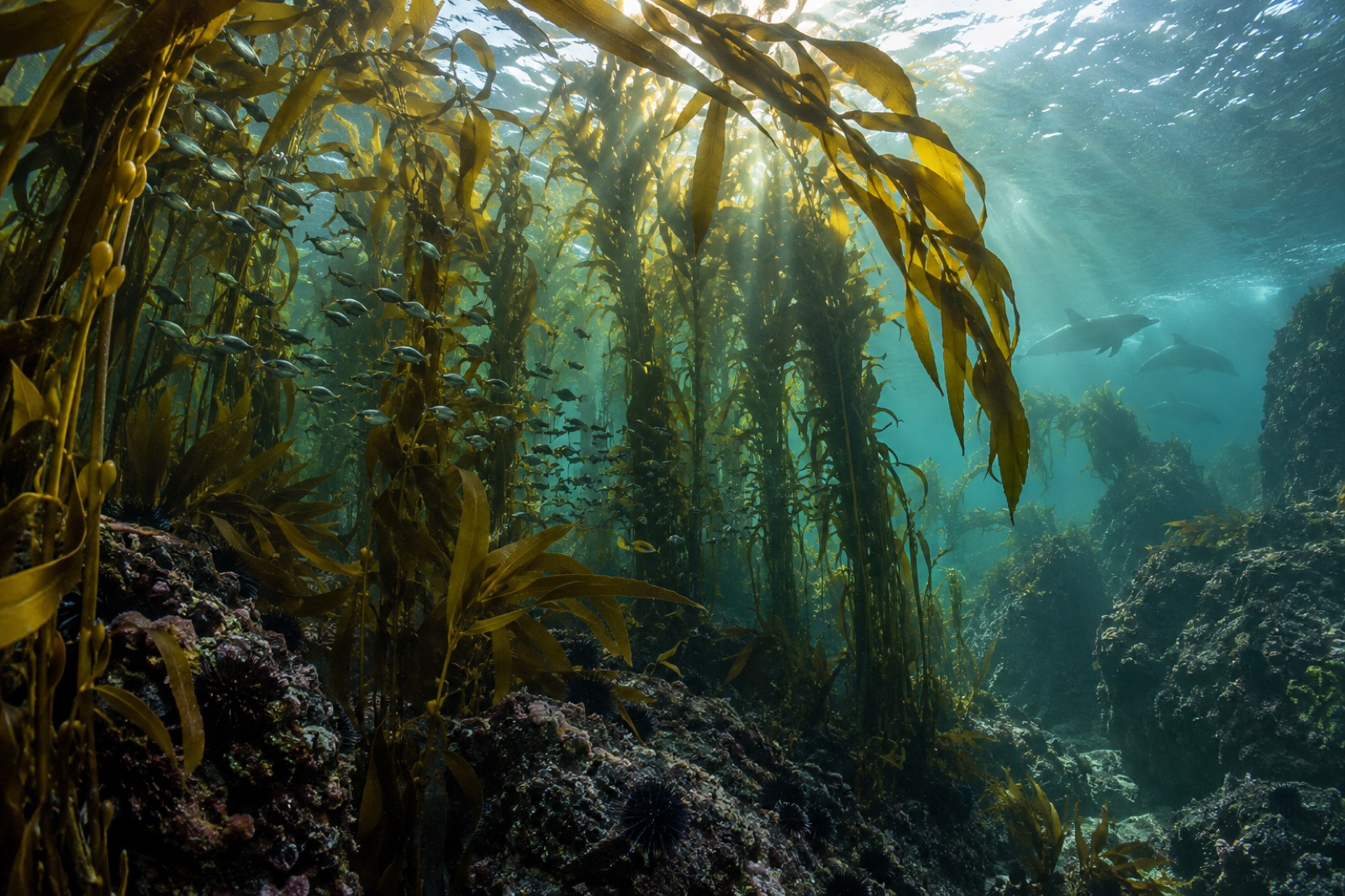
Giant kelp — Macrocystis pyrifera — fringes nearly every rocky shore on the island that is not actively ground by a glacier or bashed flat by the open sea: dense, surface-canopied forests in water as clear as glass and cold enough to sting through a dry glove. The hooked bays of the north coast, the strands inside Cumberland Bay, the kelp lanes between offshore rocks — all crowded with kelp. On the most exposed headlands the vegetation shifts to leathery bull kelps, and the intertidal drips with red and green seaweeds and filter-feeders.
The biology of kelp at 1 °C deserves a pause. Growth is slower than the galloping rates kelp achieves in California, and grazing pressure is light — there are no sea otters here, no urchin armies (an unusually urchin-poor fauna, as it happens) — so the forest persists through strategies of endurance rather than explosion, with the fauna divorced pleasantly from the trophic-cascade drama we describe in otters and urchins. Juvenile Antarctic shallow-water fish — notothenioids and icefish — work the understory, shags forage the canopy edge, and southern elephant seals rest mouth-open among the fallen fronds as though they had designed the place.
The kelp is also a structural piece of the island's carbon story. South Georgia's forests shed a constant rain of blades down-slope into water that gets deep fast; the fate of that export, washed into the Scotia Sea's circulation, is precisely the set of open questions we lay out in where kelp carbon goes — detritus pathways, buried fractions, dissolved fractions. If the Southern Ocean's kelp contribution to blue carbon is going to be honestly quantified anywhere, it will be measured against baselines from forests like this one.
The human story of South Georgia is two industries long, and both ended. Sealers arrived at the end of the eighteenth century and took Antarctic fur seals until there was effectively nothing left to take — the species was reduced to a scattered remnant on a handful of beaches. Whalers followed: Carl Anton Larsen established Grytviken in 1904, and over six decades the island's shore stations processed well over a hundred thousand whales, still the largest single-centre butchery in the industry's history. The great whales of the Southern Ocean scarcely recovered; the last station closed in the mid-1960s; the rusting flensing plans and try-works still stand at Grytviken, Husvik, Stromness and Leith, un-smelted and quietly aware of themselves as monuments.
Then, with the pressure lifted, the island did the other thing it is famous for. Antarctic fur seals rebounded from that remnant and now breed on South Georgia in the millions — the overwhelming majority of the world population, birthing on beaches so crowded in November that visitors view them from boats. Southern elephant seals haul out in the thousands; king penguins crowd the flats at Salisbury Plain and St Andrew's Bay in what may be the largest aggregations of the species anywhere — hundreds of thousands of birds in single colonies; humpback whales, hunted to near extirpation, are now recolonising the island's foraging waters in visibly accelerating numbers. Offshore, wandering and grey-headed and black-browed albatross still struggle against longline bycatch on distant fishing grounds — recovery here is real but not universal.
The final edit came from conservation itself. Introduced rats, spread by sealers, had suppressed ground-nesting birds for two centuries; between 2011 and 2015 a multi-year baiting operation — the largest island rodent eradication yet attempted — removed them, and the island was formally declared rodent-free, with the endemic South Georgia pipit and pintail already reoccupying valleys that had not heard them in anyone's lifetime.
South Georgia's other monument is one grave. Ernest Shackleton, having lost the Endurance to the Weddell Sea ice, crossed the Southern Ocean in an open boat in 1916 and then walked across South Georgia's unexplored spine to raise the alarm at Stromness — a traverse modern mountaineers repeat with equipment he didn't have and consider respectable. He lies buried in the little whaler's cemetery at Grytviken, having died of a heart attack aboard the Quest in the harbour six years later. Visitors toast the grave with whisky by tradition. Kelp frames the walk down from the headland.
The government of South Georgia and the South Sandwich Islands administers an enormous marine protected area — on the order of 1.07 million square kilometres — established in 2012 and strengthened at each five-year review, with large no-take areas around the island itself and seasonal measures protecting krill foragers. Fishing continues but under particular discipline: the longline fishery for Patagonian toothfish is independently certified sustainable, and the krill fishery operates under the Antarctic treaty's conservation commission with precautionary catch limits. Tourism comes via the International Association of Antarctica Tour Operators' protocols and the government's own visiting regime: biosecurity checks on every boot, no shore leave without a pre-landing inspection, and visitor sites watched like the statistics they are.
It adds up to one of the stricter regimes on Earth, built on the logic common to all good marine protected areas: decide what the ocean is for, then restrict what people can take accordingly. The kelp, which nobody tried to industrialise at South Georgia, got to be background scenery to the whole experiment — which is, when you think about it, the ideal.
There is no independent travel to South Georgia. Expedition ships sail from the Falklands and Ushuaia roughly October to March, most carrying kayaks, some carrying snorkel or dive programs subject to IAATO water-operation rules; other visits are science, governance or film permits. Kayaking over kelp forest in the outer bays, with fur seals inspecting the bow, is quietly one of the great paddling experiences on Earth. Wherever the itinerary lands you, assume the water wants you cold and prepared; pack for it and read the cold-water exposure guidance before you roll a sleeve up near the channel mouths.
Tidewright, being fictional, has no program in the Southern Ocean — but on our illustrative mapping roadmap South Georgia is exactly the sort of near-intact baseline we would anchor a system like Canopy Ledger against: a kelp forest under competent administration, warming measurably, changing slowly enough to learn from.
Yes — giant kelp (Macrocystis pyrifera) forms dense forests around nearly every sheltered rocky shore, in water that hovers between about 0 and 5 °C. It grows more slowly than its temperate relatives but endures, in the near-absence of the sea-urchin grazing pressure that shapes kelp forests elsewhere.
Only by permitted expedition — essentially cruise ships sailing from the Falkland Islands or Ushuaia between October and March, operating under IAATO and the territory government's rules. There is no airport and no independent access. Every landing requires biosecurity screening.
The shore stations — Grytviken, Leith, Stromness, Husvik — closed in the mid-1960s after the great whales were hunted out. Grytviken is restored as a museum and heritage site; the others stand as managed ruins, their rusting boilers and flensing plans deliberately preserved as testimony.
Not quite — it lies north of the Antarctic Polar Front and is classed as subantarctic: cold, ice-edged and krill-fed, but outside the Antarctic Treaty area. Politically it is a British Overseas Territory (South Georgia and the South Sandwich Islands), self-administered with no permanent population.
Mostly, and with nuance. King and macaroni penguins are thriving; wandering and grey-headed albatross remain under pressure from longline fisheries on distant feeding grounds. The lesson of South Georgia is that recovery needs the whole ocean protected, not just the breeding beach.
Inside the Falkland Islands' giant kelp beds — among the most extensive on Earth — and the penguins, seals and steamer ducks that run on them.
Dr. Lena Fischer ·
A coastal atlas guide to the Kerguelen Islands — vast giant kelp beds at 49°S, elephant seals and king penguins, iron-fed blooms, and the wildest kelp wilderness few will see.
Tom Okafor ·
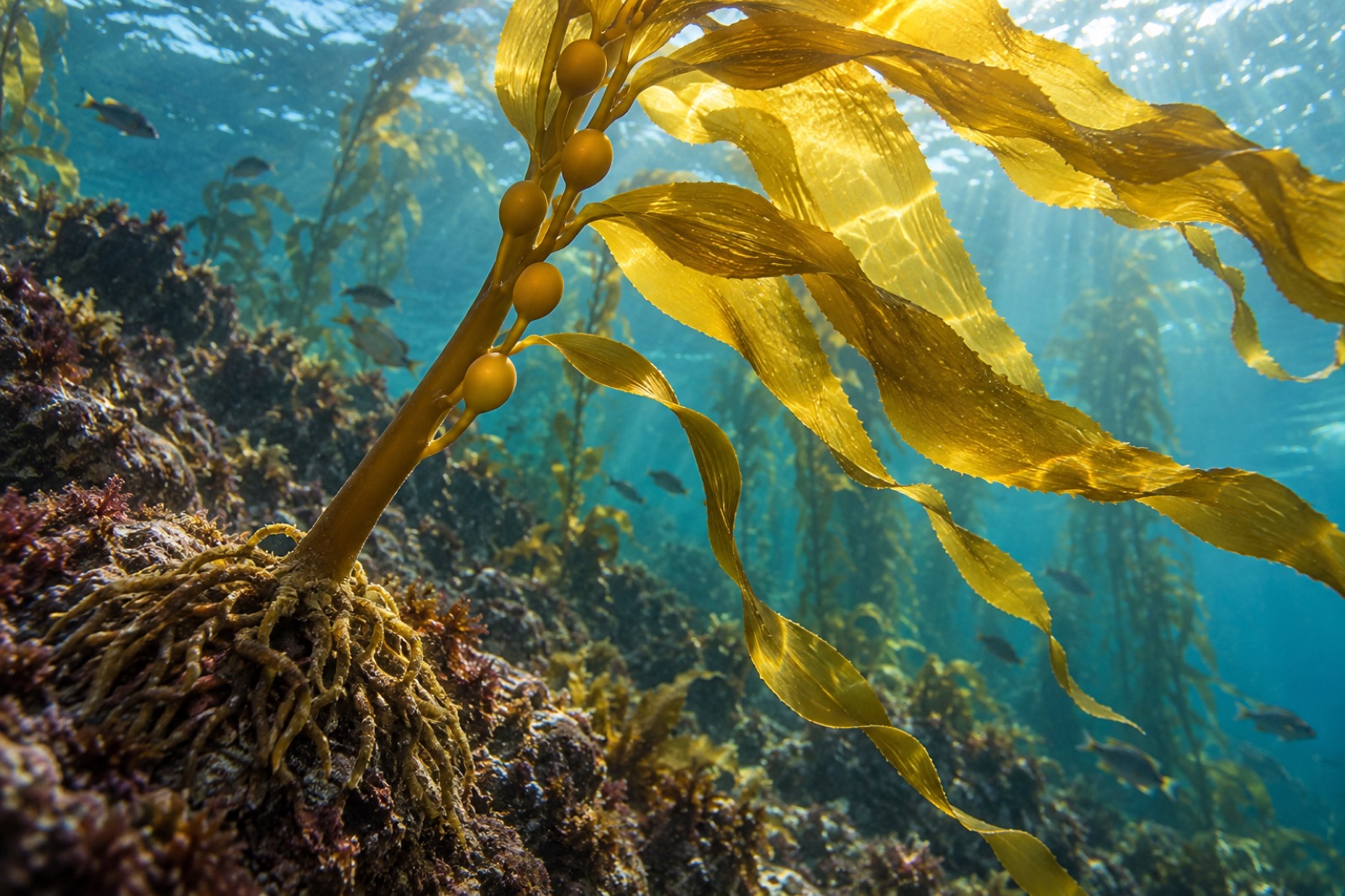
Giant kelp is the fastest-growing organism on Earth and the architect of undersea forests. Learn its biology, life cycle, range and why it matters.
Dr. Theo Nakamura ·