Atlas11 min read
Kerguelen: Giant Kelp in the Sub-Antarctic
A coastal atlas guide to the Kerguelen Islands — vast giant kelp beds at 49°S, elephant seals and king penguins, iron-fed blooms, and the wildest kelp wilderness few will see.
Tom Okafor ·
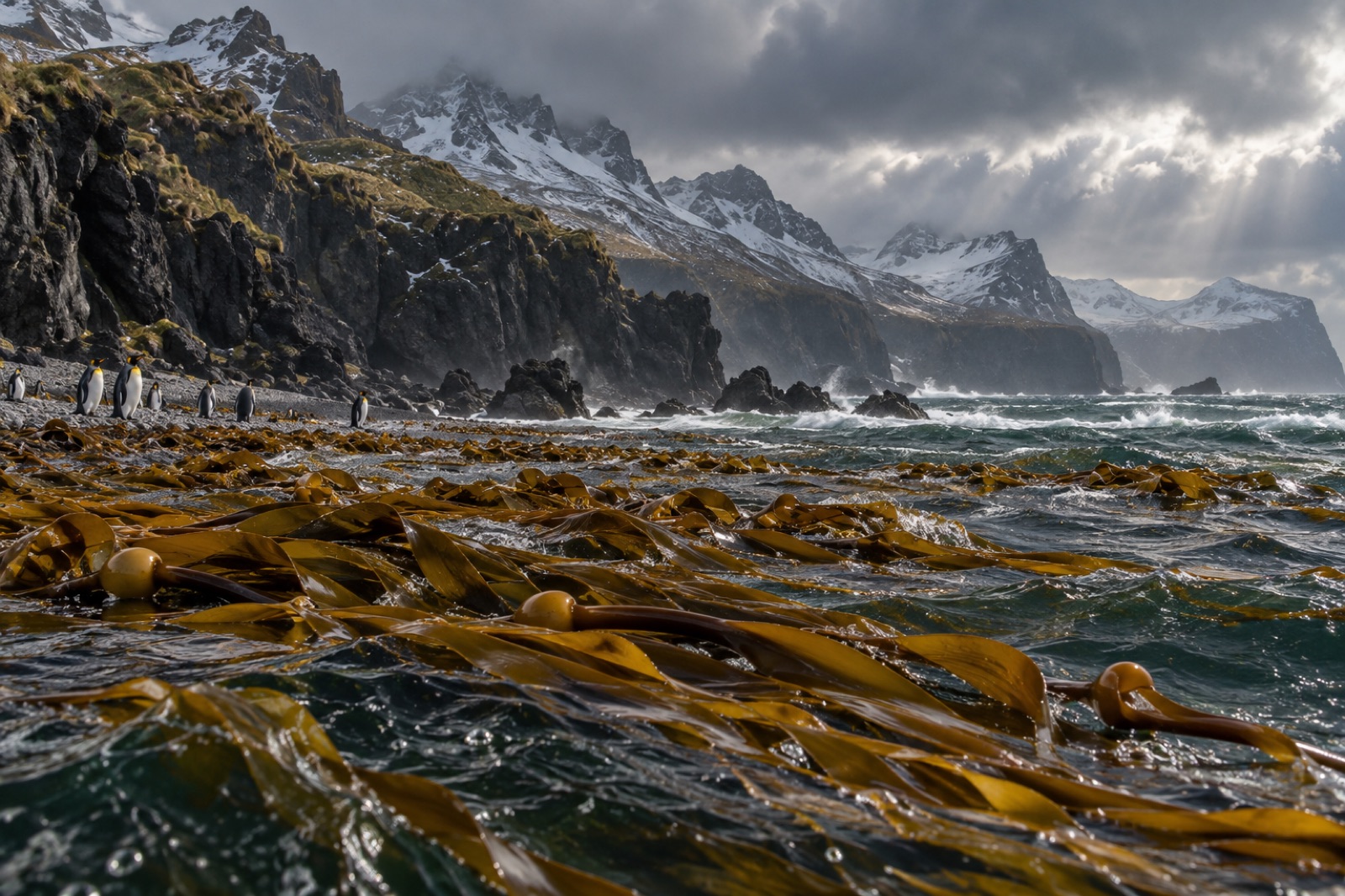
Giant kelp beds ring the Crozet Islands beneath some of the greatest penguin and albatross colonies on Earth — a coastal atlas guide to France's remote subantarctic.
Roughly halfway between Madagascar and Antarctica, in water that on most charts is simply blank, a small volcanic archipelago runs one of the densest wildlife economies in the southern Indian Ocean. The Crozet Islands — a scattering of dark, rain-rotted peaks at 46°S — hold some of the largest seabird colonies on the planet above the tideline, and below it, giant kelp beds that almost nobody on Earth has ever seen. Together with neighbouring Kerguelen they form French subantarctica: the least visited kelp coast in our Coastal Atlas, and one of the most instructive.
The archipelago splits into two groups separated by about 100 kilometres of open ocean. To the west, Île aux Cochons, Île des Pingouins and the rock-stack Îles des Apôtres; to the east, Île de la Possession and Île de l'Est, the two separated by a passage shallow enough for elephant seals to commute through kelp. All of the islands are volcanic, the product of a hotspot punching through the Antarctic Plate near the mid-ocean ridge system, and all of them sit squarely in the Furious Fifties — the belt of almost uninterrupted westerlies that circles the subantarctic.
The climate is maritime to an extreme: cool year-round (mean temperatures hover around 5°C), very wet, and windy with remarkable consistency. There is one human settlement: the Alfred Faure research station on Île de la Possession, staffed since the early 1960s and reached by supply ship from Réunion a few times a year. Everything else — five islands' worth of headlands, giant-kelp bays and seabird lava plateaus — is given over to the ecosystem, and since 2006 the whole archipelago, with its waters, has sat inside the French Southern Territories national nature reserve, within the territory later inscribed as UNESCO World Heritage. Not far east, the South Georgia forests share the same species mix at even greater scale.
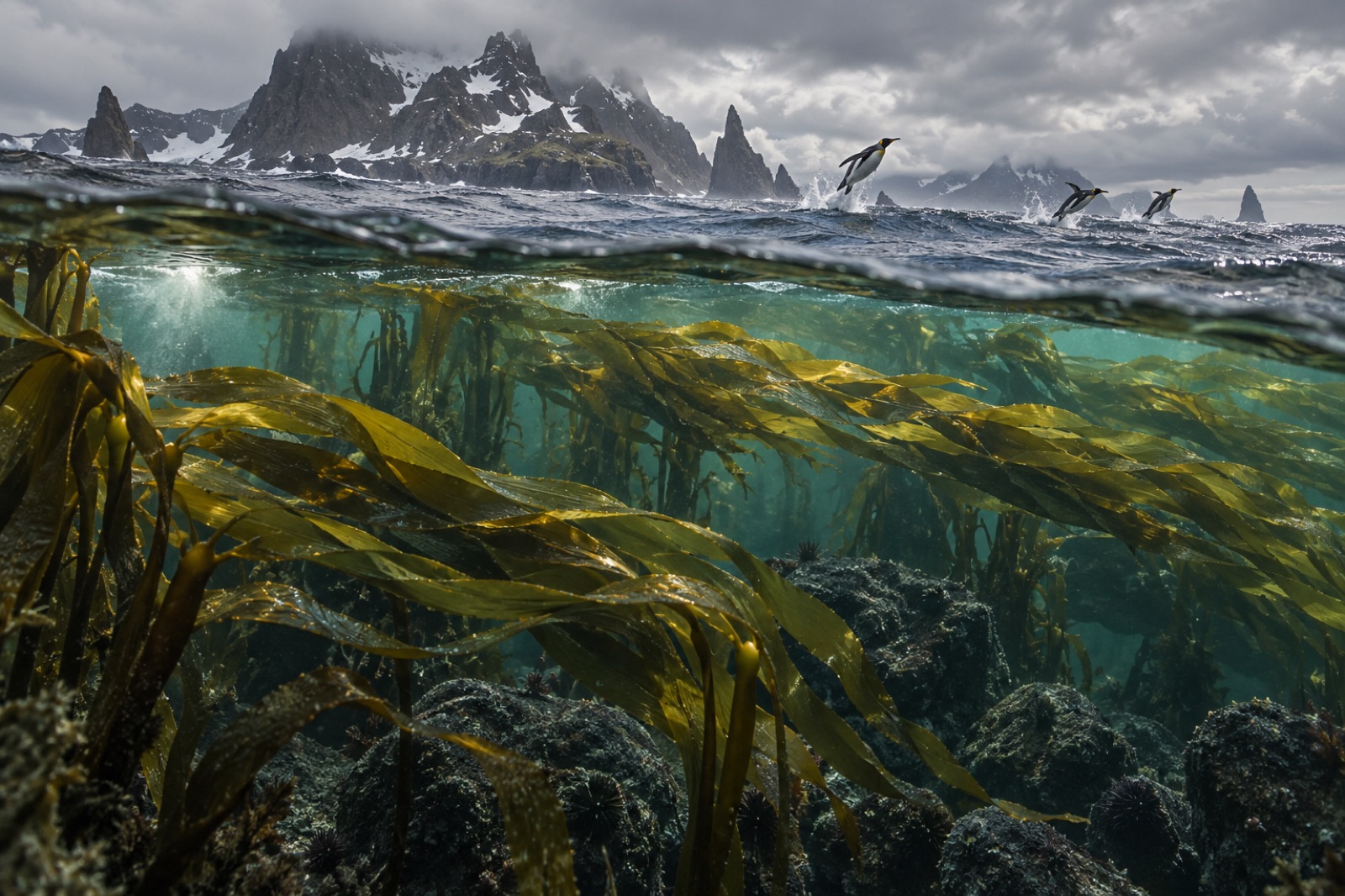
Crozet's underwater zonation is the subantarctic template in its purest form. Anywhere swell can breathe — the open outer coasts, headlands and western passages — the rocks wear southern bull kelp, Durvillaea antarctica: the honeycombed leviathan of the surf line, its air-pocketed blades rolling like wrecked dirigibles in the white water. In any bay with a measure of shelter, the canopy switches to giant kelp, Macrocystis pyrifera — the same fastest-growing organism on Earth that builds the California forests, here forming dense subantarctic stands rising 20 metres from the seabed to stream in the surface chop.
The sheltered giant-kelp bays of Île de la Possession and Île de l'Est are extensive, and old expedition accounts of navigating through steering-thick kelp in the lee of the islands read exactly like the better-known records from Kerguelen or the Falklands. Beneath the canopies, the Crozet reef is a cold water garden: dense red-algal turf, coralline crust, sponges, tunicates, and invertebrate communities whose composition is known mostly from a few dredging programs and the station's scientific dives — one of the least-surveyed subtidals of any kelp coast on Earth, and for that reason alone precious as a baseline.
A note on scale: because Crozet's offshore waters drop steeply into the deep boundary-current world of the southern Indian Ocean, kelp torn loose by the permanent westerlies does not have to travel far to leave the coastal system entirely. Drifted blades and whole uprooted plants raft eastward on the boundary currents, carrying their attached invertebrate passengers — a dispersal engine that has wired the subantarctic islands' biota together for millennia.
Above water the archipelago is, by population, one of the greatest seabird assemblies anywhere. King penguins are the emblem: Crozet historically held what was considered the largest king penguin colony on Earth at Île aux Cochons, and although that colony has undergone a dramatic, heavily studied decline in recent decades — a sobering reminder that remoteness is not immunity — hundreds of thousands of pairs still breed across the archipelago. Macaroni and rockhopper penguins commute down lava gullies to feeding grounds in and beyond the kelp. Yellow-nosed and wandering albatrosses, sooty and great albatrosses, giant petrels and a mob of petrels and prions treat the islands' cliff plateaus as a single vast rookery; the wandering albatrosses wandering out of Crozet's colonies are among the big-white silhouettes sailors know around the subantarctic.
The mammals are the louder half. Southern elephant seals crowd Possession's beaches in breeding season, their two-tonne biological reshuffling taking place metres from the island station buildings, and subantarctic fur seals have staged a genuine recovery from nineteenth-century sealing: from near-erasure to colonies filling beach after beach. Two small odontocetes worth mentioning: Commerson's dolphins — a black-and-white subantarctic form with an island-associated population — surf the kelp passes, and a well-known population of killer whales patrols the coast, famous among fisheries observers for teaching one another to strip Patagonian toothfish from longlines in Crozet's deep sector.
This is a food-web conversation between the ocean and the kelp shore that the birds and seals mediate. The seabird outputs fertilise the coastal fringe, the kelp protects and structures the shallow nursery water, and the whole system runs on the subantarctic's deep, silicate-rich, iron-adjacent productivity. We unpack the whole food-web latticework in our kelp forest food web explainer.
Crozet's scientific significance is out of proportion to its size precisely because almost nothing else happens there. Long-running programs from Alfred Faure on penguin demography, albatross tracking and seal population dynamics are among the longest seabird time series in the southern hemisphere, and it was largely Crozet data that revealed how sharply subantarctic predators respond to the slow poleward slide of the subantarctic food web's engine room — the frontal systems where the Antarctic Circumpolar Current does its feeding — as the Southern Ocean warms.
The cautionary tales matter just as much. Sealing stripped the fur seals to near-oblivion within decades of the islands' utilisation; later human presence introduced house mice and rats to some islands, and cats to Possession, with the predictable consequence for burrowing petrels. Modern French subantarctic conservation has invested in eradication and strict biosecurity, and the islands' lessons — that "no people" is not a management plan, and that even one introduced rodent can rewire an entire seabird island — have travelled to every other subantarctic territory, from Macquarie to New Zealand's Antipodes.
You almost certainly cannot. There is no tourism infrastructure on the Crozet archipelago: no commercial landings, no cruise traffic, no airstrip on the islands themselves. Access runs through the supply ship Marion Dufresne from Réunion, on rotations whose berths exist for station staff, scientists and a small number of paying passengers at cabin rates that reflect a 3,000-kilometre voyage into the fifties. Landing outside the station area is governed by the reserve's strict biosecurity. The islands' purpose — under the French system and in fact — is research and sanctuary, not visitation.
For travellers who want subantarctic giant kelp and penguin economies they can actually visit, the honest substitutes are the Falkland Islands, South Georgia on an expedition voyage, or — for the Southern Ocean kelp experience within ordinary reach — Tasmania's coasts and New Zealand's subantarctics. None is Crozet. But all are faithful to what Crozet represents: a kelp shore doing everything it evolved to do, at the volume the Southern Ocean permits, measured and respected from a respectful distance.
Crozet's kelp matters less for its direct use than for what it anchors. The beds are the sheltered half of a subantarctic coastal engine that feeds, corridors and nurseries one of the ocean's great seabird and seal economies, and they are wrapped in long scientific time series in a region that is changing fast. They are also, like their neighbours at Kerguelen, a benchmark for what intact, unharvested Southern Ocean kelp looks like — the reference state the restoration world measures itself against. Remote does not mean separate: what the Furious Fifties' kelp forests do next, under a warming and shifting Southern Ocean, will be read off these dark islands first.
The exposed coasts carry southern bull kelp (Durvillaea antarctica), while sheltered bays hold giant kelp (Macrocystis pyrifera) forests rising to 20 metres — the same pairing found around the other subantarctic islands, at remarkable density here because the steep offshore drop keeps cold, nutrient-rich water close to shore.
No — they are neighbouring but distinct archipelagos in the southern Indian Ocean. Kerguelen lies about 1,400 kilometres east-southeast, is far larger, and is famous for the sheer scale of its kelp; Crozet is smaller, steeper, and disproportionately important for its seabird colonies. Both belong to the French Southern and Antarctic Lands and share a nature-reserve umbrella.
In practice essentially not. The only access is the Marion Dufresne supply ship from Réunion a few times a year with a handful of paying berths, no landing infrastructure beyond the research station, and strict reserve and biosecurity rules. Expedition-cruise subantarctic itineraries visit other islands instead.
The archipelago historically held what researchers considered the world's largest king penguin colony, on Île aux Cochons, and has since provided the best-documented case of how quickly a super-colony can decline as subantarctic feeding grounds shift with ocean change — a case study that made Crozet central to debates about climate effects on the Southern Ocean food web.
A coastal atlas guide to the Kerguelen Islands — vast giant kelp beds at 49°S, elephant seals and king penguins, iron-fed blooms, and the wildest kelp wilderness few will see.
Tom Okafor ·
A ring of giant kelp fringes South Georgia's glaciated mountains — and around it, whales, seals and penguins are crawling back from industrial ruin.
Dr. Lena Fischer ·
Southern bull kelp (Durvillaea) grips the roughest surf coasts on Earth with the strongest holdfast of any kelp. Honeycomb blades, Māori pōhā, ocean rafting.
Dr. Theo Nakamura ·