Atlas8 min read
The Sonoma Coast: After the Bull Kelp
Sonoma's coast lost most of its bull kelp a decade ago. A guide to the collapse, the abalone closure, and where the forest is quietly returning.
Jack Callum ·
A field guide to Bodega Head — the granite headland on California's Sonoma Coast where upwelling, bull kelp and world-class marine science meet.
There are headlands you visit, and headlands that work on you. Bodega Head is the second kind. The granite tip of Sonoma County's wild coast juts into the California Current like the prow of a ship three hundred metres high at your shoulder and thirty metres at your feet, with the San Andreas Fault sliding down its back along the harbor side. The wind is a personality here. So is the ocean — and so, for seventy years of marine science, has been the ecosystem underneath.
Bodega Head is also, as of the 2020s, one of the best places on Earth to witness what losing a kelp forest looks and feels like — and what a coastline looks like in the first steps of trying to grow one back.
The geology does much of the light-giving. Bodega Head is a piece of Salinian granite carried northwest up the coast by the San Andreas Fault from its birthplace off the southern Sierra or Mojave block — the same crystalline rock that outcrops at Point Reyes directly across the fault, a watery sibling separated by the fault zone that runs down the middle of Bodega Harbor. The result: a rugged subaerial island of hard rock, battered by every north and west swell the North Pacific throws at California, with a protected cove — Bodega Harbor itself — on the lee side and a broad open Pacific front on the other.
Offshore, the shelf funnels into Cordell Bank National Marine Sanctuary, one of the most productive patches of ocean in the Bight. The name comes from the bank itself, a shallow granite-dome plateau that charges the California Current's energy through a long sweep of upwelling every spring. That upwelled water — cold, low-oxygen, nutrient-rich — rides back across Bodega Head throughout the summer. Under normal conditions, this is one of the most nutrient-productive coastal segments in North America. It is also why the coast here changes hard when the system hiccups.
To understand what Bodega Head is today, you have to know what disappeared.
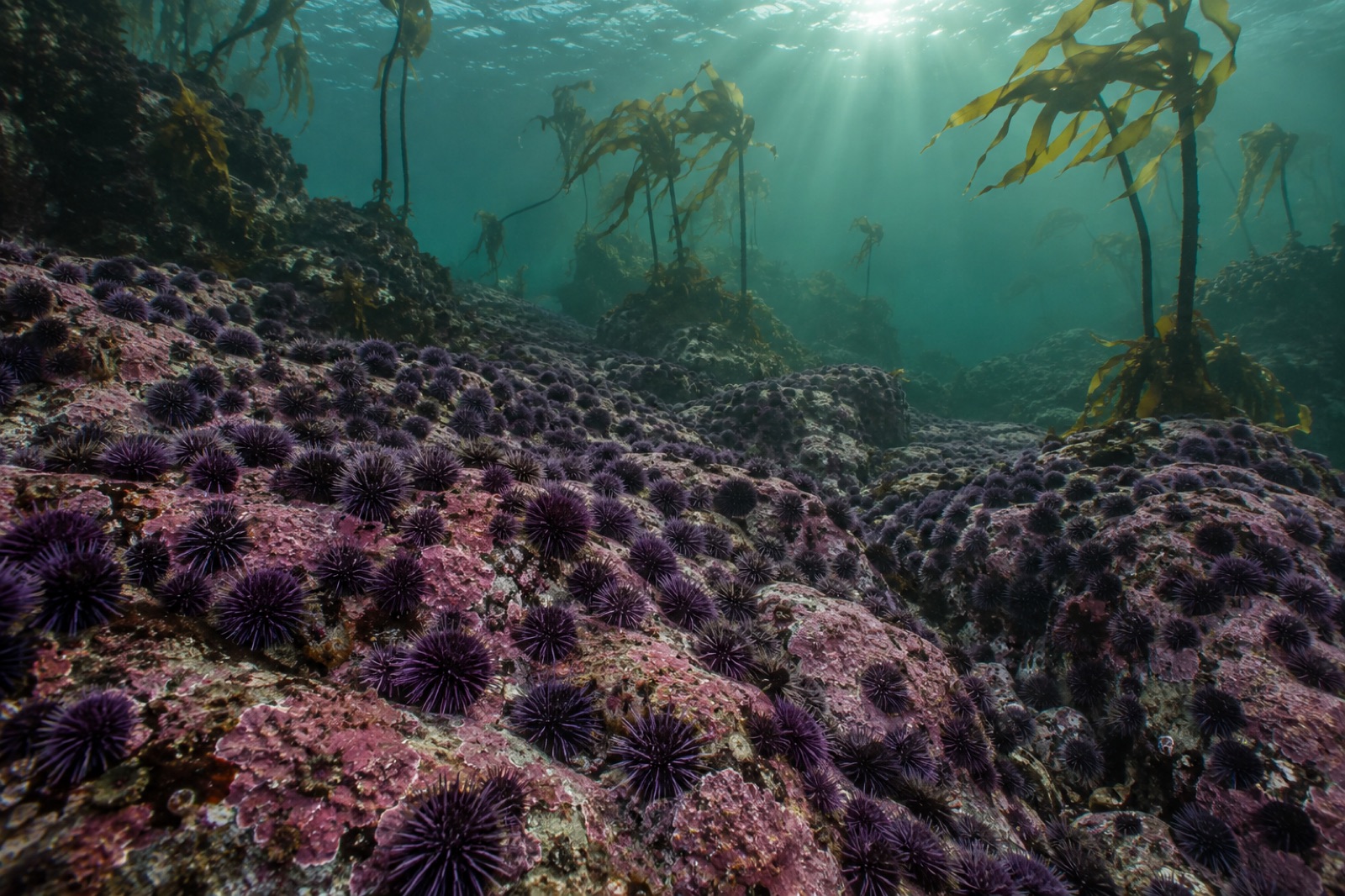
Until 2013, a nearly continuous fringe of bull kelp (Nereocystis luetkeana) lined the Sonoma and Mendocino coasts in late-summer survey shots. Then came the marine heatwave of 2014–2016 ("the Blob" and its sequel), which thermal-stressed the canopy across Northern California. At the same time, a mass wasting event in sea stars stripped three species of sunflower seastars from the coast, releasing an entire cohort of purple sea urchins from predation. The urchin population exploded — nuisance urchins, in fisheries' terms, grow faster than kelp can recover — and bulldozed the reefs. Federal agencies documented a canopy loss of more than ninety percent by aerial survey from 2014 onward.
The consequences fell in three rings: the kelp forest itself; the abalone fishery (closed since 2018); and working coastal communities whose abalone, red sea urchin, rockfish and crab economies once drew tourists and boats through Bodega Bay. Our guide to the Sonoma Coast in the post-collapse years tells that human side; the upstream Mendocino story is in Living on the Lost Bull Kelp Coast.
Bodega Head's bull kelp fringe is the visible, measurable piece of that collapse that you can walk over and examine — the lee-side pocket shows a shimmer of regrowth some years; the outer bluff shows the bare granite urchin barrens.
The University of California, Davis, has run the Bodega Marine Laboratory on the bluff above the harbor since the 1960s. Physically, BML is a cluster of laboratories and seawater systems, but functionally it is a field station with world-ranking expertise in kelp forest ecology, ocean acidification, fisheries management and climate effects — the whole syllabus of the modern coast. Researchers based there run long-term monitoring on the local bull kelp fringe, intertidal zones and urchin barrens; their work, with collaborators up and down the coast, provides much of the state dataset behind the canopy-loss numbers and the emerging restoration trials.
The work done nearby covers the full range of California's science priorities:
The public walking is superb — and far richer than a drive-by. Three walks define the visit:
The headland rim. From the parking at the end of Westshore Road, a bluff walk loops the granite point. On the open-Pacific side you get sea stacks, pelagic birds — pigeon guillemots and oystercatchers in season, black oystercatchers patrolling exposed ledges — and the headwind theater of tens of thousands of shearwaters and fulmars feeding offshore. On calm summer evenings, gray whales on the migration corridor pass almost within binocular range.
Bodega Harbor. On the lee side, the harbor is a small working fleet, empty dunes, and saltmarsh. The sand spit (Doran Beach) is a classic walk in wind-whipped dune habitat and a beginner-friendly birding circuit. The fault line is visible in the sediments.
The reserve and lab. The Bodega Marine Reserve has restricted access to protect research, but the laboratory runs public open-house events and docent walks in season. The seawater system's mess of tanks and kelp juveniles inside the lab is worth the detour if timing allows.
Campbell Cove and Horseshoe Cove. Two coves in the lee provide tidepooling on low tide — ochre stars, giant green anemones, painted crabs and sculpin. Watch swell; coves that look benign can throw a frisking wave.
Bull kelp is an annual; given cool water and reduced grazing, an empty reef can carry visible canopy inside eighteen months. Trials up and down the Sonoma coast — experimental kelp outplanting, urchin removal zones, wild harvest of "surplus urchins" by the commercial fleet when the surge is right — are quietly mapping the playbook. At Bodega Head, pockets of canopy have returned in some years since 2018 without large-scale intervention, reviving kelp bass, rockfish nurseries and herring spawn. The belt remains thin; the trend is fragile. But the system's ability to recover is not in question. If the urchins can be brought under control — a job humans, not nature, now have to do — the forest can come back on timescales short enough to be a career.
This perspective drives the illustrative monitoring and outplanting model behind Tidewright's own Holdfast nursery system: seed resilient kelp on lines in hatcheries, match genetics to the site and ocean conditions, outplant with anchoring to rocky substrate, then keep urchins down while the forest re-establishes. It is the same playbook Bodega researchers are testing — adapted, in Tidewright's fictional program, to industrial vessel support and nursery scale.
Shore diving exists at a handful of coves in the lee of the headland, and the area was once a major abalone diving coast (the fishery closed recreationally in 2018). Conditions are serious: heavy swell, cold water, and kelp recovery zones that vary by year. Divers should have significant North Coast experience and check current regulations; they have changed with the fishery closures.
Thin, patchy and variable. In some cool years a fringe of bull kelp canopy reappears in the lee coves; in warm years the outer bluff reefs are bare urchin barrens. The scientific surveys done from the marine lab track this fluctuation year by year.
Autumn (September–November) for calmest weather, clearest water and migratory seabirds; spring for khaki-brown shearwater swarms offshore and native wildflowers in the grassland; winter for whale-watching and the headland's full weather theatre. Summer can be extremely foggy and windy.
The University of California, Davis's field station on the bluff above Bodega Harbor, established in the 1960s. It runs long-term monitoring of kelp, urchins and the intertidal; works on ocean acidification; and cultivates juvenile kelp and abalone for restoration work. Public open-house days run seasonally.
No. Bull kelp (Nereocystis luetkeana) is an annual species with a single stipe and gas-filled float at its tip; it dominates north of Point Conception. Giant kelp (Macrocystis pyrifera) is a multi-stiped, longer-lived species dominant south of there. See the full profile of Bull kelp: the annual giant of North Pacific forests for the species detail.
Sonoma's coast lost most of its bull kelp a decade ago. A guide to the collapse, the abalone closure, and where the forest is quietly returning.
Jack Callum ·
A field guide to Northern California's bull kelp collapse — the heatwave, the urchin explosion, the closed fisheries, and the difficult road back.
Dr. Mara Ellison ·
A Coastal Atlas guide to Point Reyes: California's upwelling engine, fog-fed kelp, elephant seals and grey whales, and how wind builds a food web.
Dr. Lena Fischer ·