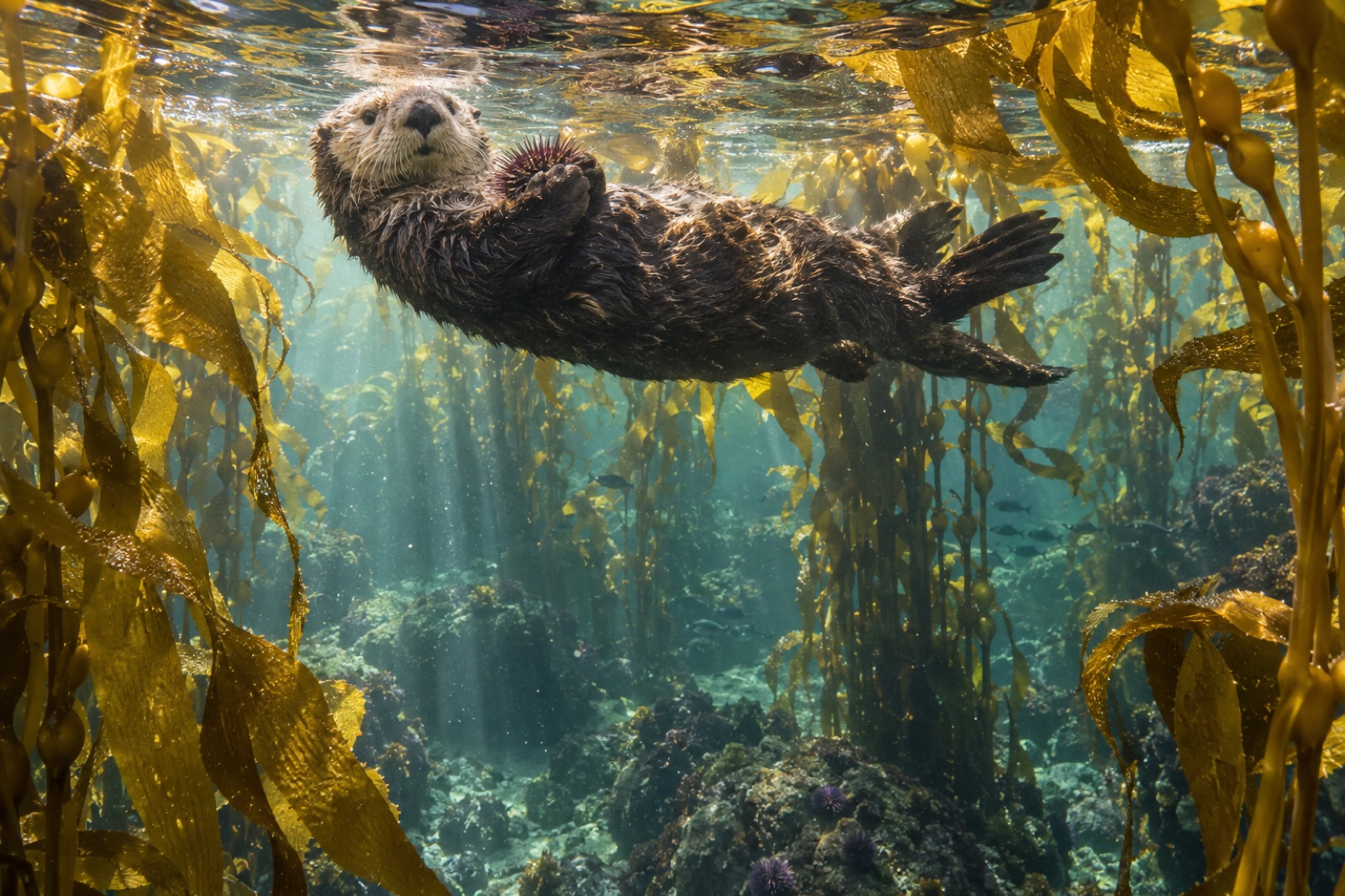
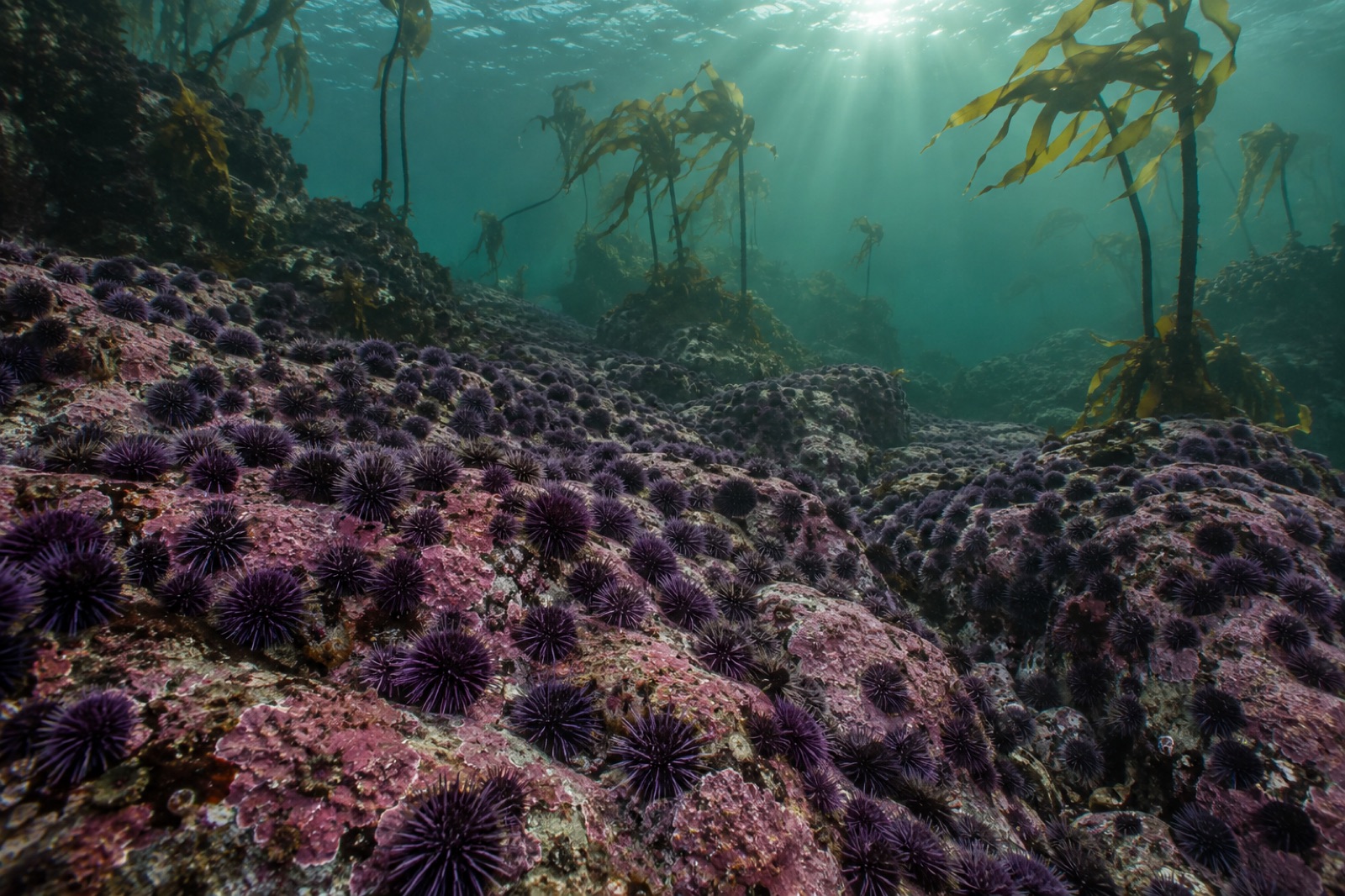
The gray whale (Eschrichtius robustus) is the most kelp-coast whale on Earth. While other great whales cross open ocean between feeding and breeding grounds, the eastern North Pacific gray runs its entire migration — one of the longest of any mammal, some 15,000 to 20,000 kilometres round trip — along the continent's edge, often inside a kilometre of shore, threading surf lines, rounding rocky headlands, and travelling for weeks within sight and sound of the kelp forests that fringe that whole coastline. Where the kelp grows, the grays go.
This article profiles the species, explains its remarkable relationship with kelp forests — feeding, rubbing, resting and hiding among the fronds — and why this coastal specialist is both a conservation success story and an animal whose fortunes track the health of the nearshore ocean.
Quick facts
|
|
| Scientific name |
Eschrichtius robustus |
| Family |
Eschrichtiidae — the gray whale's own family |
| Size |
12–15 m; 30–40 tonnes |
| Colour |
Mottled grey, carpeted with barnacles and whale lice |
| Feeding |
Primarily bottom-feeding on seafloor invertebrates (amphipods, mysids) |
| Migration |
~15,000–20,000 km round trip, Arctic feeding grounds to Baja California calving lagoons |
| Status |
Eastern population recovered from whaling; removed from the US endangered list in 1994; western population critically endangered |
Identification
A gray whale is a medium-sized baleen whale that looks, from a clifftop in January, like a slow-moving rock that has learned to breathe. It is a mottled, crusty grey animal — the true colour of its skin overlaid by patches of white and orange where communities of barnacles and whale lice have calcified onto the head and back. It lacks a dorsal fin entirely; instead a row of low knuckles runs down the rear spine, ending in the tail stock. The rostrum is arched, the mouth small and slightly upturned, the baleen the shortest and coarsest of any baleen whale — a scraping tool, not a sieve. A blow is low and bushy; the fluke is broad and often raised before longer dives. Travelling grays are famous for "spy-hopping" — rising vertically until the eyes clear the water — and for easing so close to shore that breakers wash their backs.
Feeding: the only bottom-feeding baleen whale
The gray whale's great speciality — reflected in its arched, short-baleened mouth — is benthic suction feeding. It rolls onto its side, usually the right, ploughs the seafloor with its lower lip, and pumps its tongue to suck out the sediment-dwelling crustaceans — mostly tube-building amphipods — that swarm through northern seafloors. It leaves characteristic feeding pits a few centimetres deep and a tell-tale plume of muddy water at the surface. In summer, at Chukchi and Bering Sea feeding grounds, this is a bulk harvest against the lean months ahead. The whale eats little or nothing while migrating and breeding, surviving five to six months on fat.
But bottom-feeding is not the whole story — and this is where the kelp forest enters. Gray whales are among the most flexible feeders in the baleen guild, and various populations have been documented:
- Suction-feeding on mysid swarms and crab larvae dense in the water column in and around kelp forests, particularly along the Pacific coast south of the Arctic summer grounds.
- Skim-feeding on concentrated clouds of small invertebrates at kelp-bed edges, pushing their open mouths through prey so thick the water changes texture.
- Feeding inside kelp beds directly, threading their bodies between the fronds themselves — an astonishing display of agility in a 35-tonne animal — to reach prey associated with kelp forest seafloors and holdfast communities.
A west-coast feeding aggregation known informally to researchers and whale-watchers as the "Sounders," in Puget Sound, spends spring on ghost-shrimp flats; smaller groups overwinter or linger feeding at kelp-coast sites from Vancouver Island to California rather than migrating all the way south.
The kelp forest as migratory habitat
Kelp is not just a food stop on the gray whale highway — it is part of the road's furniture, and grays use it with multiple purposes.
A landmark and a corridor. The gray's migration is famously coastal, and the nearshore kelp line — the surf-pounded fringe of giant and bull kelp beds north of the Mexican border — is one of the physical features the migration follows. Whales travelling south in winter and north in spring hold tight to the coast along hundreds of dramatic headlands, often running inside the kelp, beyond the worst of the swell, along the same green-fringed corridor that has always marked the coast.
A shield for calves. Mothers migrating north with new calves travel often so close to shore that they pass through the kelp — and the kelp is more than scenery. The dense beds damp swell and surf (see our explainer on kelp's wave-calming physics), providing a quieter travel lane for a calf working to keep station beside its mother. And the kelp offers cover: killer whales patrol the migration corridor, and orca packs open-footed hunt gray calves in places like Monterey Bay. Mothers are known to retreat to the surf line and the kelp — water too shallow, too noisy and too choked with fronds for a pursuing orca to operate effectively — holding their calves in the wave-washed kelp until the killers give up.
A back-scrubber. Gray whales actively rub among kelp fronds — deliberately swimming into kelp beds and dragging their bodies through the fronds, nosing and rolling in kelp rafts at the surface. Observers have watched this for generations along the migration route, from Vancouver Island to the Californian coast. Whether it is to rid barnacle-load irritation, play, or both, the behaviour reflects a fundamental truth: the gray whale is a whale of the shallow, frond-swinging nearshore, evolved to its coast rather than its open sea. It is the great whale most at home in a kelp forest.
Conservation: defined by recovery, retested by warming
The eastern North Pacific gray is one of the flagship recoveries of twentieth-century marine conservation. Reduced by commercial whaling to near-collapse, the population rebounded into the tens of thousands following protection, and the species was removed from the US Endangered Species list in 1994 — one of the first great whales to be delisted. Today, eastern grays support a whale-watching culture along their migratory coast, from the calving lagoons of Baja California — where the whales famously, voluntarily approach small boats and accept human touch, one of the most extraordinary encounters in wildlife watching — to migration-count lookouts in Oregon and California.
The picture is not static, though. Gray whales have undergone repeated unusual mortality events — years of elevated stranding and die-off that appear tied to feeding conditions on their Arctic grounds, with animals reaching the migration coast thin and calves scarce. These episodes track a wider transformation: the Arctic and sub-Arctic seas where grays do their year's feeding are among the fastest-warming waters on the planet, and the amphipod prey communities in that seabed are changing under the same warming that is reshaping kelp forests at the other end of their range — the marine heatwave story we describe in our kelp and El Niño explainer. The western North Pacific gray, a separate remnant population around Asia, remains critically endangered, one of the most at-risk great-whale populations in existence.
The gray whale, kelp, and what a healthy coast means
The gray whale is perhaps the clearest illustration in whale biology of a simple principle: what happens in coastal habitats determines what happens to the ocean's largest animals. The kelp forests that moderate its migration coast — the restorative work of partners from Mendocino to the Channel Islands — are not marginal habitat to it; they are the very coast it is calibrated to. The forage in its nearshore feeding grounds, the wave-damped travel lane for calves, the refuges in the kelp line — all are products of a healthy kelp coast. Restoring kelp systems, as Tidewright works to do across the migration corridor, is part of holding the fabric of that coast together for the whales that thread it twice a year.
And the best way to experience gray whales is the way that respects them: from a clifftop with a thermos, at a migration-count lookout, or on a licensed vessel that keeps its distance — the principles in our guide to wildlife ethics on kelp coasts apply at whale scale, too.
Key takeaways
- The gray whale migrates farther than almost any other mammal — up to 20,000 km annually — nearly all of it along the coast, inside or beside the kelp line.
- It is the only baleen whale adapted for benthic suction feeding, but it feeds flexibly — mysids, crab larvae and invertebrate swarms in and around kelp beds as it migrates.
- Kelp forests serve gray mothers as a swell-damped refuge where orca packs cannot follow, and whales regularly rub among the fronds.
- The eastern Pacific population was delisted in 1994 after a famous recovery; subsequent die-off events show it is closely tied to feeding-ground conditions in a fast-warming north.
- The kelp coast is not incidental to this whale — it is the road, the restaurant and the refuge. A healthy kelp coast sustains the largest animal that travels it.
FAQ
Why do gray whales swim into kelp forests?
For several reasons at once. Feeding: gray whales suck invertebrate swarms and scrape invertebrate-rich seafloor right inside kelp beds. Refuge: mothers hold calves among fronds where pursuing killer whales will not follow. Sensation: grays repeatedly rub themselves among kelp fronds, apparently by preference — possibly to slough skin and barnacles, possibly for play, likely both.
Do orcas hunt gray whales in kelp?
Yes — killer whales are the gray whale's principal predator and target calves migrating north with their mothers. Kelp beds and the shallow surf line are a mother gray's primary defence in an attack: she retreats to the kelp and the shallows, water too breaking and frond-choked for an orca to work, and waits the hunters out.
Are gray whales endangered?
The eastern North Pacific population recovered dramatically from whaling and was delisted in the United States in 1994. It has since undergone several unusual mortality events linked to poor feeding years, and the western North Pacific population, around Asia, remains critically endangered — one of the most at-risk whale populations in the world.
When can you see gray whales from shore?
Eastern Pacific grays pass south in December–February en route to calving in Baja California, and north February–May, with mother–calf pairs hugging closest to shore late in the spring migration. Any rocky headland along their Pacific coast route is a potential lookout, and several headlands host formal migration counts.
What do gray whales eat?
Mostly seafloor amphipods in Arctic summer feeding grounds, vacuumed up by benthic suction feeding. But they are among the most adaptable feeders of any baleen whale, switching to mysid swarms, crab larvae and other invertebrates — often concentrated within and around kelp forests — along the coast during migration.