Of all the great whales, only one lives its whole life in the shallows. The gray whale, Eschrichtius robustus, is a coast-hugger — a whale of bays, lagoons, surf lines and kelp beds, rarely found beyond sight of the continental shelf. It undertakes the longest migration of any mammal, thousands of kilometres up and down the Pacific rim each year, and it does much of it close enough to shore that you can follow it from a headland with binoculars. Along the way it treats the kelp forest not as scenery but as infrastructure: a landmark, a rest stop, a refuge and, by some accounts, a toybox.
Fast facts
|
|
| Scientific name |
Eschrichtius robustus — sole living member of the family Eschrichtiidae |
| Size |
Adults 11–15 m; 16–40 tonnes; females slightly larger than males |
| Lifespan |
Poorly known; commonly cited estimates run 50–70+ years |
| Range |
North Pacific: an abundant eastern population (Mexico to the Arctic) and a small, critically endangered western population (Asia) |
| Feeding |
Benthic suction feeding on seafloor amphipods and other invertebrates; increasingly, flexible foraging along the migration route |
| Status |
Eastern population recovered from whaling and removed from US endangered listing in 1994; western population remains critically endangered; both face entanglement, ship strikes and a shifting Arctic food supply |
Built to eat the seafloor
Most baleen whales are water-column feeders — they lunge, gulp or skim for krill and schooling fish. The gray whale took the other evolutionary road. It is a suction feeder on the bottom: it rolls onto its side — typically the right, judging by the worn baleen and head callosities researchers see — and presses its mouth against the sediment, sucking up and sieving out dense mats of tube-dwelling amphipods. On Arctic feeding grounds, a single gray whale disturbance furrow can run metres across, and the plumes of filtered-out mud behind feeding animals are visible from the air.
That habit explains the animal's odd anatomy. Its baleen is the shortest and coarsest of any whale's, built like a stiff brush for scrubbing mud rather than a fine sieve for krill. Its body is broadly mottled and heavily encrusted with barnacles and whale lice — each whale carries a small, unique reef on its skin — and its back sports a serrated knuckle-ridge instead of a dorsal fin, suited to a life of rolling through shallow, churning water.
The ecological consequences ripple downward. Feeding whales resuspend enormous volumes of sediment, re-ploughing the seabed and releasing nutrients into the water column — a kind of marine cultivation that links the gray whale into the same benthic-pelagic cycles that feed the kelp line it migrates along.
The migration that runs on coastline
The eastern gray whale's annual round trip — from summer feeding grounds in the Bering and Chukchi Seas to winter calving lagoons in Baja California and back — covers on the order of 16,000–20,000 kilometres, a distance matched by no other mammal. Southbound whales leave the Arctic as the ice forms in November and December; northbound whales pass the same headlands from February to May, with the newly pregnant females leading and the new mothers and calves bringing up the rear, travelling slow and close to shore.
That last convoy is the kelp coast's own. Mothers with calves hug the shoreline — often travelling within the surf zone and through the kelp beds of the Pacific coast — and there are good, layered reasons. The kelp line is a guide in turbid water, a place to rest in baffled swell, and partial cover from killer whales, which hunt calves hardest along exposed stretches like the Monterey Submarine Canyon. Where killer whales patrol, kelp is shelter.
Kelping: the behaviour nobody fully explains
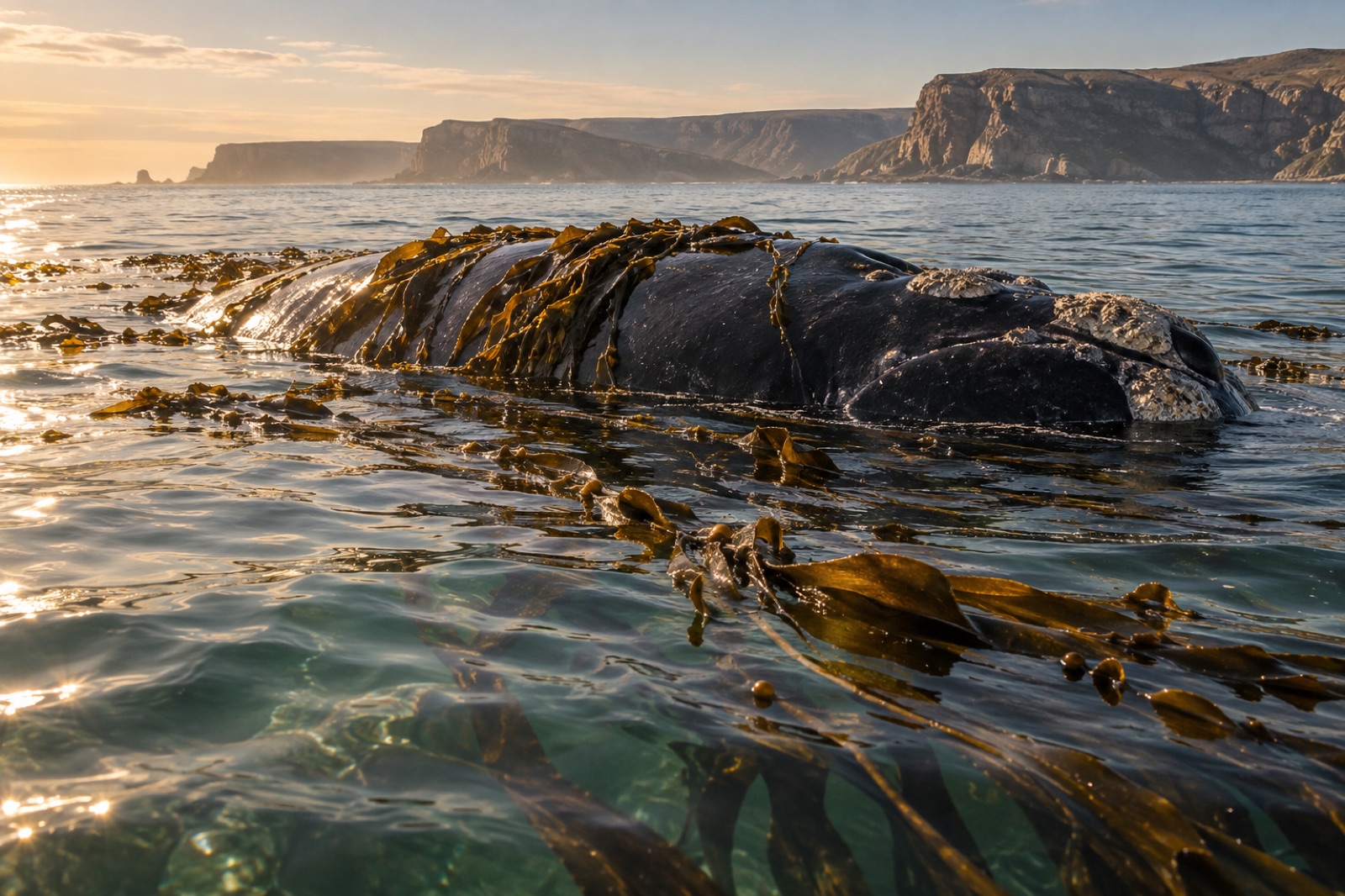
Boaters and divers off California have long reported gray whales interacting with kelp directly — rolling in streamers of giant kelp, wrapping blades and stipes around flippers and flukes, lingering in a bed for hours. The behaviour has a name: kelping. Nobody has definitively explained it. The plausible ideas overlap: the kelp may help dislodge skin parasites and loosen barnacles (kelp blades are mildly abrasive and some seaweeds carry compounds that discourage fouling), the beds offer stationary, wave-calmed rest for animals mid-journey, and — hardest to test, hardest to dismiss — it may simply be play. Whales play. Southern right whales off Argentina famously balance kelp on their heads; the gray whale of the kelp coast is unlikely to be more solemn.
The lagoons: where the species was saved
The migration's southern anchor is a string of shallow, warm, hyper-salty lagoons on the Baja California Peninsula — Ojo de Liebre (Scammon's Lagoon), San Ignacio, Magdalena Bay (our Baja coast atlas guide sets the geography) — where pregnant females calve from December onward. Calves are born in warm water free of killer whales and gain blubber fast on milk far richer than anything land mammals produce.
These lagoons are also the stage of a great conservation arc. Gray whales were hunted nearly to extinction in the nineteenth and twentieth centuries — Yankee whalers called them 'devilfish' for the violence with which mothers defended calves inside the lagoons — and the eastern population's recovery after protection, to the point of delisting in 1994, remains one of the signature good-news stories in marine conservation. The same lagoons now host carefully regulated whale-watching, famous for curious whales approaching small boats voluntarily — a behaviour visible nowhere else at that reliability.
Feeding flexibility — and trouble in the Arctic
The classical picture held that gray whales fed in the Arctic all summer and fasted the rest of the year on their blubber. Research over the past two decades has complicated it, encouragingly and worryingly at once. Encouragingly: gray whales are flexible foragers. So-called 'resident' or 'Pacific Coast Feeding Group' whales spend summer along the Pacific Northwest and British Columbia, suck-feeding on crab larvae and mysids near the surface, ploughing eelgrass meadows for ghost shrimp in Puget Sound, working the same productive shallows that feed the region's kelp forests.
Worryingly, the Arctic itself is changing. Unusual mortality events in 1999–2000 and again in 2019–2023 — when hundreds of thin, stranded whales turned up along the migration route — have been linked by researchers to poor feeding conditions on northern grounds as sea ice retreats and amphipod beds shift. A bottom-feeder is only as wealthy as the seafloor it grazes, and the gray whale's seafloor is warming. The species that survived the harpoon may yet find its hardest opponent is not a hunter but a menu.
What gray whales give the coast back
Gray whales are ecosystem engineers in the grazing-and-ploughing sense, but their economic and cultural returns are more visible: the winter migration supports whale-watching economies from the Olympic Coast to Baja, and for Indigenous communities from Siberia to Baja the whale carries millennia of subsistence and story. In a kelp-restoration frame, gray whales are a reminder that restoration grade isn't measured only in kelp stipes per square metre — it's measured in whether the coast still functions as a transit system, a nursery and a dining room for everything that has always used it. The kelp food web has whales in it.
Key takeaways
- Gray whales are the coast's own great whale — benthic suction feeders that live, migrate and calve within sight of shore, with the longest mammal migration on Earth at some 16,000–20,000 km round trip.
- Mother-and-calf pairs travel inside the kelp line, using the beds as shelter from swell and killer whales, and as known rest stops.
- Kelping — rolling, resting and wrapping in kelp — is a real, repeated behaviour, plausibly about skin care, rest and play, and still not fully explained.
- The eastern population is a rare recovery story (delisted 1994); the western population remains critically endangered, and unusual mortality events in 1999–2000 and 2019–2023 track a changing Arctic food supply.
- Gray whales are flexible feeders — an adaptability that helps, until the Arctic seafloor itself changes faster than the whales can follow.
FAQ
Where is the best place to see gray whales from shore?
Any prominent headland along the migration corridor during the windows: southbound in December–January, northbound February–May, mothers and calves April–May. Point Reyes, the Oregon and Washington headlands and the Vancouver Island west coast are classics; elevation and a northerly or southerly horizon view matter more than gear.
Do gray whales eat kelp?
No. Their diet is animal — seafloor amphipods on Arctic grounds, and mysids, crab larvae and shrimp on the way. The kelp is shelter, landmark and playground, not food; the connection runs through the shared productivity of the nearshore system rather than the plate.
Why are gray whales so covered in barnacles?
They carry a unique community of barnacles and whale lice that settles on the slow-moving, shallow-living whale as a larva and stays for life. Each whale's pattern is individually recognisable — researchers photo-identify whales partly by their 'crust'. It's commensal, not harmful: barnacles get a ride through food-rich water; the whale barely notices.
Are gray whales friendly?
In the Baja lagoons, adults frequently approach and even nudge small boats, apparently voluntarily — behaviour with no close parallel in any other whale population. Everywhere else, treat them as powerful wild animals in the middle of a migration and follow local approach rules; distance rules exist for the calves' sake as much as yours.
What threatens gray whales now?
Fishing-gear entanglement and ship strikes along the busy migration corridor, underwater noise, and — the slow big one — the transformation of Arctic feeding grounds as sea ice retreats. The 2019–2023 unusual mortality event, with hundreds of strandings, sharpened scientific attention on how thin a blubber margin the migration runs on.