Vancouver Island is nearly five hundred kilometres long, and almost every one of its shorelines grows kelp — but not the same kelp, and not the same story. The surf-pounded west coast holds annual bull kelp beds rebuilt from spores each spring. The sheltered inner coast threads golden beds through the Gulf Islands and the Strait of Georgia. And on the remote northwest tip, the sea otter — returned from local extinction just over fifty years ago — is still rewriting the ecology of the reefs it reclaims. Around all of it runs the oldest stewardship on the coast: the First Nations who have cultivated, harvested and governed these forests for thousands of years. This is the island-wide picture; for a deeper dive into the surf coast specifically, see our guide to Vancouver Island's wild west coast.
One island, three kelp worlds
Think of the island as three different kelp coasts stitched together.
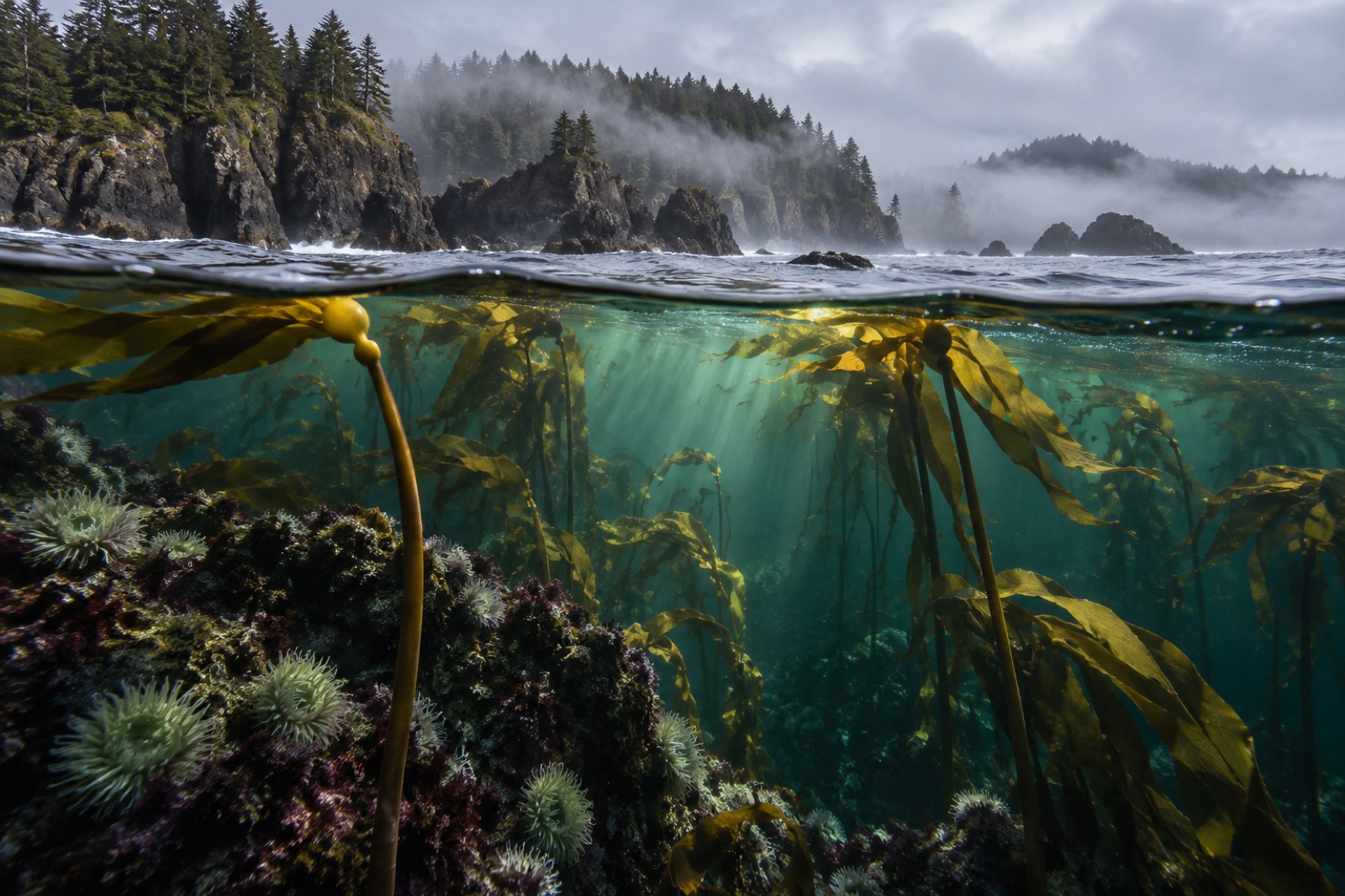
The outer coast — from the Strait of Juan de Fuca around to Cape Scott — takes the full Pacific. This is upwelling country: summer northwesterlies drag surface water offshore and pull cold, nutrient-rich deep water up onto the shelf. Bull kelp dominates, anchoring to exposed reefs in water that hovers between 7 and 14°C, with giant kelp holding the more sheltered pockets of Barkley and Clayoquot Sounds. Beds here are big, wild and seasonal — a forest felled by winter storms and regrown by June.
The north island frontier — from about Port Hardy to the Brooks Peninsula — is quieter water in every sense: fewer roads, fewer people, enormous ecological consequence. This is where sea otters were reintroduced to Canada, and where their slow spread north, south and into the fjords continues to flip reefs from urchin-grazed pavement back to forest, one bay at a time.
The inner coast — the Strait of Georgia and the island's east side — is the most populated, warmest and most stressed. Bull kelp here grows in narrower, more tide-swept beds around points and passes, from East Sooke up past the Gulf Islands to Campbell River. These beds are shallower, more accessible to kayakers and snorkellers, and more exposed to warm summers, marine heatwaves and urban runoff. Monitoring by community groups and the province has documented worrying thinning in some inner-coast beds during recent hot years — an early-warning system for what a warming coast looks like.
The otter frontier
The kelp story of the north island starts with an absence. Sea otters were hunted out of British Columbia during the maritime fur trade; the last was shot on this coast around 1929. Between 1969 and 1972, eighty-nine otters were flown down from Amchitka in Alaska's Aleutian Islands and released into Chekleset Bay, on the island's remote northwest side.
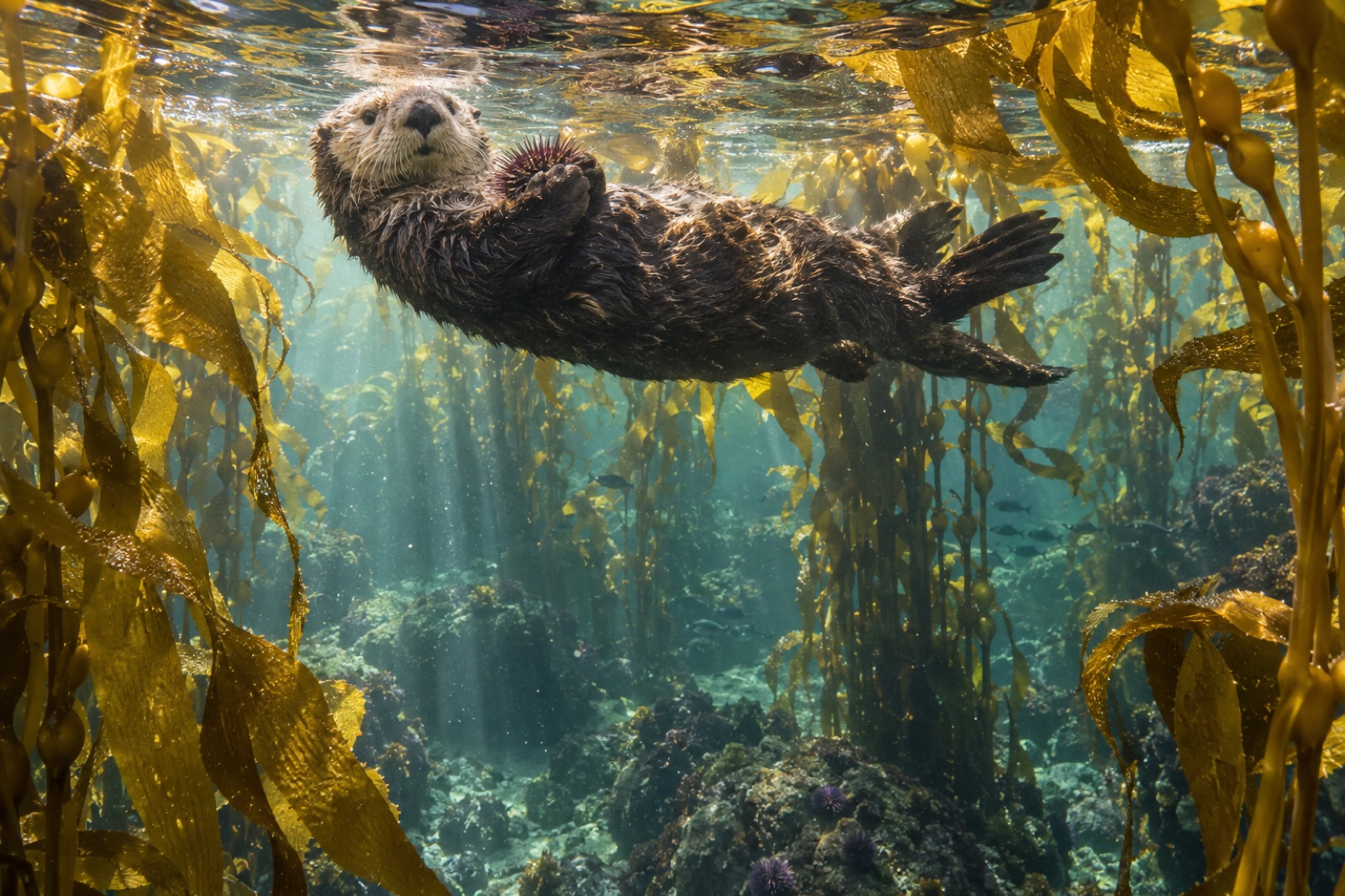
From that handful of animals, the BC population has grown into the thousands and now occupies most of the island's west coast and parts of the central mainland. The ecological signature is unmistakable, and if you dive or paddle along it you can sometimes see the front in a single day: urchin-choked rock where otters have not yet arrived, then — across an invisible line — dense bull kelp standing over grazed-down reef, the water full of the crack of shells being opened on furry bellies.
It is the classic trophic cascade, visible in real time. Otters eat urchins; released from grazing, kelp explodes; fish and invertebrate habitat multiplies. Research on this coast has put real numbers on the effect, finding more kelp, more fish and more carbon stored where otters hold territory. But the honest version of the story includes conflict: otters also eat the Dungeness crab, sea urchins and clams that coastal Nations and commercial fishers harvest. Co-management of that tension is one of the defining conservation conversations in Canada, and it is being led by the Nations themselves.
Herring on kelp: the fishery that predates the fur trade
Long before anyone measured a trophic cascade here, coastal Nations were farming kelp forests in every sense that matters. The clearest example is spawn-on-kelp: each spring, Pacific herring return to inshore waters and lay their eggs on vegetation — and kelp makes the finest substrate. Nations along the coast long ago turned this into a sophisticated cultivation, suspending fronds of giant kelp (and, in some places, hemlock boughs) in herring spawning grounds, then harvesting the egg-thick blades — a rich, storable food traded far inland along grease trails.
The practice is alive today. Heiltsuk, Haida, Nuu-chah-nulth, Kwakwaka'wakw and other Nations continue to harvest spawn-on-kelp and to fight for the herring stocks that underpin it. It reframes what a kelp forest is: not wilderness, but a tended garden with a title deed written in millennia of use. Kelp itself was also harvested directly — bull kelp stipes for fishing lines, ropes and containers, blades for food — and kelp bed locations remain embedded in place names, stories and tenure systems up and down the island.
Any serious restoration work in these waters therefore starts from tenure, not transplanting. It is the principle behind Tidewright's approach to community and Indigenous partnership: Nation-led monitoring, benefit-sharing, and governance that begins with rights-holders rather than consulting them afterwards.
The species that build the forest
Island-wide, two great canopy-makers divide the work.
- Bull kelp (Nereocystis luetkeana) is the exposed-coast architect — an annual that can grow its full twenty-metre stipe in a single summer, then vanish under autumn storms. Its beds are tide-tuned: strongest where current ensures a steady nutrient supply.
- Giant kelp (Macrocystis pyrifera) persists in sheltered sounds and parts of the inner coast, growing as a perennial, multi-stiped canopy at the northern edge of its range.
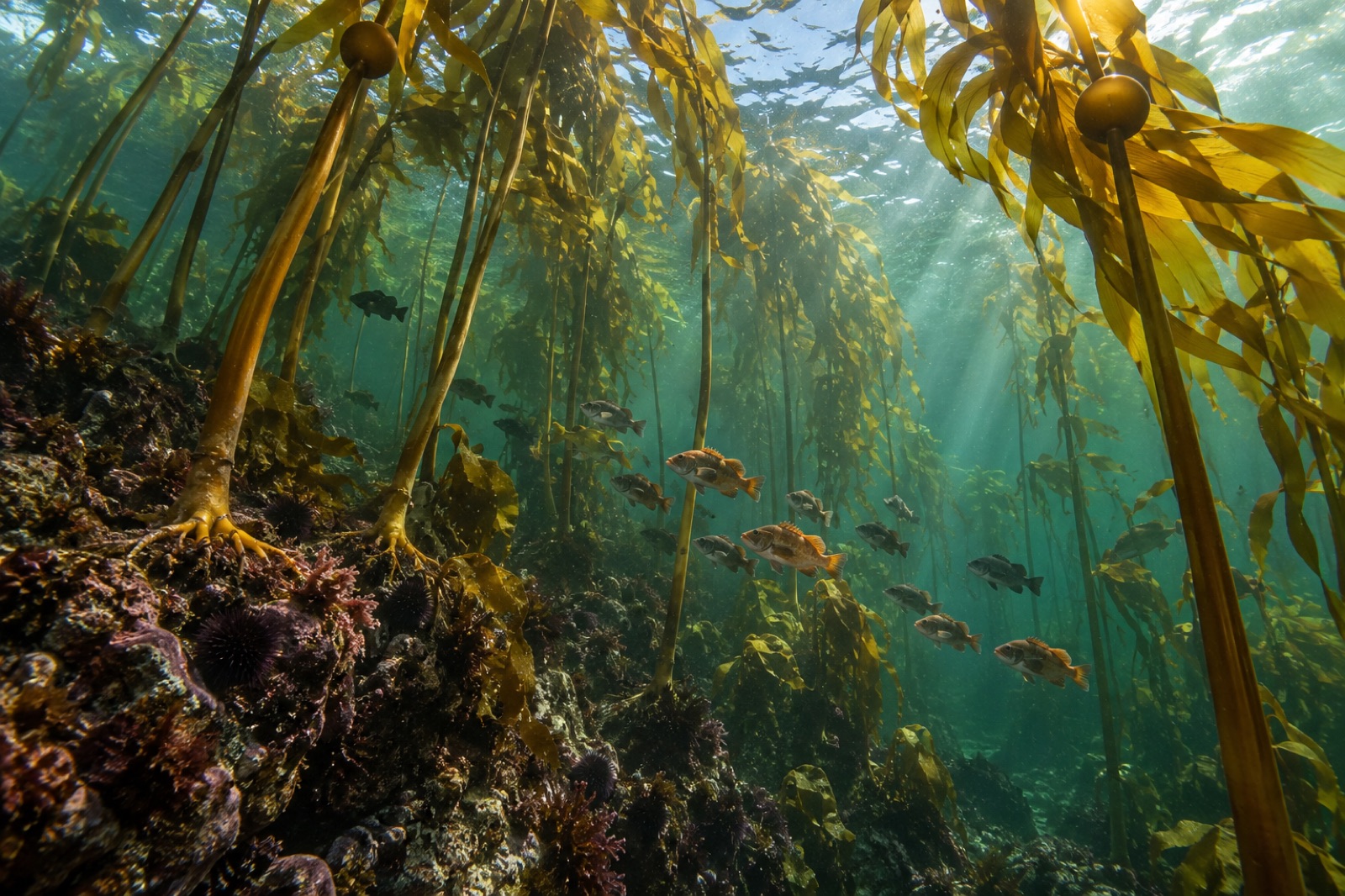
Around and beneath them: sugar kelp, winged kelp, feather boa kelp on the outer reefs, sea cabbage in the shallows, and a red-algal understory that divers describe as wading through a flower bed. The faunal cast is equally rich — hectares of rockfish habitat, wolf eels and giant Pacific octopus in the reef crevices, and harbour seals and Steller sea lions working the canopy edges.
One absence matters: the sunflower sea star, once the coast's great urchin predator, was devastated by wasting disease after 2013. On otter-free reefs — especially on the inner coast, where otters have not returned — the loss left green urchins with few controls, one reason inner-coast bull kelp beds have struggled compared to their otter-patrolled west-coast counterparts.
Seeing the forests for yourself
You do not need a drysuit to meet this coast's kelp, though certified divers will find superb shore diving around Port Hardy and Nanaimo and boat diving in Barkley Sound. Easier options:
- Paddle the Broken Group or Gulf Islands in late summer, when bull kelp beds are at full height and the water is calmest. Kayaking over a canopy at slack tide — blades streaming past a metre below the hull — is the best cheap seat in Pacific ecology.
- Visit the Ucluelet and Tofino beaches at low tide for feather boa kelp, drift bull kelp and the whole intertidal cast between forest and shore.
- Look for otters from shore between Tofino and Ucluelet, or on north island boat tours out of Port Hardy and Telegraph Cove; our otter-watching etiquette guide covers how to watch without disturbing.
- Time it right: beds peak August–October; winter storm-watching shows you the annual demolition phase that makes bull kelp forests so dynamic.
Wherever you go, remember that every one of these shores is someone's territory, many are protected through tribal parks and conservancies as well as provincial and federal parks, and the kelp beneath your kayak is managed — anciently or newly — whether you can see the management or not.
Key takeaways
- Vancouver Island holds three distinct kelp coasts: the upwelling-fed outer surf coast, the otter-recolonising north island, and the warm, pressured inner coast — each with its own kelp species mix and story.
- Sea otters, reintroduced from Alaska in 1969–1972, have restored the otter–urchin–kelp cascade across much of the west coast, with measurable gains in kelp, fish and carbon — and genuine fishery conflicts now being worked through Nation-led co-management.
- First Nations stewardship — epitomised by the living spawn-on-kelp herring fishery — is the continuity on this coast; restoration that ignores Indigenous tenure isn't restoration.
- The loss of sunflower sea stars to wasting disease has made otters the last major urchin control on many reefs, raising the stakes of their recovery.
- Late summer is the season to visit: paddle, dive or beach-walk the beds at their peak, and follow otter etiquette where the frontier animals have returned.
FAQ
Is the kelp around Vancouver Island healthy?
It depends sharply on which coast. Otter-occupied west-coast reefs generally hold dense, resilient bull kelp. Parts of the inner coast have seen beds thin or vanish during recent warm years, stressed by heat, urchins (no otters there) and runoff. Community monitoring is tracking the changes closely.
Can you see sea otters on Vancouver Island?
Yes — the west coast between Tofino and Ucluelet offers reliable shore-based viewing, and raft gatherings of males can often be seen near Bamfield and around the north island out of Port Hardy and Telegraph Cove. Keep your distance: use binoculars, stay quiet, and never position a boat between an otter and shore.
What is spawn-on-kelp?
A First Nations herring fishery in which kelp fronds (traditionally giant kelp) are suspended in herring spawning areas so the fish lay their eggs on the blades. The egg-coated kelp is then harvested and preserved. It remains an important food, trade item and assertion of Indigenous tenure.
Is bull kelp the same as giant kelp?
No. Bull kelp (Nereocystis luetkeana) is an annual with a single gas-buoyed bulb on a long stipe; giant kelp (Macrocystis pyrifera) is a perennial with many stipes and small floats along each frond. Vancouver Island grows both, mostly in different exposures.
Do I need a drysuit to dive here?
For comfortable diving, yes — water temperatures run 7–14°C year-round, and most local divers wear drysuits. Some hardy souls dive thick wetsuits in summer. If you're new to cold water, read our beginner's guide to kelp diving first.