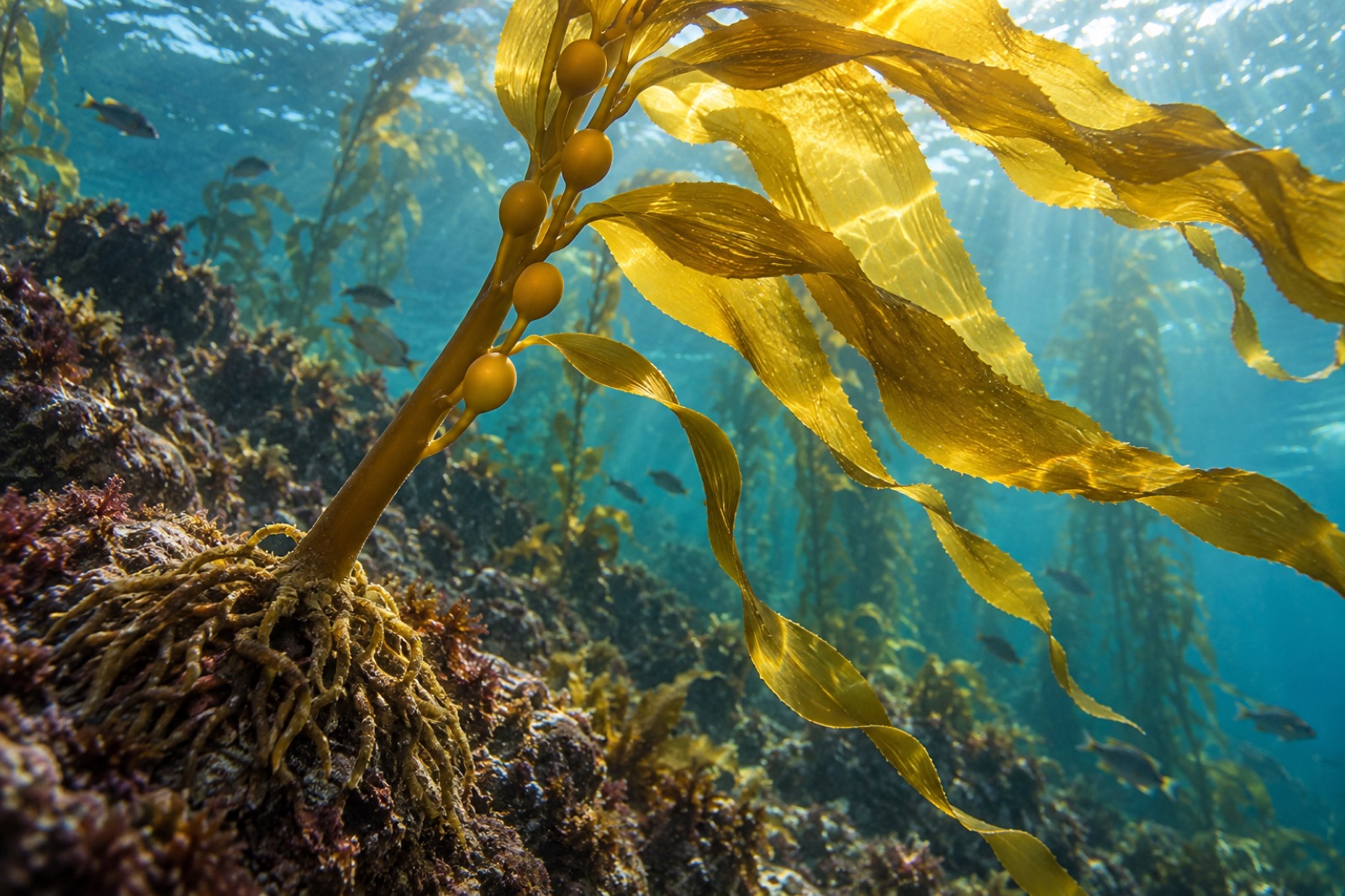
Catalina is where American kelp diving grew up. Twenty-two miles off the Los Angeles coast, the island's leeward slopes host southern California's most famous — and most dived — forests: giant kelp on pebbled granite, state-fish garibaldi stacked like orange flags, lobsters thick along the Avalon breakwater, and one of the longest residential marine-science communities on the West Coast. This guide covers Catalina's kelp geography, its growers and grazers, the science history, the dive sites, and the practical day-trip or liveaboard routes to the canopy.
Where the island is, and why its kelp stands out
Catalina Island (Santa Catalina, official) lies in the Southern California Bight, its 76-km length oriented northwest to southeast. Geographically it sits in a warm-water pocket: the mixing zone where the cold California Current gives way to Bight water, warmed further by island shadow and periodic eddies. Water temperatures at the kelp line are commonly a few degrees warmer than the coast opposite.
Two consequences follow:
- Warm-edge forests. Catalina's kelp lives near the species' thermal tolerance limit. In warm years (most famously the El Niños of 1982–83 and 1997–98), giant kelp was stripped to near-nothing along whole island exposures. In cooler years, it rebounds with spectacular speed onto the same bedrock. The island is thus a century-long time-lapse of kelp's sensitivity to temperature — which is exactly why researchers chose it.
- Clear water around the corner. Catalina's offshore position gives it cleaner water than mainland LA. Around the island's back side (the Pacific-facing west), vis of 20–30 m is ordinary on calm days — some of the best big-kelp visibility on the coast.
The island is 88% owned and managed by the Catalina Island Conservancy; the city of Avalon at the southeast tip is the tourism centre. Kelp lines the whole island's rocky shore, densest and most accessible on the leeward east coast facing the mainland.
A century of kelp science
No kelp forest in the world has been more closely watched than Catalina's. In the 1950s–60s, Wheeler North and colleagues at Caltech studied the island's kelp for commercial interests, producing the foundational science of Macrocystis: its growth rates, holdfast dynamics and nutrient limits. The Wrigley family's love for the island later endowed the USC Wrigley Institute for Environment and Sustainability and its marine science centre at Big Fisherman Cove — a working research station whose divers have been counting kelp, urchins and fish for decades.
Two Catalina findings entered the kelp canon:
- Kelp here cycles with temperature. Long-term observers watched the 1982–84 El Niño strip the forests, the La Niña recovery that followed, and the 1997–98 event do it again — the clearest historic record of kelp's heat sensitivity on the coast. Our explainer on marine heatwaves places that record into the modern climate frame.
- The bottom is as important as the top. Catalina divers documented urchin fronts and barrens on the same reefs repeated canopy recoveries, showing that kelp recovery depends on whether purple and red urchins get back into their crevices — a bottom-up reading of a top-down ecosystem.
That dual perspective — satellite canopy maps layered over diver transects — is one Tidewright's own reef work inherits almost directly from Catalina-era method. Our platform sits downstream of that science.
The wildlife story
Giant kelp is the frame, but the cast is why people come back every year:
- Garibaldi: the brilliant orange state fish, fiercely territorial over neat red-algae nests on the rock — in many ways the symbol of California kelp.
- California sheephead: the big, black-and-red wrasse moving through canopy and reef edge, males heavy-jawed with age.
- Giant sea bass: protected since the 1980s and now seen regularly again in Catalina kelp — a recovery story anchored at this island.
- Giant Pacific octopus? Rarer here than at the northern Channel Islands; cold-water island species thin out at Catalina's warmer water.
- Flying fish and leopards: leaping California flying fish in summer over the canopy edge; leopard sharks in the sandy flats inside Avalon Bay.
- Island endemics: the Catalina Island fox, the island scrub-jay, and the island's uniquely evolved plant chaparral — a reminder the whole system runs from kelp to ridgeline.
Where to dive
Catalina is the most-dived island in California for a reason — every level of diver finds a site:
- Casino Point Underwater Dive Park (Avalon): the classic. Stairs into clear kelp over a pebbled bottom sloping to 30 m. Dense kelp shallows, a kelp forest ridge, and deeper small wrecks (the SueJac sits at 25–30 m nearby) make this the standard first ocean-dive site in California. Air fills and rental gear on site; reserve classes or guided dives on summer weekends.
- Lover's Cove (Avalon): a protected cove — snorkellers and glass-bottom boats thick with garibaldi. Easy first immersion in kelp-shore wildlife.
- Farnsworth Bank (back side): an offshore seamount covered in purple hydrocoral, reachable by day boat. Advanced, current-prone, and genuinely special; a bucket-list southern California dive.
- Ship Rock (back side): a wind-washed offshore islet with clear water, huge kelp, and reliable big-animal chance — mola mola in summer, sea lions year-round.
- Italian Gardens (east end): long, shallow, beautiful kelp meadow on clean rock, usually dived by boat in calm weather.
- Big Fisherman Cove (Wrigley Marine Science Center): not a public dive site (research reserve), but the reason divers and scientists keep Catalina at the centre of kelp conversation.
Access and timing
- Ferries: Catalina Express runs daily from Long Beach, San Pedro and Dana Point; Catalina Flyer from Newport Beach. Roughly an hour crossing.
- Best season: August–October for warm water and vis; winter is colder and swells can push in, but crowds are thin and wildlife (yellowtail, occasional whales) strong. Spring winds make the channel rough.
- Book ahead on summer weekends — Avalon at capacity is a real phenomenon.
- Divers bringing or renting: Casino Point has compressors and a fill station on site; back-side sites are boat trips through Long Beach or Avalon operators, or liveaboards.
The forest's future on a warming coast
Catalina is a few degrees into kelp's warm edge already. Projections suggest the island's kelp will continue to thin in warm decades and recover in cool ones, with an overall long-term downward pressure unless climate stabilises. The island is thus both a destination and an early-warning system. It is also, for Tidewright's purposes, an inspiration: the same coast that demonstrated kelp's heat sensitivity demonstrates its capacity to recolonise when temperature, grazing pressure and seedstock line up — the alignment our own Holdfast seedstock work exists to create in places that have lost their natural seed stock.
Key takeaways
- Catalina Island sits in southern California's warm-water pocket; its kelp cycles dramatically with warm and cool years, making it a natural climate laboratory.
- Caltech research (Wheeler North era) and the USC Wrigley Marine Science Center have given the island an unmatched long-term kelp dataset.
- Casino Point Underwater Dive Park in Avalon is southern California's classic first ocean dive and the standard gateway to kelp.
- The back-side sites — Farnsworth Bank and Ship Rock — offer advanced, world-class diving for experienced divers.
- The island's kelp future is tied tightly to ocean temperature; Catalina doubles as tourist draw, research station and climate early-warning system.
FAQ
Is Catalina good for beginner divers?
Yes — Casino Point is one of America's classic first ocean dives: stairs entry, shallow kelp, on-site facilities. Go with a local instructor or guide for the first dive, and arrive early on summer weekends when the park is busy.
Can you dive Catalina as a day trip from LA?
Easily. An early ferry from Long Beach or San Pedro puts you at Casino Point by mid-morning; an evening boat back. Bring or rent gear on the island; fills and rentals are on site at the dive park.
When is Catalina diving at its best?
August–October for warmth and vis. November–March is colder (14–17 °C) and windier, but empty and clear. April–June is windy, plankton-green and the least dived.
Is the kelp still at Catalina after the El Niño damage?
Yes — and it has already cycled back more than once. Post-1998 recovery was faster than researchers initially expected where urchins stayed suppressed, and subsequent warm years have thinned rather than removed the forest. You will see kelp on a normal dive any year.
What's the difference between Avalon and the back side?
Avalon sites (Casino Point, Lover's Cove) are sheltered, beginner-friendly and accessible by staircase from town. The back side (Farnsworth, Ship Rock, Italian Gardens) is boat-accessed, advanced and clear-watered — a different trip both practically and in difficulty.