Atlas9 min read
Falkland Islands: The Engine of Southern Ocean Kelp
Inside the Falkland Islands' giant kelp beds — among the most extensive on Earth — and the penguins, seals and steamer ducks that run on them.
Dr. Lena Fischer ·
Península Valdés pairs Patagonia's most famous whale nursery with giant kelp beds at the edge of the steppe — plus one of the kelp world's sharpest invasion stories.
Most coasts ask you to choose between the big, famous wildlife and the forest beneath the surface. Península Valdés refuses. On this flat thrust of Patagonian steppe, jutting into the Argentine Sea between two gulfs, southern right whales raise their calves in water so shallow their backs graze the sand, orcas beach themselves on purpose to take sea lion pups — and offshore, in the clear, cold water of the gulfs, grow some of the western South Atlantic's best-loved kelp beds, close enough to the whale lookout at Puerto Pirámides that you can watch both in a single day. This guide covers the forest half of that story: where the kelp grows, who lives in it, the invasive seaweed that arrived in a yacht basin and rewrote the coastline's ecology, and how to see it all yourself.
Geography makes Valdés. The peninsula is a table of dry steppe about the size of a small country connected to the mainland by a narrow isthmus, the Istmo Carlos Ameghino. North of the isthmus lies Golfo San José, open and wind-scoured; south of it, Golfo Nuevo, deeper, calmer and enclosed — the gulf the whales chose. The whole complex reaches into the Argentine Sea, the broad shelf sea driven north by the cold Malvinas (Falklands) Current.
That current is the kelp's lifeline. As described in our guide to boundary currents, where the cold Malvinas flow meets the warm Brazil Current — the Brazil–Malvinas Confluence, offshore to the east — the ocean builds one of the most productive fronts on Earth. The shelf waters around Valdés sit on the cold side of that argument: nutrient-bearing, rarely warm, and rich enough to support the vast fisheries of the Argentine shelf. Water in Golfo Nuevo runs cooler than the open coast in summer, and the gulf's great depth for an enclosed basin gives kelp room to work.
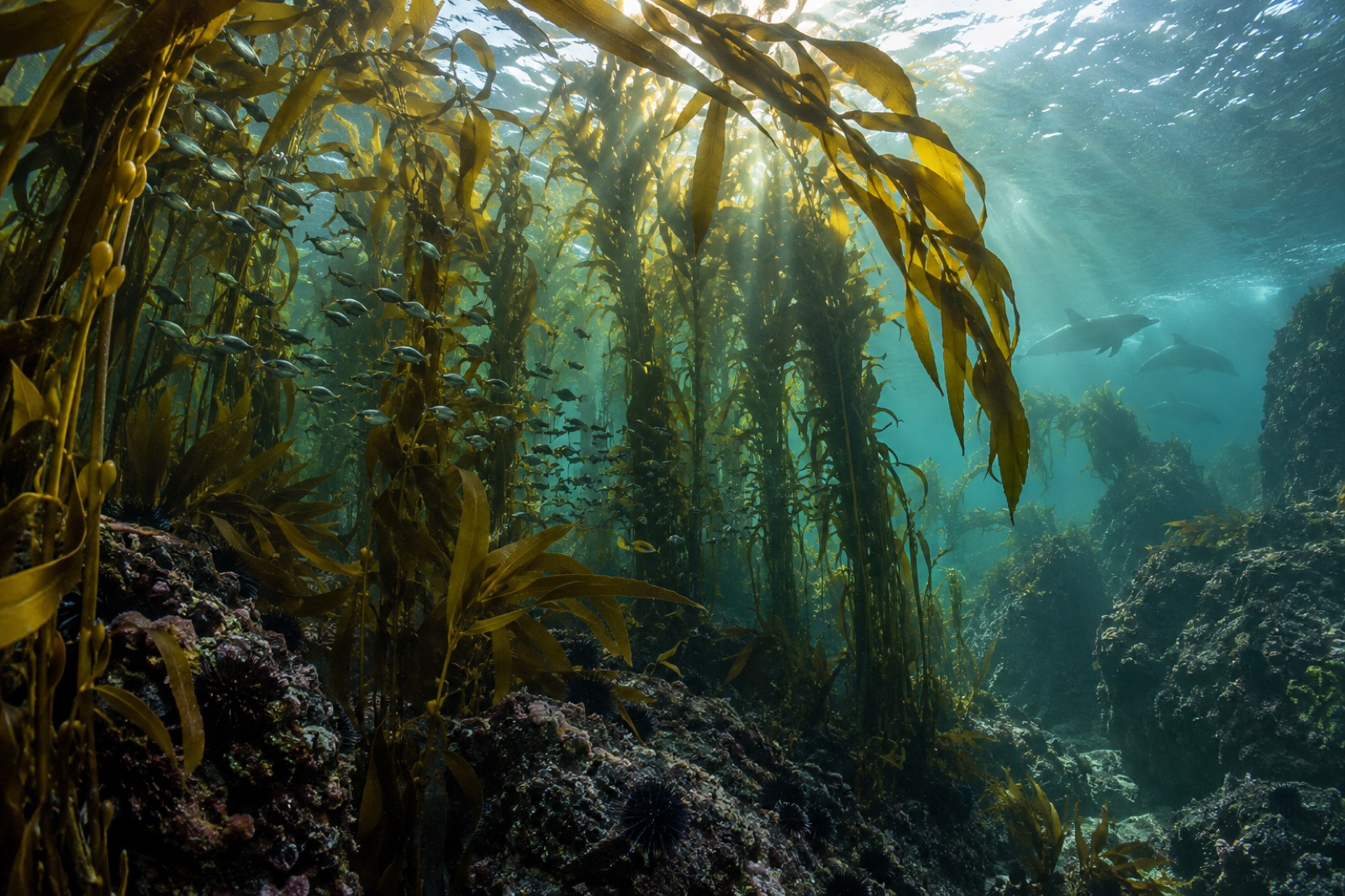
The forest-former here is the same architect that built the forests of the Strait of Magellan and the Falkland Islands: giant kelp, Macrocystis pyrifera. Around Valdés it grows as subtidal beds on rocky reef and boulder ground in roughly five to fifteen metres, forming surface canopies in the deeper stands and thick summer growth in the shallows. Fringing beds run along parts of the Golfo Nuevo shoreline and around the peninsula's points, wherever the steppe's cliffs put rock instead of sand under the tide line.
Two things make Valdés kelp distinctive. The first is the backdrop: this is kelp against a desert. Where Tasmanian or Californian forests grow under green hills, these beds lie under baked yellow steppe, guanaco country, a coastline of gravel beaches and salt flats — the last place a first-time visitor expects a lush subtidal forest. The second is the relative absence of industry. Unlike Chile's Humboldt coast, where wild kelp supports a major harvest economy, the Argentine beds have never supported a comparable kelp industry. The forest here is valued — and increasingly studied — chiefly as habitat and heritage.
Under the canopy: red king crabs in the cold south, benthic communities studied intensively out of Puerto Madryn's marine institutes, octopus in the reef hollows, and raft-sized schools of fish using the structure the way kelp fish do everywhere on Earth.
Valdés also holds one of the kelp world's most instructive cautionary tales. In the early 1990s, wakame — Undaria pinnatifida, the Japanese edible kelp — was detected in Golfo Nuevo, almost certainly arrived on vessel hulls or in ballast. It took to the gulf immediately: wharves, moorings, aquaculture gear and eventually natural reef. Puerto Madryn, the diving city on the gulf's western shore, became its Argentine capital.
The invasion matters for two reasons. Ecologically, Undaria is a fierce competitor for space on shallow reef and can displace native understory algae and young Macrocystis recruits; managers run removal programs on the worst-affected natural reefs, and recreational divers are recruited to the effort. And instructively, the Gulf of Nuevo invasion is now one of the best-documented seaweed invasions in the Southern Hemisphere — a natural experiment that has taught the world how a kelp invades, who wins, and what limits the invader. For anyone thinking about biosecurity on working coasts, it is recommended reading written in water. Our wakame species profile tells the species' double life as food and invader in full.
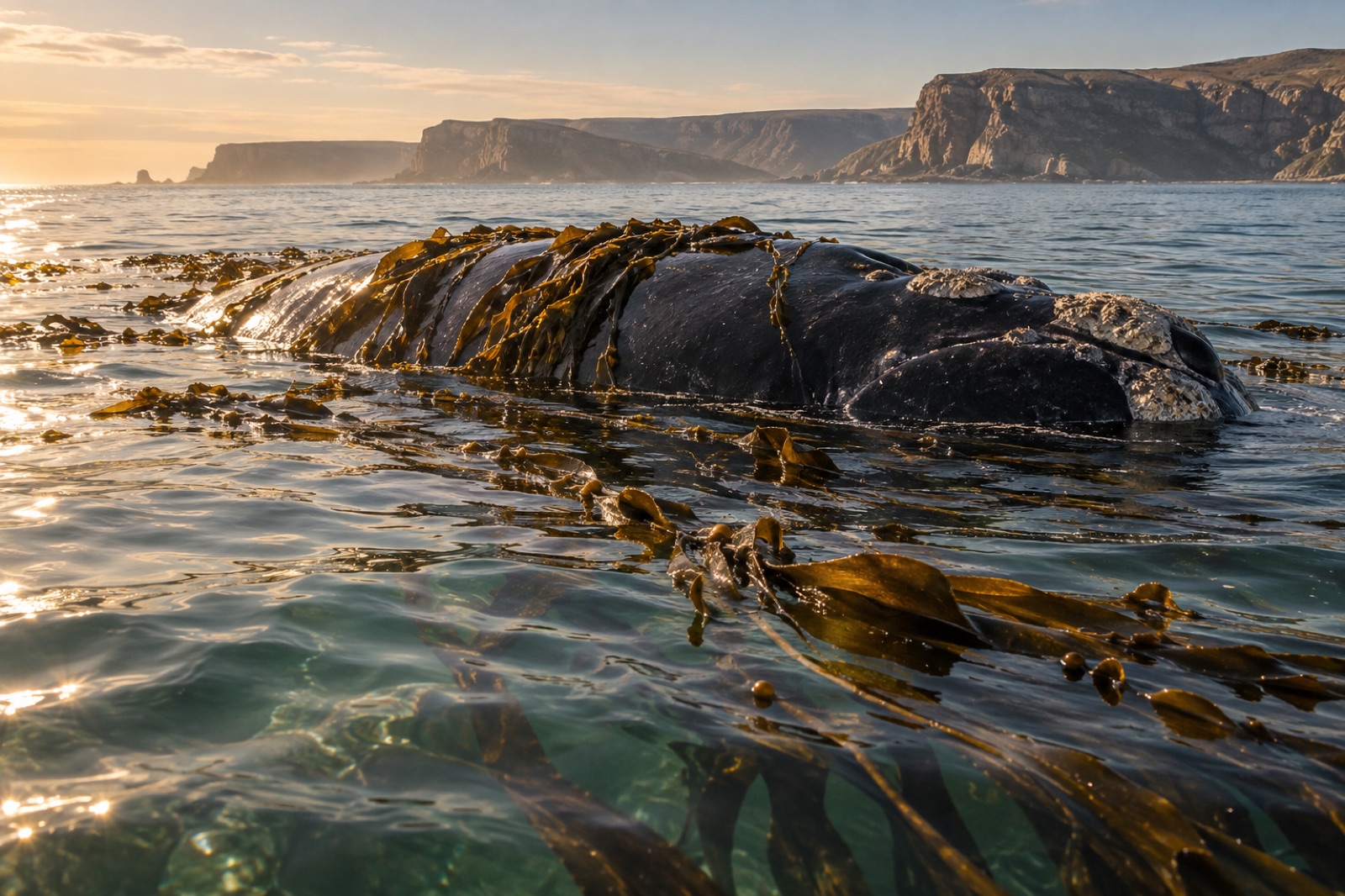
You cannot write honestly about Valdés kelp without the animals above it. June to December, southern right whales crowd the gulfs to calve — Valdés is a core reason the species recovered in the southwest Atlantic — and mothers rest at the surface in water so glassy you can see the tar-coloured calves nursing. Right whales here are famous for something subtler too: they deliberately gather kelp fronds on their backs, draping the weed like a shawl. Researchers call it "kelping" and argue about whether it is play, sensation or social signalling; what's certain is that the whales seek the kelp out, again and again. Our whale–kelp profile covers the behaviour in depth.
The rest of the cast needs no introduction: orca pods at Punta Norte practising the intentional-stranding hunt on sea lion pups in the autumn swell, one of the only places on Earth the behaviour is regular; southern elephant seals hauling onto the gravel in their thousands; South American sea lions ashore and in the kelp edge year-round; Magellanic penguins in their hundreds of thousands down the coast; and kelp gulls working every shoreline. The kelp forest is not the headline act at Valdés — but it is the stage the acts are built on.
Valdés is a reminder that kelp forests are not a niche habitat tucked away from the celebrated ocean — in the right geography they are the ground floor of it, holding up the food and the calm water that the famous animals need.
Giant kelp, Macrocystis pyrifera, forms the main subtidal forest on rocky reef and boulder ground, mostly between five and fifteen metres deep. The invasive Japanese kelp Undaria pinnatifida (wakame) is widespread in shallower water and on artificial structures inside Golfo Nuevo.
July through November gives the peak of the southern right whale season in Golfo Nuevo, and the kelp beds are present year-round. Diving is possible in all seasons with the right exposure protection; visibility is generally best outside the windiest spells.
Not on any significant scale. Unlike Chile or parts of southern Argentina, the beds around Valdés are valued for habitat, diving and research rather than an industrial harvest, and the gulfs carry strong protection because of the whale nursery.
No. Undaria competes hard for shallow space and dominates wharves and disturbed reef, but the native giant kelp beds persist, and ongoing removal and monitoring programs keep pressure on the invader at sensitive natural sites. The invasion is a burden, not an extinction.
The Falklands hold far more extensive, colder and denser giant kelp forests — among the most productive on Earth per kilometre of coast. Valdés is the warmer, desert-fringed northern expression of the same species, remarkable less for scale than for the wildlife theatre staged above it.
Inside the Falkland Islands' giant kelp beds — among the most extensive on Earth — and the penguins, seals and steamer ducks that run on them.
Dr. Lena Fischer ·
Inside the subantarctic kelp forests of the Strait of Magellan and Tierra del Fuego: cold clear water, drifting kelp highways, and science at the southern frontier.
Dr. Elias Brandt ·
The southern right whale is a slow, southern giant with a calloused head — and a documented habit of draping itself in kelp. Its biology, recovery and kelp play.
Dr. Mara Ellison ·