Encyclopedia8 min read
Black Oystercatcher: The Rocky-Shore Sentinel
Black oystercatcher Haematopus bachmani: the rock-loving sentinel of the Pacific coast — habits, tiny population and what it reveals.
Dr. Mara Ellison ·
The kelp gull is the default large gull of the southern oceans — an adaptable black-backed coastal bird from Cape Town to the Antarctic Peninsula. Full profile.
Stand on almost any kelp-fringed beach south of the equator — Cape Town, Montevideo, Bluff, Ushuaia, Perth — and the large gull scowling at you from the wrack line is almost certainly the same bird. The kelp gull (Larus dominicanus) is the southern hemisphere's answer to the great black-backed gull: one of the most widespread and successful coastal birds on the planet, a generalist so adaptable it has colonised everywhere from Antarctic research stations to tropical Brazilian landfill sites. Wherever the southern bull kelp washes wrack onto a beach, the kelp gull is there, working the fat strand line like a dockside foreman.
This profile covers identification, the species' extraordinary range and recent expansion, its ecology and behaviour, and its surprisingly direct relationship with kelp forest ecosystems.
| Scientific name | Larus dominicanus |
| Family | Laridae — gulls, terns and skimmers |
| Size | 54–65 cm; wingspan 128–142 cm; ~900–1,400 g |
| Adult plumage | White head and body, black upper wings, yellow bill with red spot, greenish-yellow legs |
| Range | Southern hemisphere coasts: Australasia, South America, southern Africa, subantarctic and Antarctic islands; expanding into North America |
| Diet | Everything: wrack-line invertebrates, fish, eggs, offal, carrion, refuse, shellfish dropped onto rock |
| Nesting | Colonial, on coastal islands, beaches, islets — and increasingly urban rooftops |
An adult kelp gull is a handsome, no-nonsense bird: brilliant white head and underparts, a slate-black back and upper wings, a strong yellow bill with a red gonys spot, and legs the colour of old lemons. In flight the black wing ends in bold white "mirrors." Juveniles pass through two or three years of mottled brown plumage — scaly, muddy and easily confused with other brown gulls — before approaching the crisp adult pattern.
Distinguishing marks against similar species: it is larger and longer-winged than any other common gull across most of its range, and that hemispheric dominance helps — on most beaches south of the tropics, if it is a big black-backed gull, it is a kelp gull. The calls are the classic gull repertoire: a laughing kyow-kyow-kyow, short yelps, and the full-throated "long call" thrown forward with the head — the default voice of the southern coastline.
The kelp gull is one of very few birds with a genuinely circumpolar southern range. Its domain takes in:
And then there is the expansion. Through the late twentieth and early twenty-first centuries, kelp gulls have appeared — and in some places established themselves — well north of their historic range: breeding adults in tropical Brazil and even a handful of mixed-species pairings and occurrences in North America and the tropical Indo-Pacific. It is among the most emphatic examples of a native generalist species exploiting an increasingly human-shaped coast. Rubbish tips, harbours and fish-processing towns are all kelp gull country; a bird that scorns waste makes wealth from ours.
The kelp gull is named for the habitat it patrols: the kelp coast, and particularly its wrack line. After every blow, tides and storm swell dump wet rafts of detached kelp onto beaches — the wrack, whose ecology our drift-kelp explainer describes. Kelp gulls are the strandline's doormen. They stalk up and down these sodden piles picking out amphipods, sandhoppers, kelp flies, small crustaceans and anything else stranded with the kelp, grabbing intertidal morsels, working around the black oystercatchers and teal that share the same line.
Beyond the wrack-line specialism, the kelp gull is a pure opportunist, all the way to the darker corners of gull ecology:
Kelp gulls nest colonially but loosely, on low coastal islands, cliff ledges, rocky islets, beaches and dunes — and increasingly on rooftops and harbour structures in coastal cities across their range. The female typically lays two to three mottled olive-brown eggs in a shallow seaweed-grass scrape, and both parents share incubation for around four weeks. Chicks fledge at roughly seven or eight weeks. Colony timing varies across the range with latitude — austral spring through summer in the temperate south, earlier in the tropics, tightly seasonal in the Antarctic.
On beaches and islands shared with rare birds, kelp gulls are sturdy defenders of their own nests — which, combined with their taste for their neighbours' eggs, makes them one of the harder neighbours a conservation-sensitive colony can have.
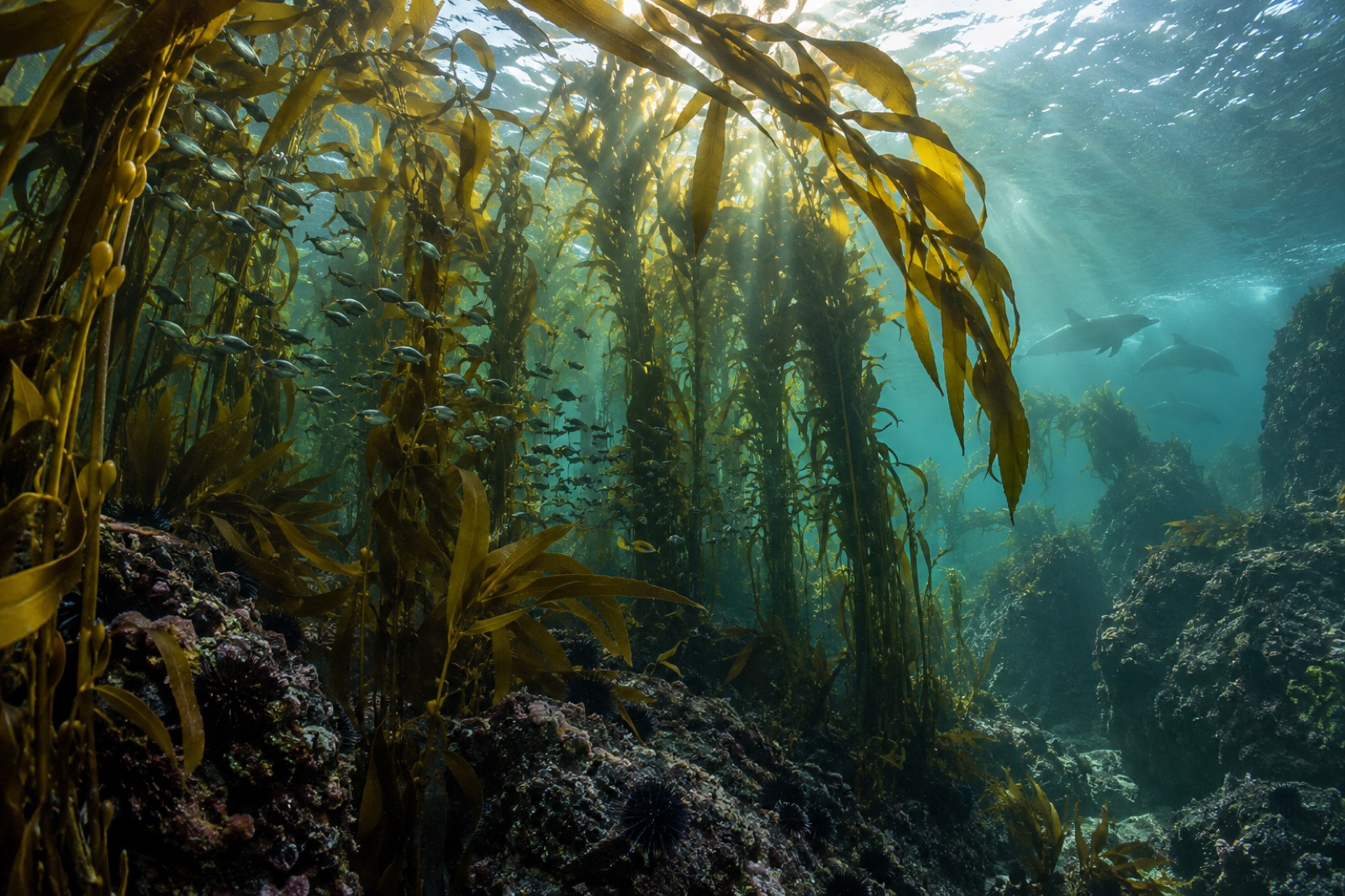
The kelp gull's namesake habitat is more than a backdrop — it is, in a sense, what the species' entire ecological niche maps onto. Kelp forests push their surplus production out of the water: storm-thrown wrack, stranded invertebrates, the nutrient-rich strandline of a working coast. That surplus, arriving daily on southern beaches, is precisely the kelp gull's larder. A healthy bull-kelp coast is, for this species, a permanently restocked one. It is one of the more visible threads through which the kelp forest feeds life above the waterline — the bird-every-person-sees standing on the strand line, wearing the kelp coast's uniform.
The gull's stellar success, of course, belongs to its generality, not to kelp alone — it prospers off fish scraps and landfills as well — but one measure of a coast's health is worth watching in any gull: when kelp beds hold and coastlines thrive, the wrack line thrives, and so does everything that works it, gulls included. It is part of the reasoning that guides Tidewright's coastal surveys, where strand-line surveys of wrack communities form part of the wider biodiversity record.
Because kelp-coast beaches are its hallmark habitat. The species is a specialist forager of the strand line of kelp coasts — the tide line where wrecked kelp washes ashore carrying crustaceans, kelp flies and other edible life. That wrack-line niche, repeated around the southern hemisphere, is what the bird is named for.
Across the southern oceans: South Africa and Namibia, Australia's southern coasts, coastal New Zealand, temperate and subantarctic South America, and colonies as far south as the Antarctic Peninsula. Its range is expanding, with breeding now recorded north into tropical South America.
They are assertive, bold gulls — territorial at the nest, confident around people at harbours, and predatory within seabird colonies, where they take eggs and chicks of terns and other birds. That assertiveness is routine gull nature rather than aggression directed at humans; give nesting colonies space and they are easy to coexist with.
Almost anything: wrack-line crustaceans and kelp flies, fish and offal, shellfish and sea urchins cracked by dropping, carrion, eggs and chicks of other seabirds, fishing scraps and human refuse. Their total generality is exactly what has made them so successful.
Not at all — the name describes their ancestral strandline niche, but they are generalists, as comfortable at a city dump or fishing harbour as on a bull-kelp beach. The kelp coast remains their emblematic habitat, and where kelp thrives, the strandline bounty it generates keeps them fat.
Black oystercatcher Haematopus bachmani: the rock-loving sentinel of the Pacific coast — habits, tiny population and what it reveals.
Dr. Mara Ellison ·
Inside the Falkland Islands' giant kelp beds — among the most extensive on Earth — and the penguins, seals and steamer ducks that run on them.
Dr. Lena Fischer ·
Guide to the Cape Peninsula's kelp forests: two oceans, sea bamboo, seals and sharks, freediving culture, and how a warming world is shifting the reefs.
Tom Okafor ·