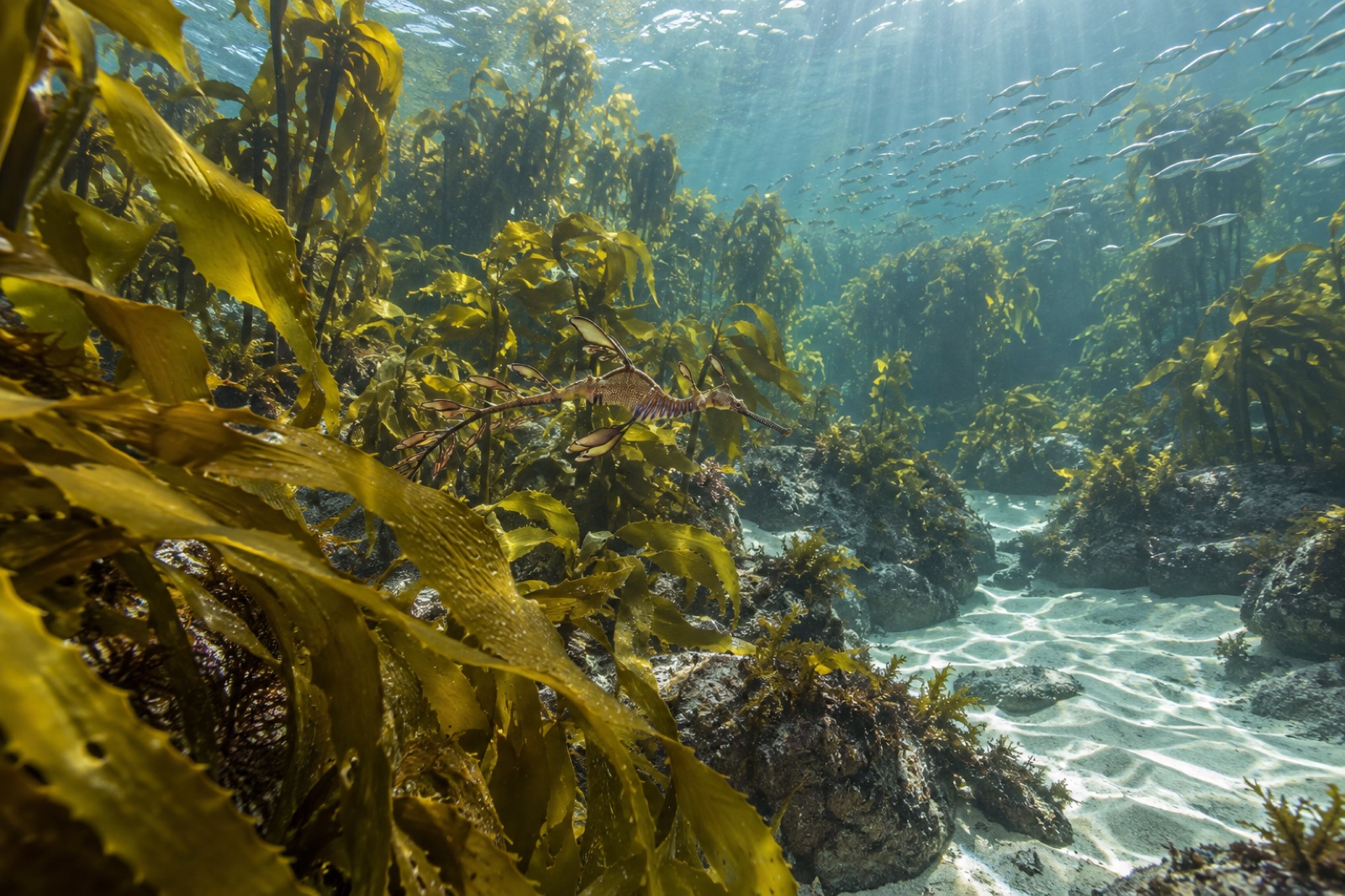
Few places on Earth let you swim in a kelp forest before breakfast and drink coffee above a penguin colony by nine. The Cape Peninsula — the finger of mountain and sandstone that ends at Cape Point, south of Cape Town, South Africa — is one of the world's great kelp coastlines, and one of its most unusual. Two ocean currents meet here. Two very different marine worlds sit a few kilometres apart. And in the sheltered coves between them, kelp forests thick enough to darken the water have become a global emblem of what a temperate reef can be.
This guide covers where the forests are, what grows and lives in them, how to experience them from the shore and in the water, and what the future holds for kelp at the edge of a continent.
Where two oceans argue
The classic story is that the Indian and Atlantic Oceans meet at Cape Point. The truth is subtler — the boundary wanders — but the ecological reality behind the story is genuine. The peninsula's western, Atlantic-facing shore is swept by the cold Benguela Current, driven by wind-fed upwelling that pulls deep, nutrient-rich water to the surface. Summer water temperatures here can be startlingly cold, often in the low teens Celsius.
The eastern shore, inside False Bay, is influenced by the warm Agulhas Current spilling around the continent from the Indian Ocean. Water there runs several degrees warmer. If you are unfamiliar with the engine behind the cold side, our explainer on upwelling and the nutrients that feed kelp forests gives the full mechanism.
The result is a peninsula with a split personality: chilly, extraordinarily productive kelp beds on the Atlantic side, and warmer, more biodiverse reefs — with kelp fringing many of them — inside False Bay. For a single headland, that is an absurd concentration of marine life.
What grows here: sea bamboo and its kin
The Cape's canopy is built by species most kelp lovers elsewhere have never heard of:
- Sea bamboo (Ecklonia maxima) is the giant of the west coast. It grows a long, hollow, gas-filled stipe that lifts its blades to the surface, forming a buoyant canopy that can reach ten metres or more. Storm-torn sea bamboo fronds pile up on beaches after winter swells, and that beach-cast kelp feeds an entire strand-line economy of isopods, amphipods, birds and bacteria.
- Split-fan kelp (Laminaria pallida) dominates deeper water, holding its fronds below the surface where the swell is less violent.
- Bladder kelp and bamboo-like understorey species fill the gaps, alongside a dense turf of red algae, sponges and sea fans in the warmer bay.
Sea bamboo is a relative of the Australasian golden kelp — if you know Ecklonia radiata from Australia and New Zealand, you will recognise the family shape immediately, scaled up. Notably, the giant kelp Macrocystis pyrifera that dominates California, Chile and the subantarctic is absent here; the Cape canopy belongs to the Ecklonia lineage.
The wildlife: seals, sharks and "sharks' alarms"
A Cape kelp forest is not a quiet garden. It is closer to a crowded, well-patrolled city.
Above the canopy
African penguins commute past the kelp at Boulders Beach and Stony Point. Cape gannets, cormorants and African oystercatchers work the shallows. Cape fur seals haul out by the thousand at colonies like Duiker Island off Hout Bay, and their porpoising through the surface canopy is one of the great sights of temperate diving.
In the forest
Sevengill cowsharks — big, spotted, prehistoric-looking predators — cruise the channels inside False Bay and are a signature encounter for divers. Smaller catsharks, shysharks and pajama sharks are everywhere if you look. Red Roman and hottentot seabreams pick through the fronds, and octopus — made globally famous by the documentary filmed in these very forests — dens in shell-lined holes on the sand channels between kelp stands.
The missing giant and the new arrivals
For decades, great white sharks were the bay's apex presence, hunting seals around Seal Island. In recent years their numbers in False Bay have collapsed, coinciding with the appearance of orcas that prey on large sharks. The reshuffle is a live lesson in how quickly food webs can reorganise — the kind of top-down ecology explored in our piece on trophic cascades in kelp forests.
Experiencing the forest
Freediving and snorkelling
The Cape Peninsula has quietly become one of the world's freediving capitals, and the kelp is why. Sheltered coves around Simon's Town, with names like Windmill Beach and the kelp beds off Boulders, offer two to eight metres of water, moderate swell, and a canopy you can drop into straight from the rocks.
If you are new to breath-hold diving in kelp, read our guide to freediving in kelp: etiquette and safety before you go. The essentials apply doubly here: never freedive alone, watch your entitlement to bottom time around resting seals, and treat the swell forecast as gospel. Winter westerlies flatten the Atlantic side; summer south-easters ("the Cape Doctor") churn False Bay and clear the west. Local knowledge matters more than any app.
Scuba
The peninsula's scuba scene ranges from shallow kelp-and-sand circuits suitable for new divers to deeper reefs, wrecks and — for the qualified — cowshark dives inside the bay. Visibility swings from two to fifteen metres, often over a single tide. A 7 mm suit or a drysuit is honest kit for the Atlantic side; see our drysuit vs wetsuit comparison if you are kitting up for cold water.
From the shore
You do not have to get wet. The boardwalk at Boulders, the rock pools at Dalebrook and St James (with a posted tidal-pool swimming culture), and the walking trails of Cape Point Nature Reserve all overlook working kelp beds. After a big winter storm, the wrack line on the Atlantic beaches is its own safari.
Working reefs: harvest, research and restoration
Cape kelp is not only scenery. There is a long-standing, regulated hand-harvest of beach-cast and fresh sea bamboo, much of it processed into feed for the region's abalone aquaculture industry. Permit-holders cut kelp in ways designed to leave the holdfasts and standing forest intact.
The coastline is also a research powerhouse. South African universities and marine institutes have made the peninsula one of the best-instrumented kelp systems in the Southern Hemisphere — a natural counterpart to the satellite-and-drone canopy mapping that platforms like Tidewright's Canopy Ledger are built to scale. Long-term monitoring here matters, because the peninsula sits exactly where climate models predict fast-moving change.
Threats and signs of resilience
The Cape's kelp forests have so far shown more resilience than counterparts in Tasmania or northern California — some west-coast beds have even expanded with shifts in upwelling. But the system is not immune:
- Marine heatwaves have already touched South African coasts; our marine heatwave primer explains why even short events matter for kelp reproduction.
- Warming on the False Bay side is pushing warm-water species in and squeezing cold-affinity species toward the tip of the peninsula — a poleward retreat with a geographic dead end.
- Predator upheaval (the orca–white shark–sevengill reshuffle) is still playing out, and no one yet knows where the food web settles.
For anyone who loves working coastlines, the Cape is also a model of co-existence: a big city, a small fishery, an aquaculture industry, a research station and a tourism economy all rowing around the same forests. Programs that bring operators and councils into shared stewardship — the kind described on our solutions for dive operators page — take their cue from places like this.
Key takeaways
- The Cape Peninsula hosts two distinct kelp systems: cold, upwelling-fed Ecklonia maxima forests on the Atlantic side and warmer False Bay reefs influenced by the Agulhas Current.
- Sea bamboo (Ecklonia maxima), not giant kelp, builds the canopy; Laminaria pallida holds the deeper fringe.
- Wildlife is exceptional: African penguins, Cape fur seals, sevengill cowsharks, octopus and a recently rearranged great white shark story.
- It is one of the world's best shore-entry freediving and snorkelling kelp destinations — but cold water and swell demand respect, a buddy and local advice.
- The forests support a regulated harvest and an aquaculture feed industry, and they are among the best-monitored kelp systems in the Southern Hemisphere.
- So far resilient, the Cape's kelp faces marine heatwaves, warming in False Bay and predator-driven food-web change.
FAQ
Where is the best place to snorkel in a Cape Town kelp forest?
The sheltered coves around Simon's Town and Boulders Beach inside False Bay are the most popular, with easy rock entry, shallow kelp beds and frequent seal and penguin traffic. The Atlantic-side coves near Hout Bay and Llandudno are colder and swell-exposed — rewarding, but better suited to experienced snorkellers with the right exposure protection.
Do I need to scuba dive to see the kelp forests?
No. Much of the canopy sits in two to eight metres of water, and freediving or snorkelling puts you inside it. Several operators also run boat-based viewing and kayak trips over the kelp beds for people who prefer to stay dry.
Is it dangerous to swim where great white sharks live?
False Bay historically had seasonal white shark activity, and a long-running local shark-spotter program uses lookout flags and sirens at popular beaches. White shark sightings in the bay have dropped sharply in recent years, but the spotters remain active — follow their flag system, and swim where locals swim.
What is the difference between sea bamboo and giant kelp?
Sea bamboo (Ecklonia maxima) grows a single thick, hollow gas-filled stipe that buoys its blades to the surface, while giant kelp (Macrocystis pyrifera) grows many fronds with individual gas bladders and can reach far greater lengths. The Cape canopy is sea bamboo territory; true giant kelp forests lie further south, toward Patagonia and the subantarctic islands.
When is the best time of year to visit for kelp diving?
Autumn (March to May) generally offers the most settled balances of wind, swell and water clarity on both sides of the peninsula. Winter swell clears the Atlantic side between storms; summer south-easterly winds favour the Atlantic side and ruffle False Bay. Conditions change fast — plan around the forecast, not the calendar.