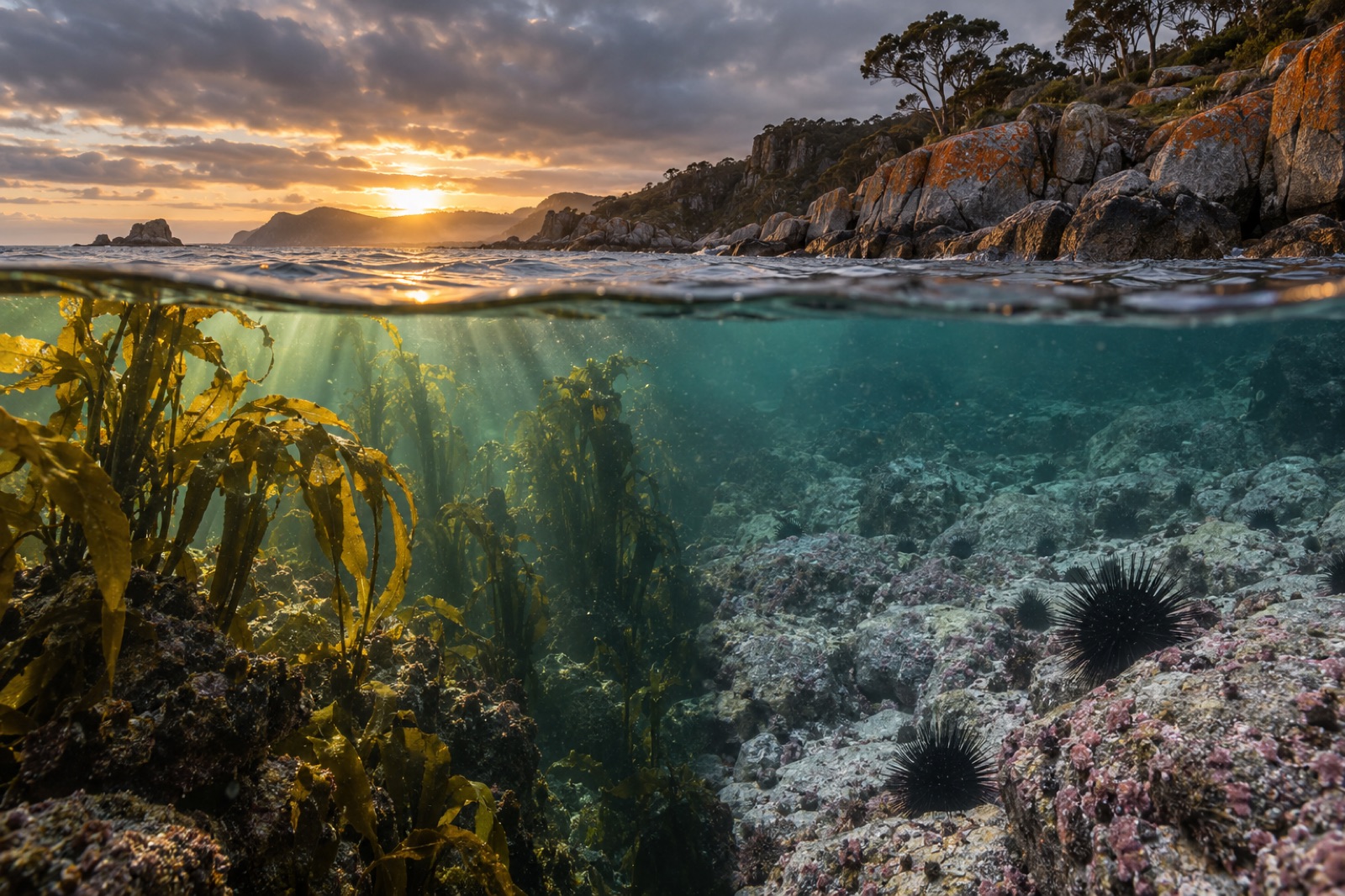
Sydney is that rare thing: a five-million-person global city whose front door opens onto kelp forest. Walk the Bondi-to-Coogee path, swim at a harbour beach, or take the ferry past the Heads, and you are rarely more than a few hundred metres from living seaweed forest — golden kelp meadows, weedy seadragon gardens, and the famous returning crayweed reefs. If you arrived here asking what happened to Sydney's kelp and what state it is in now, the short answer is: the city lost one of its two great forest-formers to its own sewage in the 1980s, has since brought it back by hand, and today offers one of the most instructive case studies in urban marine restoration anywhere on Earth. It is also genuinely superb diving.
Sydney's rocky reefs grow on Hawkesbury sandstone ledges that run like submerged terraces from Palm Beach to Kurnell. Two large seaweeds structure this coast:
- Golden kelp (Ecklonia radiata) — profiled in our Encyclopedia — forms sunlit meadow-forests on shallow reefs from around three to fifteen metres. Ecklonia is the workhorse kelp of the Great Southern Reef, and Sydney sits near the middle of the continent-spanning system it dominates.
- Crayweed (Phyllospora comosa) — a denser, tree-like fucoid forming the classic forest canopy of southeast Australia, historically carpeting shallow reef from Port Macquarie down to Tasmania.
Both feed the coast's signature herbivores — most conspicuously the long-spined sea urchin Centrostephanus rodgersii — and both underwrite the fish communities divers come for: blue gropers, leatherjackets, sweep, morwong, and the Port Jackson sharks that gather in the deeper gutters over winter.
The disappearance: how a city lost its forest
Through the 1970s and 80s, crayweed vanished from roughly seventy kilometres of the Sydney metropolitan coastline — the entire urban shore, from around Palm Beach to Botany Bay. Surviving forests hung on to the north at Long Reef and beyond, and to the south. The timing pointed one way: Sydney's coastal sewage outfalls, discharging inadequately treated effluent at the shoreline through those same decades, rose and the forest fell. Scientists concluded that the polluted water acted against the most vulnerable life stage — the microscopic juveniles and gametes — so the forest slowly died standing, adult by adult, with no recruitment behind it. The mechanics of that recruitment bottleneck echo the biology we cover in kelp spore dispersal.
In the early 1990s Sydney commissioned its three deepwater ocean outfalls, moving treated effluent several kilometres offshore. Water quality along the beaches improved substantially, and data from monitoring programs recorded the change. But the crayweed did not return on its own — not in a decade, not in two. The adult-free reefs had no local source of juveniles, and crayweed disperses poorly; a forest does not walk seventy kilometres on its own.
The comeback: replanting a forest
Researchers at the University of New South Wales and the Sydney Institute of Marine Science — working under the banner that became known as Operation Crayweed — decided the forest needed a ferry. Beginning around 2011, teams collected fertile adult crayweed from surviving stands at Long Reef and other sites, bolted or cable-tied mats of it to cleared reefs inside the historic gap (notably around Bondi, Maroubra and other headlands), and monitored what happened.
The transplanted adults took, reproduced, and — the crucial test — their offspring established as free-living juveniles. Restored patches began recruiting beyond the original transplant mats. It is now a standard international example that seaweed forest restoration by transplantation can work, and work cheaply, once the original cause of loss has been fixed. The lesson has been absorbed into restoration practice worldwide, including the site-selection discipline Tidewright writes about in why we don't seed every reef: clean the water first, then bring the forest.
Underwater Sydney: what the restored coast looks like
Dive the coast today and you move between three cities at once: the skyline above, the sandstone suburbia of ledges below, and the forest communities between.
- Cabbage Tree Bay, Manly — a no-take aquatic reserve where eastern blue gropers the size of kelpies approach within arm's reach, dusky whalers pass seasonally, and rays rest in the sand gutters. One of Australia's great snorkels, off the beach.
- Shelly Beach and North Harbour — protected, shallow, people-friendly water where the blue groper — New South Wales' state fish — behaves like a civic mascot.
- Kurnell and The Steps — the renowned weedy seadragon country, kelp-edge meadows over sand where dragons drift like escaped ornamentation.
- Bare Island, La Perouse — an easy-entry reef in Botany Bay that's a first dive for generations of Sydney divers. New to kelp diving? Start with the beginner's guide and the shore-dive planning checklist.
- Magic Point, Maroubra — a boat dive where grey nurse sharks aggregate around a cave; one of the most reliable places on the east coast to meet this placid, protected species.
- The winter shark awning. Along reef edges across the coast, Port Jackson sharks pile companionably into gutters each winter to mate and lay their strange auger-shaped eggs among the kelp.
Water temperatures run from around 15–16°C in late winter to 23–24°C in late summer; a 5 mm wetsuit covers most of the year, and visibility swings from garden-pond murk after big east-coast swells to twenty-metre coral-water days when the East Australian Current pushes in clean.
The pressures: a current that is getting stronger and hotter
Sydney's reef story is not a finished one. The East Australian Current — the warm highway running south off the coast — is strengthening as the climate warms, bringing two linked consequences. First, the long-spined urchin, already abundant on Sydney reefs where crayweed is absent, is marching south with the current into Tasmanian waters and converting kelp to barrens there — the process we unpack in how urchin barrens form. Second, the crest of the warm water is transporting tropical reef fish larvae into Sydney each summer, and each year a few more survive the winter — the "tropicalisation" of temperate reefs, Marine Heatwaves 101 written in fish.
Sydney also illustrates the value gradient of the urban sea: this coast's kelp sits in a city of swimmers, surfers, councils, anglers and citizen scientists who notice change and act on it. That mix of watchful public and capable science is precisely the partnership model behind reef-restoration programs everywhere, including those described under communities on this site.
Key takeaways
- Sydney's coast carries two forest-forming seaweeds: golden kelp meadows and the tree-like crayweed canopy.
- Crayweed disappeared from some 70 km of the metropolitan coast in the 1980s; sewage pollution is held responsible, acting on the kelp's juvenile life stages.
- Deep ocean outfalls cleaned the water; transplant projects then reintroduced fertile adult crayweed, which now reproduces on restored reefs — a world-reference restoration case.
- Underwater Sydney is a wildlife capital: blue gropers, weedy seadragons, grey nurse and Port Jackson sharks, all on a metro shoreline.
- The strengthening East Australian Current is the pressure to watch — warming water, southbound urchins and tropical fish arrivals.
FAQ
What exactly is crayweed?
Crayweed (Phyllospora comosa) is a large brown seaweed of southeast Australia that forms dense intertidal-to-shallow-subtidal forests on rocky reefs. It is a fucoid rather than a true kelp, but it plays the same forest-forming role — shelter, food, habitat — for reef communities.
Why didn't crayweed return once the sewage problem was fixed?
Crayweed disperses only over short distances, and the reef within the metropolitan gap had no nearby adult "seed stock". Removing the pollution fixed the cause, but the ecology needed a reintroduction — which the transplant projects supplied by bolting fertile adults back onto cleared reefs.
Where can a beginner see Sydney's kelp forests?
Cabbage Tree Bay (Manly) and Shelly Beach are the classic entries — calm, shallow, protected, with guaranteed blue gropers and kelp meadows in easy depth. In Botany Bay, Bare Island is the traditional first dive. Always swim with a buddy and check conditions at the top of the tide.
Is it safe to dive with the big animals — gropers, sharks?
Blue gropers are large, curious and harmless. Grey nurse sharks are protected and unaggressive. The etiquette is what you'd apply anywhere: give animals room, never corner or touch them, and keep hands and cameras at a respectful distance.