Explore9 min read
Wildlife Ethics in the Kelp: How Close Is Too Close?
A diver and snorkeller's ethics guide for kelp forests: safe distances for seals, otters and sharks, body language to read, and how to watch without chasing.
Tom Okafor ·
Diving and snorkelling where seals and sea lions live: keeping legal distances, reading their body language, what to do when one approaches — and why the animal decides.
At some point on a temperate-coast dive, it happens: a shape accelerates out of the green, blows a ribbon of bubbles in your face, and hangs upside down an arm's length away, examining you with huge, calm eyes. An encounter with a seal or sea lion in the water is one of the great privileges of kelp-country diving — and also one of the encounters where human enthusiasm most often spoils the thing it came for. The full spectrum of kelp-forest manners is covered in our wildlife ethics guide; this page goes deep on the pinnipeds — how to meet them legally, read their signals, and keep both ends of the encounter safe.
Two families share these coasts, and they behave differently enough that your etiquette should too.
True seals — harbour seals and their cousins — are the quieter neighbours. On land they're awkward, galumphing animals; in the water they're torpedoes. Wild harbour seals are typically cautious: they'll watch you from a distance, porpoise past, and only sometimes close in. A harbour seal that chooses to interact is doing you a favour; one that keeps its distance is asking for the same.
Eared seals — sea lions and fur seals — are the extroverts. California sea lions, and their Australian, New Zealand and South American relatives, are famous for approaching divers, somersaulting through bubble streams and playing tug with fin tips. Juveniles especially are the ocean's golden retrievers: all curiosity, no brakes. This is delightful, and it's exactly where ethics gets active — because the animal's boldness makes it easy for a diver to slide from "being visited" into "provoking a performance."
Most countries protect pinnipeds by law — marine mammal protection acts that prohibit harassment, with minimum approach distances set for boats and swimmers. The numbers vary by jurisdiction and sometimes by species and season, so check local rules before you travel. As a working personal standard, many marine parks converge on guidelines like these: don't approach closer than roughly 10 metres in the water, more for resting or nursing animals, and never block an animal's path to its haul-out or the open sea.
Two principles beat any number:
Pinnipeds tell you everything, once you know the vocabulary. In the water, watch for:
On land the ladder is simpler: a resting seal that is sleeping is content; one that has lifted its head to watch you is already spending energy on you; one that is shuffling or lurching toward the water is being flushed by you. Back away at head-lift, not at the lurch.
A young sea lion buzzing a diver is one of the finest experiences in temperate diving. Handle it like this:
The wide-angle urge is strong — sea lions are made for it. Set your distance with the strobes and let the animal come into the frame; a shot "earned" by chasing is a shot of a fleeing animal, and you can see it in their eyes. On snorkel, vertical duck-diving at a seal to close range is pursuit, full stop; patience at the surface produces better images and better manners. And mind the time: a crowd of five photographers orbiting one tolerant juvenile is five times the pressure the animal signed up for. Rotate in, take your frames, rotate out.
Serious injuries are rare. The realistic risks are nips from overexcited juveniles — with infected bites the main medical concern — and crowding a large territorial male or a mother with a pup. Stay passive, keep your distance discipline, and exit calmly if an animal's behaviour escalates, and encounters stay firmly in the "privilege" category.
End the dive calmly, clean the wound thoroughly, and see a doctor promptly — and explicitly tell them the bite came from a seal. Pinniped bites can cause specialised infections that need specific antibiotics, so the detail genuinely matters to your treatment.
If a resting seal has lifted its head to look at you, you're already at the edge; back up until it settles. Many beaches set legal minimums — metres to tens upon metres depending on jurisdiction and whether pups are present — but "the animal isn't reacting to me" is the deeper standard.
No. Even when an animal initiates contact, touch transfers our bacteria to them, habituates them to hands, and escalates play in ways you'll lose control of. Being chosen as scenery is the encounter; the moment you reach out, you've changed the terms.
Outside pupping and moulting seasons, on calm mornings, in places with resident non-breeding groups. Local operators and marine parks can tell you which colonies are year-round residents and which become nurseries — plan for the former, admire the latter from a legal, and ethical, distance.
A diver and snorkeller's ethics guide for kelp forests: safe distances for seals, otters and sharks, body language to read, and how to watch without chasing.
Tom Okafor ·
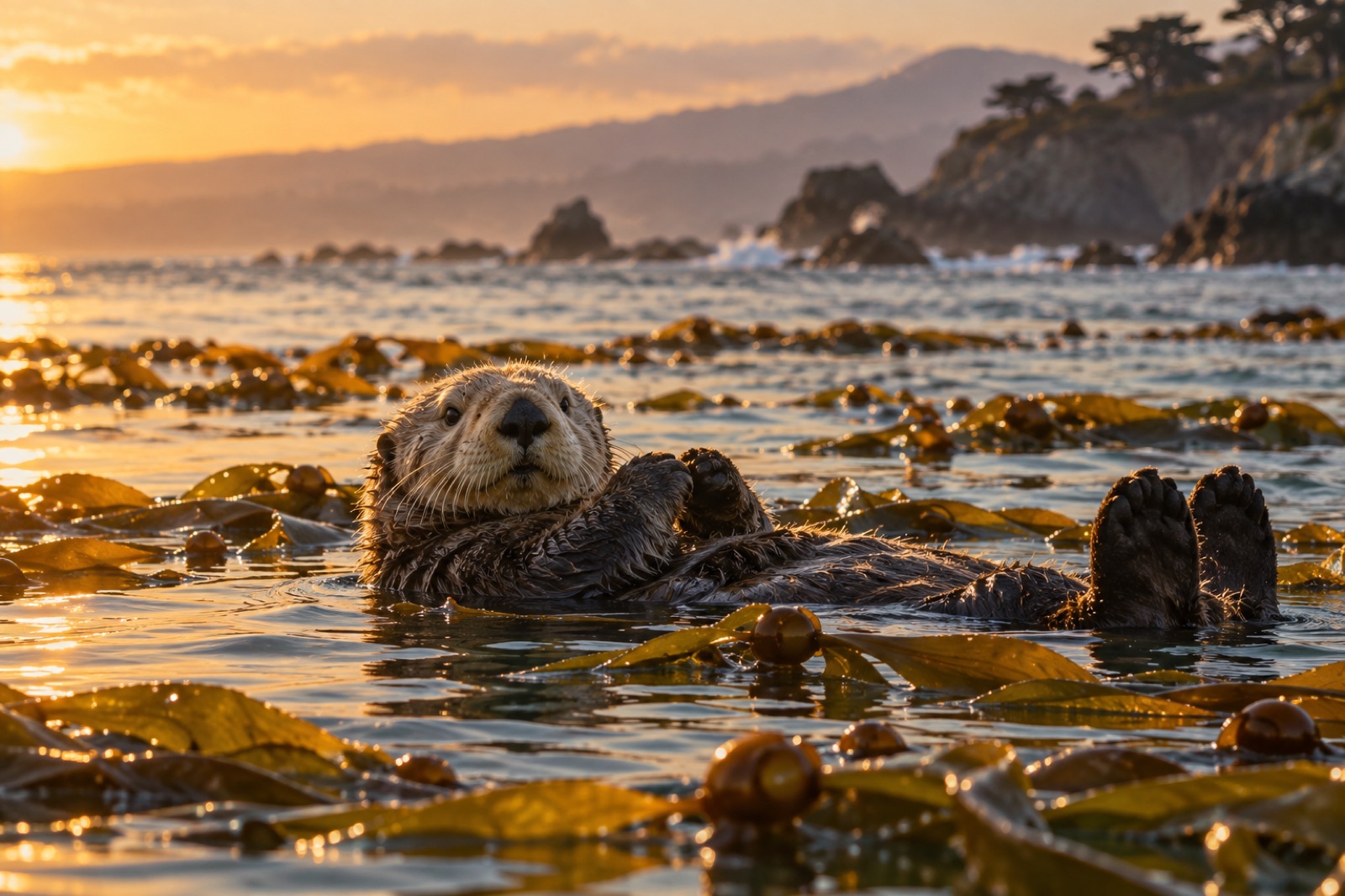
Sea otters look playful but waste energy if you get too close. Practical distances, what to never do, and how quiet watching supports kelp forest recovery.
Tom Okafor ·
Kelp forests are safe, magical snorkeling — if you respect cold water, surge and canopy. Skills, gear, hazards and spots for your first kelp snorkel.
Dr. Theo Nakamura ·