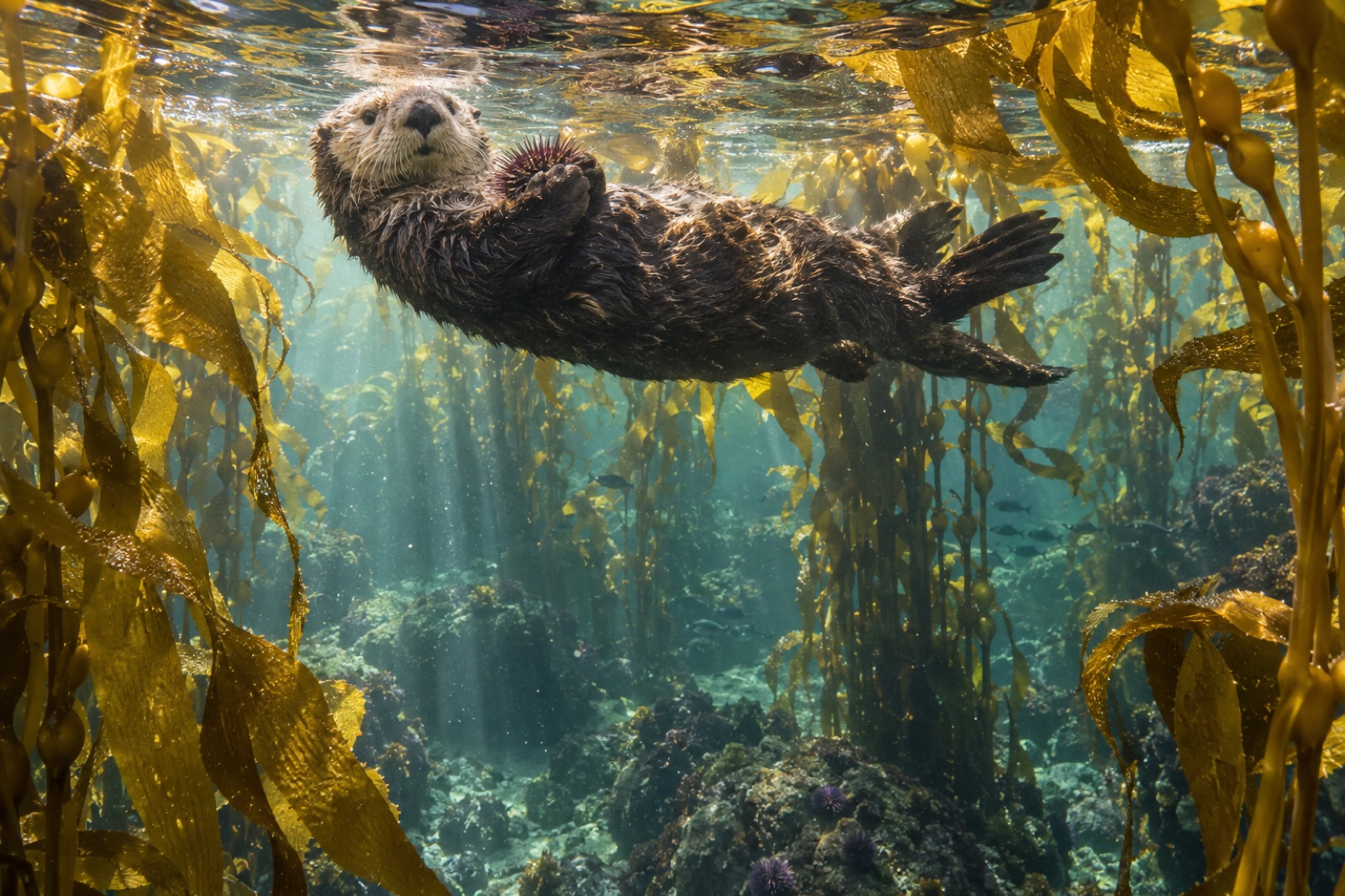
If the kelp forest has a voice, it is the California sea lion (Zalophus californianus) doing the talking. These are the animals barking on every marina dock from San Francisco to La Paz: the chocolate bulls roaring from their favourite buoys, the pale-faced mothers threading through a bull kelp canopy with a pup in tow, the torpedo-shaped juveniles that barrel-roll around a diver's exhaust bubbles. Improbably strong, disarmingly curious and visible from shore more often than almost any other large marine mammal, the California sea lion is many people's first wild pinniped — and one of the clearest animal indicators of how warm or cold the California Current is running.
Fast facts
|
|
| Scientific name |
Zalophus californianus |
| Group |
Mammalia; Otariidae — the eared seals (sea lions and fur seals) |
| Length / weight |
Males to ~2.4 m and 350+ kg; females ~1.8 m and up to ~110 kg |
| Coat |
Dark chocolate brown (males) to tan; males develop a ridged, sagittal crest on the crown with age |
| Range |
Southeast Alaska to central Mexico, with a separate Galápagos species (Z. wollebaeki) and the extinct Japanese sea lion as close relatives |
| Breeding |
Mostly on offshore islands: California's Channel Islands and Mexico's Pacific islands; pupping in early summer |
| Diet |
Anchovies, sardines, hake, mackerel, squid; whatever the current delivers |
| Lifespan |
Typically 15–25 years |
Built to fly underwater
California sea lions are otariids — the "eared" seals — and unlike the galumphing harbour seal they can rotate their hind flippers forward and walk on land on all fours. Underwater they fly on long, wing-like foreflippers; the hind flippers act as rudder. A sprinting sea lion can exceed 40 km/h and turn inside its own length, which is why even experienced divers are startled when an interested bull decides to inspect their mask at speed.
The nostrils are closed at rest and open only to breathe — an elegant economy that lets a sleeping sea lion float nose-high without snorting water. Internal ears close underwater. The coat is short and the insulation is blubber, which changes with the season; a fat October bull and the same animal lean after the breeding fast look like different species. Males reinforce the species' social soundscape with a dog-like bark used for territorial announcement; females and pups locate each other in a crowded rookery by each other's individual calls, a vocal signature problem among thousands that sea lions solve fluently.
Rookery summer, roving winter
The species' calendar runs on islands. In early summer, pregnant females and breeding bulls converge on traditional rookeries — above all the southern Channel Islands (San Miguel is the great nursery of the US population) and islands off Baja and the Gulf of California. Bulls establish aquatic territories offshore and fast through much of the season; females give birth to a single pup within days of arrival, then begin a commute: a day or two at sea hunting anchovy and squid, then back to nurse, for nine to eleven months.
After the breeding season, the population disperses. Adult males famously migrate well north, hauling out in rafts into British Columbia and Alaska where there are no sea lions at all in June; females and juveniles stay closer to the rookeries. If you visit our Channel Islands atlas guide, you will see the quiet testament written in the visitor logs: early summer is when the nurseries are dense, loud and worth the boat crossing.
A sentinel of the current
California sea lions turned out to be one of the better-kept instruments in the California Current's dashboard. Because mothers are tied to a rookery while pups wait ashore, a warm-water year that pushes anchovies and sardines north or deep forces sea lion mothers to hunt longer and farther — and pups pay first. The result is measurable, and it makes prime-time news each time: large numbers of thin, stranded pups on California beaches during warm ocean anomalies.
The mechanism got a full workout during the strong El Niño events of the past decade and the exceptionally warm "Blob" years before them, when stranding networks documented crisis-level numbers of starving pups. Our explainer on marine heatwaves covers the physics; the sea lion is its most photogenic victim instrument. Domoic acid — the neurotoxin produced by certain algal blooms that concentrates in anchovies — causes another recurring stranding pattern, disoriented pregnant females seizing on southern California beaches after feeding on tainted prey. Rehabilitation centers have treated many such cases; the blooms that cause them have become more conspicuous with warmer, more stratified coastal waters.
Watching sea lions, then, is never just whale-watching. It is reading the current's condition in a single species — which is exactly the kind of sentinel data Tidewright's Canopy Ledger monitoring approach treats as first-class evidence for ecosystem health.
The ecology underneath the charm
Sea lions are generalist mid-water predators taking whatever forage fish the current serves up, which includes the small fish that commercial and recreational fisheries also want. That overlap has made the species historically contested — state bounties ran into the 20th century — and it still complicates management: sea lions preying on threatened salmon in constrained river bottlenecks have been the subject of genuine conservation-policy tension where two recovering species collide. Note the asymmetry: when forage fish are abundant, sea lions scatter harmlessly; the conflicts concentrate at bottlenecks, including certain dam approaches. Policy responses range from non-lethal deterrence to, in specific authorised cases, removal of identified individuals.
Within the kelp forest itself, sea lions have their own cascade of effects. They stir up schools that giant kelp shading catches in shelter; they drop scraps that scavenging fish and giant Pacific octopus recycle; their carcasses feed the rare deep scavengers of canyon floors. And for human observers they remain one of the great entry points into ocean literacy: the garibaldi is the kelp forest's most visible fish; the sea lion is its most visible mammal.
Two more species in the family album
Taxonomists once squeezed the Galápagos sea lion and the Japanese sea lion into Zalophus californianus as subspecies. Genetics and anatomy have since separated them: the Galápagos sea lion (Z. wollebaeki) is the equatorial sister species, smaller and adapted to a warm island world, and the Japanese sea lion (Z. japonicus) — hunted to extinction by the mid-20th century — is a permanent cautionary record of what unregulated take can do to an otariid in just decades. California's population, by contrast, recovered strongly after 1972 protections and today numbers in the hundreds of thousands; it is one of the more successful marine mammal recoveries on the US West Coast.
Key takeaways
- California sea lions are eared seals (otariids): ear flaps, walking hind flippers, fore-flipper "flight" underwater, extreme agility.
- Rookery-based breeders: pups born on islands in early summer, mothers commuting to sea to hunt anchovies and squid for nine months or more.
- Populations are climate sentinels: warm-water years and harmful algal blooms show up in emaciated, stranded pups — an indicator for the whole current.
- Recovery since 1972 protections has been real, but the species collides with endangered salmon at river bottlenecks, an unresolved policy problem.
- The lineage lost the Japanese sea lion to hunting within living memory; California's recovery is a success story, not a default.
FAQ
What is the difference between a seal and a sea lion?
Sea lions (otariids) have small external ear flaps, long foreflippers they "fly" with, and hind flippers that rotate forward so they can walk on land. True seals (phocids, like the harbour seal) lack ear flaps and move on land by wriggling. Voice is another giveaway: sea lions bark; most true seals are quiet on land.
Are California sea lions dangerous to swimmers and divers?
Generally no — curiosity is the normal mode. But adult bulls are large, powerful and territorial in the breeding season. Do not get between a bull and his territory, do not approach animals on land, and if a sea lion displays or charges underwater, back away calmly. Bites, while very rare, are serious because of marine bacteria; any bite needs medical care.
Why do sea lions pile up on docks and buoys?
Hauling out lets them rest warm and dry, and floating platforms are predator-free and conveniently placed. Where docks were not built for pinnipeds, the weight of hauled-out rafts can be substantial — many marinas in the species' range now regard sea lions as permanent tenants.
Do California sea lions live in kelp forests?
They forage around and through kelp beds constantly, and juveniles play in the canopy, but they are not kelp obligates — they range widely through coastal waters following schooling fish and squid. The kelp forest is one of their favourite rooms, not their whole house.
Are California sea lions protected?
Yes — they are protected under the US Marine Mammal Protection Act (and equivalent Mexican laws). The population is large and not listed under the Endangered Species Act, but protections limit harassment, hunting and capture, and specific conservation conflicts are managed through authorised, targeted measures.