The northern elephant seal (Mirounga angustirostris) is one of the ocean's most extreme
athletes and one of conservation's great comeback stories. Bulls reach four metres and more
than two tonnes — the largest seals in their hemisphere — and between breeding seasons they
run double migrations of up to 20,000 kilometres a year, diving deeper and longer than any
pinniped. All of it happens just offshore of the kelp coasts of California and Baja
California, where their rookeries have grown from a handful of survivors into colonies of
tens of thousands.
Anatomy of a deep diver
Everything about an elephant seal is overbuilt for the mesopelagic night shift. During
foraging trips they spend roughly nine of every ten minutes underwater, on dives that
routinely reach 500–600 metres and hold for twenty minutes or more. Exceptional dives
recorded by instruments have exceeded 1,700 metres, and long dives have stretched past two
hours.
The physiology behind this reads like a diver's wish list: blood with roughly twice the
oxygen-carrying volume, per body mass, of a terrestrial mammal; muscles packed with
myoglobin; the ability to collapse the lungs and shunt blood to the brain and heart only;
and a cavernous spleen working as a blood bank. They sleep on the dive — drifting
belly-up in slow ten-minute "drift dives" several hundred metres down, in the deep dark
where their main predators rarely go.
Bulls carry the species' namesake proboscis, an inflatable nose that amplifies their
threat calls into a rolling, drum-like roar across a beach of a thousand rivals. Adult
males also bear a thickened, scarred chest shield — a lifetime of battle scars from the
winter mating tournaments.
Habitat and life at sea
Elephant seals are animals of the North Pacific gyre. After hauling out to breed or moult,
they spin out to sea and fan across an ocean basin: females tend to forage far offshore in
open-ocean waters between about 40° and 50° N, while males follow the continental
margin north toward the Aleutians and Gulf of Alaska, feeding over the deep seabed. Their
menu is deep-water fare — squid, hake, small sharks, skates and rattails — tracked in the
twilight layer partly by exquisitely sensitive whiskers that can read the wake turbulence
of swimming prey.
Their coast of origin is the kelp belt. Rookeries sit on island and mainland beaches from
central Baja California north to Point Reyes — the same cold, upwelling-driven coastline
whose offshore kelp forests and green inshore waters mark
the beginning and end of every migration. A beachmaster bawling on a rookery above a
herring-spawned kelp bed is a pure portrait of the
temperate North Pacific.
Hunted to the edge and back
No species profile of Mirounga can skip its history, because the recovery is the story.
Commercial sealing for blubber oil stripped the rookeries through the nineteenth century;
by the 1880s naturalists presumed the species extinct. A remnant group — estimates put it
between twenty and a hundred animals — persisted on Mexico's Guadalupe Island.
Protection changed everything. Mexico protected the survivors in 1922, and as animals
drifted north they were covered by the U.S. Marine Mammal Protection Act of 1972. The
population rebounded at a striking clip through the twentieth century and now numbers well
over 150,000 across roughly two dozen rookeries, with growth continuing southward and
northward from the founding colonies. Visitors at Piedras Blancas near San Simeon can
now watch thousands of animals from a boardwalk — a scene that did not exist before 1990,
when the first pup was born there.
The bottleneck left a scar: genetic diversity is extremely low compared with other
pinnipeds, a legacy biologists watch closely as climate-driven disease and storm losses
press on the recovering population. The rebound is real, but it is a case study in both the
power and the hangover of near-extinction.
The calendar of a colony
Elephant seals come ashore on an astonishingly firm schedule, which makes them among the
best wildlife watching on the continent.
Winter: breeding season
From December into March the rookeries erupt. Bulls fight roaring chest-to-chest battles
for rank; females arrive pregnant from last year's season, give birth to a single
forty-kilogram pup within days, nurse on fat-rich milk for about four weeks while fasting
entirely, mate again, and slide back into the sea. Weaned pups — "weaners" — teach
themselves to swim in the shallows before their first migration. It is one of the most
energy-saturated spectacles in nature, and it plays out at Año Nuevo, Piedras Blancas,
San Miguel Island and Guadalupe all at once.
Spring and summer: the catastrophic moult
Adults return ashore once more each year — females and juveniles mainly in spring, big
bulls in summer — to shed their entire coat and upper skin layer in a month of ragged,
moaning beached torpor. They fast through it. By the time the moult is done, the animal
rests on the sand looking like a rug being unmade, and the beaches smell like the
hedgerow of the ocean.
Elephant seals and kelp: neighbours, not roommates
Adults forage far offshore and deep, so you will seldom see one in a kelp forest. But the
connection is coastal and real. Rookery beaches sit beside kelp beds; weaners learn to
swim in kelp-sheltered coves; juvenile seals sometimes rest draped in surface kelp canopies
the way their harbour seal cousins do. And the same
upwelling engine that feeds the forests off
Monterey Bay and the
Channel Islands fertilises the wider food web their open-
ocean squid depend on. A healthy elephant seal colony is one more sign of a working
temperate coast — the outcome every restoration project on this coast is pointed toward.
Key takeaways
- The northern elephant seal is the Northern Hemisphere's largest seal: bulls top four
metres and two tonnes, with an inflatable proboscis and battle-hardened chest shield.
- It is an elite diver — routine dives of 500–600 m and 20+ minutes, with records beyond
1,700 m and two hours — and sleeps on drifting dives in the deep scattering layer.
- Sealing cut the species to fewer than a hundred survivors by the 1880s; protection by
Mexico (1922) and the U.S. (1972) powered one of conservation's great recoveries, to
well over 150,000 animals today.
- Rookeries run a strict calendar: birthing and breeding December–March, a full-body
"catastrophic" moult in spring and summer, all in public view at places like Piedras
Blancas and Año Nuevo.
- Adults forage deep and far offshore, but their coast of origin is the kelp belt — and
a booming colony is a flagship signal of a recovering temperate ecosystem.
FAQ
How deep can a northern elephant seal dive?
Routine foraging dives reach 500–600 metres, deeper than most military submarines operate,
and typically last twenty minutes or longer. Instrumented seals have been recorded past
1,700 metres, and some dives have exceeded two hours — among the deepest and longest of any
air-breathing animal.
Why are they called elephant seals?
For the bull's proboscis — an inflatable, trunk-like nose that resonates threat calls into
a metallic roar — and for the species' sheer mass. Adult males outweigh most rhinoceroses.
How did northern elephant seals recover from near-extinction?
Nineteenth-century oil hunting left perhaps twenty to a hundred survivors on Guadalupe
Island, Mexico. Mexico protected them in 1922; animals recolonising the U.S. gained
protection under the 1972 Marine Mammal Protection Act. With breeding beaches finally
unmolested, the population compounded for decades — though the genetic bottleneck of that
tiny founding group is still measurable today.
Where can I see elephant seals in the wild?
Piedras Blancas near San Simeon, California offers year-round viewing from boardwalks with
peak drama December through March. Año Nuevo State Park runs guided walks in breeding
season. The Channel Islands — especially San Miguel — and Mexico's Guadalupe island host
the largest colonies, though access is limited.
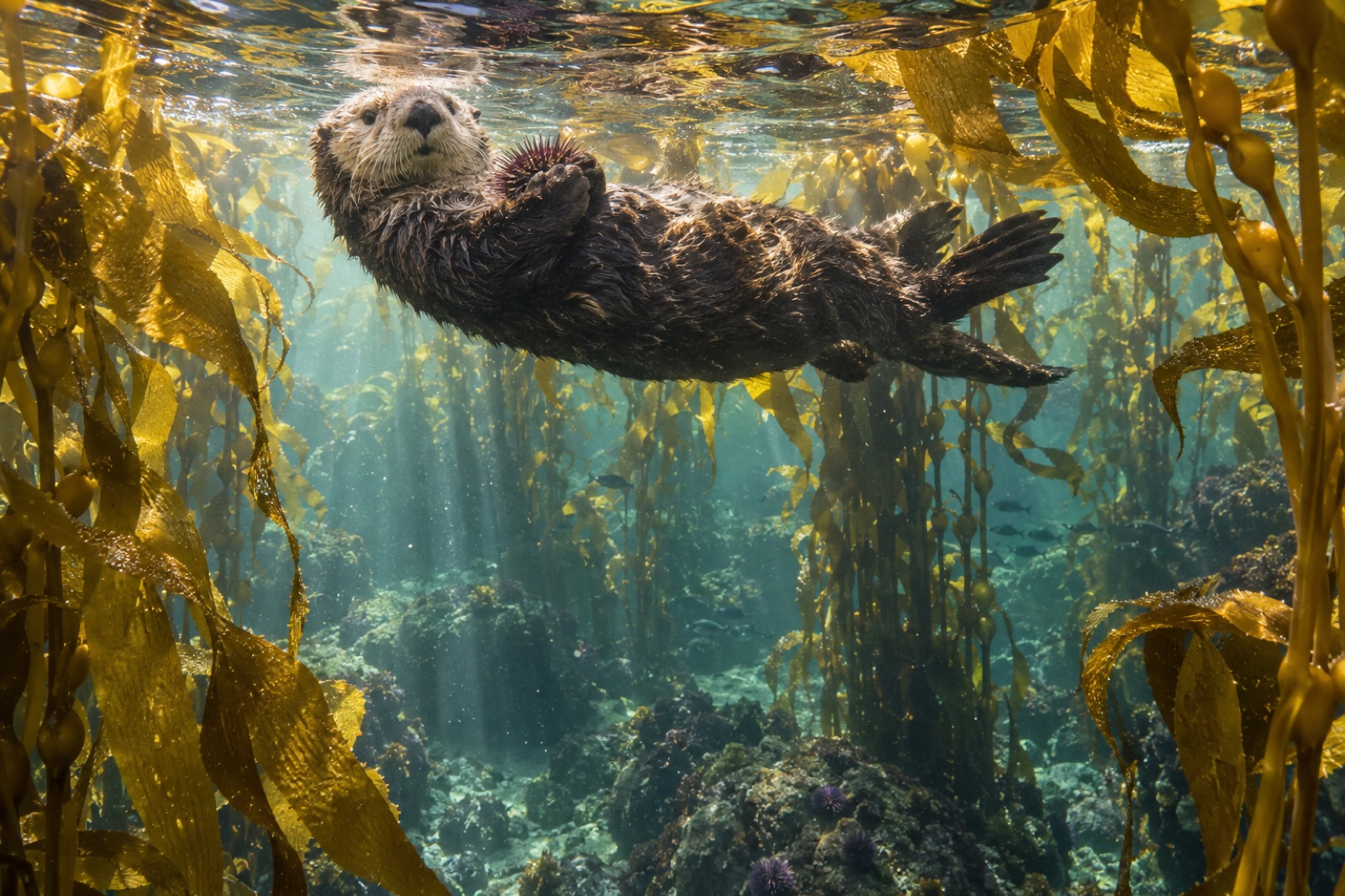
Do elephant seals and sea otters overlap in the kelp forest?
They share coastline rather than habitat. Sea otters live in
the kelp; elephant seals pass it on the way to the open North Pacific. But their pups learn
to swim in the same sheltered coves, and both species are emblems of the same recovering
Pacific coast.