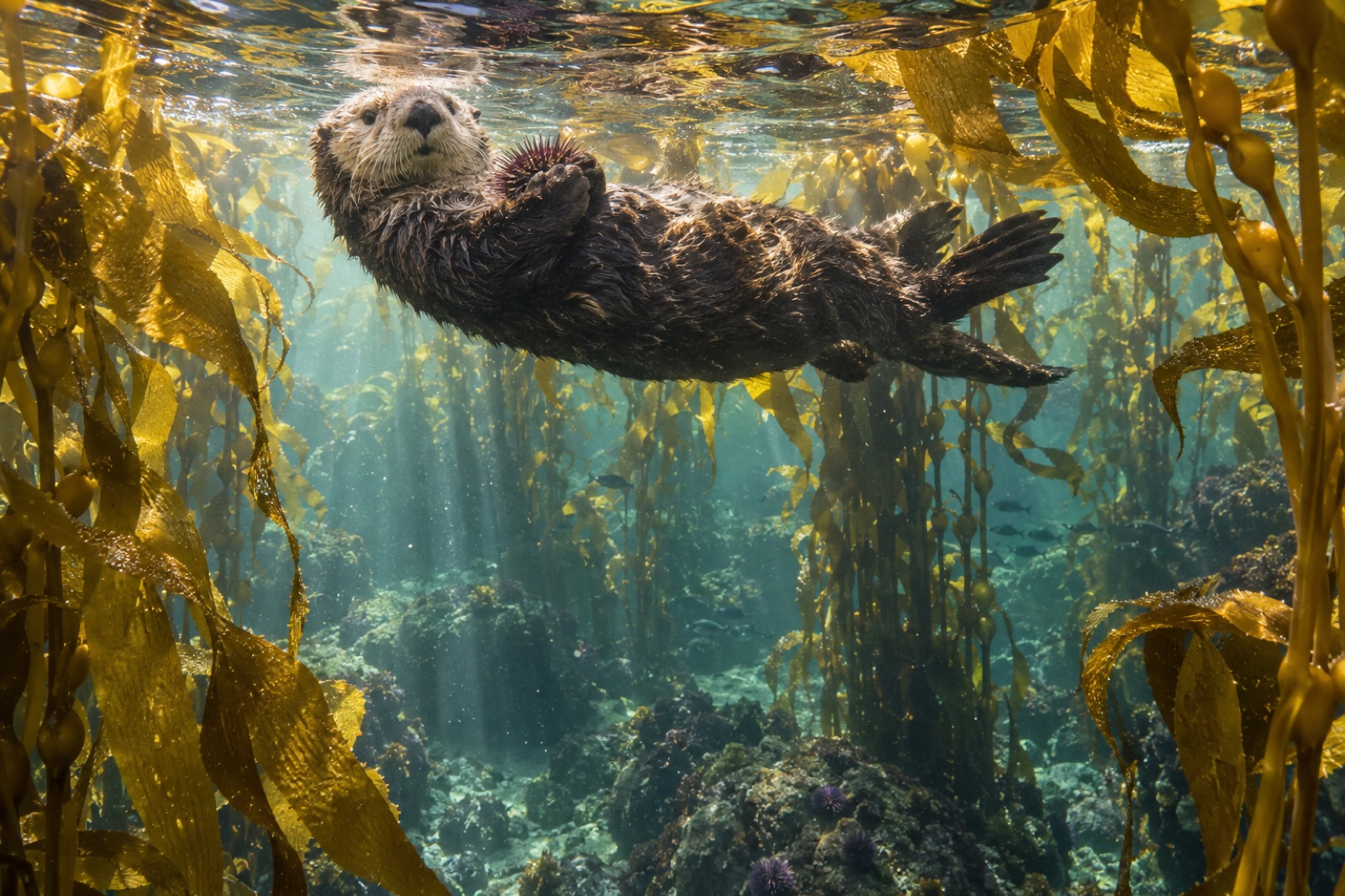
Here is a question kayakers ask constantly: do seals actually live in kelp forests? The honest answer is the interesting one — no, and very much yes. The harbour seal (Phoca vitulina) is a coastal generalist, as comfortable over a Scottish sandbank as a California reef, and it does not depend on kelp the way a sea otter does. But on the temperate coasts where giant and bull kelp grow, harbour seals structure their entire working day around the forest's edge: they haul out on the reefs kelp surrounds, hunt the prey fields kelp feeds, drop their pups within earshot of the canopy, and slip into the fronds when something with teeth arrives. If the otter is the kelp forest's keystone resident, the harbour seal is its most constant neighbour — and watching how the two species partition the same water tells you most of what matters about the forest's health.
(For the full species profile — anatomy, range, life history — see our harbour seal profile. This piece is about the relationship.)
The working day: haul out, commute, hunt
Harbour seal life is tidally scheduled. At low water, seals pour out of the sea onto exposed ledges, sandbars and low reef shelves — haul-outs that on kelp coasts are often the same flat reef platforms the forest rings. Hauling out isn't lazing: it is thermoregulation, rest and predator safety, since a seal on land (even lava-flat land) is faster to reach open water than a seal lying deep in three-dimensional terrain. The kelp fringe around a haul-out shelf does double duty here — it dampens the worst of the wave chop, part of the forest's documented wave-damping service, and it marks the boundary beyond which the hunting starts.
High tide flips the schedule. Seals leave the rocks and commute, and on kelp coasts the commute frequently runs through the forest itself. Tracking and diet studies on kelp-coast seals converge on the same picture: harbour seals are mid-level predators with a generalist's menu — small schooling fishes, rockfishes, flatfishes, octopus, squid and crustaceans — and the kelp forest assemblage supplies much of it. They are ambush-adjacent hunters rather than pursuit hunters: a seal works the dim gullies at the kelp margin, the sand–reef boundary where flatfish lie, the canopy edge where schools of juvenile fish hang. The same reefs that hold copper rockfish and lingcod linger in the memory of the seals that know them.
Kelp as refuge — sometimes
The second service kelp does a seal is concealment, with an asterisk worth taking seriously. Harbour seals and their pups are prey for great white sharks and transient orcas, and there is diver and observer lore — supported by growing scientific attention — that kelp forest structure offers some refuge: a shark or orca hunting in three-dimensional forest must negotiate terrain its prey knows intimately, and a seal threading the canopy gains a manoeuvrability edge over a much larger animal. Watch a seal drop into the forest when a boat throttles up nearby and the logic is obvious.
But the asterisk: kelp forest is also where the danger lives. Great whites patrol kelp margins precisely because seals are there. Transient orcas have been observed working kelp beds, and on parts of the coast — Tasmania's remaining giant kelp among them — kelp habitat and seal-predator overlap are simply the same addresses. The canopy is a place to hunt, rest beside and sometimes hide in, not a safe room. For a young seal, the forest is a complicated neighbourhood with both the groceries and the predators.
Pups in the shallows
Pupping season on the northeast Pacific runs from spring into summer — the weeks when the coast is at its gentlest and the kelp is near its seasonal peak. Mothers choose quiet, sheltered coves and low ledges for birth, frequently within kelp-sheltered bays, and the pattern repeats everywhere you look: same seal species, same forest, from Monterey to Vancouver Island. The nursing weeks are the most visible seal–kelp interaction a paddler will ever witness: mothers trade off feeding trips among the forest's prey with long alongside rests with the pup, and when both swim, the pup learns the vertical maze of the canopy at its mother's flank — the tuition phase of a kelp education.
This is also the season for the sternest rule in kelp-coast etiquette. A lone pup on a beach or rock is usually cached, not abandoned — the mother is out foraging and will return. Approaching, touching or "rescuing" such a pup is how real abandonment happens. Watch from well back, keep dogs leashed, report genuine concerns to a marine mammal stranding network, and let the kelp-fringed coastline do its work.
What seals tell you about the forest
Harbour seals are, in monitoring language, a top-of-web sentinel: they integrate the state of the prey field beneath them and they sit at the interface between reef and open water. Persistent seals at a kelp coast mean the system is producing enough schooling fish, rockfish and cephalopods to support mid-level predators. Their haul-outs mark the calm-water reef platforms; their hunting patterns map the productive margins. For those of us who dive these coasts — see our guide to shore diving in kelp country — a reef with seals overhead is usually a reef worth your tank: the same productivity served them both.
Restoration teams watch them too, for honest bookkeeping. A recovering kelp bed that starts holding seals is passing an audit designed by a predator with no stake in the outcome. On Tidewright's own restoration sites — the numbers here are illustrative — our field leads log seal sightings along transects as one informal line in a much more rigourous monitoring stack centred on the Canopy Ledger and eDNA surveys. Nobody claims the seals validate the carbon accounting; they validate that the food web is rebuilding, which in the end is what the forest is for.
Watching seals well
The kelp forest's best seal encounters are earned by patience and distance policy. Guidelines worth keeping:
- Distances matter. Keep well clear of haul-outs — seals flushed into the sea lose rest and mothers can be separated from pups. On the water, slow to a crawl near forest edges with seals on the rocks; on land, use binoculars and stay on the trail.
- Underwater, let them choose. Seals are curious and will frequently close the distance themselves. Stay calm, keep fins slow, and the interaction is theirs. Never corner a seal against the reef or block a route back to the surface.
- Don't feed, ever. A seal that associates boats or divers with food is a seal with a shorter, harder life.
- Photograph ethically. Long lenses and wide shots; the best seal-in-kelp photographs document behaviour, not proximity. Our kayaking over kelp guide covers platform etiquette in more detail.
Key takeaways
- Harbour seals do not depend on kelp forests the way otters do — but on kelp coasts they structure their day around the forest: haul-outs on its platforms, hunting along its margins, pups in its sheltered coves.
- Kelp offers real but partial refuge from sharks and orcas; it is also where those predators hunt. The forest is a neighbourhood, not a sanctuary.
- A lone pup is usually cached while its mother forages. Distance is the whole ethic; contact is the harm.
- Seal presence over a reef is a coarse and honest signal that the food web is producing.
- Watch them well: no flushing haul-outs, no approaching pups, no feeding — kelp-coast etiquette serves the ecosystem you came to see.
FAQ
Are harbour seals dangerous to divers and swimmers?
Not realistically. Harbour seals are small, curious pinnipeds and underwater encounters are typically inspection, not aggression — a face at two metres, a bubble-blow, a departure. Respect standard rules (no touching, no crowding, especially with pups), and any bite risk comes only from handling stressed animals. Social-media stories of seal "attacks" almost always involve habituated, fed animals — yet another reason feeding is the unforgivable offence.
Do seals eat kelp?
No — they are carnivores through and through. The kelp connection is indirect: the forest builds and holds the fish, octopus and squid communities seals actually hunt. Their menu is the reef's, not the reef itself.
Why do seals disappear from a beach you visited before?
Tide and season. Haul-out use tracks the tidal cycle — a flat reef shelf that carries fifty seals at low water is a cresting wave at high tide, and the seals are hunting instead. Seasonal moulting peaks also concentrate them. If seals have truly left a long-used site, disturbance (boats, dogs, development) is the first thing investigators check.
What is the difference between seals and sea lions in kelp country?
The short version: sea lions (like the California sea lion) have visible ear flaps and long front flippers they can walk on; true seals like the harbour seal don't, and move on land in a humping caterpillar inch. Underwater in the forest, sea lions are the boisterous gymnasts; harbour seals are the quiet watchers hovering at the kelp edge, deciding whether you are interesting.
Does kelp restoration bring seals back?
It brings back their reasons to be there. Seals follow prey, prey follows structure and productivity, and a rebuilding canopy reconstitutes the reef food web from the bottom. But seals are also faithful to traditional haul-outs and slow to change address — recovery in seal use can lag recovery in kelp by seasons or years. Presence of seals over a restored bed is encouraging; their absence is not, by itself, a verdict.