Encyclopedia8 min read
Opaleye: The Blue-Eyed Grazer of the Shallow Kelp
The opaleye is a herbivorous sea chub with opal-blue eyes that shapes California's shallow reefs from tidepools to kelp edges. Biology, diet and ecology.
Dr. Mara Ellison ·
The halfmoon (Medialuna californiensis) is a blue-grey sea chub that grazes kelp on Southern California and Baja reefs — ID, diet and habitat.
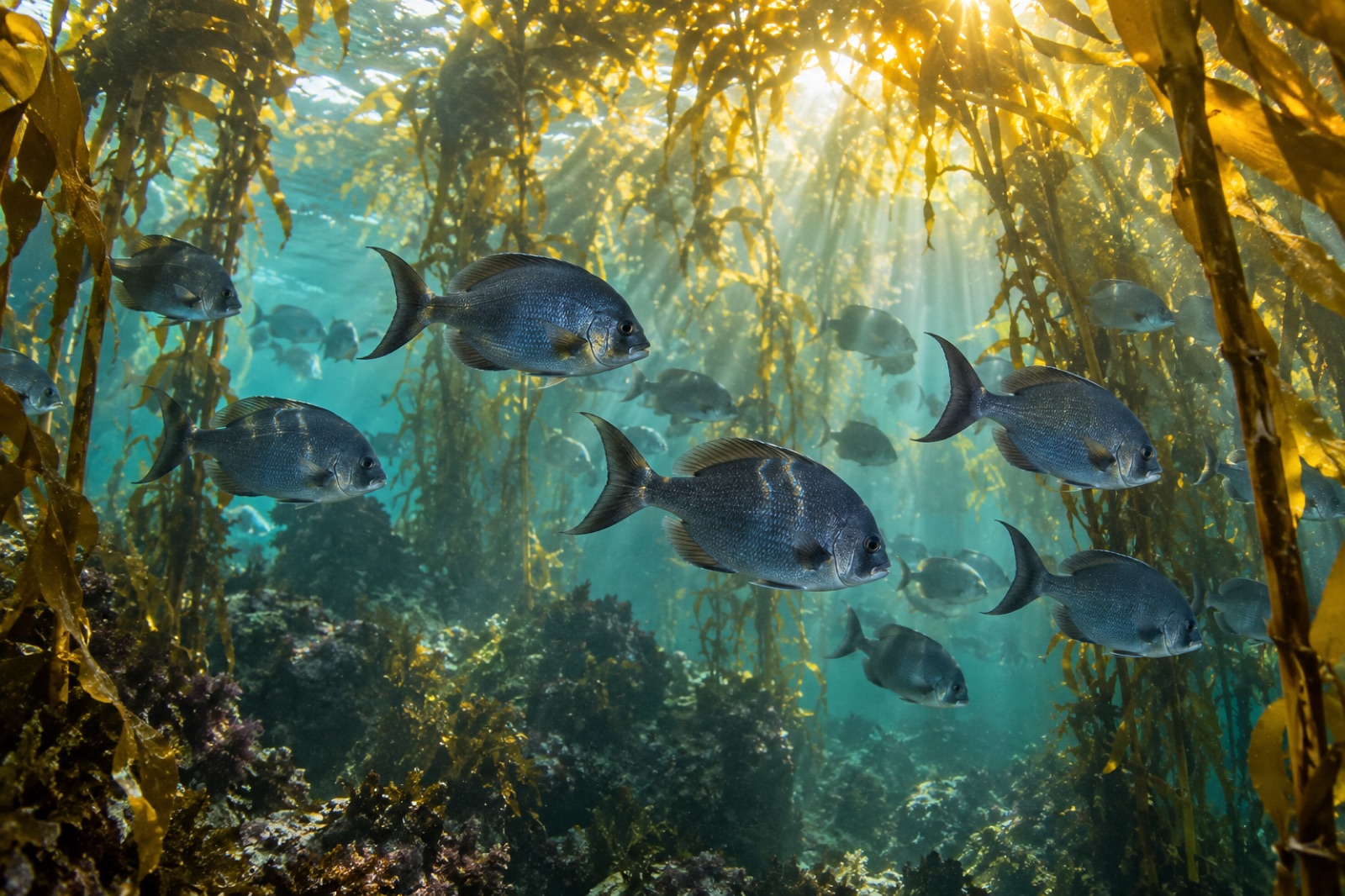
Drop into the kelp off Catalina on a late-summer dive and somewhere in the blue-grey layer between the sunlit canopy and the dark reef bottom you'll meet a school of slate-coloured fish, each the size of a dinner plate, tails cut into clean crescents, all of them eyeing you with the calm wariness of fish that have seen divers before. Those are halfmoons (Medialuna californiensis) — one of the most abundant mid-sized fish on Southern California's rocky reefs, a kelp-eater, a cleaning-station client, a bait-barge familiar, and the fish that fills half the fish tacos of the Baja peninsula. A profile, then, of the reef's blue-silver everyman.
| Scientific name | Medialuna californiensis |
| Family | Kyphosidae — the sea chubs, alongside its close cousin the opaleye |
| Range | Southern British Columbia (rare) through California to Baja California's Gulf of California waters |
| Habitat | Kelp beds, rocky reefs, pier and platform structure — surf zone to ~40 m |
| Size | To about 48 cm; most encountered are 25–35 cm |
| Diet | Omnivorous: brown algae and kelp, red algae, sponges, anemones, small crustaceans |
| Reproduction | Egg-broadcasting; pelagic eggs and larvae over open water adjacent to reefs |
Medialuna is Spanish for "half-moon," and if you look at the tail you see the name immediately: where most reef fish carry a forked or squared tail, the halfmoon's is a clean, symmetrical crescent, like a new moon turned sideways. The look extends through the whole fish. Adults are a handsome, deep slate-blue to blue-grey above, paling toward silver below, with near-invisible vermiculated mottling; the fins are dusk-dark, the eyes disproportionate, ringed in blue-grey. Against the kelp-forest backdrop — amber fronds, jewelfish-bright sunlight — a school of halfmoons is the mid-water itself given shape, grey-slate and patient.
Juveniles are warmer — brassy-olive, broadly barred with dusky vertical bands — and phase through green-gold before settling into the adult slate, a colour shift that confuses a great many fish-ID beginners into thinking they're looking at two species.
The halfmoon's rectangle-of-confusion on a California dive list is small but real:
Easiest rule: crescent tail + slate blue + size of a dinner plate = halfmoon. Nothing else on the reef checks all three boxes.
Halfmoons are mid-water fish of the mid-forest. Where garibaldi and blacksmith hold to the reef and surface canopy respectively, halfmoons cruise the middle storey — the five-to-fifteen-metre band beneath the canopy and above the understory — in schools of a few dozen to a few hundred. They work a route, more than a territory: a school drift-feeds its way along a reef face over the course of a dive-day, pausing at cleaning stations and food patches, moving on.
That cruising habit matches their teeth and gut. Halfmoons carry the sea-chub toolkit — a small mouth of close-set cutting teeth, a long fermenting gut, and an appetite that spans algae and small animals alike. Stomach-content work on the species reads like an overview of the forest: shredded brown algae, blades of young giant kelp, red-algal turf, fragments of sponge and colonial tunicate, gammarid amphipods by the handful. They are grazers in the rotation of the reef's moving pasture — nipping kelp where it grows fast, cropping turf where it overgrows, mopping small crustaceans from algal surfaces in between.
Their herbivory is gentler than the opaleye's specialist mowing, but it is similar in direction — reef-scale cropping of fast-growing algae — and the two species are the coast's two main fish-lawnmowers, stationing over the same pastures. In a kelp forest food web where most fish are carnivores, the halfmoon and opaleye run the herbivore guild with an assortment of small grazers.
Here is the wrinkle that separates halfmoon from their surfperch neighbours: where surfperches bear live young, halfmoons spawn broadcast-style, releasing sperm and eggs into open water over the reef. Spawning runs through the warm months — summer into autumn, peaking with the warmest water — and the fertilized eggs drift pelagic, hatching into larvae that spend weeks in the plankton before settling to the reef as centimetre-long juveniles.
That pelagic phase gives the halfmoon connectivity that live-bearers like the surfperches lack. Genes and young fish can move tens of kilometres down the coast on coastal currents; a depleted reef can be re-charged by larvae drifting in from downstream forebears; a newly restored reef can recruit halfmoons within its first seasons of regrowth, rather than waiting generations. It's why, on our own restoration transects, halfmoon schools are often among the first fish communities to reappear when kelp returns to a barren reef — a visible, countable sign that broadcast-spawners can get to new forest quickly.
Halfmoons and Southern Californians have a long familiarity. They are the bait-barge fish: chum a live-bait receiver at first light and halfmoons stack in by the hundred, taking anchovy scraps with uninhibited enthusiasm. They are a bread-and-butter recreational catch from piers, jetties and skiffs — caught on small hooks baited with mussel, squid or algae-wrapped red worms — and the recreational limit combines them with their opaleye cousins and kelp bass under a general kelp-bed-complex bag.
In Baja, the halfmoon is a kitchen institution: chopa is the cook's name, and halfmoon fillets go into half the peninsula's fish tacos. Good fresh halfmoon is firm, white-fleshed and mild; like opaleye it will take on a weed flavour if the gut bacteria are given time to work, so the standard handling advice holds — clean quickly, chill fast, cook soon.
Conservation status: secure. Their reefs — the kelp beds the Catalina guide introduces — are certainly pressured by the same heatwave cycles and urchin outbreaks that hit the forest, but the halfmoon itself is a resilient, euryphagous mid-trophic fish with connectivity on its side. Among the species to watch as the coast warms, it is one of the more hopeful ones: closer to a warmth-tolerant generalist than a cool-shackled specialist.
Halfmoons are do-see fish: approachable, unhurried, present in numbers. Drift the mid-water at Casino Point or off the Channel Islands at 8–12 m, and hold still near a gap in the canopy; within a few minutes a school will pass through, breaking around you like slow water around a piling. Predators — sea lions, cormorants, big kelp bass — find them out at the reef's blue edge, and if you're lucky with your timing you'll see the school ball up and flash as a unit, slate-blue flare turned suddenly silver in the sun.
Night divers with the patience to look upward sometimes find halfmoons sleeping in frond crevices after dark, still crescent-tailed, dimmed-down, hanging vertical in the water column — our night diving in kelp forests piece covers what else wakes up out there while the reef sleeps.
Yes — excellent if handled right. Clean immediately on capture, chill hard, cook within a day or so; delay lets the gut flora give the flesh a weedy note. In Baja the same fish is chopa, a fish-taco staple.
Body colour and tail. Opal-eye are olive to dark green-grey with fiery iridescent-blue eyes and a rounded tail; halfmoons are slate blue-grey with cool blue-grey eyes and a clean crescent tail. They often school together — the easy backyard see-both-at-once pair.
Any Southern California kelp bed through the classic 5–15 m mid-water band — Casino Point Dive Park, the Channel Islands reefs, La Jolla's kelp edges — plus Baja's Pacific kelp coast southward. Snorkel or dive, daylight hours, and simply hold still near a canopy gap.
Yes — kelp blades form a measured share of the adult diet, mixed with red-algal turf, sponges and small crustaceans. They are omnivorous grazers rather than strict herbivores, but kelp is a real line item in the budget.
Look at the tail: a near-perfect crescent, like a half-disc of moon, where most reef fish carry a fork or a square. Medialuna, Spanish for half-moon, is both the genus and the common name.
The opaleye is a herbivorous sea chub with opal-blue eyes that shapes California's shallow reefs from tidepools to kelp edges. Biology, diet and ecology.
Dr. Mara Ellison ·
The señorita is a small California wrasse that runs cleaning stations, swarms in glittering schools and buries itself in sand at night. Meet the kelp forest's hygienist.
Dr. Theo Nakamura ·
Catalina Island is southern California's kelp capital — Casino Point, Farnsworth Bank, warm-water giants and a century of marine science under the canopy.
Dr. Mara Ellison ·