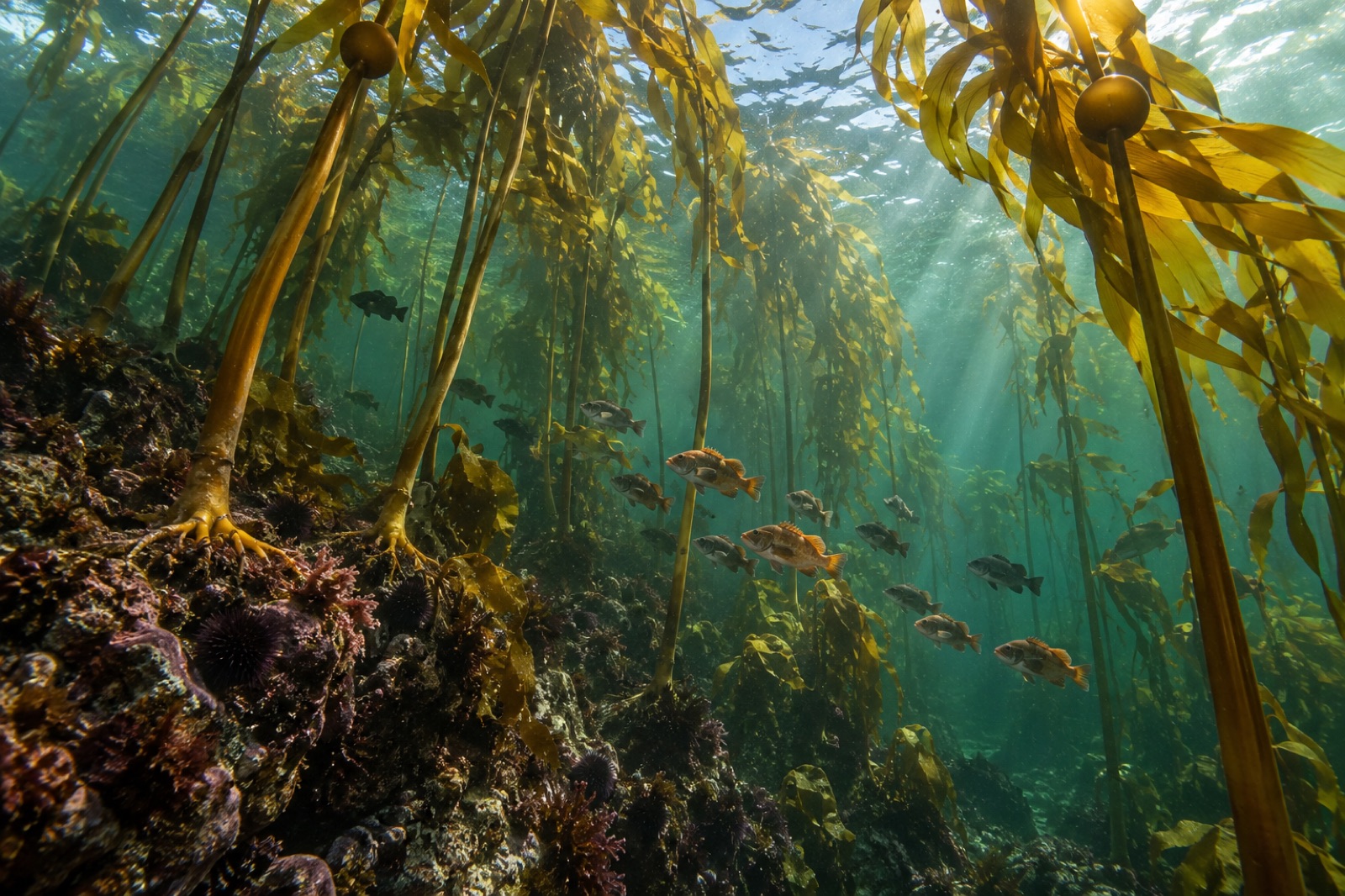
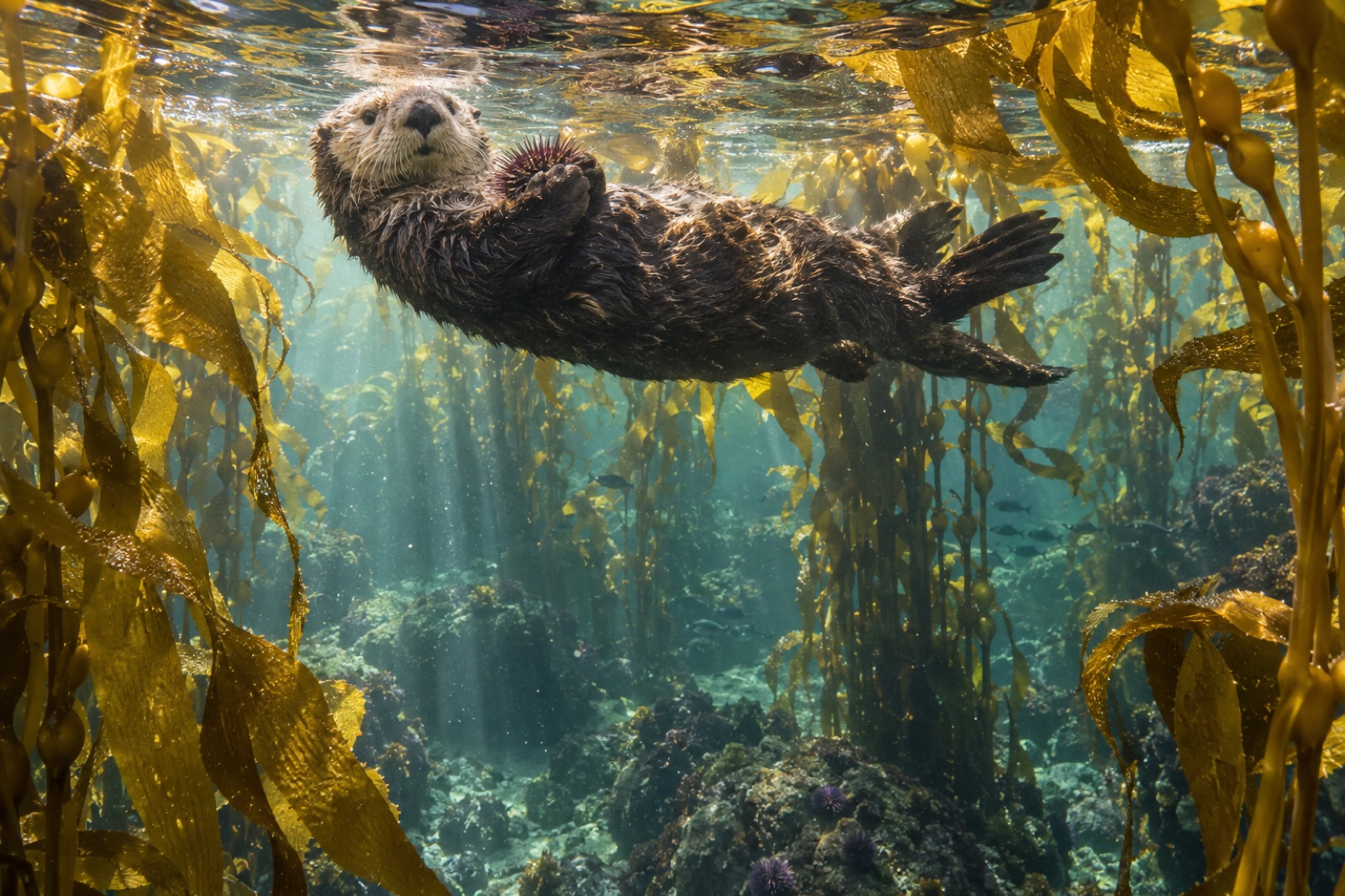
Every year, in the cold green shallows from California to Alaska, the ocean briefly turns the colour of milk. Tens of thousands of tonnes of Pacific herring arrive from offshore schools, crowd into bays and kelp beds, and in a matter of days lay layer upon layer of adhesive eggs on whatever the shallows offer — eelgrass, rockweed, pier pilings and, where forests stand, the fronds of giant and bull kelp itself.
The Pacific herring (Clupea pallasii) is not a glamorous fish. It is small, silver, and mostly famous as something else's lunch. But its spawning run is one of the great wildlife events of the temperate Pacific — a burst of biomass that draws whales, sea lions and seabirds to the coast, sustains some of the world's oldest fisheries, and quietly depends on underwater vegetation to succeed. Understanding the link between herring and kelp is understanding why shallow habitat restoration matters far beyond the kelp itself.
A silver wall: meet the Pacific herring
Pacific herring are schooling fish of the family Clupeidae, close relatives of the Atlantic herring and the sardines. Adults run perhaps 25 centimetres — a hand-span of mirror-flanked muscle built around a simple, brilliant strategy: gather in schools too large for any one predator to dent, filter plankton, and deliver the year's feeding as a single, concentrated event.
That school is a conveyor belt in the kelp forest food web. Herring convert plankton into protein and deliver it to almost everything bigger: salmon, lingcod, halibut, harbour seals, sea lions, humpback whales, and the seabirds — murres, gulls, cormorants and surf scoters — that time their own breeding to the fish. Fisheries scientists call herring a forage fish, but "the ocean's middlemen" is more honest: almost every great coastal predator photograph you've ever seen was possible because of a fish like this one.
Why kelp is a nursery
Herring eggs are adhesive, and herring are choosy. In the days before spawning, schools survey the shallows, and where they finally spawn, they lay down thick mats of eggs — tens of thousands per female — glued to surfaces in layers up to ten eggs deep. Submerged vegetation is prime real estate:
- Giant and bull kelp fronds lift eggs into the current, well above bottom sediment, in clean, oxygen-rich water that rocks and wharves can't match.
- Rockweed (Fucus) hosts eggs in the intertidal, where the eggs survive hours of emersion at low tide.
- Eelgrass meadows are favoured wherever they grow in calm bays, and in some areas nearly the whole stock spawns among the blades.
Each female's eggs are fertilised in the water column by waiting males, which is what turns the sea turquoise-white — a visibility so dramatic kayakers can see the spawn from above. Eggs take roughly ten days to two weeks to hatch depending on temperature; the larvae drift in the plankton before joining the great schools offshore. The catch, in clean habitat, is a heartening arithmetic: eggs laid high on vegetation in well-oxygenated water hatch in far greater numbers than eggs smothered in sediment.
The spawn: two weeks that feed a coast
If you have never seen a herring spawn, imagine a wildlife documentary staged in your local harbour. Sea lions body-surf through the schools. Grey whales in Puget Sound skim the shallows on their sides, mouths open. From above, rafts of scoters and gulls pack the fizzing water, while eagles line every overhanging branch. The air smells sharp and alive — brine and a strange, sweet mineral note that is unmistakably spawn.
It is also, for people, a feast of long standing. Cultures along the North Pacific coast have harvested herring roe for thousands of years — most elegantly by placing weighted hemlock or cedar boughs, or fronds of kelp, into the water ahead of the spawn and lifting them out days later thick with eggs: spawn-on-kelp, or SOK, a delicacy and prestige trade good from Alaska to British Columbia whose traditions are explored in our atlas guide to Sitka Sound, where the spring spawn still draws whales to Tongass Narrows. These harvests are embedded in Indigenous management systems of extraordinary sophistication — and where they continue, they are not merely tolerated but actively practiced as acts of stewardship.
The modern spawn-on-kelp fishery descended from this tradition: wild kelp fronds, or kelp grown on lines, are suspended in net-enclosed ponds with a few tonnes of mature herring ("pound" spawning), lifted after the eggs set, packed, and shipped — much of it destined for Japan as kazunoko kombu, herring roe on kelp, a prized new-year food.
Where herring stand today
The picture is mixed, and honesty matters here. Some stocks are healthy and well-managed — British Columbia's Strait of Georgia herring, for instance, supports one of the last sizeable herring fisheries on the west coast, with a carefully managed spawn-on-kelp fishery alongside. Others have collapsed. The Cherry Point stock in Puget Sound, once the region's largest, fell catastrophically in the late twentieth century and has never recovered; it is the subject of extended conservation petitions and debate. California saw its San Francisco and Tomales Bay fisheries contract sharply.
The drivers are the usual suspects, entangled: historical overfishing (roe season could take a large share of a stock in days), warm-water years that reduce plankton and condition, and — increasingly — habitat. The shallow fringing bays that herring need have been dredged, filled, armoured with seawalls, and smothered in sediment; kelp beds have contracted in warming events; eelgrass has been lost to moorings and development. A herring school can only spawn where the shallows remain worth spawning in. Restoration, then, is not the garnish on herring conservation; it is a core ingredient.
How kelp work helps the silver wall
The chain of logic from kelp to herring is direct, and it is why Tidewright's restoration planning — where programs include reseeding shallow rocky reef (how the platform works) — counts herring among its beneficiaries even when the target is the forest. Where kelp density is restored in historically important bays:
- Spawning substratum comes back — live fronds in clean water, the natural alternative to decking and creosote pilings.
- Water quality around the bed improves; the kelp itself is a biofilter and oxygen-maker by day.
- The settled juvenile kelp-beds shelter gobies, shrimps and year-class forage that young-of-year herring use in their first, most vulnerable months.
None of this substitutes for good fisheries management — harvest set low enough to leave a spawning stock, marine protected areas sited on the historic beds — but it builds the physical stage on which the spawn can once again take place. That is the argument we make to councils, and it is the practical reason herring surveys appear in our monitoring plans. (Tidewright is a fictional demonstration company; the fishery relationships described are illustrative.)
Watching the spawn
You don't need a boat. Spawns are visible from piers, seawalls, kayaks and shore trails — scan for turquoise-white water, aggregations of birds, and sea lions working a tight area. Bundle up; the run happens in the cold months, when the water is coldest and the air clearer than it sounds. A few pointers:
- Give the school room. Do not paddle through the middle of an active spawn.
- Check local rules before harvesting roe-on-kelp yourself; in BC and Alaska permits and permits-by-licence apply, and Indigenous harvest rights take precedence.
- Bring binoculars. Half the show is a mile out, following the fish.
Key takeaways
- Pacific herring spawn in late winter and spring, laying adhesive eggs in thick layers on vegetation — with kelp fronds, rockweed and eelgrass among the most valuable substratum.
- The spawn is a major wildlife event, drawing whales, sea lions and tens of thousands of birds to shallow bays.
- Spawn-on-kelp is both an ancient Indigenous harvest and a modern fishery product, prized in Japan as kazunoko kombu.
- Several major herring stocks have collapsed; surviving fisheries need both conservative management and healthy shallow habitat.
- Kelp restoration returns natural spawning habitat and juvenile shelter, making herring a direct beneficiary of kelp work.
FAQ
When does the herring spawn happen?
Timing shifts south to north and year to year with water temperature, but the season runs roughly from January in California through February–March in British Columbia and into April–May in Alaska. Local fisheries departments and harbour authorities publish daily spawn updates; a sudden raft of bird activity on a bay is often the first visible sign.
What exactly is spawn-on-kelp?
Herring eggs laid on kelp fronds — traditionally, fronds held in the water for the herring to find; in the modern fishery, wild or farmed kelp suspended in enclosures with mature herring, then lifted and salted. It is eaten as a delicacy (mainly in Japan) and harvested sustainably at volumes set by stock assessment.
Do herring return to the same bays to spawn?
Substantially, yes — herring show strong homing to the bays where they were themselves spawned, which is why losing a spawning ground (to fill, harbour works, or chronic sedimentation) can mean losing the stock segment that used it for good.
Is the spawn dangerous to swim in?
No — the white water is milt (sperm), and spawn events are harmless to people, though the water is cold and the sea lions preoccupied. If you kayak or swim near one, keep well clear of actively feeding whales and avoid disturbing the school.
Why do kelp beds matter when herring can spawn on docks and pilings?
They can, and do — but man-made structures give no nursery value, often sit in poorer water, and support fewer hatchlings in sedimented bays. Live kelp offers clean, oxygenated, current-swept fronds in the harbour's best-lit, best-flushed shallows — and the months of shelter that follow for the next generation of juveniles.