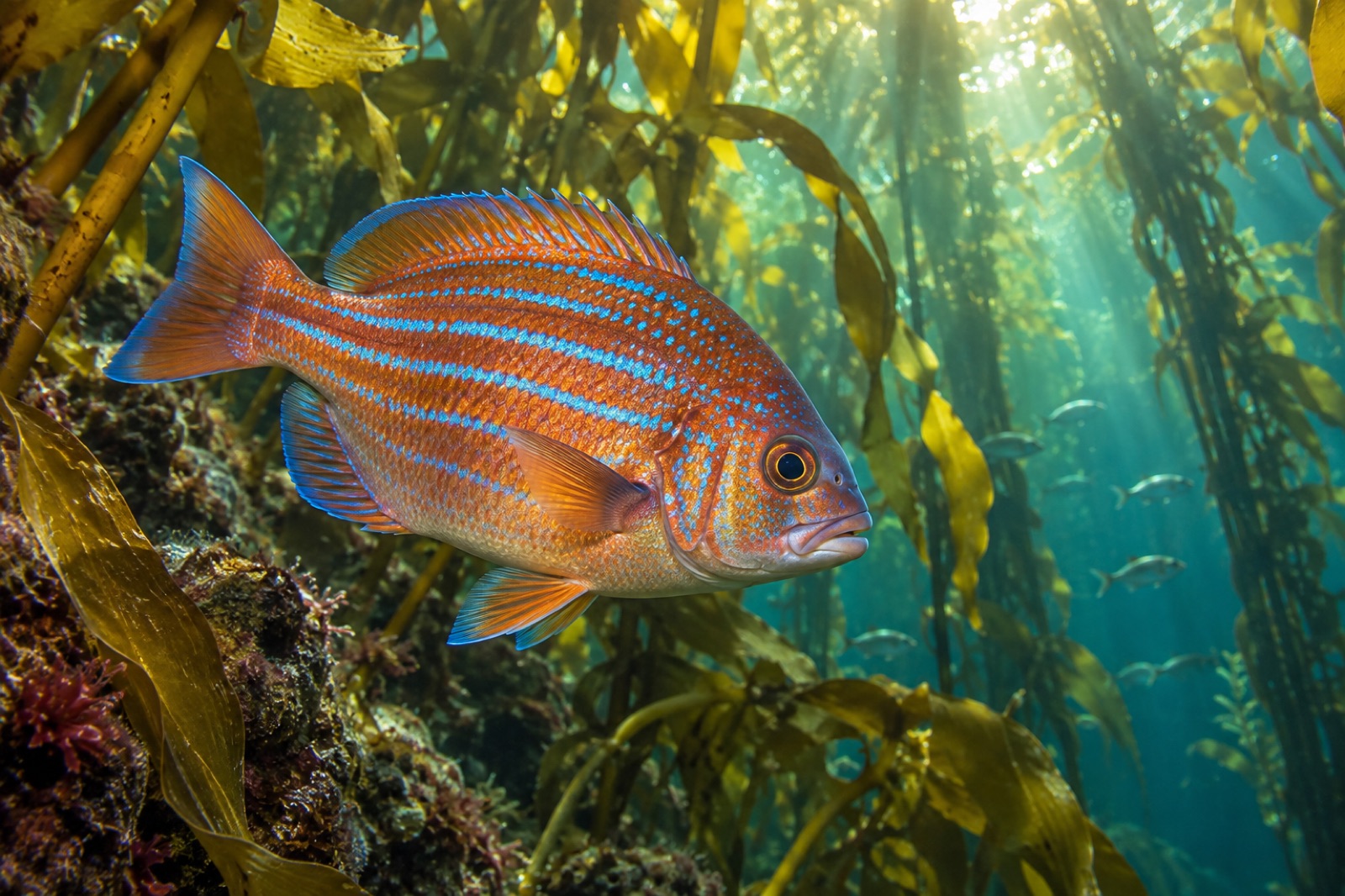
The question that lands in my inbox more than any other about California fish is a photo: a snorkeller's slightly blurry shot of an orange-red fish shot through with electric blue, asking, sheepishly, whether it is really possible to see that in cold green water. Yes. That is the rainbow surfperch (Hypsurus caryi), the most vividly coloured fish of the North Pacific kelp coast, and this is the complete field guide to finding and naming it. (We have a shorter species profile of the same fish; this piece is the hands-on, where-to-look version.)
This is a shore-accessible fish. You can legitimately find a rainbow surfperch without a boat, without scuba, sometimes without getting past your knees — which is what makes it so much fun, and why the ID deserves doing properly.
First impression: what your eye catches
Before any markings resolve, the rainbow surfperch reads as three things at once, and learning to combine them is 90 percent of the identification:
- Shape. Deep and compressed — a classic surfperch disc, tall-bodied relative to its length to about 30 cm — with a small terminal mouth and a strongly forked tail.
- Ground colour. Orange-red to copper, duskier along the back, paling to silver-pink on the belly. Weather, season and locality shade it toward brick or toward peach, but the warm orange read is the base note.
- Colour attack. On top of the copper, the fish wears electric blue: horizontal stripes running the flank length, blue-rimmed fins, and scattered iridescent blue spots on the body and tail base. In low light the blue goes grey; in noon light over a sand wash it is grotesque — and unmistakable.
If the fish in view is orange-red and blue-striped and deep-bodied and hovering in a California kelp bed, stop looking: it's a rainbow.
Separating it from the neighbours
The genuinely confusable fish are all other surfperches, and mostly they fail the colour check within seconds. A crib for the three species you will actually mix with:
| Fish |
Colour read |
Pattern |
Habitat cue |
| Rainbow surfperch |
Orange-red / copper ground |
Blue horizontal stripes, blue fin rims, blue spotting |
Weedy reef, kelp edges, rocky-bay wharves |
| Striped surfperch |
Darker, brassier |
Orange-and-turquoise interrupted bars and rows of spots running vertically-ish |
Surge-zone reefs, shallower and more exposed |
| Kelp perch |
Kelp-green to brown |
Nearly plain; a faint dusk bar or two |
Tight against kelp fronds in the canopy |
The striped surfperch deserves the most care: it, too, flashes blue on an orange fish, and in bad light I've watched good IDs split both ways. The tiebreakers are pattern grammar (the rainbow's marks run along the body as horizontal stripes; the striped's as broken vertical bar stripes) and depth of body (the rainbow is deeper-disc). Get the light on your side before you commit.
Where to actually find one
The rainbow surfperch is a fish of the central and southern California rocky coastline — its northern limit sits around Mendocino, and the population thins quickly toward it; the southern half of the state and the Channel Islands carry the showpiece densities. Within that zone, hunters I've learned from use a consistent short list of habitats:
- The shallow half of the kelp bed, over rock. The classic. Three to fifteen metres, among boulders with an algal understory, inside Monterey Bay and down the central coast. They browse algae coat for crustaceans all day.
- Rocky-bay wharfs and pilings. This surprises people, because wharfs feel like "urchin and pipefish" territory. But where a pier stands over a mixed sand-and-rock bottom in a semi-protected bay — think the piers of Monterey, Santa Cruz, Capitola, the harbour fences of the central coast — adult rainbows work the piling bases and the structure-shadowed sand. They are one of the most reliably observed fish in this exact habitat, to the point of being a regular in pier-angler catches.
- Tidepools and surfgrass, for the young. Juveniles and sub-adults recruit through the inshore nursery line: low intertidal pools, surfgrass, green algae projects. If your tidepooling is good, a coin-sized rainbow in a Monterey pool is a normal late-summer find, which makes this the one kelp-forest fish where the whole age series is visible from shore.
Snorkel gear is the best platform. Scuba works, but a rainbow at five metres in good light is a fin-wiggle away from a rock face you'll want to be slow beside; this is a fish you read better from the surface, hovering, letting the animal look at you instead of the reverse.
Watching the working day
A rainbow's day is visible behaviour at pleasant distances. The fish holds station off structure, tilts to examine kelp blades and rock crust, and picks — amphipods, small crabs, shrimp, anything small and jointed living on the surface film. The pick rate is unhurried; this is a browser, not a charger. Midday schools are loose; resting fish at dusk gather nearer cover and fade their blues down into the shadows.
Like every surfperch, the rainbow is live-bearing: small broods of large, ready-to-swim young born after winter mating and a long gestation. That fact quietly shapes the population into something local (surfperches barely disperse): the rainbows of a named cove are that cove's fish, decade after decade — which is partly why they are such good citizens of citizen-science reef surveys, and why the old local knowledge about which headland holds them tends to keep being right. We walk through their whole community, and all its rules, in the fishes group of our Encyclopedia.
Key takeaways
- The rainbow surfperch (Hypsurus caryi) is a deep-bodied surfperch of central and southern California kelp coast, growing to about 30 cm, and the coast's most colourful kelp-bed fish.
- Identification is three signals at once: deep compressed shape, a copper-orange ground colour, and electric-blue horizontal stripes, fin rims and spotting.
- Chief lookalike is the striped surfperch; separate them by pattern direction (horizontal vs vertical-broken) and habitat (weedy reef vs surge crest).
- Find them around shallow kelp beds over rock, beneath rocky-bay wharfs like those in Monterey and Santa Cruz, and — as juveniles — in tidepools and surfgrass along the nursery shore.
- Like every surfperch, it is live-bearing and local: the fish of each cove are lifelong residents, and worth knowing by name.
FAQ
Can you catch rainbow surfperch, and are they good to eat?
They are a popular wharf and shore catch in central California — light tackle, small hooks, small bits of mussel or shrimp — and are considered good eating by many anglers. As with every surfperch, the thinking angler releases females guarding their annual young and keeps within season and limit; the families are locally recruited, so today's mother fish is most of next year's cove population.
When is the best season to find them?
They are resident year-round, but summer and autumn give the best show: calmer seas over the shallow kelp, warmer water in the bays, juveniles entering the tidepools, and adults holding station in the best light of the year. In mid-winter swells the same reefs churn up and the fish pull deeper.
Do rainbow surfperch live in northern California or Oregon?
The range runs from about Mendocino County south into Baja California. North of that they are essentially absent — rare strays, not a fish to plan around. Northern California and Oregon have their own surfperch community, but the rainbow is the southern branch's showpiece.
Why is it the only really colourful temperate fish there?
It isn't quite the only one (garibaldi and even striped surfperch run it close), but bright flanks are rarer in green water because they mostly don't pay: blue-on-orange scrambles visually against sun-flecked kelp fronds surprisingly well, and with living kelp as backdrop the rainbow is both flag and camouflage. Seen against your landlubber's reference of "colourful = coral reef," the fish is a reminder that the flamboyance is local adaptation, not latitudes.
How big does it get?
About 30 cm is the ceiling, and most adults you'll meet are 15–25 cm. Deep-bodied fish look bigger underwater than they are; a 25 cm rainbow holding steady in front of you, inspection-level calm, is a genuinely large animal-reading experience for a coast fish.