Encyclopedia9 min read
Owl Limpet: The Territorial Gardener of the Rocky Shore
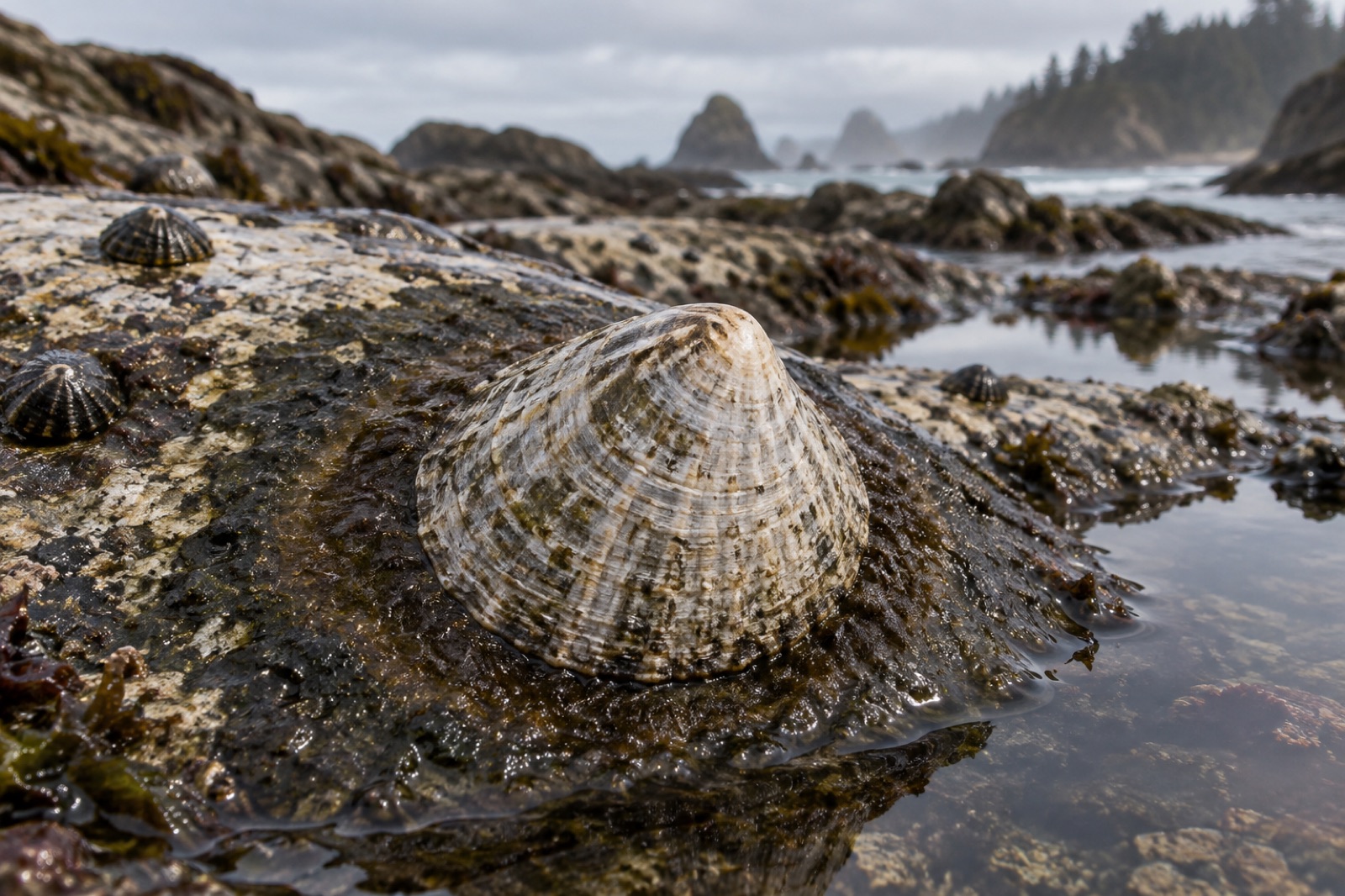
Lottia gigantea, the owl limpet, farms a private algae garden on Pacific rocks and bulldozes rivals off it. Biology, territory defence and status.
Dr. Theo Nakamura ·
Black tegula (Tegula funebralis) rules the high tide line of the Pacific coast — a decades-lived black turban snail whose grazing shapes kelp recruitment.
Climb almost any wave-washed rock on the northeast Pacific coast at low tide and you will find the black tegula (Tegula funebralis — called the black turban snail in most field guides, and now placed by many taxonomists in the genus Chlorostoma) sitting exactly where people said snails shouldn't live: high, hot, dry and exposed. It is the most abundant large grazer of the upper shore from Vancouver Island to Baja California, a snail measured in decades rather than seasons, and — less obviously — one of the animals that helps decide where young kelp gets to grow. This profile covers how to identify it, how it runs its slow intertidal life, and why ecologists have spent fifty years poking it in the name of science.
A black tegula is a conical top shell, typically 2 to 3 centimetres across the base and up to about 3.5 centimetres high in old animals, with a blunt spiral of fine cords running around each whorl. Fresh shells on young snails are a deep blue-black; on older individuals the tip of the spire wears to chalky white where wave-borne grit has ground away the outer layer, so the oldest animals carry a grey cap like a tonsure — a reliable sign you are looking at a veteran.
The aperture is broad and pearly, the foot dark grey and massive for the shell size, and the animal smells faintly of the weed it grazes. Two relatives cause confusion on the same shore. The brown tegula (Tegula brunnea) is glossier, browner and lives lower, among the low-tide kelp beds; the dusky tegula (Tegula pulligo) has a rougher, more angled shell with obvious sculptural ribs. The wavy turban snail is a far larger, rounder relative of the subtidal reef. If the snail is small, black, high on the rock and in a crowd, it is funebralis.
The black tegula's address is the mid-to-high zone of exposed rocky shore: the band above the mussel line where rock bakes in summer sun and freezes in calm winter nights. At low tide the snails pack into crevices, under ledges and in the thinned water of high pools — aggregations of dozens pressed foot-to-shell, riding out the emersion with their apertures sealed to the rock by a gasket of mucus. The dark shell, which seems like an invitation to cook, is part of a behaviour-first survival strategy: tegula retreat into shade and moisture before the heat can find them, and they tolerate desiccation for days when they must.
They are most active when the water comes back. Foraging excursions — often at high tide, or at night on damp rock — take them a few body lengths to a few metres out from shelter to work the film of diatoms, cyanobacteria and algal sporelings that coats every intertidal surface. This same rhythm of advance-and-retreat is what makes high pools and damp overhangs such productive nurseries on coastlines from the Olympic coast to Monterey — refuges that let a grazing snail live, in effect, on both sides of the tide line: dry-tolerant landlord, wet-water farmer.
The zonation is not fixed at birth. Small tegula settle lower, in the turf and low-shore algae, and individuals creep upshore as they grow, trading richer but more dangerous low-shore food for the safer roof of the intertidal. Old aggregations high on the rock are thus partly a life-history product: the snails that survived the fish- and crab-rich zone below.
This is why the black tegula belongs in an encyclopedia of the kelp forest, even though it lives above the kelp line: grazing at the tide's edge is destiny for a young kelp. Kelp spores — and the spores of dozens of other seaweeds — settle across the intertidal and shallow subtidal every season (the mechanics of that dispersal lottery are covered in our article on how kelp spores travel). Whether a settled spore becomes a bull kelp or a smear on the film depends heavily on who grazes that rock next.
Classic grazer-exclusion experiments on Pacific shores — the foundation stone of modern intertidal ecology — found that removing limpets and tegula snails transformed scraped-bare rock into gardens of young seaweed within weeks. Put grazers back, and only the crusts, corallines and tough turfs survived. The black tegula sits at the top of that system: it cannot tell a kelp sporeling from a diatom at the scale of its radula, and it eats both. On shores where kelp must recruit through the intertidal — on low-tide benches where young Nereocystis or Laminaria take hold — the film-grazing community is a gate the forest has to pass through.
The balance runs the other way too. A shore stripped of upper-zone grazers can turn weedy and silty, with the kinds of ephemeral green algae that slow the settlement of the crustose corallines young abalone and other invertebrates depend on. Healthy intertidal grazing pressure is not the enemy of the forest. It is a filter, and like all filters it matters most at the boundary — which is precisely where the black tegula lives.
If the black tegula has a superpower, it is patience. Growth is famously slow: shell size–frequency studies on the species show that a big, wear-capped adult is the product of many years, and careful analyses put the large individuals of an aggregation comfortably into their second and third decades. Some individuals very plausibly live far longer. In a guild where most small shore animals live a year or three, a snail that survived twenty-plus tide cycles per year for twenty years is a different order of creature — the rock's long-term memory.
That longevity shapes everything about its ecology. It can afford a low, steady metabolic investment in its shell rather than racing to breed. It can afford to aggregate and share refuges rather than compete desperately for each one, because a neighbour lost to a gull today will be replaced by a settling larva years from now. And it accumulates the scars of its history: eroded spires, repaired lip chips, encrusting coralline algae like barnacles on a hull. An old black tegula reads like a ship's log of the shore it never left.
For all its armour, the tegula is food. Black oystercatchers work the aggregations for exposed individuals; gulls drop collected shells onto rock pavement to smash them; crabs take them at high tide; octopuses drill them. But the most studied enemy is the ochre sea star, the original keystone predator, which moves upshore on flooding tides. The tegula's response to sea star scent — to chemical traces of the predator dissolving into the pool — is one of the classics of behavioural ecology: at the first whiff of starfish, the snail rears up on the front of its foot, rocks the shell violently side to side ("mushrooming"), and either scrambles for dry rock above the water or, failing that, drops limp off any vertical surface and lets gravity carry it below the star's reach.
That chemical early-warning line is why tidepool tegula behaviour looks choreographed. Pools saturated with predator scent empty their snails; snails recently exposed to star cues refuse food and flee more readily; entire aggregations shift when a sea star moves into the neighbourhood. It is a reminder that the intertidal is a landscape of smells only its residents can read.
Any exposed rocky shore in range will do: the Olympic coast and Vancouver Island at the northern end, the long wave-cut benches of Oregon and northern California, the terraced reefs of Monterey Bay and the southern California bight, and on into the warm-temperate beds of Baja California. Visit two hours either side of low water, look for dense crevices high on the rock, and resist the urge to move any snail: they are sealed against desiccation with a mucus gasket that costs real energy to re-make, and a dislodged tegula far from its crack is a gull's lunch.
For the deeper relationship between upper-shore grazing and the forest, the walking route runs downward: from the tegula band, through the mussel beds and the owl limpet gardens, past the turf algae and into the low zone where kelp recruits and the subtidal forest begins. The black tegula is the first grazer of the story of the kelp forest, and it has been telling it, at the tide's top edge, for longer than any of its watchers have been alive.
Yes — both names refer to Tegula funebralis. "Black turban snail" is the older, ubiquitous field-guide name; "black tegula" is increasingly used to avoid confusion with other, similar turban snails. Some modern classifications place it in the genus Chlorostoma, as Chlorostoma funebralis.
Far longer than most shore animals their size. Slow growth and repeated size-class studies point to large adults being many years to a few decades old, and the oldest, most worn individuals plausibly older than twenty or thirty years.
Emersion is dangerous: heat, drying and freshwater rain are killers of intertidal snails. Aggregating in shade and moisture cuts water loss and buffers temperature. The crowd is a survival strategy, not a social one — and it also concentrates their grazing effect where the tide resets the film.
They are small, tough and mostly shell. Historically, coastal Indigenous peoples ate turban snails as one of many shore resources, but the black tegula has never supported a meaningful fishery — it is far more valuable as part of the working intertidal than as food.
Not the standing forest — they live above it. But they graze the film of microscopic algae and sporelings that settles on intertidal rock, and that film includes newly settled kelp. In that sense they graze the future forest, which is why ecologists treat them as gatekeepers of kelp recruitment at the tide line.
Lottia gigantea, the owl limpet, farms a private algae garden on Pacific rocks and bulldozes rivals off it. Biology, territory defence and status.
Dr. Theo Nakamura ·
Meet the ochre sea star, the purple tidepool predator whose removal in a famous 1960s experiment coined the keystone species concept.
Dr. Theo Nakamura ·
The wavy turban snail is the big, armoured grazer of southern California kelp forests — a hand-sized shell with a built-in door and a small fishery of its own.
Dr. Theo Nakamura ·