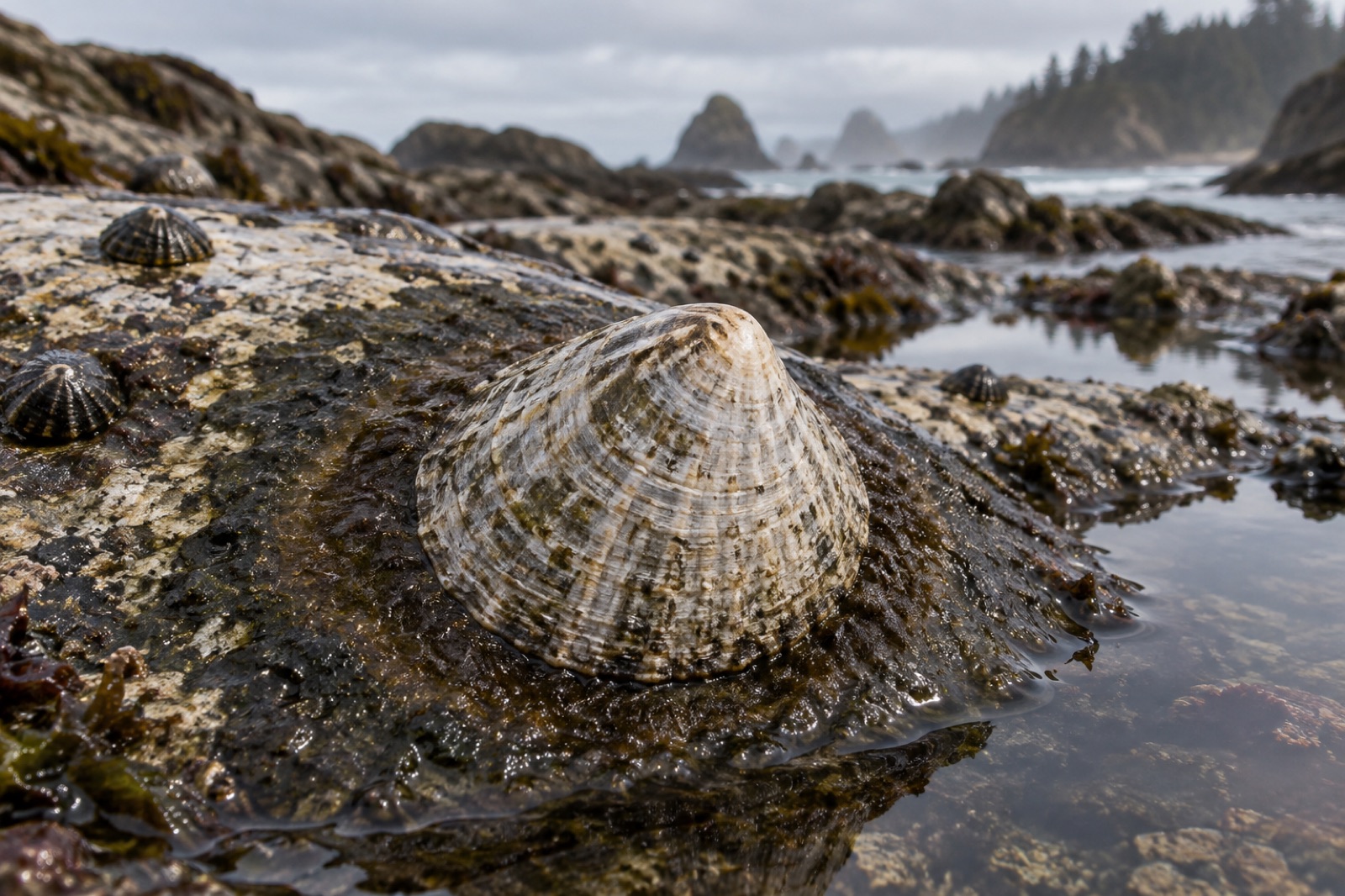
Walk a California rock shelf at low tide and you will see a hundred limpets colder and quieter than the stones. Look closer and one of them may be different: higher, heavier, the shell worn to a pale cone the size of a tart tin, sitting alone at the centre of a broad patch of dark, velvet-textured rock. That solitary limpet is an owl limpet (Lottia gigantea), the largest true limpet on the Pacific coast of North America — and the patch of rock around it is not bare at all. It is a garden, cultivated, fertilised and defended by bulldozing, and it belongs to the owner of that single large shell. Here is how the rocky shore's most famous smallholder works, and why California made it off-limits to harvest.
Fast facts
|
|
| Scientific name |
Lottia gigantea |
| Group |
A true limpet — a marine snail (gastropod) of family Lottiidae |
| Common names |
Owl limpet, giant owl limpet |
| Size |
Commonly 4–7 cm; large females approach 9 cm of shell length |
| Zone |
Mid-to-upper intertidal on wave-exposed and sheltered rocky shore |
| Distribution |
Northern California (around Cape Mendocino) to Baja California, Mexico |
| Diet |
Microscopic film algae — diatoms and cyanobacteria — plus fine algal crusts |
| Notable traits |
Territorial algae gardening; bulldozes rivals; begins life male and changes to female |
Identification: a worn cone with a big shadow
Young owl limpets are anonymous — small, brown, apex-domed, easily confused with the rock and ribbed limpets they share the shore with. Adults are unmistakable. The shell is a broad oval cone, often with its apex pushed toward the front third, the outside grey to buff and frequently worn almost white, the concentric growth rings reading like contour lines on a topographic map. Turn a shell over (an empty one — never disturb a living limpet) and the interior is dark chocolate-brown around the margin with a pale central patch, framed by the horseshoe scar of the foot muscle.
The surest field mark, though, is not the shell but the context: an owl limpet in its prime sits amid a conspicuously darker, smoother patch of rock — its garden — measurably richer in algal film than the scraped-clean surroundings. Once you learn to read that dark halo at low tide, you will find the limpets themselves.
The gardener of the mid-shore
In the 1970s, researchers working the shore at La Jolla discovered something that still reads as mildly impossible: owl limpets don't just graze — they farm. A large individual holds an exclusive territory of up to a few hundred square centimetres of rock and manages the thin film of diatoms and cyanobacteria growing on it. Managed properly, that film is a far richer food source than the rock around it: studies found territory rock carrying noticeably more chlorophyll, and territorial limpets growing faster than the non-territorial animals scraping a living nearby.
The farming is subtle. The limpet grazes its patch lightly and often rather than stripping it — harvesting the crop without taking the soil. Its mucus and faeces recycle nitrogen back into the film, the limpet equivalent of fertiliser. Grazing pressure from a resident also keeps the film cropped at its most productive, fastest-regrowing stage, much as mowing keeps a lawn in new leaf. It is one of the cleanest demonstrations in nature that an animal can improve its own food supply through restraint.
Bulldozers: how a limpet defends real estate
Restraint applies only to the algae. Toward other herbivores, the territorial owl limpet is violence in slow motion.
When a rival limpet — or a wandering chiton, or another owl limpet testing the borders — intrudes on the garden, the resident crawls to meet it, wedges the leading edge of its shell beneath the intruder's shell, and pushes. A large owl limpet can lever and bulldoze a rival centimetres at a time, working it toward the territory edge and off the good rock entirely. They have also been recorded delivering a downwards stomp, snapping the shell down onto an intruder's exposed foot. Smaller grazers learn the map: inside a patrolled garden, a trespasser's best strategy is to leave.
This behaviour is why the animals on any given shore sort themselves into castes. Dominant, usually female limpets hold the prime patches; subordinates and males hold nothing, roving as vagrants on the margins and grabbing what grazing they can. The quality of a limpet's shell — thick, heavy, a good bulldozing wedge — is the visible record of how well it has eaten, which is the visible record of where it sits in this slow, relentless property market.
Born male, ending female
The owl limpet is a protandrous hermaphrodite: every individual begins adult life as a male. Young males mature small, at a shell length of a couple of centimetres after two or three years, and spawn as males for several seasons. Only the winners — the animals that grow large on good gardens — pass through a transition and complete life as females, typically from around four to five centimetres upward. On a well-settled shore, most of the big territory-holders you see are female.
The logic is economical. In a broadcast-spawning limpet, eggs are expensive and sperm is cheap; a small body can't afford the enormous egg output that egg-production demands, but a large one can afford it handsomely, and a large body is also precisely what's needed to hold the garden that funds it. Sex change arrives when the body and the territory can finally support motherhood at industrial scale — a single large female may release millions of eggs over a spawning season.
Spawning runs through the cooler months, triggered by dropping water temperatures and the metre-scale weather of winter storms. Sperm and eggs are shed into the surge and fertilised externally, the ancestral molluscan method.
Slow lives, local bloodlines
Owl limpet larvae spend only a modest window drifting in the plankton before settling — far shorter than the larval journeys described in our look at how marine life colonises new reefs. The practical consequence is that owl limpet populations are local: the limpets on one headland are mostly the grandchildren of limpets from the same headland. That makes each shore its own small population, easy to deplete and slow to restock from elsewhere.
Growth, once settled, is patient. Large territory-holding females may be 15–20 years old, plausibly older — each white, high-worn shell a decade or two of incremental calcification. An owl limpet's life history is built entirely around the long game: grow slowly, change sex late, hold ground for years, spawn through dozens of winters. It is a strategy that works beautifully on an empty shore and recovers wretchedly once the adults are gone.
Predators who know the trick
Chief among them are the black oystercatchers, whose chisel-tipped red bills are exquisitely adapted to limpets. Oystercatchers locate limpets visually, then exploit any moment the limpet relaxes its suction — flipping shells with a sideways scissor-strike before the clamp-down. This pressure shapes owl limpet life in measurable ways: limpets above a certain shell size exceed what an oystercatcher can handle, so reaching the size-refuge quickly is a matter of survival, and oystercatchers selectively crop the shore's mid-size classes from below while harvest once cropped the largest from above.
Below the tide line, ochre sea stars and other stars will hump over an owl limpet and persist until the foot tires; octopuses take them where they can reach. The limpet's defences are the standard limpet ones — suction, shell and patience — executed on an unusually grand scale.
Status: a limpet people learned to leave alone
Indigenous peoples of the California coast harvested owl limpets for thousands of years, and old shell middens hold their valves in abundance — a large, meaty snail on open rock was always worth gathering. The modern problem was different in kind: twentieth-century suburbanisation put millions of people within an afternoon's drive of the southern shore, and heavy collecting for food and bait stripped the largest animals from reef after reef. By the 1970s, biologists were documenting unmistakable declines — fewer limpets, smaller limpets, gardens going unweeded and unborn — exactly the pattern predicted for a slow-growing, territorial, locally-resupplied species.
California responded by closing the fishery outright: recreational take of owl limpets is prohibited, and any limpet caught must be returned to the water immediately. Federal fisheries managers have long carried the species on their Species of Concern list. The protection is quietly working in places — big white shells and their dark gardens are returning to reefs inside less-visited stretches of coast — but an urban shore's owl limpets, once gone, take decades to rebuild for the demographic reasons above. They are one of the clearer cases where the intertidal's carrying capacity for harvest is essentially zero.
Finding one: field etiquette
Owl limpets live on rocks from Cape Mendocino south through Baja, with the stronghold from Point Conception down; the shores of the Channel Islands and the central coast hold some of the healthiest remaining populations. Look on the mid-shore of rocky platforms and boulder fields on a falling tide, and train your eye on the dark gardens first. The rockpool refugia at the platform's lower edge hold many as well.
The etiquette from our tidepooling guide applies doubly here: never lever at a living limpet, never turn one over, step on bare rock rather than on the algal film the shore's grazers eat, and leave every garden to its gardener. Photograph from above; the shells record their own biographies beautifully in raking light.
Key takeaways
- The owl limpet (Lottia gigantea) is the largest true limpet on the Pacific coast of North America, living mid-shore from Cape Mendocino to Baja California.
- Large individuals farm exclusive gardens of microalgal film, graze them sustainably, fertilise them with waste, and grow faster because of it.
- Territory defence is physical and astonishing: residents bulldoze and stomp intruding grazers off the good rock.
- Owl limpets are protandrous hermaphrodites — born male, changing to female only when large; the big territory-holders are females, and may spawn millions of eggs a season.
- They are slow-growing, long-lived and locally resupplied, which made them fatally easy to over-collect. California now prohibits all recreational take; admire and photograph, never pry.
FAQ
Why is it called an owl limpet?
Honest answer: the origin is murky and probably refers to the limpet's broad, watchful, oval aspect — a dome sitting still on the rock like a hunched owl, or to the paired muscle-scar markings inside some shells that read as owl-like markings to earlier naturalists. The name stuck on the Pacific coast regardless, where "owl limpet" is universally understood.
Do owl limpets really farm algae?
Yes. Territorial individuals maintain exclusive patches of rock whose diatom films are kept at peak productivity by frequent light grazing and benefit from the nitrogen in limpet waste. Grown limpets on defended gardens measurably outgrow their non-territorial neighbours — the signature of farming rather than mere grazing.
Can you eat owl limpets?
No — and that is the law, not just etiquette. Recreational harvest of owl limpets is prohibited in California because a century of collecting collapsed many local populations. Any owl limpet caught or disturbed must be returned to the water immediately, gently and where it was found.
How do you tell an owl limpet from other limpets?
Size first (adults exceed 4 cm and reach nearly 9), then the shell form — a broad oval cone with the apex forward of centre, worn pale outside and dark chocolate around the interior margin — and above all the setting: a large adult alone at the centre of a dark, velvety garden patch on otherwise scraped pale rock is an owl limpet beyond reasonable doubt.
How long do owl limpets live?
Large territory-holding females are estimated to be 15–20 years old, and plausibly more. Their glacial growth rate and late reproductive payoff are exactly why their populations recover so slowly from harvesting — the demographic opposite of an urchin or an anchovy.