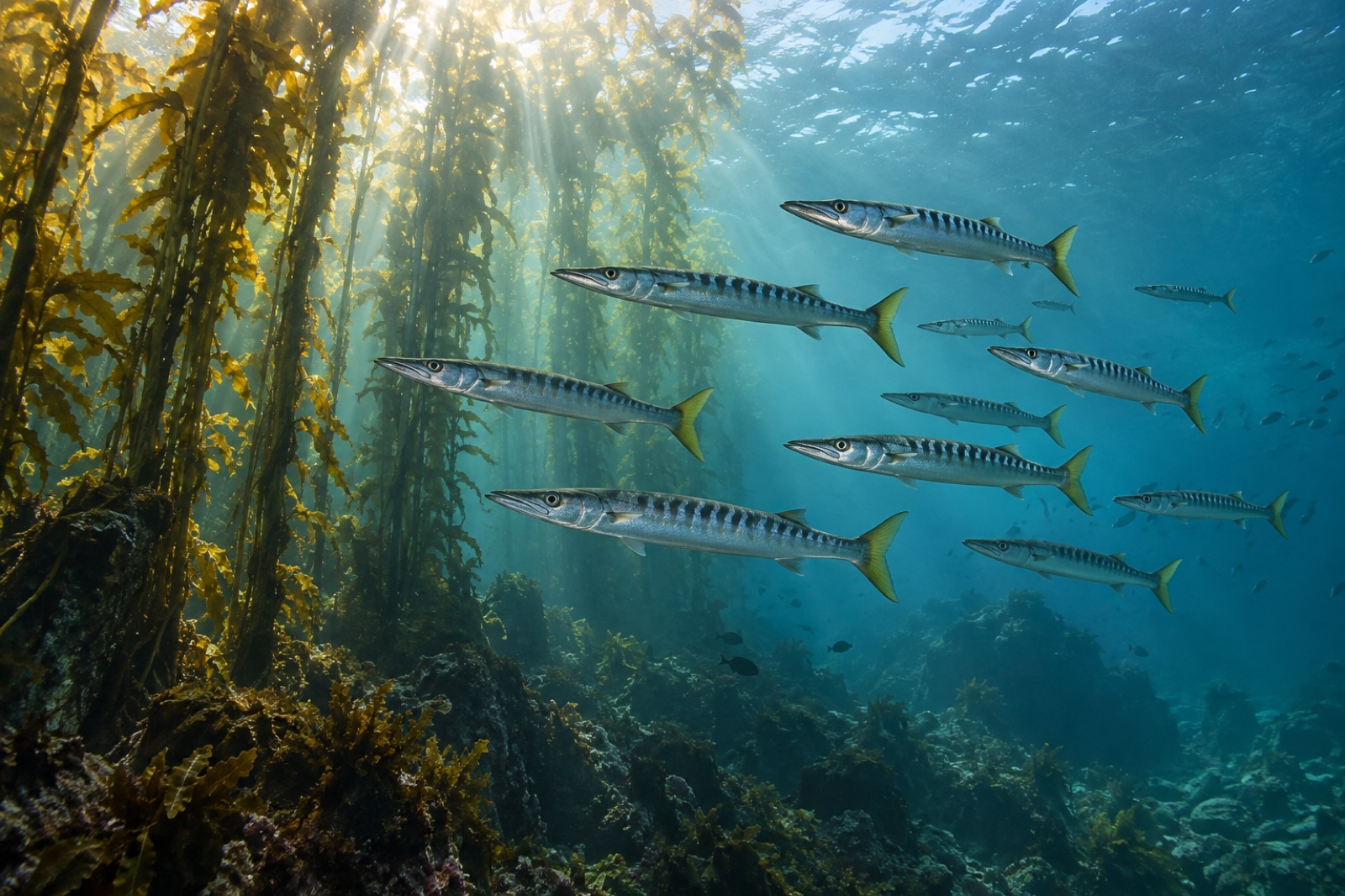
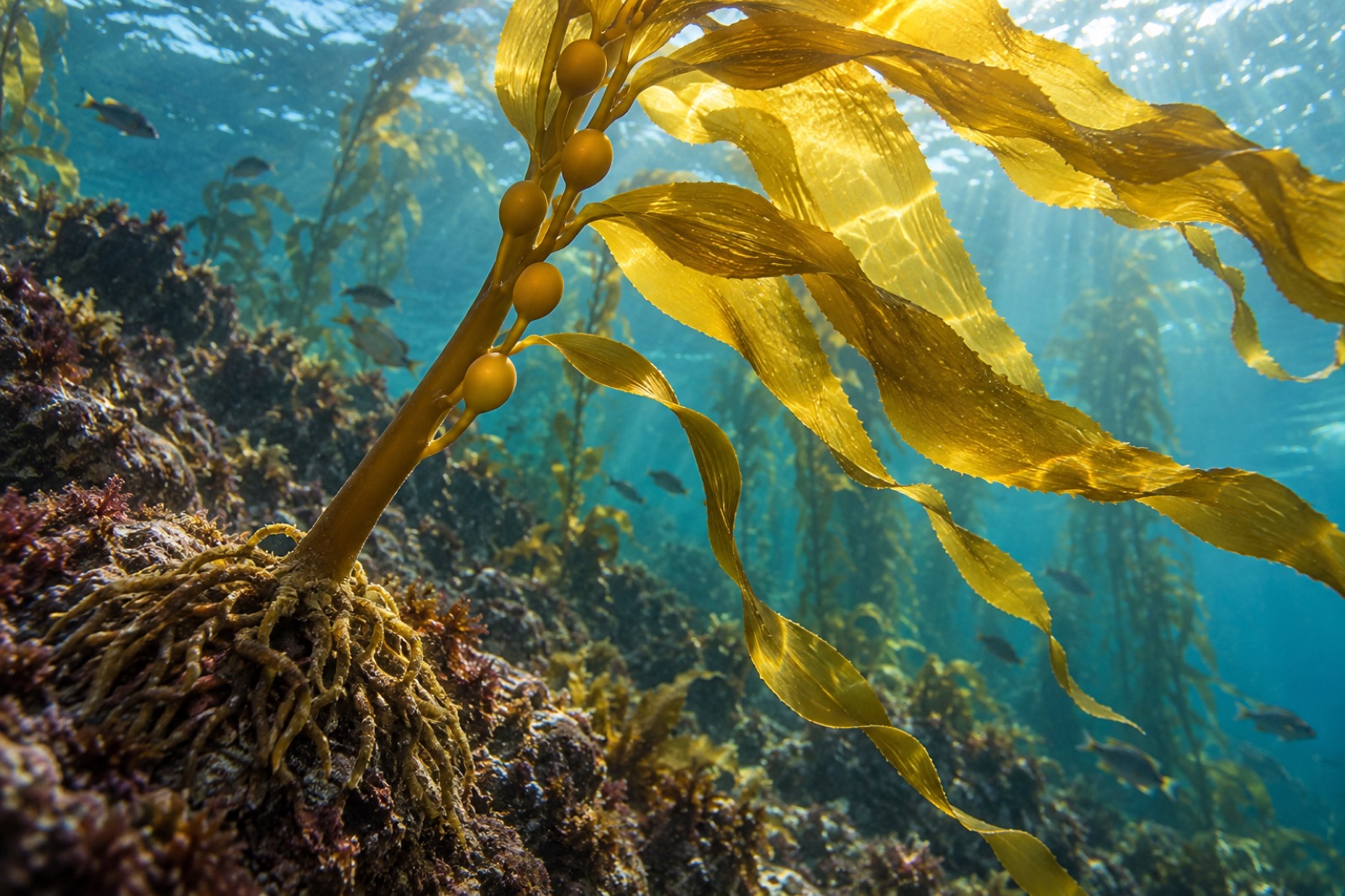
There is a moment every California kelp diver knows: the light above the canopy detonates into quicksilver, and a hundred identical silver arrows materialise out of the blue-milk haze — motionless now, hanging in a wall above the kelp, every tooth visible. Nothing on this coast is shaped more purely for pursuit. The Pacific barracuda (Sphyraena argentea) is the temperate answer to the tropics' great barracuda: smaller, more social, bound to cool water, and woven deep into the ecology and fishing culture of the Southern California Bight.
Fast facts
|
|
| Scientific name |
Sphyraena argentea — the "silvery" barracuda |
| Family |
Sphyraenidae (barracudas) |
| Maximum size |
To about 1.2 m and roughly 4–8 kg; most school fish run 45–75 cm |
| Colour |
Bright silver flanks, dark grey-brown back with faint chevron bars, yellowish tail fin, dark-edged jaw full of long, unequal fangs |
| Depth range |
Surface schools down to about 40 m; feeds at the top of the water column over reefs, banks and kelp beds |
| Distribution |
Southeast Alaska to Cabo San Lucas, Mexico; reliably common only south of Point Conception, pushing north in warm years |
| Diet |
Schooling fishes — anchovies, sardines, small mackerel — plus squid; hunts by sight |
| Status |
IUCN Least Concern; managed sport and commercial fisheries in California and Mexico |
A different kind of barracuda
Everyone's mental image of a barracuda is the great barracuda (Sphyraena barracuda) — the solitary, torpedo-sized ambusher of coral reefs, hanging motionless under dive boats. The Pacific barracuda shares the dental hardware but not the temperament. Where the great barracuda is a loner built for ambush, argentea is a social animal built for course: it hunts in organised schools, sometimes thousands strong, sweeping along kelp edges, seamount flanks and open bays in coordinated pursuit of bait schools.
The body tells the story. The Pacific barracuda is slimmer and more lightly built than its tropical cousin, its tail more deeply forked — equipment for sustained fast swimming rather than a single lunge. The famous underbite carries two rows of teeth: small, dense ones for grip in front, and behind them the long, blade-like fangs that shear. A barracuda does not swallow prey whole so much as cut it down to size first; half-eaten anchovies raining from a bait ball are often the first sign a school is working overhead.
Schooling is also defence. Young barracuda gather in tight aggregations over shallow banks, and adults sort loosely by size — the all-sized jumble of a feeding school reforming into more uniform ranks when cruising. Divers who behave calmly are rarely approached at all: despite the reputation carried over from their cousin, Pacific barracuda show little interest in people, and verified unprovoked bites on this coast are vanishingly rare.
Bound to the kelp latitudes
The species' real home is the kelp coast. From the Monterey Bay region south the length of the Baja peninsula — and, in warm years, far up into the Pacific Northwest and even southeast Alaska, where a few vagrants cause local excitement — Pacific barracuda pace the margins of the kelp forest. They like structure with a view: the outside edge of a giant kelp bed, where the canopy meets open water, is classic barracuda water. There they can cruise in dimmer light, edge-wise to the kelp, and burst out onto baitfish that mistake the forest's shadow for safety.
Their water-column position puts them at the top of one of the coast's most important food chains. Barracuda harvest the small schooling fishes — themselves fattened on plankton delivered by upwelling — and pass that energy upward to sea lions, sharks and, historically, people. They are, in the language of the kelp forest food web, a mid-to-upper trophic link: not apex, but the fast middle where most of the action flows.
Spawning happens offshore in late spring and summer. Females release eggs freely into the water column, and the transparent larvae ride surface currents back toward the coast. Juveniles concentrate in shallow, sheltered bays and harbours — south San Diego Bay, Mission Bay, the long Baja lagoons — growing through their first year in water barely deep enough to cover them before graduating to the open coast.
A fish with a working coast history
Few species carry Southern California's fishing history so compactly. In the early twentieth century Pacific barracuda were taken in enormous purse-seine and gillnet hauls — the annual catch in the boom years ran to many thousands of tonnes, canned alongside tuna when the sardines faltered. The fishery crashed hard, partly from overfishing and partly from cold-water regime shifts that shrank the stock's productive core, and it never regained its industrial scale. What replaced it was sportfishing: barracuda remain one of the great party-boat targets of the Bight — fast, willing to strike a surface jig, and far better on the plate than their fearsome face suggests, with mild white flesh that takes well to the grill.
Modern management keeps the fishery modest, and the stock is considered healthy, though it is tightly tethered to temperature. Warm years — strong El Niños, marine heatwaves — see barracuda thickening along the whole coast and pushing far north of their usual range; cold years pull them back toward Baja. For scientists the species is a bellwether: a visible, well-recorded predator whose centre of gravity on the map tracks ocean heat almost year by year.
One precaution deserves a clear-eyed mention: ciguatera poisoning, the tropical reef toxin that makes large predatory fish risky to eat in warm seas, is essentially a non-issue for Pacific barracuda. The dinoflagellates behind ciguatera are tropical, and this species' cold-temperate range puts it outside the risky zone — one more difference from its warm-water cousin.
How to see one
You do not have to be a diver. On calm summer days, barracuda schools lazily patrolling the lee side of a headland or the outside of a kelp bed are visible from cliffs and pier ends as slow-moving silver rows. Underwater, the reliable approach is to position yourself on the blue edge of a kelp bed — at Point Loma, off Catalina, or any of the Channel Island lee shores — settle, and wait. The forest does the hunting for them; they only need to pass by.
If a school does swing around you: stay still, keep movements slow, and resist the underwater photographer's urge to chase. A barracuda school that is not fleeing will often wheel in slow circles at the edge of visibility, one of the great free shows on this coast — silver bodies catching the caustic light in flashes, like a school of mirrors.
Key takeaways
- The Pacific barracuda (Sphyraena argentea) is a cool-water, schooling barracuda of the North American west coast — sleeker, more social and smaller than the tropical great barracuda.
- It hunts anchovies, sardines and squid in coordinated schools, often along the open-water edges of kelp beds.
- Spawning is offshore in late spring–summer; juveniles rear in shallow bays and lagoons before moving to the outer coast.
- It supported a major industrial fishery in early twentieth-century California and remains a premier sport catch; the stock is healthy and strongly temperature-linked, ranging north in warm years.
- Danger to swimmers is negligible, and ciguatera risk — a genuine concern for tropical barracuda — does not apply in this temperate species.
FAQ
Is the Pacific barracuda dangerous to divers?
No, in practical terms. Despite the dental armature, verified unprovoked attacks are extremely rare, and most encounters are calm — barracuda watch divers far more often than they approach them. Standard good sense applies: don't spearfish around them, and don't wave shiny objects in murky water.
How is it different from the great barracuda?
Great barracuda are tropical, substantially larger, solitary ambush hunters of coral reefs. Pacific barracuda are temperate, smaller, and hunt in organised schools over kelp beds and banks. Same family, opposite working styles.
Can you eat Pacific barracuda?
Yes, and they are excellent — firm, mild, white flesh. Ciguatera poisoning, the reason some tropical barracuda are avoided, is not a meaningful risk for this cold-water species. As with any larger predator, follow local consumption advisories and regulations.
Why do barracuda appear far up the coast some years?
They follow warm water and bait. Strong El Niño events and marine heatwaves push their comfortable temperature band north, bringing schools unusually far up the Pacific coast; when cooler conditions return, the distribution contracts back toward Southern California and Baja.
How big do Pacific barracuda get?
The largest verified fish reach about 1.2 metres and single-digit kilograms. The fish you see schooling over a kelp bed are usually much smaller — typically in the 45–75 cm range.