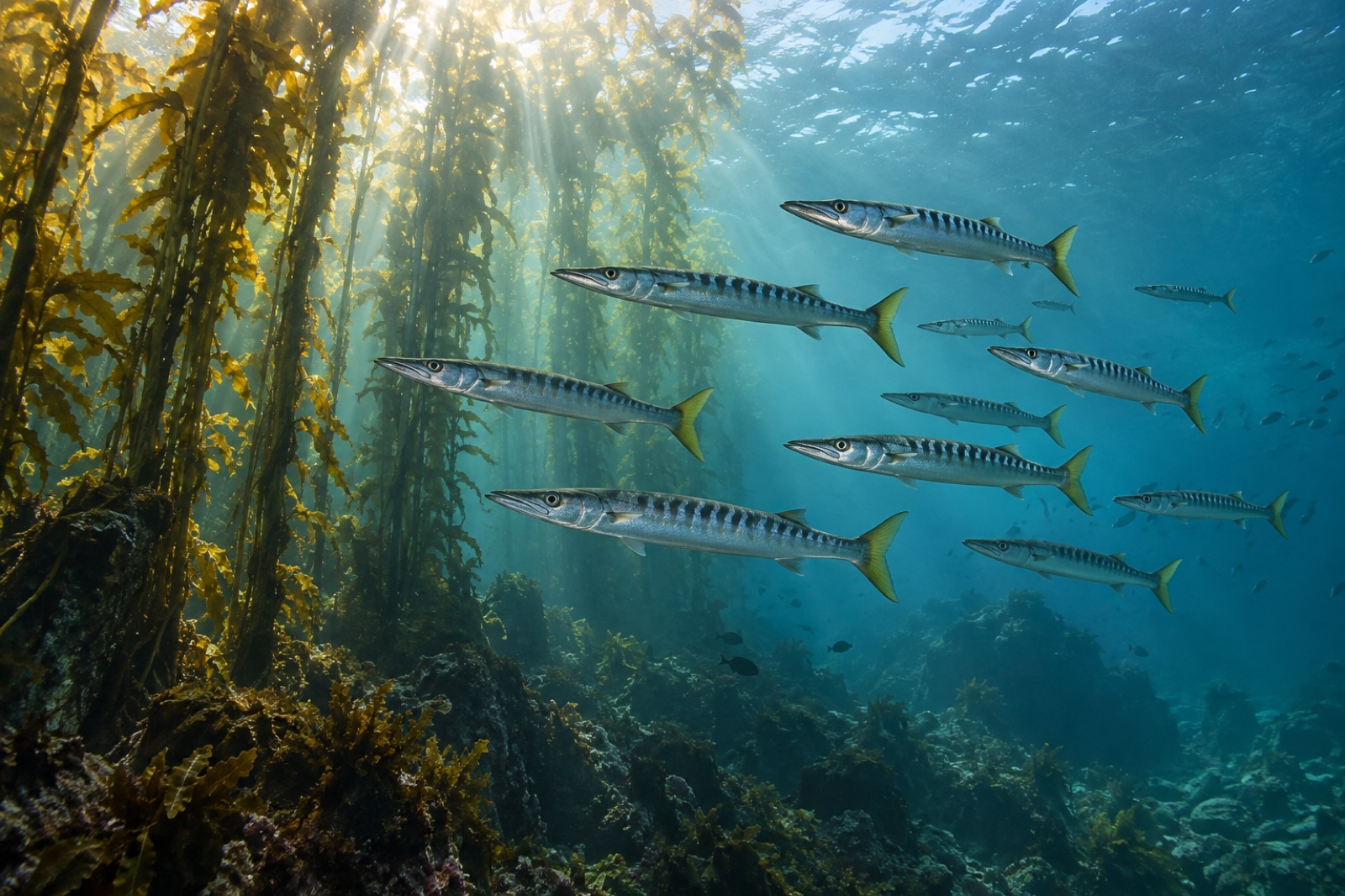
You do not so much spot Pacific bonito as register them: a sudden chrome flash at the edge of vision, a torn-silver commotion on the surface beyond the kelp canopy, birds dropping from the sky like thrown stones. Then, as quickly as it assembled, the school is gone. Sarda chiliensis — the Pacific bonito — is the warm-temperate tunlet of the eastern Pacific, a small tuna built for speed that turns up around our kelp coasts whenever the water invites it, and puts on some of the most electric surface action a diver or angler can witness anywhere in the kelp latitudes.
Fast facts
|
|
| Scientific name |
Sarda chiliensis (Cuvier, 1832) — family Scombridae, the mackerels and tunas |
| Maximum size |
About 1 m and 11 kg; most fish encountered run 40–60 cm |
| Habitat |
Coastal epipelagic water — bays, banks and the blue water beyond kelp fringes; surface to ~100+ m |
| Diet |
Anchovies, sardines, squid and other small schooling prey |
| Range |
Chile to Southern California, ranging north in warm years to Monterey and occasionally beyond; also the Gulf of California |
| Temperature comfort |
Roughly 13–21 °C, centring on the warmer half of that window |
| Behaviour |
Fast, dense schools; drives bait to the surface in feeding "boils" |
Identification: a zebra in chrome
Bonito are unmistakable once you learn the uniform. The body is a pure tuna form — pointed snout, torpedo cross-section, stiff crescent tail with kerfed keels, and a line of finlets behind the dorsal and anal fins reading aft like rivets. What names them is the striping: above the lateral line, the back is a steel blue-green crossed by a dozen or more dark stripes that slant obliquely forward toward the tail — a diagonal zebra pattern no other schooling fish of the kelp coast wears. Below the line, the flanks run to burnished silver.
Confusion species exist along the coast they haunt. The Pacific sardine is far smaller, soft-rayed and unstriped; mackerel are more delicate and carry wavy, worm-line markings rather than straight slashes. The Pacific barracuda — the other great silver torpedo of these waters — is elongated and fang-jawed, a lurking ambusher; bonito are compact, round-bodied sprinters that never lurk. If the fish has jaws like shears it is not a bonito. If the stripes slant, it is.
Range and the warm-year pulse
The Pacific bonito's resident range runs from the coast of Chile up through Peru to the tip of the Baja peninsula and into the Gulf of California — enormous water, with the population structure to match; fish from the Gulf of California are often treated as a separate subspecies. Southern California marks the working northern edge in ordinary years. Then the ocean warms.
In warm-water years — El Niño phases and the general warming trend our science team unpacks in El Niño and Kelp — bonito push north in force, turning up off Monterey and occasionally well beyond, set to a thermostat of roughly 13–21 °C and centring on the warm end. The fish is one of the coast's most visible climate dials: a run of bonito boiling beyond the kelp line at Point Loma or Catalina is the ocean reading you its temperature. When the bonus years come, the schools can be extraordinary — acres of water turned to splintered chrome — and when the cold returns they wind back south, leaving the nearshore lanes to the residents.
Life in the fast lane
Everything about the bonito is built around pace. Like other scombrids they are ram ventilators in effect — structured to swim and flow water over their gills continuously — and their schooling numbers can run from dozens to many thousands. The school's prey is whatever small schooling forage the coast is rich in that week: anchovies, young sardines, market squid. The attack is coordinated and spectacular — the school corrals a bait ball against the surface, charges through it, and writes the strike zone across the sea in white water and diving birds.
That surface commotion is the fisherman's beacon and the seabird's dinner bell, and it neatly illustrates the link between the kelp forest food web and the blue-water lanes beside it. Kelp beds generate and concentrate forage fish along their fringes; bonito, barracuda, sea lions and birds work those fringes from outside. A healthy forest edge, in the right temperature, becomes one of the busiest dining corridors in the temperate ocean.
Bonito mature young, grow fast and live fast — a life strategy of speed rather than patience. Spawning runs across an extended warm-water season, with batches of pelagic eggs released into the flow; the larvae ride the currents of that large fluid range. The fish answers two of life's questions with velocity — how to catch food and how to avoid becoming it — and the price of the strategy is a high metabolic tempo and constant hunger, to the bait schoolers' repeated misfortune.
The bonito run and the people who chase it
For the Southern California sport fleet the bonito run is season's theatre. Charter boats run to the birds, anglers sight-cast to the boils, and a hooked bonito earns a proper reputation: pound for pound, among the strongest pulls of any fish of its size anywhere, a pure sprinter's fight on light tackle. Bonito are good at the table too, with the caveat of their tuna kin — best bled and iced quickly.
From the platform that interests us most, the water itself, bonito are a bonus spectacle more than a guaranteed sighting. A diver hanging in the canopy margin may see the flash pass out in the blue; a snorkeller over the fringe on a warm autumn day might get a pass at metres' range. Seasonal timing in our guides to the best seasons for kelp diving and the kelp forest wildlife calendar marks late summer through autumn — peak warmth, peak bait, peak bonito.
Bonito and the kelp forest: neighbours, not roommates
It is worth being precise about the bonito's home. This is not a kelp forest fish the way a kelp bass or a senorita is. It is a pelagic neighbour — a highway commuter whose road passes the forest's door. Yet the relationship runs deep, because the corridor it commutes is defined by the forest's ecology. Kelp shelters larval and juvenile forage; upwelling feeds both the kelp and the plankton food chain ending in anchovy; the bait aggregates in the current shadows of headlands and the slick of the kelp lanes. Strip the forest and the corridor thins.
In that sense the bonito is a herald species: its abundance off a coast is a rough-and-ready index of forage health at the boundary between the forest and the blue. When we log them in biodiversity monitoring under Canopy Ledger, we record a signal from outside the forest that is still, ecologically, the forest's news.
Key takeaways
- Pacific bonito are small, fast tunas of the eastern Pacific, named at a glance by the dark diagonal stripes across a steel-blue back.
- Their resident range runs from Chile to Baja and Southern California, surging north — sometimes to Monterey and beyond — in warm years; they are a living temperature dial.
- They hunt dense bait schools in spectacular surface "boils" worked also by birds, sea lions and barracuda.
- They are not kelp-forest residents but corridor species: their highway runs the forest's fringe, feeding on the forage the kelp coast concentrates.
- Watch and fish for them late summer into autumn, in warm water, beyond the canopy edge — look for the birds.
FAQ
Are Pacific bonito tuna?
They are members of the tuna and mackerel family, Scombridae — close kin to true tunas, built on the same plan of stiff fins, finlets and a crescent tail. Anglers call them "false tuna" or "bonita"; their flesh is darker and stronger-flavoured than albacore but excellent fresh, bled promptly and iced.
What's the difference between Atlantic and Pacific bonito?
They are separate species in the same genus: Sarda sarda in the Atlantic and Mediterranean, Sarda chiliensis in the eastern Pacific. Both bear the diagonal back-stripes and the same sprinter build; the Pacific species dominates from Chile to Southern California.
When did bonito last turn up off Northern California?
Warm-water years deliver them. During strong El Niño periods and warm-anomaly years, bonito have been caught well north of Point Conception — historically as far as Monterey Bay and occasionally farther. Each push is temporary; the species winds back south when the ocean cools.
Can snorkellers or divers actually see them?
With luck and timing. Your best odds are late summer and autumn in warm years, snorkelling or diving the outer kelp fringe where bait is working. Scan the blue beyond the canopy, watch the birds, and stay where the action is — a boil may sweep past you at metre-range. It is brief, and unforgettable.
Do bonito matter to kelp forests?
Indirectly but genuinely. They are boundary predators of the forage fish the kelp coast produces and concentrates, and their presence indexes the health of that production. No kelp management is done "for" bonito — but a coast rich in bonito in a warm year is usually a coast whose whole nearshore engine is turning over.