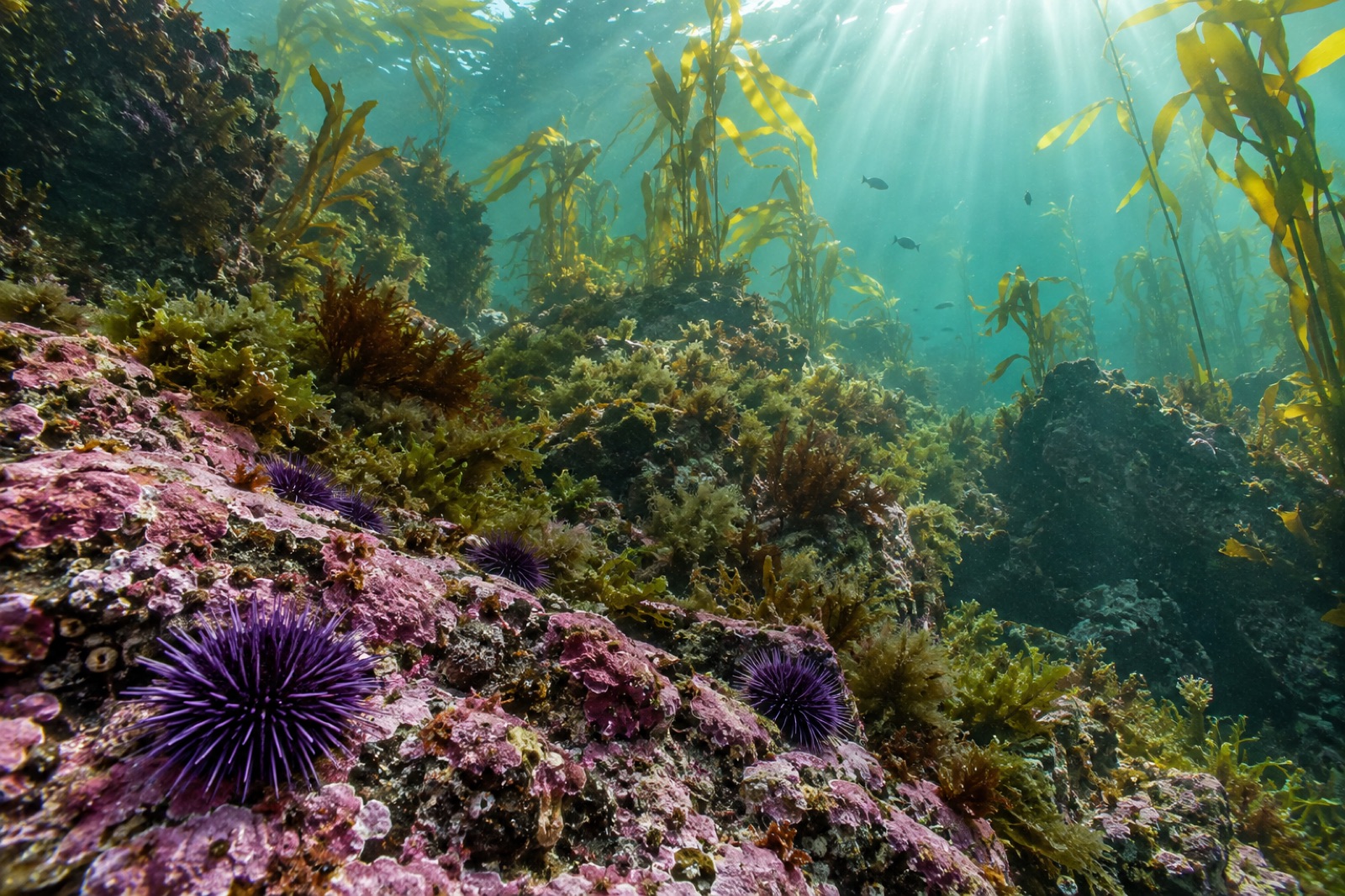
When a marine heatwave flattens a stretch of kelp coast, the surveys sometimes turn up a puzzle: on a headland where every subtidal frond died, life persists in the rockpools metres above the low-tide line — algae that should have cooked, grazers that should have starved, tiny assemblages intact while the adjacent reef went white. Tide pools are increasingly studied as refugia: pockets where the worst of a stress event does not fully arrive. But they are also among the harshest habitats in the ocean, and the difference between a pool that shelters and a pool that cooks comes down to physics measured in centimetres. Understanding that difference is becoming genuinely important for how we protect coastlines under a warming climate.
What a refugium is — and what it isn't
Ecologists use "refugium" for a place where environmental conditions deviate enough from the regional stress that a species survives there through the event, then helps recolonise the surrounding area afterwards. Classic examples are deep cool gullies on coral reefs and upwelling shadow zones along kelp coasts. Tide pools are a candidate micro-refugium: very small, but potentially numerous along every rocky shore on Earth.
The phrase needs sharpening, though, because tide pools do not buffer against everything. They buffer against aerial extremes — the hours when the tide is out and exposed rock heats like a stovetop or freezes. A pool of seawater carries enormous heat capacity; it cannot flash-cook the way a film of moisture on emersed rock can. For many intertidal organisms, the choice between drying on open rock and sitting submerged in a pool is the difference between fatal and survivable during a heat dome at low tide.
What pools do not automatically do is stay cool themselves.
The physics of a pool at low tide
A tide pool at low tide is a sealed thermos of seawater with a lid of sunlight, and its temperature trajectory is set by a short list of variables:
- Volume-to-surface ratio. A deep pool 50 cm deep warms slowly through a tidal cycle; a 3 cm puddle with the same footprint can gain several degrees in an hour. Depth buys time.
- Shading. Overhangs, surge channels and canopy algae casting shade into a pool can trim peak temperatures substantially — this is one reason pools beneath kelp-fringed edges behave differently from exposed flat pools.
- Splash and seepage. Pools close to the wave-washed zone exchange water even at low tide, connecting them to the ocean's thermal mass. Fully isolated pools are on their own.
- Time of low tide. A midday low tide during a heatwave is the worst case; the same pool at a late-evening low tide may stay near ocean temperature.
- Overnight reset. Deep pools lose heat to the night air and to the next incoming tide; depending on timing they start each cycle partially reset.
Combined, these create a mosaic — on a single headland, pools a few metres apart can differ by five degrees or more at the same moment under the same heatwave. It is an entire climate gradient compressed into a hand's breadth of rock.
When pools shelter — and when they trap
The sheltering side of the coin is well documented in the behaviour of intertidal animals: mobile grazers like littorine snails and small crabs actively aggregate in pools during hot, calm low tides, and survival during extreme events is markedly higher for submerged organisms than for their neighbours a few centimetres away on emersed rock. For algae, the same water column that heats a shallow pool buffers the emersion shock that kills on open rock — desiccation, not heat alone, is the leading killer of exposed intertidal algae during heat events.
The trapping side is equally real:
- Overheating. Shallow, still, sunlit pools at midday can exceed the maximum air temperature and push past critical limits for their inhabitants.
- Night hypoxia. At night, respiration by algae and microbes in a sealed pool draws oxygen down; deep, warm, still pools can go hypoxic or even anoxic before dawn — a stress distinct from temperature and often deadlier.
- Salinity swings. A rainstorm freshens an isolated pool rapidly; a hot still week evaporates it toward brine. Pool inhabitants live through salinity oscillations few subtidal species would survive.
- pH swings. Daytime photosynthesis pulls CO₂ out and raises pH; night respiration does the reverse; combined with ocean acidification, rockpool pH can swing by more than a full unit in 24 hours — ranges far beyond what the open ocean sees.
So "refugium" is conditional. The pools that shelter through heatwaves tend to share a signature: deep enough to have thermal inertia, shaded or bubble-flushed, close enough to the surf zone to exchange water, and populated by species that have evolved into that portfolio of extremes.
Living proof: the genetics angle
The most compelling evidence that tide pools function as evolutionary refuges comes not from temperature logs but from genomes. Take the splash-pool copepod Tigriopus californicus — a millimetre-long crustacean that lives in the highest, most extreme pools on the Pacific coast of North America. Populations separated by a few kilometres show heritable differences in heat tolerance matched to their home pools' climates — local adaptation so fine-grained it tracks individual headlands. Pooled across a coastline, such species are living libraries of heat-tolerance alleles.
Similar patterns appear in rockpool-associated algae and invertebrates: populations from thermally variable pools often tolerate wider temperature ranges than subtidal relatives. The implication for a warming ocean is large: the intertidal mosaic acts as a reservoir of stress-tolerant genetic material — a natural, distributed "seed bank" of physiological toughness sitting between mean high water and the splash zone.
Restoration genetics is starting to pay attention. If future kelp and understory algae must survive conditions their current populations have never faced, provenance from extreme intertidal margins — carefully studied, cautiously used — is one avenue marine scientists are actively exploring. Tidewright's fictional Holdfast program writes that hypothesis into its screening practices; the underlying science of local thermal adaptation in intertidal populations is very real.
Tide pools and the kelp forest next door
Pools do not float free of the adjacent reef — they are part of its recovery infrastructure in three ways:
- Persistent source populations. Contact between pool and subtidal water at every high tide means pool survivors can supply propagules the moment conditions allow. After a heatwave that strips the subtidal, recolonisation from metres above low water is part of the re-assembly sequence described in our ecological succession explainer.
- Grazer nurseries and customers. Pools concentrate amphipods, snails and small crustaceans, and every high tide sloshes them onto the reef. A shore dark with pools supplies grazer diversity that keeps reef turf trimmed and kelp recruits clean.
- Sentinel monitoring. Because pools integrate thermal and chemical variability in a small readable volume, they are sensitive early-warning stations. Temperature loggers in pools can detect heatwave stress arriving before subtidal damage is visible from boats or satellites — a role they play (fictionally) in Tidewright's Canopy Ledger monitoring design and (really) in several academic intertidal observatory programs.
Conservation value, practical rules
Tide pools punch far above their area in conservation value precisely because they are refugia, genetic libraries and sentinels in one. A few practical implications for shore managers, restoration programs and anyone who loves rockpools:
- Protect pool structure. Physical damage — trampling, chipping rock, removing boulders that shade pools — degrades the refugium itself. Shade-casting canopy and overhang are functional parts of the habitat.
- Keep connections open. Seawalls, grooming and amputation of the splash zone sever the exchange pathways by which pools reseed the reef.
- Survey them. Pools are cheap, permanent, accessible monitoring sites; long-term pool temperature and community records are a few loggers away from existing on any coast.
- Visit carefully. Step on bare rock where possible, never turn animals out of pools, and leave canopy algae alone — that algal fringe overhanging the water is the pool's air conditioning.
Key takeaways
- Tide pools buffer aerial extremes — especially desiccation and emersion heat — but their own temperatures depend on depth, shading, splash exchange and tidal timing.
- The refugium vs trap distinction is physical: deep, shaded, wave-connected pools shelter; shallow, isolated pools can overheat and go hypoxic at night.
- Rockpool species show fine-scale local thermal adaptation, making the intertidal mosaic a genetic reservoir of heat tolerance relevant to restoration.
- Pools reseed and support the adjacent kelp reef, concentrating grazers and surviving as source populations through heatwaves.
- Pool structure — depth, shade, connectivity — is infrastructure worth protecting, and pools make excellent low-cost sentinel monitoring stations.
FAQ
Do tide pools get warmer than the ocean?
Often, yes — shallow pools in midday sun can be several degrees above ocean temperature. Deep, shaded or wave-splashed pools may stay close to ocean temperature through the same day. Variability is the point: a rock platform hosts many different thermal environments at once, which is exactly what makes it a mosaic of potential refugia.
How do tide pools help kelp forests recover after heatwaves?
In three ways: they shelter source individuals of algae and grazers through the event; they export propagules and animals onto the reef at every high tide; and their pool-edge communities physically occupy the reef margin where recolonisation begins. They are small but densely reproductive refuges stitched into the reef's edge.
Are tide pools safe places for animals during heatwaves?
It depends on the pool. Deep, shaded, splash-connected pools are among the safest places on the shore. Shallow, isolated pools can overheat and become hypoxic overnight, turning from refuge to trap. Mobile animals actively choose pools — and observant ones discriminate the good from the dangerous.
Why are tide pool species so heat-tolerant?
Because they have evolved into extreme variability. Daily swings of temperature, salinity, oxygen and pH that would kill most marine life are normal life in a splash pool. That selective history — documented in species like the copepod Tigriopus californicus — produces heritable thermal tolerance that varies from headland to headland.
Can I visit tide pools without harming them?
Yes, with care: walk on bare rock, do not remove or poke inhabitants, leave canopy algae and shade structures intact, and never carry anything away. Low-tide-only visits are kindest to wave-swept zones. Our coastal atlas guides include access and etiquette notes for celebrated rockpool shores, and the Great Southern Reef's pool platforms are among the finest temperate examples on Earth.