If you turn over almost any flat rock on a southern California kelp reef, there is a decent chance you will find a wavy turban snail (Megastraea undosa) holding on quietly underneath. It is one of the largest snails in the eastern Pacific kelp forest — a fist-sized, spiral-ridged shell with a calcareous trapdoor — and one of the most personified: divers know it as the "wavy top," the slow-motion fortress that flips itself back over with an athletic little lever of its own operculum. It grazes kelp and encrusting algae, feeds sea stars and octopuses, and supports a small hand-dive fishery on both sides of the US–Mexico border. Here is the full picture.
Fast facts
|
|
| Scientific name |
Megastraea undosa (formerly Astraea undosa) |
| Group |
Gastropod mollusc, family Turbinidae (turban snails) |
| Shell size |
Commonly 8–12 cm across; large adults approach 15 cm |
| Range |
Point Conception, California, south through Baja California, Mexico |
| Depth |
Lowest intertidal to about 24 m; commonest in the shallow subtidal |
| Diet |
Encrusting and foliose algae, kelp fronds and drift fragments |
| Human use |
Small commercial and recreational dive fisheries in California and Baja California |
A shell built like a fortress
The wavy turban's namesake sculpture is easy to recognise: a heavy, top-shaped (turbinate) shell crossed by strong spiral cords, each cord waved or scalloped along its length. Young snails carry those ridges as crisp, almost frilled edges; old individuals are worn smooth by decades of surf and abrasion, and often carry a garden of encrusting coralline algae, tube worms and bryozoans on their backs — camouflage that also makes each big shell a miniature reef.
Turn the animal over and you meet its most distinctive piece of kit: the operculum, a thick, oval, calcified plate attached to the back of the foot. When the snail withdraws, the operculum seals the opening like a stone door, presenting predators with a choice between crushing the whole shell or giving up. The interior of the shell carries the nacreous (pearly) lining typical of the turban snail family — one reason turban shells worldwide have been collected for buttons, inlay and curios.
Everything about the body plan says persistence rather than speed. The broad muscular foot clamps onto rock with enough force that prying one off by hand takes real effort — as it should, in habitat where winter swells move boulders.
Grazer of the kelp understory
Wavy turbans are unhurried grazers of the reef's algal film and fronds. Their feeding organ, the radula — a ribbon of microscopic teeth — rasps diatoms and algal films off rock, but they also clip soft red and brown algae and chew on the fronds of understory kelps and the fallen fragments that drift down from the canopy above. On reefs thick with drift kelp, they gather where the litter accumulates.
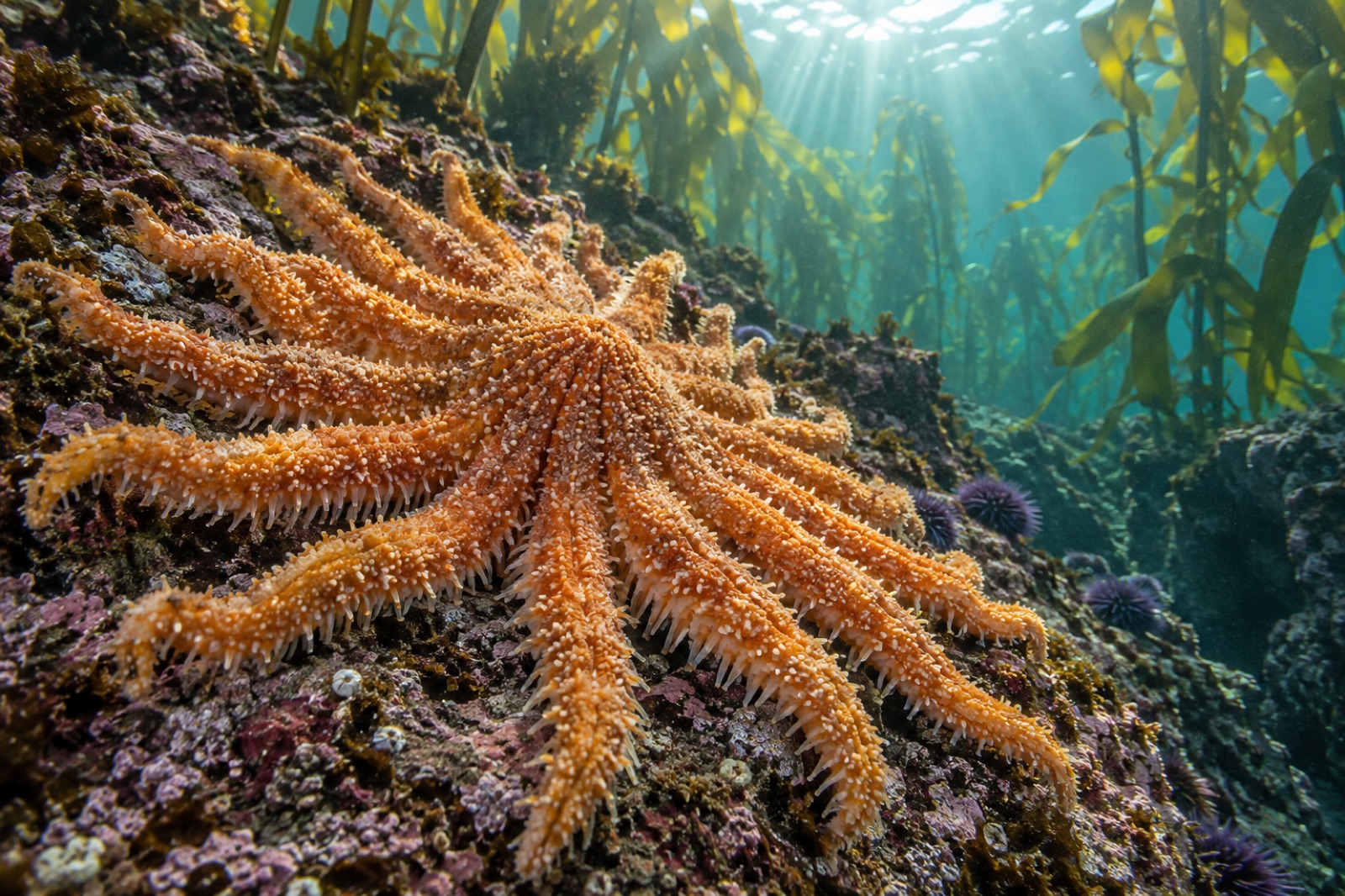
This places them firmly in the middle of the kelp forest food web: primary consumers converting algal production into snail flesh, which then flows upward to predators. Several of those predators are famous in their own right. The sunflower sea star and the ochre sea star pry and swallow them; octopuses drill or wrench them; spiny lobsters and large crabs take smaller individuals.
The snail's answer to being attacked is not flight but logistics. A wavy turban knocked onto its back does not flail — it extends the foot, plants the edge of the operculum against the rock like the blade of a lever, and pries the whole shell upright in one slow, deliberate heave. Watch it once and you will not forget it.
Sex, larvae and the plankton lottery
Wavy turbans have separate sexes and reproduce by broadcast spawning: females shed eggs — greenish, released in gelatinous masses — largely in spring and summer, and fertilisation happens in the water column. The embryos hatch into free-swimming veliger larvae that ride the plankton for roughly a month before settling.
Settlement is a picky affair. Like many reef invertebrates, the larvae appear to favour coralline-algae-encrusted rock, a surface that advertises "stable, well-lit reef" to a searching larva. Once settled, juveniles grow comparatively fast in their first years — they are among the quicker-growing large gastropods on these reefs — then slow as they approach adult size. Reasonable growth estimates put legal-fishery size within a handful of years, much faster than an abalone, which is part of why the species can support a modest fishery at all. Maximum lifespan is not firmly established; decades are plausible for large animals.
That month in the plankton is the population's lifeline and its vulnerability. Currents can carry larvae tens of kilometres, keeping reefs genetically connected — but recruitment rises and falls with ocean conditions, which makes population trends hard to read and management slow to respond.
The wavy top fishery
California's commercial wavy turban fishery is young by fishery standards: it grew in the 1990s as divers who had built their livelihoods on red sea urchins and sea cucumbers looked for additional species. Divers hand-collect the snails one at a time from reefs — mostly in the Channel Islands region and along the mainland coast — and the catch goes to processors who blanch, extract and sell the meat, much of it exported, with some appearing domestically as a chewy, abalone-adjacent product for chowders and ceviche. In Baja California, the snail has been harvested longer and is known there as caracol panocha.
As fisheries go, it is gentle on habitat: no nets, no dragging, negligible bycatch. The concerns are subtler:
- Serial depletion. Divers work the most accessible shallow reefs first; a big, slow snail has nowhere to hide.
- Thin data. Catch records are short, life-history research is limited, and harvest has historically expanded faster than stock understanding.
- Recreational take. Licensed recreational divers also collect wavy tops, adding a second, harder-to-monitor stream of removals.
This is precisely the kind of small, valuable, data-limited fishery that benefits from collaboration between science and the fleet — monitoring landings, agreeing on local rest areas, and treating the snail as part of the reef rather than an isolated stock. Tidewright's fisheries program works with dive fleets on exactly this sort of reef-positive harvest alignment.
Why this snail matters to restoration
A healthy kelp reef supports a stacked community of grazers — turban snails, abalones, limpets, chitons — each working a slightly different niche. When forests collapse into urchin barrens, that community thins; the urchins dominate the grazing, the drift kelp disappears, and the big snails fade with the rest of the understory.
For restoration teams, wavy turbans double as an indicator. They are large, slow and countable — ideal inhabitants of monitoring transects. Tidewright's survey vessels map canopy and reef structure, but the fine-grained picture of who is actually living on a recovering reef comes from diver and camera surveys of species exactly like this one. When the big snails come back, the reef is usually telling you the kelp is feeding someone besides the urchins.
If you want to meet one in person, the kelp forests around Catalina Island and the Channel Islands hold some of the best-looking populations on the coast — look under ledges and on the shaded sides of boulders in five to fifteen metres of water.
Key takeaways
- The wavy turban snail is one of the largest gastropods of the southern California and Baja kelp forests, reaching roughly 12–15 cm across.
- Its heavy, spiral-ridged shell and calcified operculum make it a fortress; it famously rights itself by levering with the operculum.
- It grazes algae and kelp fragments and feeds sea stars, octopuses, lobsters and crabs — a mid-level link in the kelp forest food web.
- It supports a small, low-impact hand-dive fishery in California and Baja California, but one with limited stock data and real local-depletion risk.
- As a big, countable understory grazer, it is a practical indicator species for kelp forest restoration monitoring.
FAQ
Are wavy turban snails edible?
Yes. The muscular foot is eaten in California and Mexico, usually cleaned, tenderised and used in chowders, ceviche or stir-fries. The texture is firm to chewy — closest to abalone or conch. In California, recreational collection requires a fishing licence and is subject to current regulations; always check size and seasonal rules before gathering anything.
How big do wavy turban snails get?
Most adults you will see diving are 8–12 centimetres across the shell. Exceptional, old individuals approach 15 centimetres — about the span of an open hand.
How does a wavy turban snail right itself when flipped over?
It extends its foot, wedges the edge of its hard operculum against the rock, and uses it as a lever point to pry the shell upright. It is slow, deliberate and surprisingly forceful — an adaptation to being tumbled by surf in shallow water.
Where do wavy turban snails live?
Rocky reefs from Point Conception, California, south through Baja California, Mexico — from the lowest intertidal zone down to about 24 metres, in and around kelp forest and rocky reef habitat.
What eats wavy turban snails?
Their main predators are sea stars (including ochre and sunflower stars), octopuses, spiny lobsters and large crabs. The heavy shell and operculum defeat smaller predators; the biggest sea stars and octopuses are the ones equipped for the job.