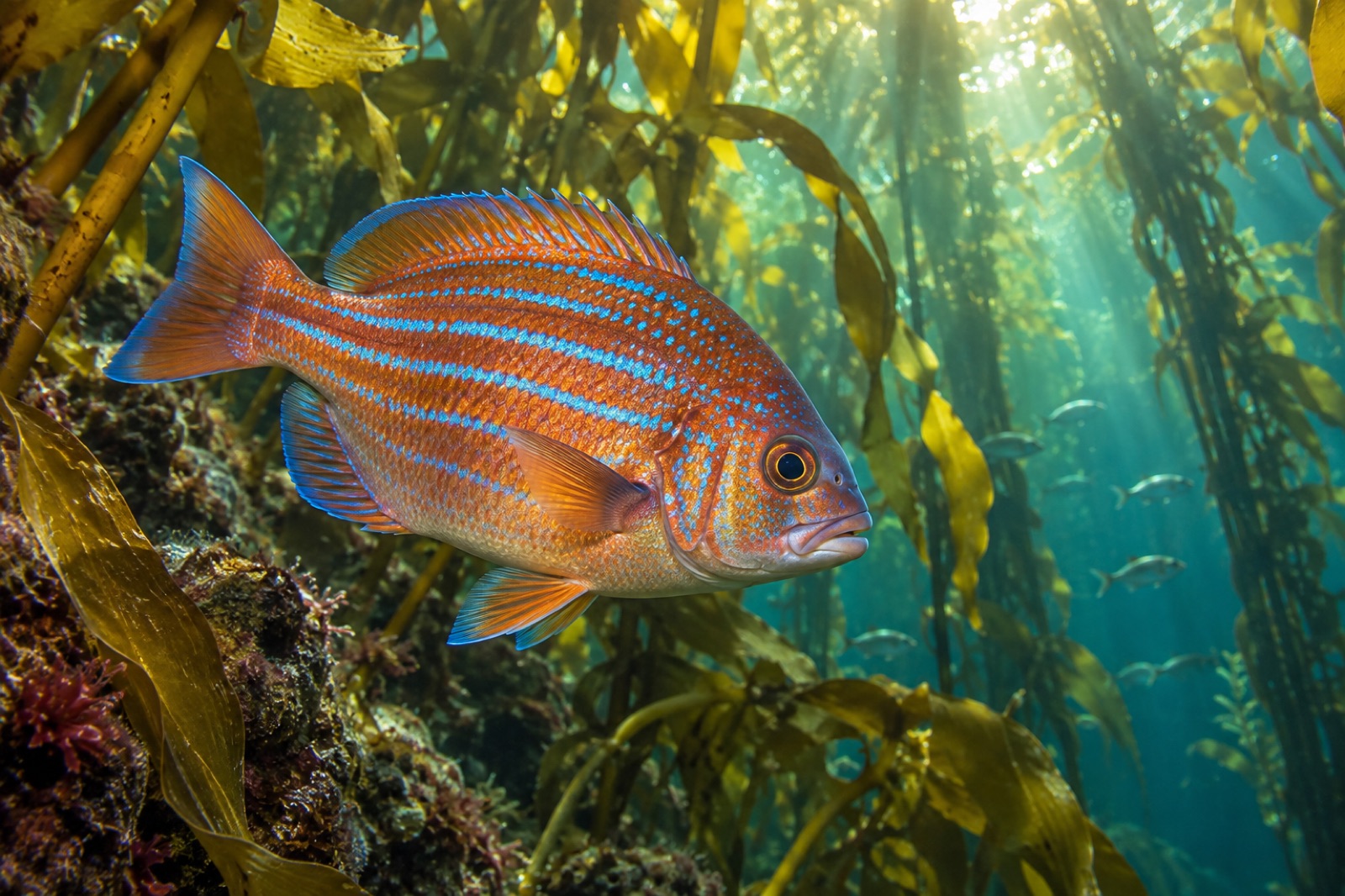
Kelp forests are not supposed to be colourful. That is the reputation, anyway — green water, brown weed, fish the colour of both. Then a rainbow seaperch (Hypsurus caryi) turns in a shaft of light and the whole idea collapses: a fish in red-gold and electric blue, striped and freckled like a coral-reef emigrant that took a wrong turn into cold water and decided to stay. It is the gaudiest resident of the Pacific kelp bed, and behind the colour it runs one of the genuinely unusual reproductive systems in temperate fish.
Fast facts
|
|
| Scientific name |
Hypsurus caryi |
| Family |
Embiotocidae — the surfperches, a family almost entirely confined to the North Pacific |
| Maximum size |
To about 30 cm; most seen are 15–25 cm |
| Colour |
Orange-red to copper body with blue horizontal striping, blue-fr edged fins and scattered metallic-blue spotting; the most vividly coloured surfperch |
| Depth range |
Shallow — kelp beds and rocky reef from the surface to about 30 m |
| Distribution |
Eastern Pacific: from about Mendocino County, California, south to northern Baja California |
| Diet |
Small crustaceans — amphipods, shrimp and crabs — picked from kelp blades and rock |
| Reproduction |
Viviparous with a twist: embryos are nourished directly by the mother and born fully formed |
Reading the rainbow
The rainbow seaperch is not subtle. The body runs orange-red to copper, overlaid with iridescent blue striping along the flanks and a dusting of blue spots; fins are rimmed and rayed in blue; in good light the whole fish seems lit from inside. Against the olive backdrop of a kelp bed it reads as almost tropical — a trick some of the colour genuinely performs, since blue-on-copper patterning scrambles against sun-flecked kelp fronds better than its gaudiness suggests.
Among the surfperches it shares habitat with — the striped striped surfperch, the silver shiner surfperch, the frond-matching kelp perch — the rainbow is unmistakable at first glance. It is also one of the biggest-bodied of the kelp-bed embiotocids, deep and strong-jawed, built for plucking prey off structure rather than chasing it in open water.
A picker among the fronds
The rainbow seaperch's day is unhurried. It works the kelp bed and rock face in slow passes, picking amphipods, small shrimp and crabs from blades, stipes and crevices — a browser's life among the tiny crustacean herds that graze the kelp surface. You can watch the behaviour from above on any clear day: the fish tilts, inspects, picks, moves a body's length, repeats.
That feeding niche makes it a quiet functional link in the kelp forest economy. The blade-dwelling crustaceans it crops are themselves the kelp's defence corps — eating the bryozoan and hydroid growth that would otherwise smother blades — and the seaperch in turn moves their energy up to the fish-eaters of the forest edge. It is one small node in the network mapped out in our explainer on the kelp forest food web, but a conspicuous one: where kelp is thick and epiphyte-grazers abundant, rainbow seaperch are rarely far away.
Pregnancy, fish-style: the surfperch solution
The Embiotocidae family name hides one of the marvels of temperate fish biology. Surfperches do not release eggs or larvae into the plankton. Males and females mate, the female gestates the brood inside her ovary for months, and — here is the unusual part — nourishes the developing embryos directly, through an interface between embryonic tissues and the ovarian wall that functions rather like a placenta. She then gives birth to fully formed miniature fish.
The rainbow seaperch follows the family plan: mating in autumn, a long winter gestation, and birth of advanced young in spring and early summer. The broods are small — a handful to a couple of dozen young — but each newborn is centimetres long, finned, eyed and ready, typically heading straight for shallow algae and eelgrass cover within its first hours.
Evolutionarily, this is a bet on quality over quantity. No planktonic dispersal means no drift lottery — but also no long-distance colonisation. Surfperch populations are local in a way that few marine fish are: the rainbow seaperch of one headland are, in the most literal sense, the descendants of that headland's fish. For a marine ecologist this makes surfperches unusually legible — a resident census with almost no immigration noise — and it is one reason long-term surfperch counts feature in the protected-area comparisons described in our piece on what marine protected areas actually protect.
Patient fishes, long lives
Rainbow seaperch grow slowly and live long for their size — a decade or more, with the biggest, most vividly coloured males the veterans of the bed. Like the resident rockfish of the deeper reef beyond, they reward reef protection disproportionately: a no-take kelp bed's seaperch simply get older, bigger and calmer, becoming some of the most approachable fish a diver can meet.
They are also a fishery species with a difference: popular with pier and shore anglers in central and southern California, but taken modestly compared with rockfish, and managed with the surfperch family under relatively conservative limits. Their live-bearing, local biology means each bay's population must mostly sustain itself — the same lesson every local fish teaches, at a scale a snorkeller can check on a Sunday.
Finding them
The rainbow seaperch is a southern species: from about Mendocino south through Baja, with the densest populations around the kelp forests of central and southern California — the classic beds of Monterey Bay mark the northern heartland, and the Channel Islands the southern showcase. Look in the shallow half of the kelp bed, over and against rocky structure, in three to twenty metres. Snorkellers see them routinely; divers see them up close, since an undisturbed adult will often hold position and let you read every stripe. The rest of the surfperch clan, and the wider kelp-fish community they swim in, is profiled in the fishes group of the Encyclopedia.
Key takeaways
- The rainbow seaperch (Hypsurus caryi) is a large surfperch of California–Baja kelp beds, and the most vividly coloured fish of the temperate Pacific forest.
- It feeds by picking small crustaceans off kelp and rock — a browser's niche that ties it closely to healthy, epiphyte-grazed beds.
- Like all surfperches it is truly viviparous: embryos are nourished inside the mother for months and born as fully formed fish, with no planktonic stage at all.
- No larval drift means strongly local populations; each headland's seaperch are largely their own lineage, making them excellent indicators of reef condition.
- Long-lived and calm, it is a signature species of protected kelp beds — and frequently the most beautiful fish a California snorkeller will ever meet.
FAQ
Why is it called a seaperch if it lives in kelp?
The family name refers to its perch-like build and its origins in surf-zone shallows; "rainbow seaperch" is the older common name. In practice it is a kelp-bed and reef fish as much as a surf fish, holding shallow rocky habitat carpeted in kelp.
Do rainbow seaperch lay eggs?
No — quite the opposite. Females gestate their young internally for months, nourished through a placenta-like interface, and give birth to fully formed, independent juveniles. There is no egg or larval stage adrift in the plankton.
How big do rainbow seaperch get?
To about 30 cm, with most adults encountered in the 15–25 cm range. The largest, oldest males carry the deepest reds and blues.
Where do rainbow seaperch live?
From roughly Mendocino County, California, to northern Baja California, on shallow rocky reef and kelp beds from the surface to about 30 metres — densest in the central and southern parts of the range.
No. Despite the name, surfperches (Embiotocidae) are an almost entirely marine North Pacific family, unrelated to true freshwater perches — closer kin to damselfish and wrasses in the modern tree of fish life.