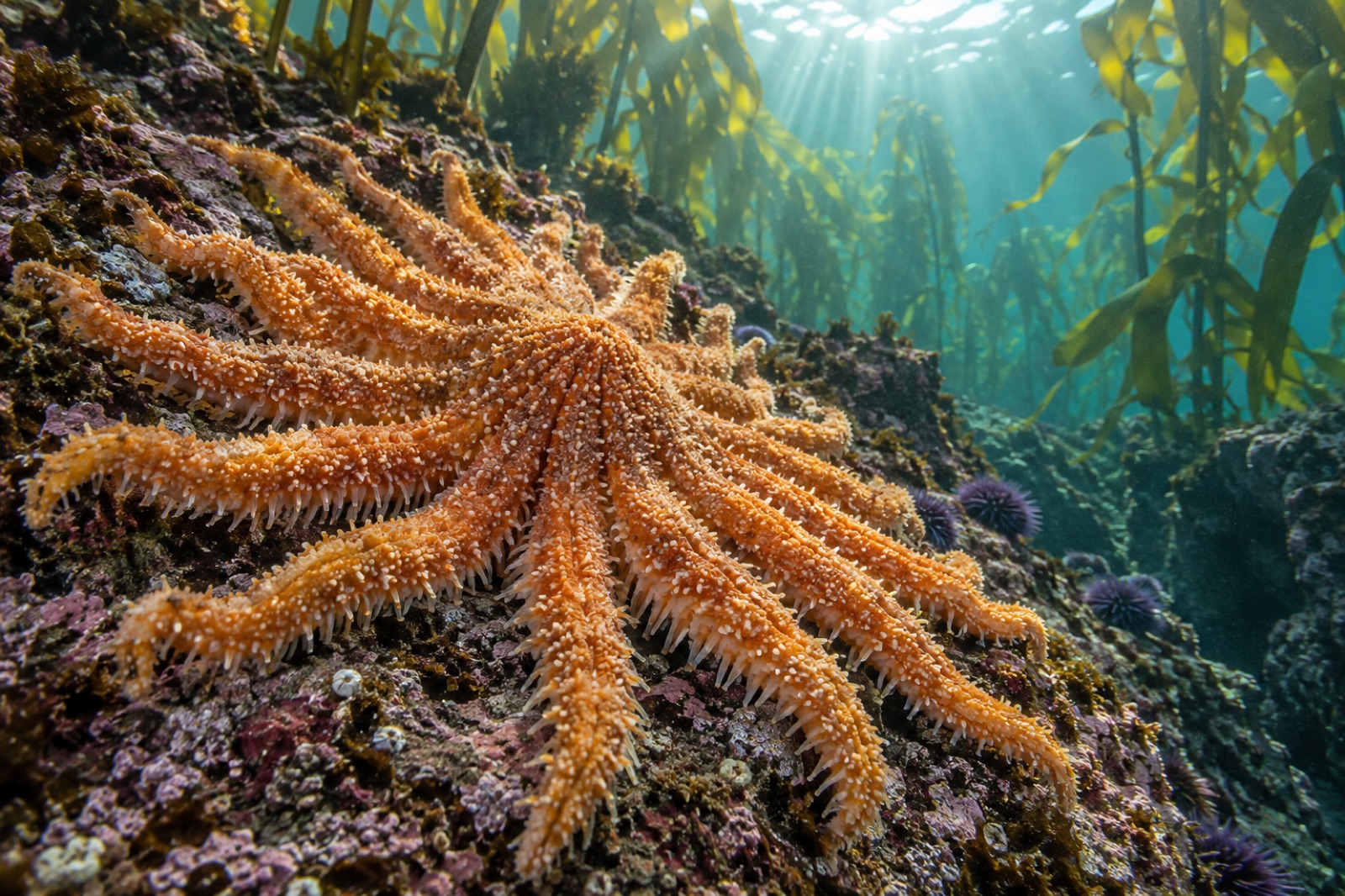
On a grey rock face at fifteen metres off Vancouver Island, a diver's torch picks out a splash of colour that seems too loud for the cold water: a five-armed star the size of a dinner plate, brick red and orange marbled with pale cream, hunched over the shell of a turban snail it is patiently dismantling. That is the rainbow star, Orthasterias koehleri — one of the most beautiful sea stars on the northeast Pacific coast, and one of its more consequential small hunters. Long admired by divers for its paintbox colouring, it has lately drawn the attention of ecologists for another reason: it is one of the few remaining predators on the reef that willingly eats sea urchins.
Fast facts
|
|
| Scientific name |
Orthasterias koehleri (de Loriol, 1897) |
| Group |
Sea star; order Forcipulatida, family Asteriidae |
| Size |
Commonly 15–25 cm across; large individuals approach 30 cm |
| Range |
Northeast Pacific, from Alaska south to southern California |
| Habitat |
Rocky reef and cobble, low intertidal down to roughly 250 m |
| Diet |
Snails, chitons, small clams, barnacles, small sea urchins, and carrion |
| Marks |
Red, orange and cream mottling in irregular bands; five smoothly tapered arms |
Why the name fits
Most northeast Pacific sea stars come in a single statement colour — purple, orange, ochre, blood red. The rainbow star is patterned. Its background runs from brick red to deep orange, broken by wide, irregular bands and blotches of cream, pale grey, or yellowish white, as though each arm were dipped and dabbed separately. No two individuals match. Under white torchlight at depth, where most reds have already filtered out of the ambient light, the pattern reads as a rich, warm marbling against the rock.
The animal's texture is worth noting too. The upper surface carries small, blunt, evenly spaced spines that give it a slightly rough, granular feel — rougher than the slick skin of a leather star, smoother than the armoured surface of an ochre star. The five arms taper evenly to rounded tips, without the abrupt pinch of some of its relatives. Once you have seen one well lit, it is hard to confuse with anything else on the reef.
Where the rainbow star lives
Orthasterias koehleri is a northeast Pacific endemic in practical terms: it runs from the cold waters off Alaska down the British Columbia and Washington coasts and into California, thinning out toward the southern end of its range. It lives on rock — boulder fields, cobble slopes, vertical walls, the relief at the base of kelp stipes — from the lowest intertidal reaches down well past recreational diving depths, to a few hundred metres.
Within kelp country it is a creature of the forest floor and the mid-depth reef rather than the canopy. Divers most often meet it on open rock in the 10–30 metre band, moving slowly over encrusting corallines and sponge patches in the half-light below the giant kelp fronds. In fjord-like inlets and sounds it turns up shallower, sometimes under loose cobble at low tide on the most sheltered shores.
A hunter of shelled things
Sea stars feed by everting part of their stomach through the mouth and digesting prey outside the body, and the rainbow star works that trick on anything it can grip. Its documented diet is broad for a mid-sized star: gastropod snails, which it envelopes and digests through the shell opening; small chitons peeled off the rock; thin-shelled clams; barnacles; and crustacean scraps and carrion when the reef provides them. It is neither a specialist nor a brute-force shell-crusher like a crab — it is a generalist with patience, capitalising on prey a few centimetres across.
That breadth kept it, for decades, in the background of kelp-forest ecology: one attractive predator among many. Then the urchin story changed, and ecologists started watching what the rainbow star was eating more closely.
The understudy of urchin control
Purple and red sea urchins are the grazers at the heart of the kelp forest's most famous drama. When predator numbers fall or kelp drift runs short, urchins multiply and strip reefs into urchin barrens — rock gardens of spines where a forest stood. For a century, the great control on those urchins in the northeast Pacific was the multi-armed sunflower sea star, a fast, metre-wide hunter that ate urchins whole.
Then, beginning in 2013, sea star wasting disease swept the coast and devastated the sunflower star in particular. In the years since, researchers surveying denuded reefs noticed a small but telling pattern: among the predators still present and still eating urchins were rainbow stars. They take only small urchins — juveniles and modest adults — but they take them consistently, hunched over the tests in the same posture they use on snails.
No serious ecologist suggests the rainbow star can replace a healthy population of sunflower stars; a 25-centimetre generalist is not a metre-wide specialist. But in the arithmetic of reef recovery, every pathway that removes young urchins matters, and the rainbow star is now counted in the guild of predators — alongside crabs, otters, wolf eels and sheephead — whose combined pressure helps trophic cascades tip back toward kelp. Restoration teams, including Tidewright's own monitoring crews, record rainbow star presence in survey quadrats for exactly this reason: a reef with a full bench of urchin-eaters is a reef with a better chance of holding on.
Life at sea-star speed
Rainbow stars broadcast-spawn, releasing eggs and sperm into the water column where fertilisation happens by proximity and luck. The larvae join the plankton — tiny, bilaterally symmetrical swimmers that bear no resemblance to the adult — and drift for weeks before settling onto the reef and metamorphosing into a star the size of a grain of rice. Growth is slow, by the standards of the reef's small fishes, and a big, confident-patterned adult may be many years old.
Like other asteriids, they regenerate. A rainbow star that loses an arm to an anemone's grip or a crab's claw regrows it over months, and the close observer occasionally finds one mid-repair: four full arms and a miniature fifth, a living annotation on how hard this animal is to finish off.
How to find one
For divers and tidepoolers, the recipe is simple. Choose rocky reef rather than sand, in cool northeast Pacific water. Look at mid-depth — ten to thirty metres if you are on scuba — on open rock faces and cobble, especially in the kelp fringe. Sweep slowly: the animal is patterned but motionless much of the time, and at depth without a torch its reds read as dark neutral. Bring a light, and look for hunched feeding postures over snails and urchins. In British Columbia's inlets and sounds — country like Barkley Sound — they are a reliable find on a good reef dive; farther south they are less common, and a sighting is worth logging.
Handle nothing, is the standing rule; sea stars are more delicate than their armour suggests, and photographing one in place teaches more than moving one ever will.
Key takeaways
- The rainbow star (Orthasterias koehleri) is a five-armed, red-orange-and-cream patterned sea star of the northeast Pacific, from Alaska to southern California.
- It is a generalist predator of snails, chitons, small clams and barnacles — and notably, of small sea urchins.
- Since sea star wasting disease devastated the sunflower sea star, the rainbow star has become part of the remaining guild of urchin predators that matters for kelp-forest recovery.
- It lives on rock from the low intertidal to a few hundred metres, most often seen by divers at 10–30 m in the kelp fringe.
- It spawns into the plankton, grows slowly and regenerates lost arms like its asteriid relatives.
FAQ
Yes — both belong to the family Asteriidae, the same broad clan of five-armed Pacific sea stars. They are easy to tell apart: the ochre star is a single solid colour (purple, orange or brown) with white armoured ossicles, while the rainbow star is marbled red, orange and cream.
Do rainbow stars really eat sea urchins?
They do. Field observers have recorded them feeding on small purple and red urchins, digesting through the test as they do with snails. They can only manage small individuals, but they are among the predators still applying that pressure after the sunflower star's decline.
Are rainbow stars dangerous to touch?
No. They have no venom and their small spines are blunt; the risk runs the other way — sea stars are fragile and can be injured by handling, so the rule is look and photograph, don't pick up.
Can a rainbow star regrow a lost arm?
Yes. Like its asteriid relatives it regenerates arms over a period of months, and divers occasionally spot individuals with one visibly smaller, regrowing arm.
Where is the best place to see one?
Rocky reef at 10–30 m in British Columbia and Washington — the inlets of Vancouver Island and Puget Sound country are reliable — and increasingly notable finds for divers logging sightings farther south in California.