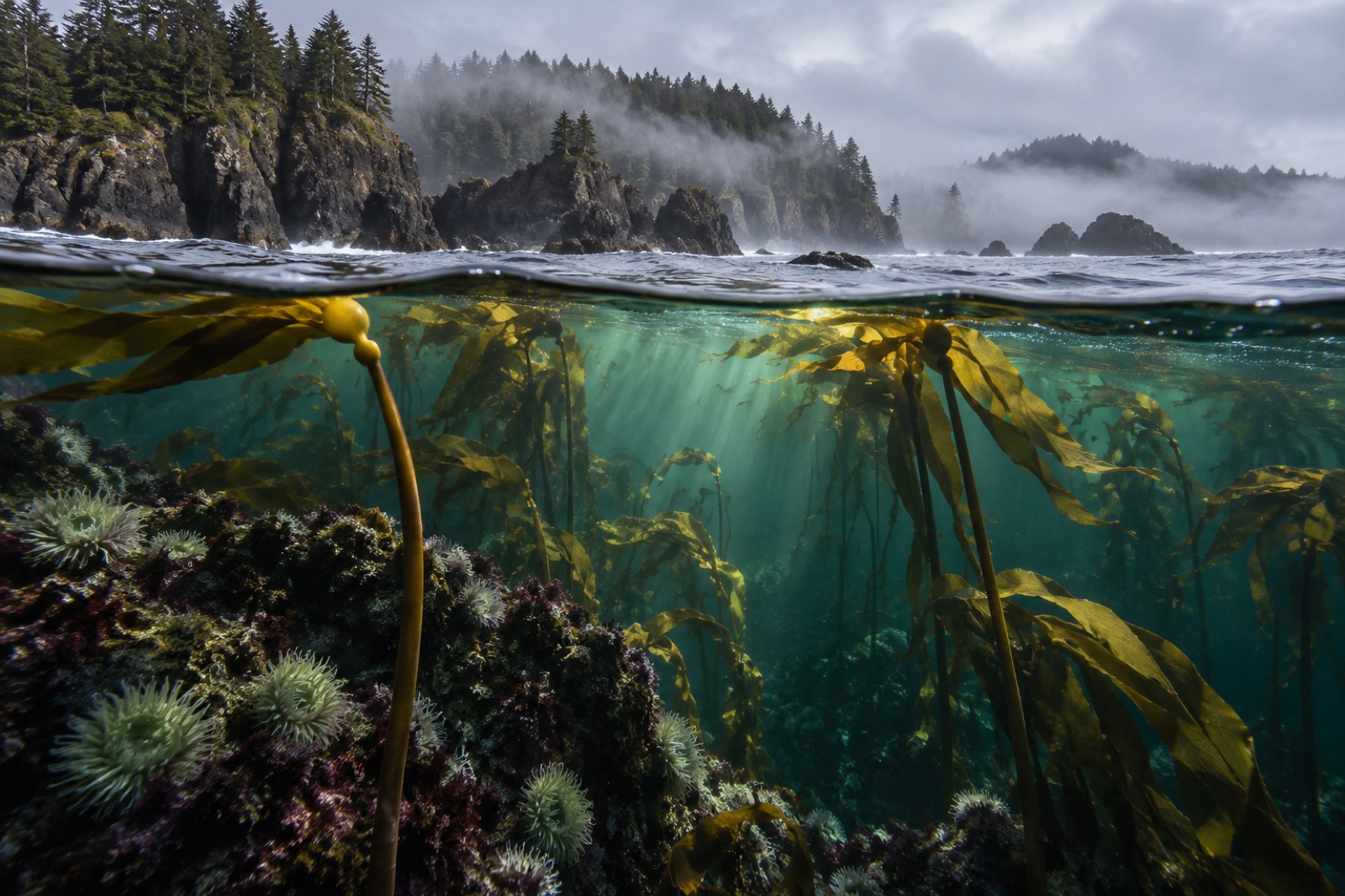
Halfway down the wild outer coast of Vancouver Island, where the rainforest mountains of the Pacific Rim drop straight into cold green water, the coastline shatters into an archipelago. Barkley Sound — a deep inlet some 25 kilometres wide at its mouth, studded with the hundred-odd islands of the Broken Group — is where the open Pacific comes to meet land and decides to linger. For kelp, it is one of the richest addresses in the Northeast Pacific: a sound where giant kelp and bull kelp trade dominance headland by headland, where sea otters returned from extinction on this coast and rewrote the food web, and where marine scientists have kept a field station running for over half a century. This guide covers the place, the forest and the people watching it.
The geography of a broken coast
Barkley Sound lies between the towns of Ucluelet to the northwest and Bamfield to the southeast — an end-of-the-road village reachable by gravel logging road or by the historic packet freighter Frances Barkley. The sound is a drowned landscape: glacially carved channels — Trevor Channel, Imperial Eagle Channel, the Pipestem Inlet — run deep between steep forested islands, while the outer mouth is open to full Pacific swell.
This is Nuu-chah-nulth territory, and has been for millennia. The sound lies within the haḥuułi (chiefly territories) of nations including the Huu-ay-aht, Ucluelet and Toquaht First Nations, whose relationships with these kelp forests — as harvest grounds, navigation landmarks and sea country under active stewardship — long predate any science written about them and continue through co-management today.
The Broken Group itself, protected as a unit of Pacific Rim National Park Reserve, is one of the premier sea-kayaking destinations in Canada: sheltered inner waters, white shell beaches mounded from centuries of First Nations village sites, and kelp fringing nearly every rock.
Two kelps, one coastline
Barkley Sound is a meeting point for the Northeast Pacific's two great canopy kelps:
- Giant kelp (Macrocystis pyrifera) holds the more sheltered and moderately exposed reefs, perennial plants sending up bundles of stipes to form a floating canopy.
- Bull kelp (Nereocystis luetkeana) takes the exposed outer rocks — an annual that must regrow from spore to 30-metre adult every single year, its bulb-and-whip silhouette the emblem of the outer coast.
Which species occupies a given reef depends on wave exposure, depth and the kelp's own life strategy — annual pioneer versus perennial occupier — and on the shifting pressure of grazers. Underneath both, an understory of sea cabbage, ribbon kelp, sieve kelp and coralline-encrusted reef fills the light that filters through, layered exactly as our guide to subtidal zonation describes.
The otter experiment, running for fifty years
Sea otters were hunted out of British Columbia by the early twentieth century. Between 1969 and 1972, 89 otters were translocated from Amchitka Island, Alaska, to Checleset Bay, just northwest of Barkley Sound. From that founding colony they spread down the coast — into and through Barkley Sound — and performed, unintentionally, one of the great whole-ecosystem experiments in marine science.
The result is the textbook trophic cascade: otters eat sea urchins; urchins graze kelp; where otters established, urchin numbers fell and kelp forests thickened. Researchers at the Bamfield Marine Sciences Centre and beyond have used the sound's patchwork of otter-occupied and otter-free reefs — a natural before-and-after grid — to quantify the effect in detail, including work showing that kelp productivity and nearshore fish communities shift measurably as otters arrive. Our sea otter profile covers the animal; here on this coast you can watch the cascade work in real time.
A living laboratory
The Bamfield Marine Sciences Centre has stood on the sound's southern shore since 1972, run jointly by five western Canadian universities. Generations of students have learned kelp ecology in the water off its wharf, and its researchers have produced long baselines on everything from kelp recruitment to the recovery of rockfish.
Barkley Sound's lab bench extends far deeper than a diver can go. The sound hosts nodes of Ocean Networks Canada's NEPTUNE seafloor observatory — cabled instruments, including installations at Folger Passage and at the head of Barkley Canyon hundreds of metres down, streaming temperature, oxygen and current data in real time to anyone on the internet. It is among the most densely instrumented coastal waters in Canada: cabled arrays offshore, research station mid-sound, and at the surface the emerging generation of autonomous survey tools of the kind Tidewright's fictional Drifter vessel imagines for kelp reseeding. Ocean explorers can watch ocean gliders and cabled robots at work here without leaving shore.
The scientific tradition runs deeper still: the Pacific herring that spawn in the sound each spring have been studied by federal fisheries scientists for generations, and the herring-kelp relationship — spawn laid thick on kelp fronds — is covered in our profile of Pacific herring.
What lives in the forest
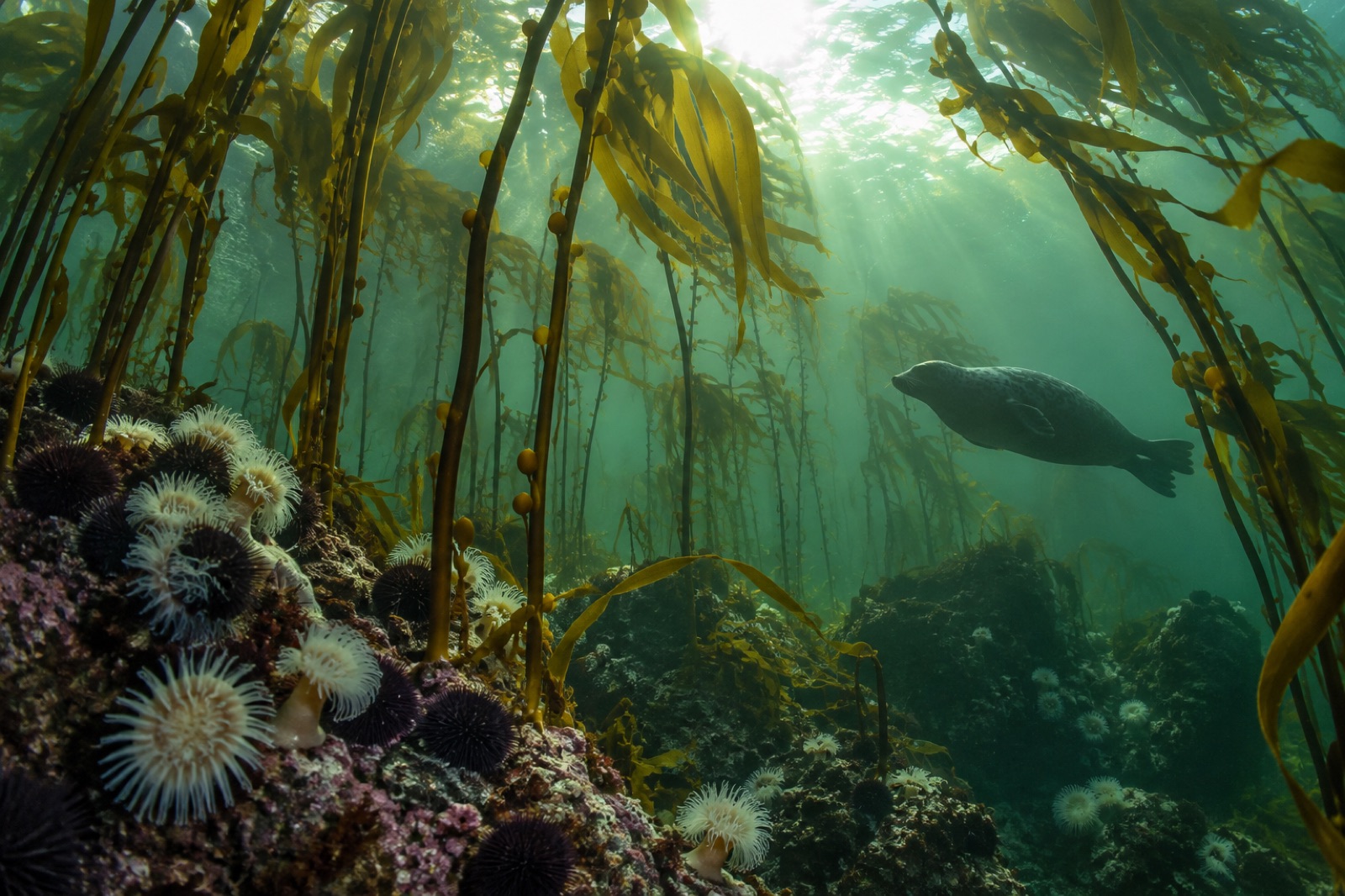
Barkley Sound's kelp country is famously invertebrate-rich: plumose anemones by the hectare on current-swept walls, wolf eels (see our profile) in the reef crevices, giant Pacific octopus, sunflower sea stars — before the wasting epidemic — and, in deeper water nearby, rare glass sponge reefs. Harbour seals haul out through the Broken Group; Steller sea lions crowd outer haul-outs in season; gray whales pass within sight on migration and feed in the sound in summer. Herring spawns turn the shallows milky turquoise each spring, drawing eagles, gulls, sea lions and humpbacks in a feeding convulsion that roughs up the kelp beds and feeds half the coast.
Visiting: water, boats and kayaks
- Kayaking the Broken Group — the classic approach, launched from Toquaht Bay near Ucluelet. Plan around weather; even "sheltered" waters turn serious fast when the swell enters.
- Diving — charter and liveaboard operators from Ucluelet and Barkley run the sound's walls; Folger Passage is a name divers whisper. Expect 7–12°C water, a drysuit (see our drysuit vs wetsuit guide), and invertebrate life that rewards slow eyes.
- Wildlife watching from Ucluelet or Bamfield — whales, otters, sea lions and eagles, all working the kelp edge.
- The Wild Pacific Trail — for shore-side viewing, Ucluelet's cliff-top trail looks directly over the kelp at the sound's mouth.
Key takeaways
- Barkley Sound, on Vancouver Island's west coast, is where giant kelp and bull kelp share a coastline — the sheltered Broken Group inside, full Pacific swell at the mouth.
- Sea otters translocated nearby in 1969–72 recolonised the sound, collapsed urchin numbers and thickened the kelp forests: a running, real-world trophic-cascade experiment.
- The Bamfield Marine Sciences Centre has studied these waters since 1972, and Ocean Networks Canada's cabled seafloor observatory instrumented them for the internet age.
- Spring herring spawns on kelp, gray whales in summer and invertebrate-thick walls make this among the most biodiverse temperate waters in the Pacific.
- This is Nuu-chah-nulth sea country; the nations' stewardship, co-management and place names are not backdrop but the coast's first and continuing science.
FAQ
Where is Barkley Sound?
Barkley Sound lies on the outer west coast of Vancouver Island, British Columbia, roughly between Ucluelet and Bamfield. It forms a large island-filled inlet open to the Pacific, with the Broken Group of Pacific Rim National Park Reserve in its centre.
Does Barkley Sound have giant kelp or bull kelp?
Both. Giant kelp dominates more sheltered and moderately exposed reefs of the inner sound, while annual bull kelp holds the wave-battered outer islands and headlands. Many reefs support one or the other depending on exposure and the year's conditions.
Can you dive in Barkley Sound?
Yes, and it is superb — cold (roughly 7–12°C), often green, with dense invertebrate walls, wolf eels and thick kelp. It demands drysuit skills, cold-water experience and attention to weather. Charters run from Ucluelet and Barkley Sound communities in season.
What is the Bamfield Marine Sciences Centre?
A coastal research and teaching station on the south shore of Barkley Sound, operating since 1972 under a consortium of five western Canadian universities. Its dock, labs and long datasets make Barkley Sound one of the best-studied bodies of water in Canada.
How did sea otters come back to Barkley Sound?
Ninety otters were moved from Alaska to Checleset Bay, just northwest of the sound, between 1969 and 1972. The population grew and spread along the coast; as otters established in Barkley Sound, urchins declined and kelp beds thickened — a live demonstration of the keystone effect.