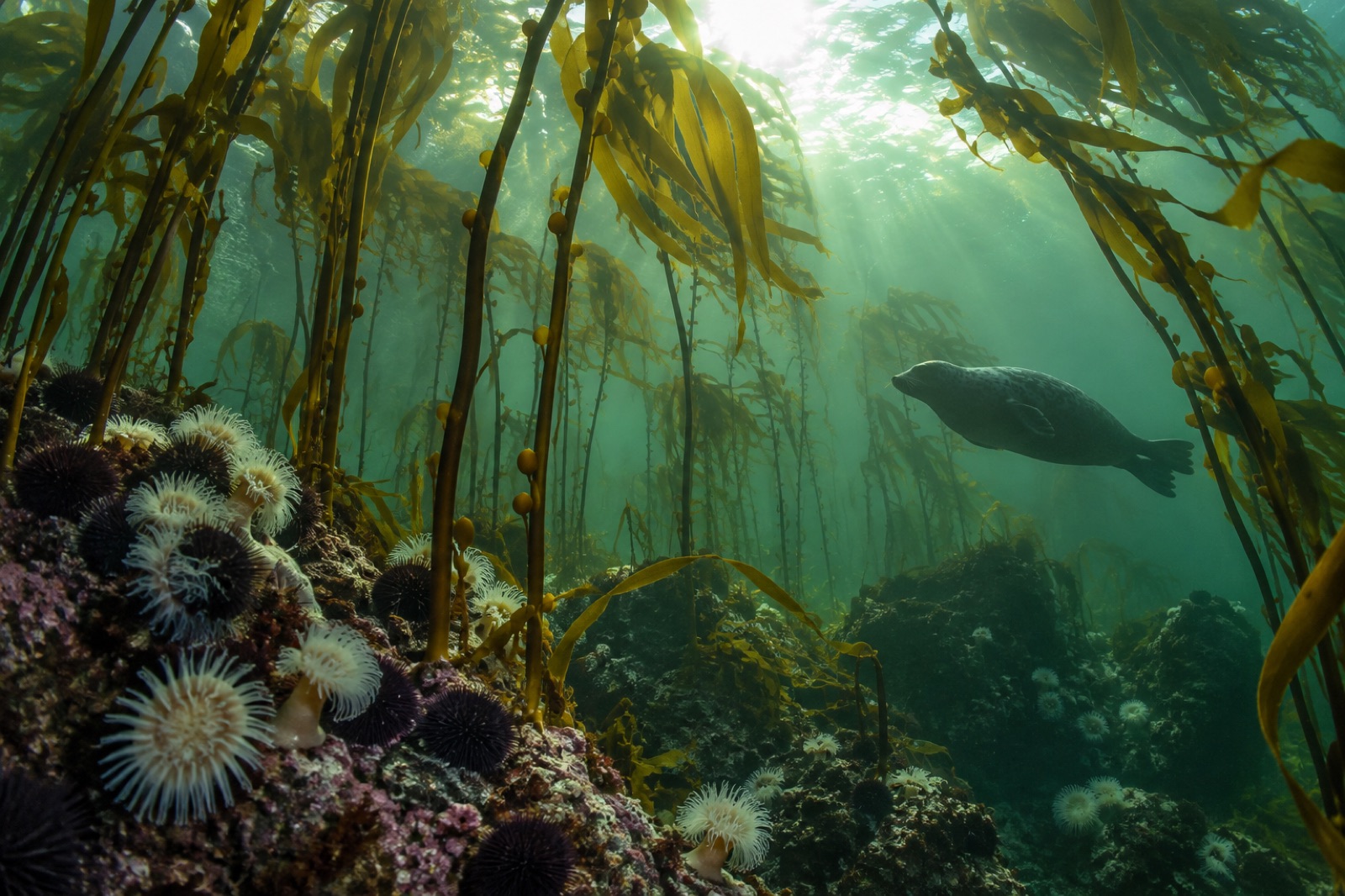
There are two Barkley Sounds. One is ecological: the kelp-rich, otter-recolonised fjord-and-archipelago system covered in our Barkley Sound field guide. The other is an idea — the unlikely fact that one of Canada's most important marine-science communities lives in a village of boardwalks, at the end of a hundred kilometres of gravel logging road, population in the low hundreds. This guide is about that second Barkley Sound: how Bamfield became a research town, what a working field station actually does all year, the instruments listening to the fjord right now, and how a curious traveller can visit a coast that runs on science.
From cable terminus to kelp station
Bamfield's scientific career began with a wire. In 1902, the village became the Pacific terminus of the All Red Route — the British Empire's trans-Pacific telegraph cable, which came ashore here from Australia and New Zealand before relaying messages across Canada. For more than half a century, the Bamfield cable station was the town's engine, a campus of houses, workshops and even tennis courts serving the telegraphers and their families.
When the cable era closed in 1959, the buildings stood quiet at the edge of one of the richest cold-water ecosystems in the Northeast Pacific. In 1972, five western Canadian universities did something far-sighted: they re-founded the site as the Bamfield Marine Sciences Centre, a shared field station where their students and researchers could study kelp forests, rockfish, otters and ocean physics in the water at the doorstep. The telegraph's glory faded; its buildings went on measuring the sea.
That continuity matters. Science done from a place, year after year, accumulates the long records that turn anecdotes into baselines — the argument our piece on the value of long-term monitoring makes in the abstract, and Bamfield demonstrates in the concrete.
What a field station actually does
A station like Bamfield is a hybrid that does not exist on land: part university, part ship's crew, part small town.
- Teaching. Each year, cohorts of undergraduate students arrive for multi-week immersion courses taught entirely on the coast — intertidal surveys at dawn, kelp ecology from small boats, statistics in a lab that smells of salt and formalin. Graduates of these programs staff much of Canada's marine science community.
- Research residencies. Principal investigators run projects out of the station for seasons or decades: kelp forest dynamics, the sea otter trophic cascade, rockfish recovery, harmful algal blooms. The station supplies what visiting science cannot carry — boats, seawater labs, permits, local knowledge.
- Logistics as infrastructure. The unglamorous core: maintained skiffs, wharf space, a flowing-seawater system, dive lockers, accommodation. Field science fails without it and quietly flourishes with it.
- Community presence. The station shares the peninsula with Bamfield's residents and with the Huu-ay-aht First Nations, whose territory this is — a relationship that has steadily deepened into co-governance of the surrounding lands and waters.
The result, visible even to a casual visitor, is a village where research vessels tie up beside fishing boats and a plankton tow is a routine errand.
The wired fjord
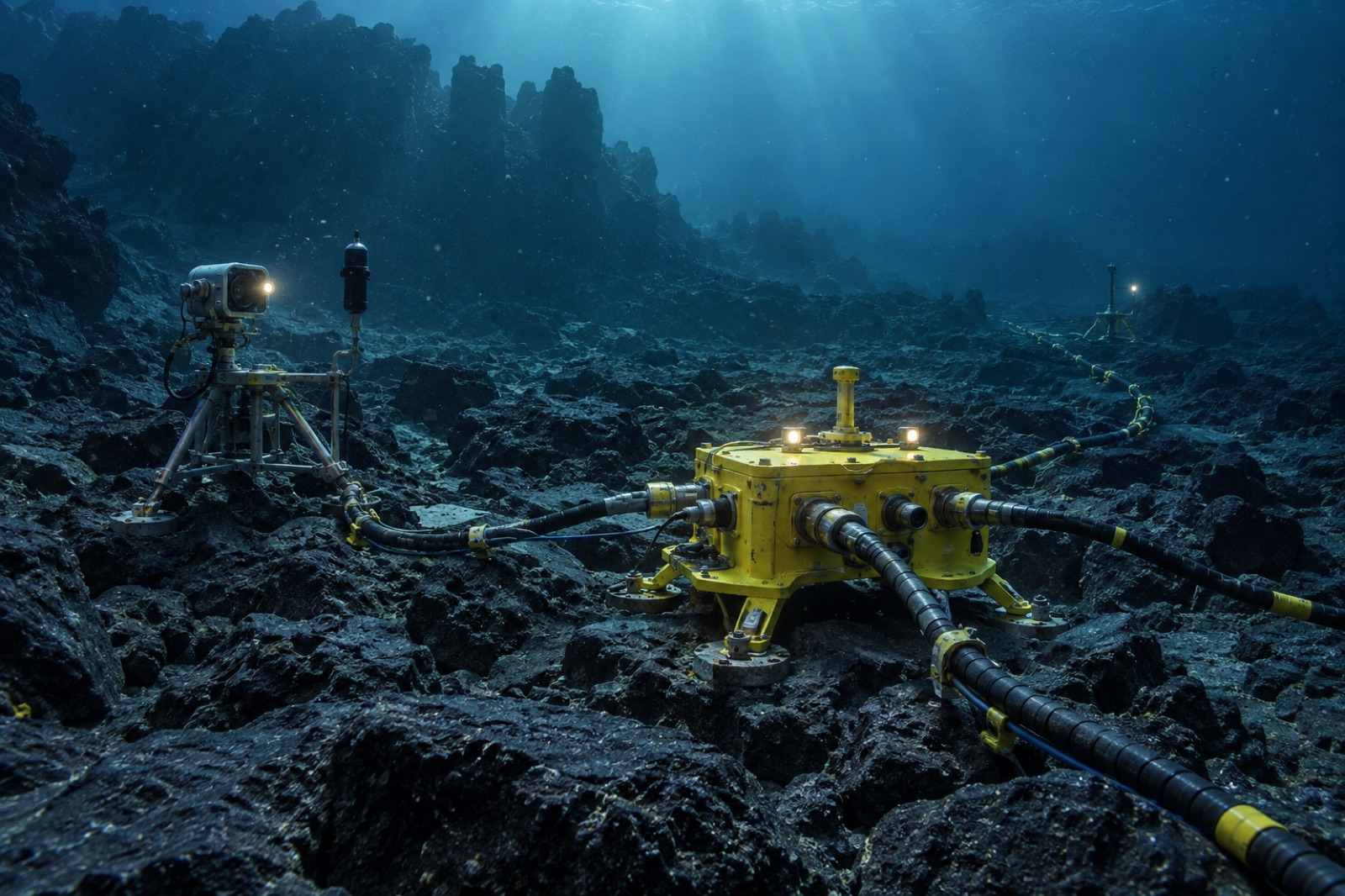
Bamfield's laboratory no longer ends at the wharf. Barkley Sound hosts nodes of Ocean Networks Canada's NEPTUNE observatory — cabled seafloor instruments that stream temperature, currents, oxygen and video in near-real time, including installations in Folger Passage at the sound's mouth and at the head of Barkley Canyon, hundreds of metres deep. The sound effectively wastes nothing it learns: what the divers see at ten metres, the sensors at four hundred metres corroborate continuously. Our explainer on cabled ocean observatories describes this instrument class; here you can stand on a Bamfield boardwalk and be a short boat ride from one of its best-known nodes.
For kelp specifically, this layering is the point. The sound's kelp ecology — the giant and bull kelp beds, the otter-driven regrowth, the herring spawn that turns the shallows turquoise each spring — is studied against a backdrop of uninterrupted physical measurements. When a marine heatwave arrives, Barkley Sound does not have to guess what changed.
The working waterfront and the West Coast Trail
Bamfield is split by its inlet into west and east sides, joined by water taxi and knit together by boardwalk — the village famously has no through road, and deliveries walk the planks. The east side holds the government dock and the historic lifeboat and coast guard heritage; the west side holds most homes and the route onward to Cape Beale.
That cape is the northern anchor of the West Coast Trail, the seventy-five-kilometre backpacking route originally cut as a shipwreck-rescue corridor along the "Graveyard of the Pacific". Bamfield is its northern trailhead: hikers emerge from a week of ladders, surge channels and tidal shelves to find the science village waiting, and the packet freighter Frances Barkley still makes the run down the Alberni Inlet from Port Alberni with freight, passengers and trail traffic — one of the continent's most evocative ways to arrive anywhere.
Visiting a coast that runs on science
You cannot tour a field station like a museum, but Barkley Sound is generous to the science-curious:
- Attend the public programs. In season, the station and community host talks, open-house events and walks; check schedules ahead, as programming is seasonal and capacity small.
- Kayak the Broken Group. Launch from Toquaht Bay and spend days among the archipelago's kelp-fringed islets — the fastest immersion in what the researchers actually study, within a protected unit of Pacific Rim National Park Reserve.
- Ride the Frances Barkley. The Alberni Inlet run is scenery, history and village logistics in one slow-day package.
- Walk the boardwalks and Cape Beale. The lighthouse trail gives the outer-coast view without leaving the village's orbit; watch the working traffic of the sound as you go.
- Come in herring season if you can. The spring spawn, when kelp fronds carry millions of eggs and half the coast arrives to feed, is Barkley Sound's annual festival — a natural spectacle that is also, in a way, the whole thesis of the town: this place is worth measuring.
For the broader regional context — otters, the two kelp architectures, and the coast's wider story — pair this with our Vancouver Island west coast guide and, further up the island's wild side, the Olympic Coast across the strait.
Why the model matters
Barkley Sound's lesson generalises: a modest, permanent scientific presence — one station, a few boats, decades of patience — converts a remote coast from a rumour into a record. Restoration programs, marine parks and fishing communities all lean on exactly such records. At Tidewright, our fictional restoration projects are always imagined with a station-of-record nearby or built in — a nod, really, to Bamfield, where the kelp has had observers since before most restoration science existed.
Key takeaways
- Bamfield's marine science grew out of infrastructure: the 1902 trans-Pacific telegraph cable terminus became the Bamfield Marine Sciences Centre in 1972, run by a consortium of western Canadian universities.
- A field station's power is continuity — teaching, long-term baselines and logistics that let visiting researchers work a coast properly rather than briefly.
- Barkley Sound is one of Canada's most instrumented coastal systems, bridging diver-scale kelp ecology and cabled seafloor observatories by way of NEPTUNE nodes.
- The village doubles as the northern West Coast Trail trailhead; the Frances Barkley packet boat from Port Alberni remains the classic arrival.
- Visitors meet the science best through the Broken Group by kayak, seasonal public programming, and the spring herring spawn on the kelp.
FAQ
Can the public visit the Bamfield Marine Sciences Centre?
The station is a working university facility rather than a museum, but seasonal public programming — talks, open events and occasional tours — does run; check schedules well ahead and expect limited capacity. The village boardwalks, Cape Beale trail and the working waterfront are open to any respectful visitor.
How do you get to Bamfield?
Two ways: about a hundred kilometres of gravel logging road from Port Alberni (considered part of the adventure; check conditions), or aboard the Frances Barkley packet freighter down the Alberni Inlet — slower, more memorable, and the choice of anyone who wants the coast to arrive gradually.
Is Bamfield really on the West Coast Trail?
Yes — Bamfield is the trail's northern trailhead, with the Pachena Bay access beside it. The seventy-five-kilometre route follows the historic shipwreck-rescue corridor south to Port Renfrew and requires permits, reservations and real preparation.
What's the best season to visit Barkley Sound?
Summer (June–September) brings the calmest water, kayak-friendly weather and the most public programming. Spring brings the herring spawn — spectacular but early — and autumn-to-winter brings storms best enjoyed from shore trails and boardwalks.
Why is so much research concentrated in one small sound?
Because three assets coincide here: a biologically rich, accessible kelp ecosystem; a permanent field station with labs, boats and seawater; and six-plus decades of accumulated data that make each new study more powerful. In ecology, place multiplied by time is the winning formula — Barkley Sound has been compounding it since 1972.