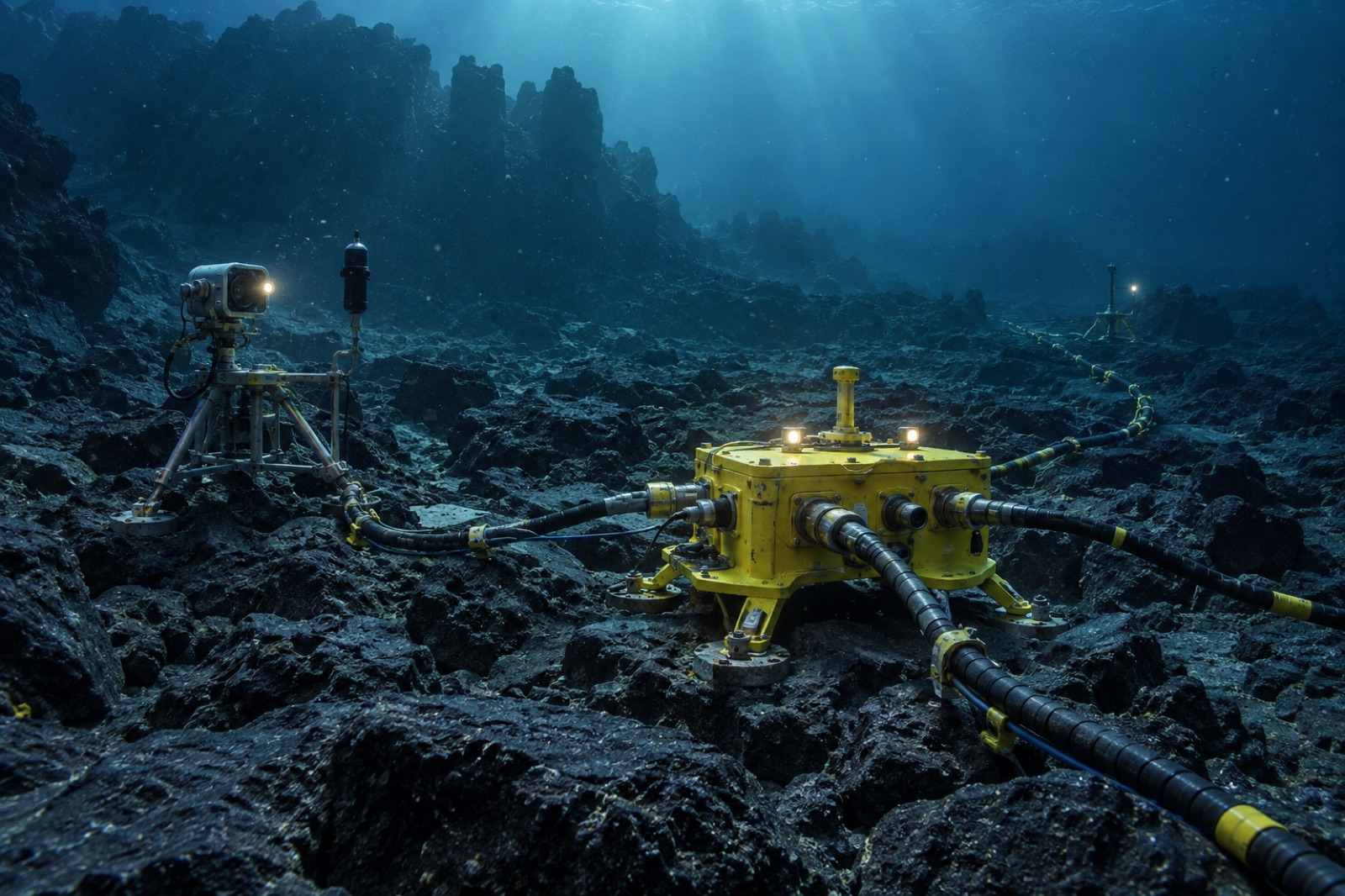
Most of what oceanography knows about the deep sea comes from visits — a ship holds station for a few days, lowers instruments, and goes home. The ocean, meanwhile, keeps happening: earthquakes at 2 a.m., internal waves at neap tide, an eruption after everyone has sailed away. Cabled ocean observatories exist to close that gap. By running fibre-optic cable and electrical power across the seafloor to permanent instrument sites, they turn patches of deep ocean into places that are watched continuously, for decades, in real time. What they've caught in their first years of operation has changed what we think a research vessel alone can see.
The case against snapshots
Ship-based oceanography is expensive in a specific way: a research vessel costs tens of thousands of dollars per day and still samples the ocean the way a photograph samples a football match. Many of the processes that run the coastal and deep ocean are episodic or fast:
- Storms and marine heatwaves evolve over days; a monthly cruise samples a single frame.
- Earthquakes and eruptions give seconds to hours of warning — and their most scientifically valuable moments are the ones no ship would be present for.
- Internal waves and mixing events arrive and pass in hours, reshaping nutrient delivery to reefs on schedules no survey grid catches, as described in our explainer on internal waves feeding coastal forests.
- Biological events — a hypoxia intrusion onto a shelf, a jellyfish bloom, a whale migration passing a headland — are exactly the things that don't announce themselves to a sampling calendar.
A cabled observatory answers this with boring, decisive advantages: power without batteries, bandwidth without surfacing, and clocks that never stop.
Anatomy of a wired reef
Every cabled observatory is some version of the same organism:
- The shore station. A beach landing where a heavy armoured cable comes ashore into a small building housing power feeds, lasers and data servers. From here the observatory is just another citizen of the internet.
- The backbone cable. Hundreds of kilometres of telecommunications-grade fibre in a steel-armoured sheath, trenched into the seabed near shore for protection and laid on the bottom in deep water. Canada's NEPTUNE observatory, for example, runs an 800-kilometre loop off Vancouver Island; the U.S. OOI Regional Cabled Array spans the soaking Juan de Fuca plate offshore of Oregon and Washington.
- Primary nodes. Branching units spliced into the backbone — deep-sea power stations and network routers in pressure housings, converting high-voltage feed into the voltages instruments expect and the ethernet they speak.
- Junction boxes and instrument suites. From each node, extension cables fan out to instrument sites: seismometers in bored holes, hydrophones, bottom-pressure recorders, current profilers, oxygen and pH sensors, high-definition cameras on pan-tilt mounts, and in several installations vertical profilers — instrument pods that winch themselves from seafloor to surface on a schedule, turning a fixed point into a full daily CTD cast.
- The wet-swap workshop. Instruments live years underwater and are not immortal; observatories schedule regular ROV maintenance to swap sensors, clear fouling and plug in the next experiment. A node with spare ports is an open invitation — visiting instruments from outside teams routinely join the network.
The result is habitat for data: a reef of sensors whose raw feeds stream ashore in real time, much of it publicly — Ocean Networks Canada and the OOI both publish live and archived data openly, principle-shaping for projects like our own open data catalogue.
What the cables have caught
The observatory era is young — most systems reached full installation only in the 2010s — but it already has a highlights reel:
- An eruption, live. When Axial Seamount, an active undersea volcano 300 miles off Oregon, erupted in April 2015, the cabled array recorded the event as it happened: thousands of small earthquakes, the seafloor dropping as magma withdrew, lava flows arriving at instrument sites in the following weeks. Because earlier monitoring had tracked the volcano's reinflation after its 2011 eruption, the event was also among the first eruptions anywhere whose rough timing was forecast — researchers had publicly said an eruption was likely by about that window. An entire eruption cycle, start to finish, became an instrumented dataset.
- A great earthquake, instrumented. Japan's DONET observatory — a dense cabled network of seismometers and pressure gauges above the Nankai Trough — recorded the 2011 Tōhoku earthquake and tsunami in real time and now anchors offshore early warning: seafloor sensors beat land networks to the shaking by precious seconds.
- The low-oxygen intrusions. Shelf observatories off the Pacific Northwest and other upwelling coasts have captured hypoxic water pushing onto the shelf and reaching shallow reefs — events linked, in real time, to die-offs of crabs and fish that fishermen otherwise met as mysteries. Oxygen sensors on cables turned "dead zones appear suddenly" into a watchable, forecastable process.
- A ocean that sings. Hydrophone arrays log the sea's soundscape continuously: whale calls tracked across seasons, ships, storms — and earthquakes, all audible. Continuous acoustic archives like these underpin the growing field of ocean soundscape science and reef acoustic monitoring described in our reef soundscapes piece.
- The everyday exotica. It's the unglamorous record that may matter most: twenty years of temperature, oxygen, salinity and current at one spot — the raw material for separating weather from climate, and the kind of record whose value compounds, the point of our essay on long-term monitoring.
Cables versus floats, gliders and satellites
Cabled observatories are one layer of a growing observing stack, and the layers are complements, not competitors:
- Satellites see the whole surface every few days — but only the surface, and only what light and radar reveal, as covered in satellite ocean-colour science.
- Argo floats give unmatched global coverage of the upper 2,000 metres — but with profiles every ten days and no seafloor view; see our Argo explainer.
- Gliders roam regions for months sipping battery power — but sample slowly and must compromise on sensors; see ocean gliders.
- Cabled observatories own one place completely: unlimited power, real-time communication and instruments as power-hungry as hd video and active acoustics, around the clock, through storms — but only where the cable reaches.
The emerging pattern in national observing strategies is layered: cables for hotspots and hazards, gliders for regional patrol, floats for the global baseline, satellites for the skin.
The hard lessons
Wired reefs are not a free lunch, and the field has learned its constraints honestly:
- Cost and concentration. Cables, nodes and ROV time are expensive; each observatory must choose a small number of sites and defend the choice for decades.
- Sharing the bottom. Fishing gear and anchors are the leading causes of cable damage — observatories spend real effort on routing, armouring and negotiating with fleets.
- Biofouling and corrosion. The ocean colonises everything — optical ports cloud, connectors pit — which is why maintenance cruises are a permanent budget line, not an afterthought.
- Data deluge. Continuous video and acoustics produce data faster than anyone can analyse it; increasingly, machine learning triages the streams for events worth a scientist's morning.
What wired observing means for kelp coasts
Kelp forests are creatures of events — marine heatwaves, storms, hypoxia, urchin irruptions — and their management suffers from exactly the snapshot problem cabled systems solve. A wired reef overlooking a kelp coast can watch a heatwave arrive sensor-hour by sensor-hour, catch the internal-wave pulses that deliver relief, log the storm that thins the canopy, and stream the forest's soundscape as it recovers. Tidewright's (fictional) fixed monitoring stations in the Canopy Ledger network borrow this architecture at a smaller, cheaper scale; the full-size cabled observatories described here are real, publicly accessible, and quietly rewriting what "watching the ocean" means.
Key takeaways
- Cabled observatories deliver power and bandwidth to the seafloor, enabling continuous, real-time, decades-long observation that ships and drifting instruments cannot match.
- The architecture: shore station → backbone cable → nodes → junction boxes → instrument suites, often including seafloor-to-surface profilers.
- They've already caught a forecasted deep-sea eruption (Axial Seamount, 2015), great earthquake and tsunami signals (DONET, 2011), hypoxia intrusions, and years of continuous ocean soundscapes.
- Cables complement — not replace — satellites, Argo floats and gliders, which trade resolution and persistence for coverage.
- Known limitations: high cost concentrated at few sites, vulnerability to fishing gear, biofouling, and overwhelming data volumes.
- For event-driven ecosystems like kelp forests, wired observing converts climate surprises into monitored, learnable processes.
FAQ
How do cabled observatories get their data ashore?
The same way international internet traffic crosses oceans: fibre-optic strands inside the backbone cable. Instruments speak standard ethernet at the node; the data reach shore stations and public archives in near-real time — often fast enough for earthquake early warning.
Do the cables harm marine life?
The footprint is small — a cable on the bottom and instrument frames the size of furniture — and EMF from power feeds is far below levels shown to affect most marine animals. Protected corridors, careful routing and slow, ROV-assisted installation keep local disturbance minimal; observatories typically operate under strict environmental permits and monitoring.
Who operates the big cabled observatories?
Major systems include Ocean Networks Canada (NEPTUNE and VENUS off British Columbia), the U.S. Ocean Observatories Initiative's Regional Cabled Array (off Oregon and Washington), Japan's DONET and its successors along the Nankai Trough, and the MARS cabled testbed in Monterey Bay. Much of their data is publicly accessible online.
Can anyone use the data?
Largely, yes. These observatories were built on open-data principles: live sensor feeds, archived time series and even streaming seafloor video are available to researchers, educators and the public — a model we follow in Tidewright's own fictional open data program.
Why not just use more buoys and gliders?
Coverage and persistence trade against power and bandwidth. Battery systems are wonderful for roaming and for spreading observations wide; they can't run hd cameras, active acoustics or heavy compute for years at one spot. Cables fill that niche, and the two approaches increasingly work the same seascape together.