Science10 min read
Ocean Deoxygenation: The Ocean's Breathlessness
The ocean is losing oxygen — measurably and globally. How warming and nutrient stress squeeze marine life's air supply, and what that does to kelp forests.
Dr. Lena Fischer ·
'Every second breath comes from the ocean' — true, and incomplete. Here's the ocean's real oxygen budget, who pays in, and kelp's honest share.
"Every second breath you take comes from the ocean." The line shows up in museum exhibits, conservation campaigns and half the kelp-industry decks ever printed. It is broadly true — marine photosynthesis produces roughly half of Earth's oxygen — and quietly incomplete, because a budget has two columns. The ocean spends almost everything it earns. Understanding the real oxygen budget — gross production, respiration, the small net balance, and where the stock actually lives — is more useful than the slogan, both scientifically and for thinking about what kelp restoration can and cannot claim.
This article lays out the budget honestly. The decline side of the ledger is covered in ocean deoxygenation; the forest-specific production question in do kelp forests make oxygen. This one is the global accounting.
Oxygen enters the ocean from two sources, of wildly unequal size:
Photosynthesis — the overwhelming one. Phytoplankton in the sunlit surface ocean — the euphotic zone — plus seaweeds, seagrasses and other coastal vegetation, split water and exhale oxygen at prodigious aggregate rates. Best estimates put marine photosynthesis at roughly half of global oxygen production, with the other half from land. Within the marine half, the tiny cyanobacterium Prochlorococcus is credited by researchers with roughly a fifth of Earth's total production — one genus of bacteria outproducing every forest on any continent. Diatoms and other larger phytoplankton carry much of the rest, particularly in the blooms of cold, nutrient-rich seas.
Air–sea exchange — the small one. The atmosphere and ocean swap gases continuously, and depending on local undersaturation, the surface can take oxygen in — but the net global direction over a year is close to neutral, and in a warming ocean, mostly outward (warm water holds less gas). Air–sea exchange is the accounting line that lets the ocean pass oxygen up, not an independent factory.
Here is the quiet half of the slogan: marine respiration consumes nearly all of the oxygen marine photosynthesis produces. The cells that made the oxygen burn some of it themselves; bacteria, zooplankton, fish and everything else in the water column burn most of the rest, digesting the same organic matter photosynthesis built. Decomposition of the ocean's sinking organic rain — marine snow — is the ocean's internal oxygen bill, and it is enormous.
On annual average, gross marine oxygen production and gross marine consumption nearly cancel. This has a profound implication for how we talk about it: the oxygen in your lungs from "the ocean" is real, but the ocean is not steadily pumping net oxygen into the atmosphere year on year — most of the air's oxygen bank was deposited over geological time, when a small fraction of produced organic matter escaped respiration by being buried in sediments rather than recycled. Burial is the net deposit. Respiration is the tax. On human timescales today, the ocean's net oxygen exchange with the atmosphere is small, and — because of warming — slightly negative: the ocean is now a marginal net exporter of its declining stock, not income but savings being surrendered.
A second misconception dissolves with one inventory comparison: the atmosphere holds the overwhelming majority of Earth's free oxygen — something like 99 per cent of the combined atmosphere–ocean stock. Dissolved oxygen in the ocean is a comparatively thin savings account, distributed unevenly: replete at the wind-mixed surface richest in photosynthesis, thinnest in the mid-water oxygen minimum zones where respiration has had centuries of cumulative claim against slowly ventilated water, and reasonably recharged again at depth only where deep currents deliver recently surfaced water.
This distribution is what makes the ocean's oxygen ecology so sensitive even though the planet's oxygen bank is unassailable in human timescales. We are in no danger of running out of atmospheric oxygen — the stock dwarfs any plausible consumption and replenishment imbalance. But the ocean's interior is measurably losing oxygen, because warming reduces solubility at the surface and strengthens stratification, slowing the ventilation that recharges the deep. The interior decline since the mid-20th century is estimated at a few per cent of the ocean's stock — small against the total, concentrated where it matters: expanding oxygen minimum zones, compressed habitat for mid-water life, and intermittently hypoxic shelf waters. That is the real concern in the budget: not planetary breathlessness, but ocean interior poverty.
Now the honest placement of the forest this site exists for. Kelp forests are among the most productive ecosystems on Earth per square metre — details in kelp forest primary production — and a sunlit kelp canopy can be a local oxygen refinery: daytime oxygen supersaturation around a healthy bed is routine, supporting a dense community of respiring life. But three cautions keep the ledger honest:
None of this diminishes restoration — it locates its real value: biodiversity, fisheries, coastal protection, nutrient cycling, and a quantifiable but modest carbon export, not a promise to re-oxygenate the planet.
The forward-looking conclusion of the budget is dual:
Atmospheric oxygen: don't worry. Human activities change the air's oxygen concentration negligibly compared to CO₂; even aggressive fossil-fuel scenarios leave the O₂ stock effectively untouched on any civilisational horizon.
Ocean interior oxygen: worry, in a governed and measurable way. Declining solubility plus stronger stratification is a persistent drain on the ocean's thin O₂ account, and the consequences concentrate where life depends on the margin — mid-water layers and enclosed seas. The remedy runs through the same lever as the carbon problem: less warming means less deoxygenation. Locally, nutrient management matters too — coastal eutrophication can push enclosed waters into hypoxia by stoking respiration at the very place the budget is tightest.
The ocean's oxygen budget, in one honest sentence: the sea pays in roughly half of Earth's oxygen, spends almost all of it within itself, banks only what burial protects — and under warming is slowly depleting an interior account that was never large.
By production accounting, marine photosynthesis as a whole produces roughly the same order of oxygen as all of the land's combined vegetation — which is to say it exceeds any single terrestrial ecosystem, rainforests included. Compare like with like, though: each side also respires most of what it makes.
No, not on any human-relevant horizon. The atmospheric stock is immense relative to consumption flows, and even substantial changes in photosynthesis or fossil-fuel use move atmospheric oxygen fractionally. The real oxygen issue is inside the ocean, not in the air.
Emphatically, for the right reasons: habitat and biodiversity, fisheries productivity, nutrient cycling, coastal protection, food, and a modest measurable carbon-export service. The oxygen slogan was never needed to justify any of it — the forest's real portfolio is rich enough.
Two mechanisms working together: warm water physically dissolves less gas, so the ocean takes up less oxygen at the surface; and a warmer surface layer is more buoyant, strengthening stratification so that oxygenated surface water mixes downward more slowly. The interior then respires its existing oxygen with slower resupply.
Gross production is all the oxygen photosynthesis releases. Net is what remains after the producers' own respiration — and net-net, after the whole ecosystem respires, is roughly the export that could be buried. Slogans quote gross; budgets run on net.
The ocean is losing oxygen — measurably and globally. How warming and nutrient stress squeeze marine life's air supply, and what that does to kelp forests.
Dr. Lena Fischer ·
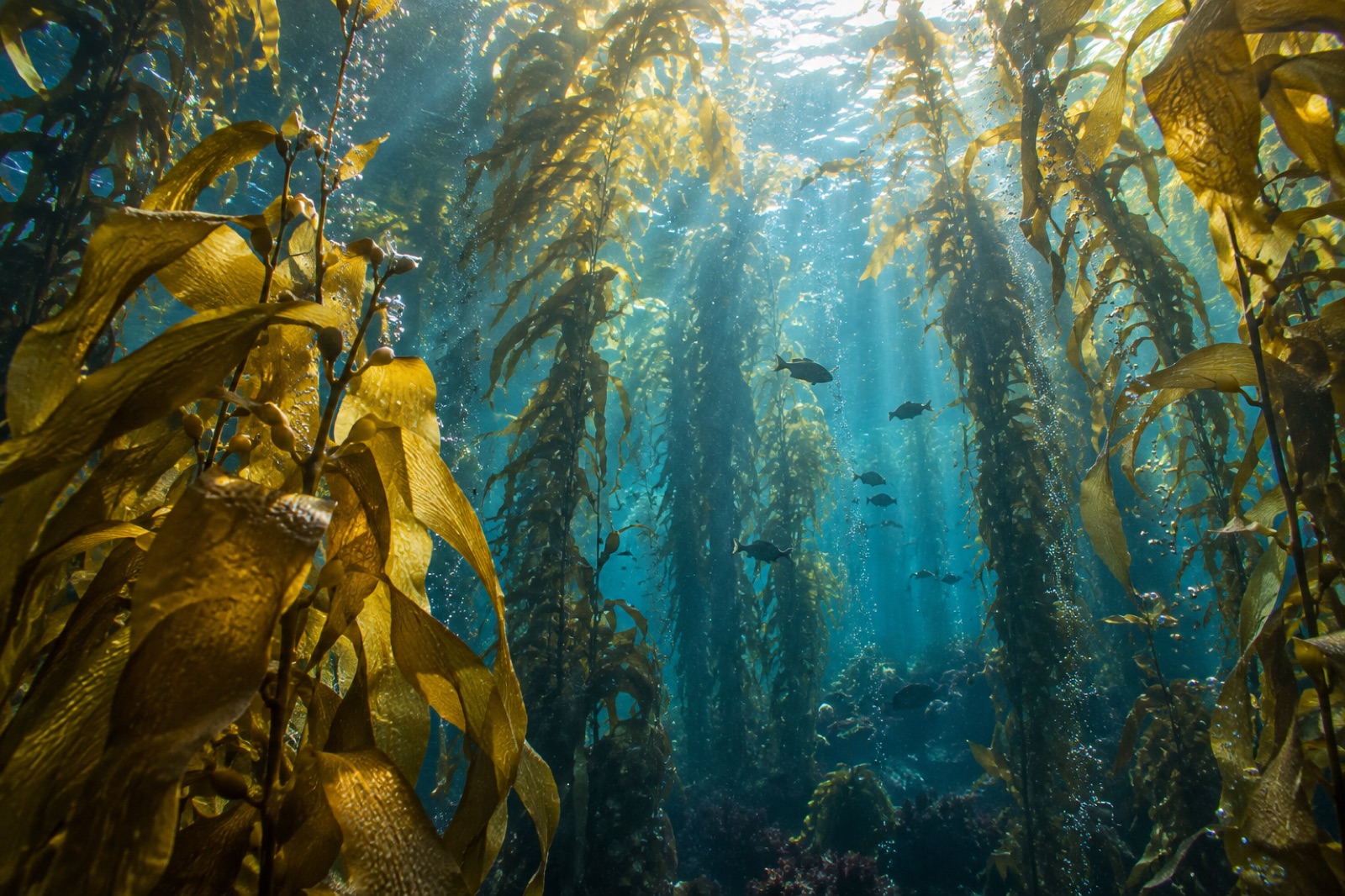
Kelp forests photosynthesise hard — but how much oxygen do they actually produce, where does it go, and is the 'lungs of the ocean' slogan honest science?
Dr. Theo Nakamura ·
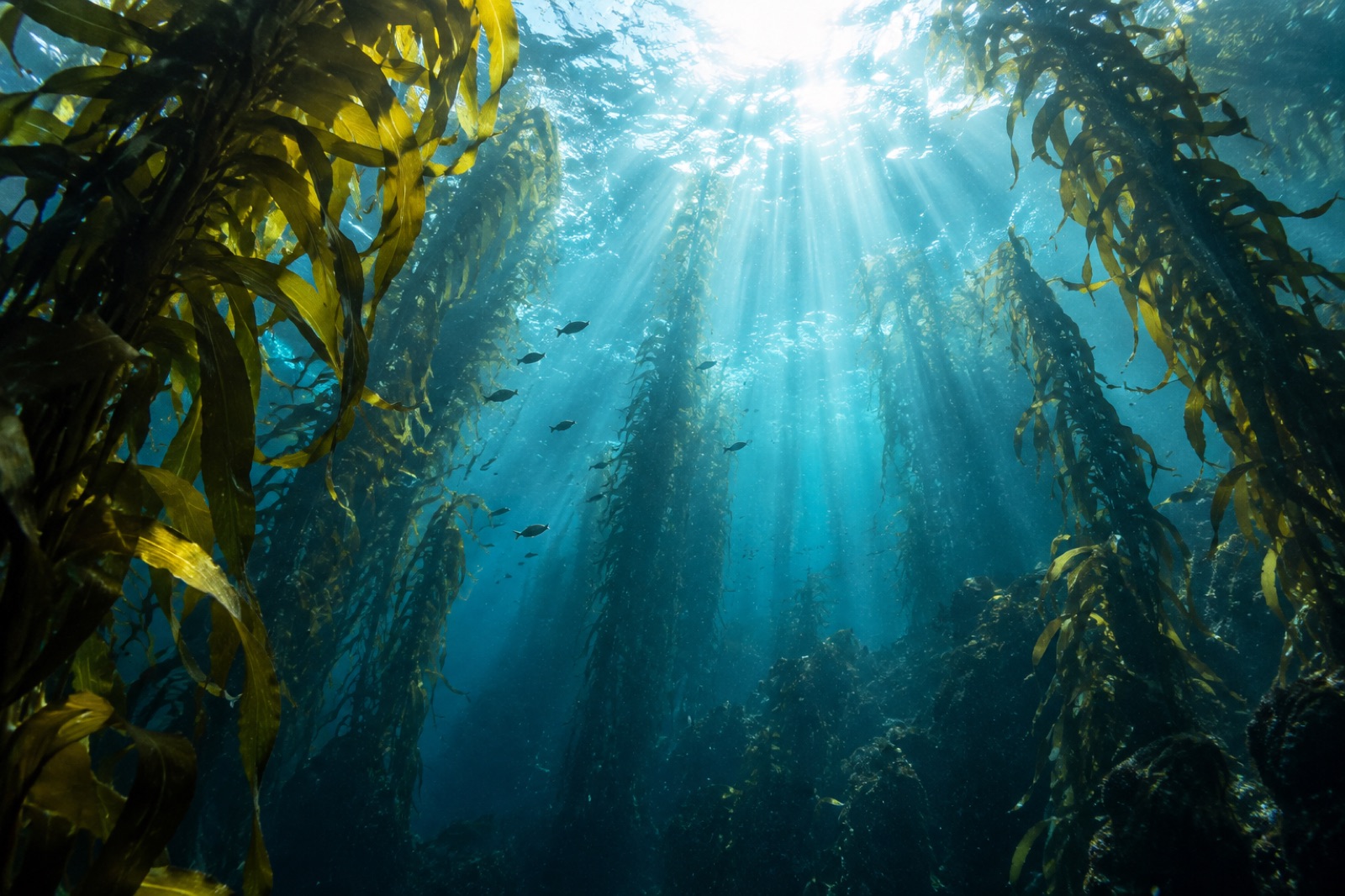
The euphotic zone is the sunlit skin of the sea where photosynthesis powers nearly all marine life. What defines it, how deep it runs, and why it matters.
Dr. Theo Nakamura ·