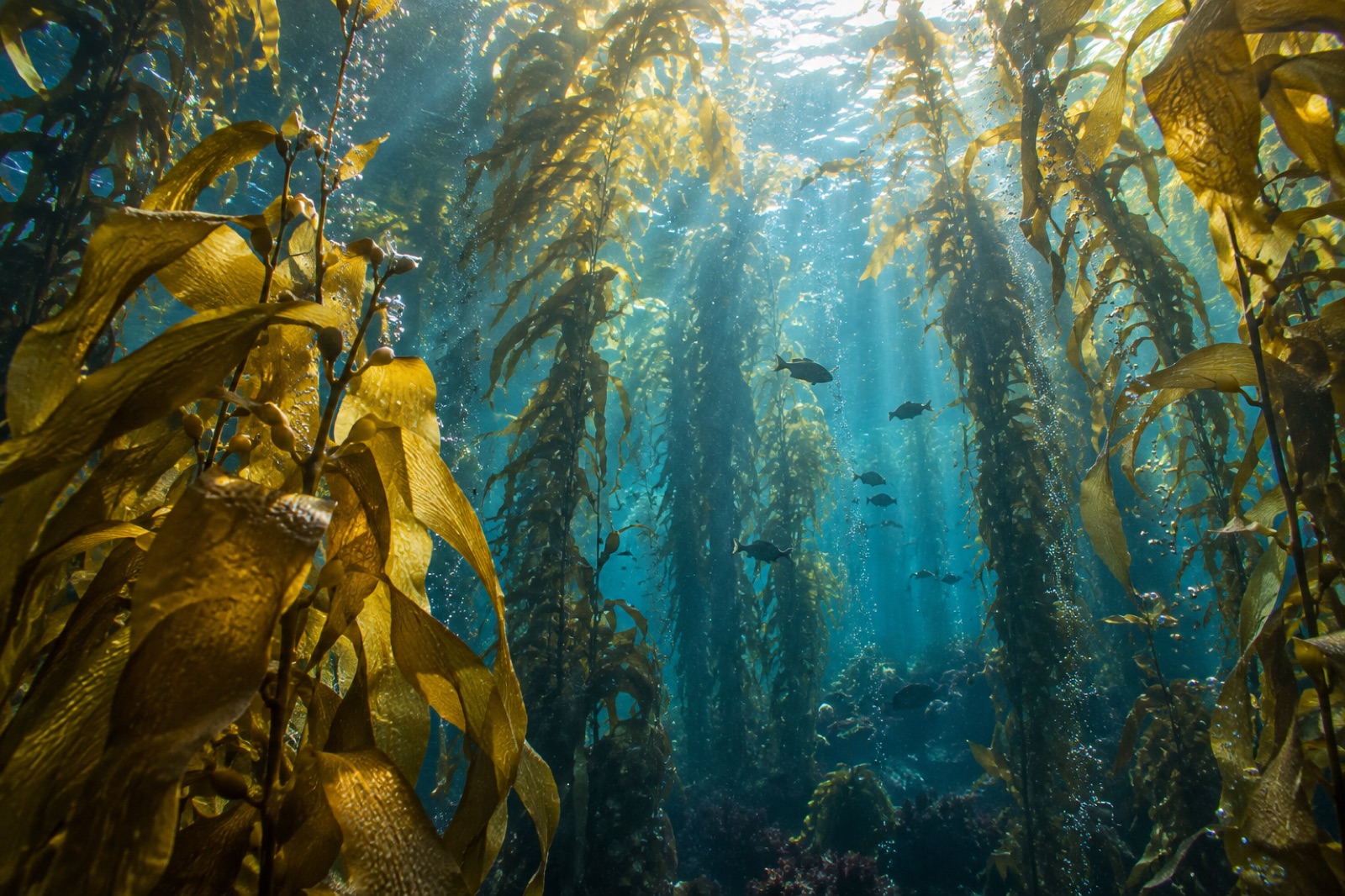
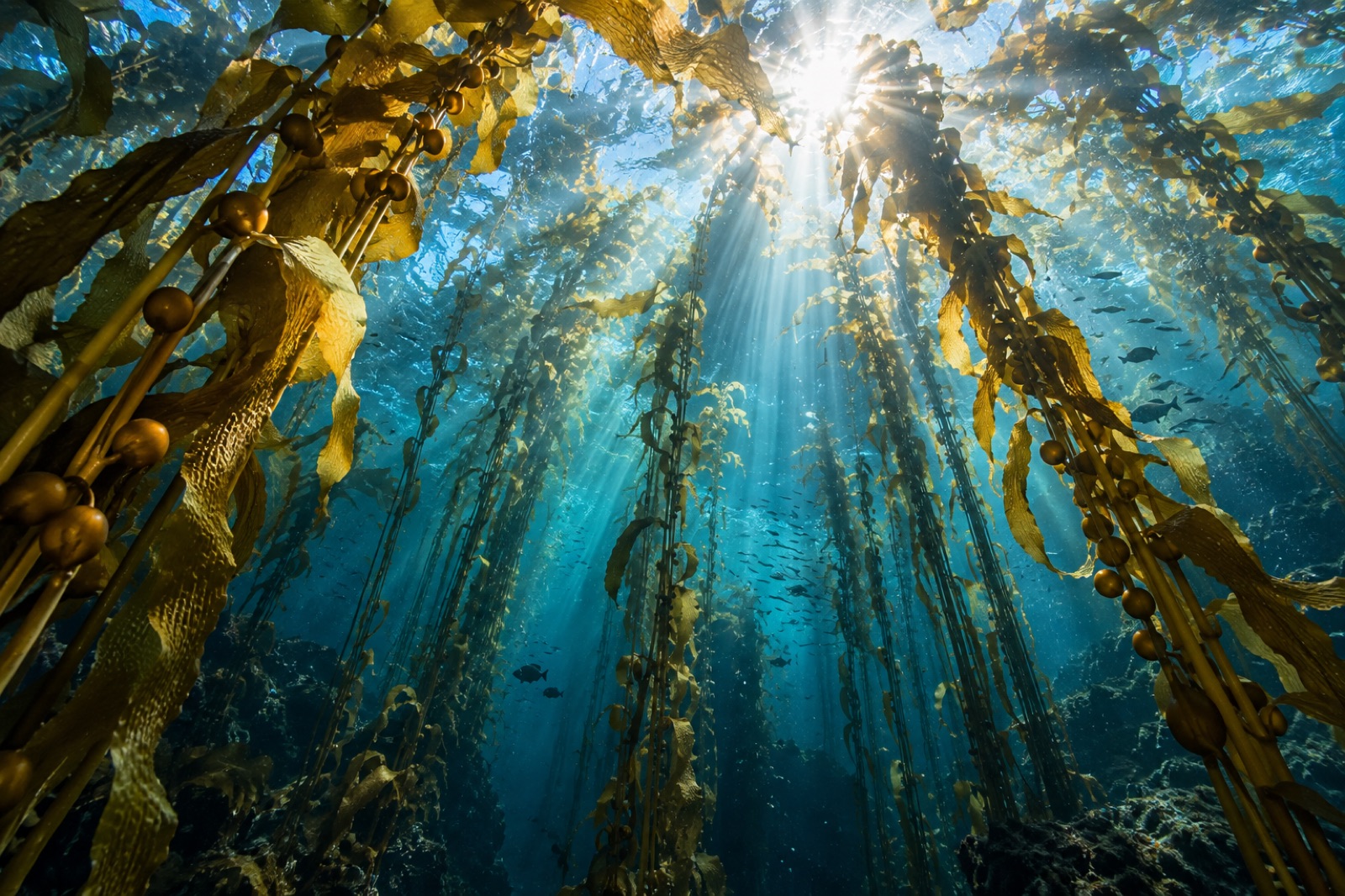
Yes — kelp forests produce oxygen. Under a noon sun in clear, nutrient-fed water, a giant kelp canopy can release oxygen fast enough to supersaturate the water around its fronds, and a diver working the understory on a bright afternoon is swimming through water more oxygen-rich than anything the open sea above can offer. But the honest answer to "do kelp forests oxygenate the ocean?" is longer, stranger and more interesting than the slogan. Some of that oxygen is breathed back by the forest itself within hours; some never stays where it was made; and the forest's most consequential gift to ocean chemistry may be where its carbon ends up rather than what its oxygen does in the meantime.
This piece walks through what kelp photosynthesis actually delivers, how oxygen differs from carbon in this story, and why the popular "lungs of the ocean" framing needs careful handling.
The photosynthesis part: how much oxygen, roughly
Kelp photosynthesis runs on the same fundamental equation as a tree's: carbon dioxide and water in, organic matter and oxygen out. What makes kelp special is how fast it runs. Giant kelp blades can add length at rates measured in tens of centimetres per day under good conditions, and kelp forests rank among the most productive ecosystems ever measured — our explainer on kelp forest primary production covers how those rates are estimated from dive tapes, blades and harvestable biomass.
For every molecule of CO₂ fixed into sugar, roughly one molecule of O₂ is released. So high productivity means locally impressive oxygen output. Working numbers from published productivity studies of kelp beds vary with species, season and water clarity, but a sunlit canopy on a good day can generate an oxygen flux comparable, per square metre, to a productive phytoplankton bloom — extraordinary for a community anchored to rock rather than spread through the water column.
Two details matter for how you picture this:
- The oxygen is released into water, not air. Dissolved oxygen in seawater is measured in milligrams per litre, and water holds roughly thirty times less oxygen than the same volume of air. "Supersaturation" inside a canopy means the water temporarily holds more than its equilibrium share — a real, measurable comfort to fish and invertebrates, not a pipeline to the atmosphere.
- It is a daytime event. Photosynthesis stops at dark; respiration does not. Kelp, and every creature sheltering in it, keeps breathing all night.
The night shift: forests that breathe
This is where the story earns its nuance. A kelp forest at 3 a.m. is a net oxygen consumer. The kelp respires. So do the fish, the urchins, the microbes working through yesterday's shed tissue, and the thick biofilm coating every blade. On calm, warm nights, the oxygen surplus the canopy built by midday can be substantially drawn down by dawn.
Over a full day-night cycle, the picture depends on the season and the fate of the forest's production:
- Spring and summer, growing forest: net oxygen producer during the day, net consumer at night, roughly neutral-to-positive overall.
- Autumn storms, senescing blades, decomposing drift: the microbes move in, and the local oxygen balance can tip negative — especially in calm, poorly flushed water.
- Annual species like bull kelp or sugar kelp: a sharp version of this cycle, with a fast, oxygen-generating spring growth phase followed by a decomposition season.
The diel swing is why some of the lowest dissolved oxygen readings in kelp country come not from polluted harbours but from sheltered beds on still pre-dawn mornings in late summer. The forest is alive and breathing — that's all. For the global picture of where oxygen loss is a crisis, see our explainer on ocean deoxygenation, which concerns midwater and open-ocean layers on climate timescales — a different phenomenon entirely.
Export: oxygen's travelling companion
Phytoplankton account for the great majority of oceanic primary production — the open sea is where most marine photosynthesis happens, and much of the oxygen in Earth's atmosphere has planktonic ancestry. Kelp forests hug a narrow ribbon of rocky coast; their total area is a small fraction of the ocean's sunlit surface, so even at fierce local rates they cannot rival phytoplankton's sheer scale.
What kelp does have is an unusual economy of export. A large share of kelp production is not eaten where it grows; blades abrade, tear, and drift. That drifting carbon — and where it ends up — is the subject of our piece on where kelp carbon goes. The oxygen side of the export story is subtle: when kelp tissue is exported beyond the reef and decomposes at depth, the oxygen cost of that decomposition is paid somewhere else. That separation is what makes exported carbon matter for the climate ledger — carbon buried in deep sediment is carbon that isn't respired back to CO₂ in the local water column — while the oxygen produced at growth time has long since been breathed, recycled or exchanged with the atmosphere.
In other words: oxygen is the exhaust of production, not its product. It was spent, mostly, doing the work of production and its immediate aftermath. The durable legacy of a kelp forest is in the carbon and the habitat, not in a standing credit of spare oxygen.
Oxygen versus carbon: two different ledgers
People often conflate "produces oxygen" with "stores carbon," and they are related but not interchangeable:
- Oxygen released during photosynthesis is balanced almost molecule-for-molecule by oxygen consumed when that organic matter is respired or decomposed — unless the carbon is removed from circulation (eaten and later sunk, exported, buried). Only carbon that stays out of the loop represents net new oxygen in the world, and for marine systems that fraction is small.
- Carbon storage asks where the fixed carbon goes: grazed and respired quickly, or carried to depth and locked in sediment — potentially for centuries. This is the premise behind serious blue-carbon accounting, which tracks carbon fate rather than oxygen release.
A forest that grows a tonne of kelp and then rots on the beach has, over the season, moved very little net carbon or oxygen. A forest that exports a fraction of that growth to a deep basin did something climatically meaningful — and its oxygen history is a footnote.
Local benefits are still real
None of this diminishes what canopy oxygen does locally. Supersaturated water in a sunlit understory is a genuine refuge for juvenile fish, abalone and crab during warm spells, when warmer water holds less oxygen and everyone's metabolic rate climbs. Bubble streams streaming off surface canopy — visible proof that the canopy is outgassing faster than the water can absorb — are among the most cheering sights in temperate diving. And in restoration terms, a recovering forest re-establishing daytime oxygen production around its fronds is re-inflating exactly the habitat cushion that heat-stressed reef animals need.
Tidewright's monitoring program treats dissolved oxygen as one strand of habitat quality among many: canopy cover, water temperatures through the water column, recruitment of fish and invertebrates, and carbon export estimates all sit in the same ledger. No single number — and certainly not a slogan — carries the story of a forest.
So what should "lungs of the ocean" mean?
As poetry, fine. As ecology, it misleads twice: first by implying a global oxygen service kelp forests don't provide at scale (the atmosphere's oxygen balance is a geochemical deep-time story, and marine photosynthesis as a whole is largely balanced by marine respiration), and second by underselling the forest's real services — habitat for hundreds of species, coastal protection, fisheries, and carbon export. A kelp forest is less a lung than a neighbourhood: a place where production, shelter and chemistry concentrate life. It deserves the better metaphor.
If you want the mechanics underneath all this — pigments, the brown light, the physics of photosynthesis underwater — our explainers on how kelp photosynthesises and light underwater pick up from here.
Key takeaways
- Kelp forests do produce oxygen — locally, vigorously and measurably; sunlit canopies can supersaturate the water immediately around them.
- The forest is a daytime producer and a night-time consumer of oxygen; calm pre-dawn readings late in the season can be the lowest of the cycle.
- On a global scale, phytoplankton dominate ocean oxygen production; kelp's narrow coastal band can't compete on area.
- Oxygen production and carbon storage are different ledgers — exported and buried carbon, not standing oxygen, is the climate-relevant outcome.
- "Lungs of the ocean" is decent poetry and poor science; a kelp forest's real value is habitat, productivity and carbon export.
FAQ
Do kelp forests produce more oxygen than rainforests?
Per unit area, a productive kelp canopy can rival intensive phytoplankton growth — so locally, its photosynthetic rate is world-class. But kelp covers a tiny fraction of Earth's surface compared to forests or the open ocean, so any "produces more oxygen than" claim is a rate-per-square-metre statement, not a global one. And almost all marine oxygen production is balanced by marine respiration over time.
Why is oxygen sometimes lowest around kelp before sunrise?
Because all night, the kelp and every animal and microbe in the forest kept respiring while photosynthesis was off. In calm, poorly flushed water, that overnight drawdown can drop dissolved oxygen noticeably by dawn — especially late in the growing season when biomass is high. Daylight refills it.
Does restoring kelp forests help with ocean deoxygenation?
Only indirectly and locally at best. Large-scale ocean deoxygenation is driven by warming and stratification in midwater and open-ocean layers, far from kelp habitat. Restored forests can improve local daytime oxygenation in the canopy, but they are not a treatment for midwater oxygen loss.
Is the oxygen kelp produces connected to its carbon credits?
No — carbon crediting tracks the fate of fixed carbon (grazed, exported, buried), because only carbon kept out of circulation counts as storage. Oxygen release during growth is not itself a storable product; monitoring programs measure oxygen to understand habitat condition and metabolic balance, not to invoice it.
Can I see kelp producing oxygen while diving?
Often, yes. On bright days, surface-reaching canopy can outgas faster than the surrounding water absorbs, and fine bubble streams rise off the blades. That silvered, fizzing canopy is photosynthesis outrunning the water's capacity to absorb what it makes — visible primary production in progress.