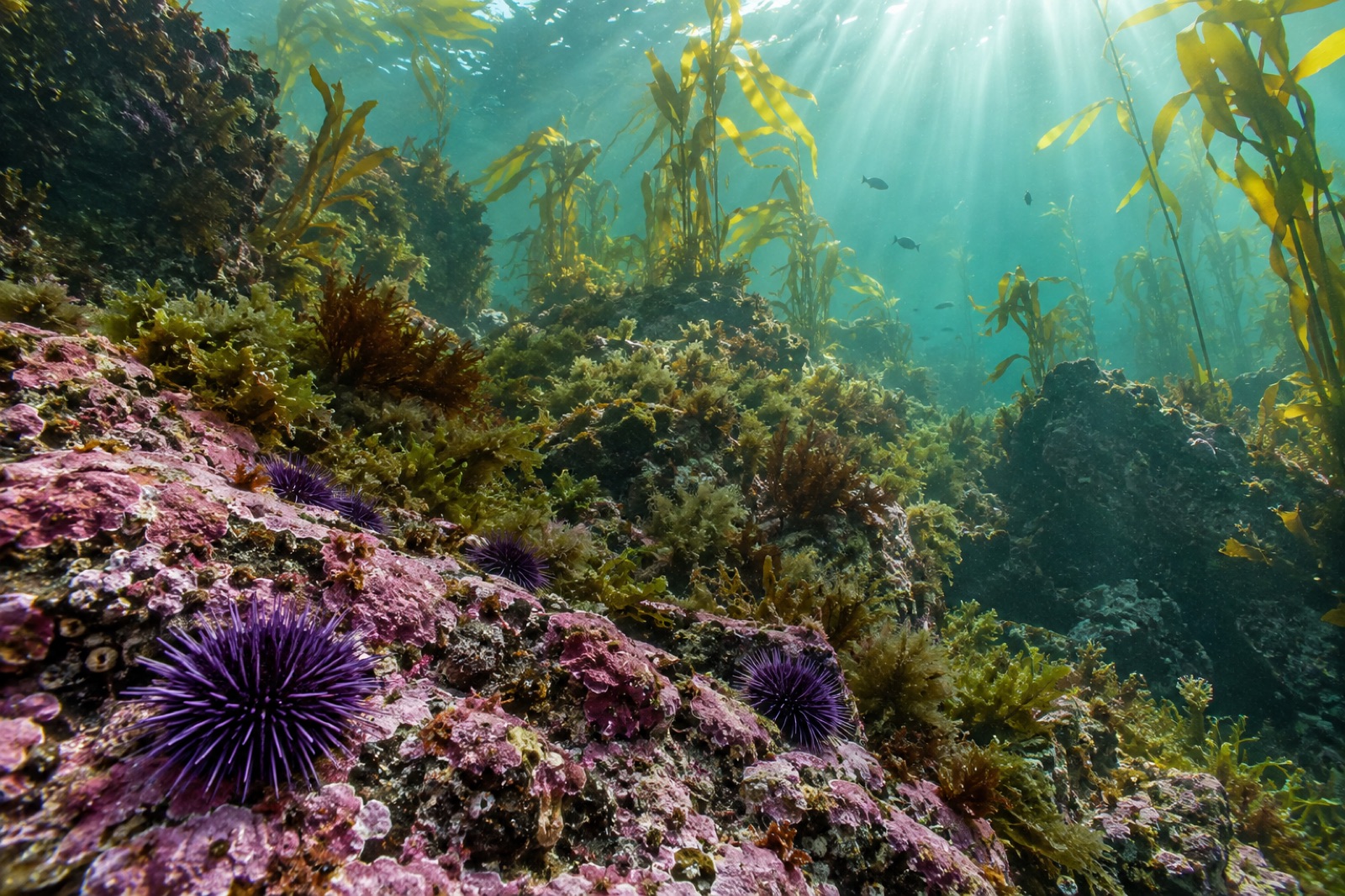
Not all kelp forests are built the same way — and the deepest difference is not size or shape but time. Some kelps, like the bull kelp of the North Pacific, live fast and die young, completing their visible life in a single year. Others, like giant kelp and the great Laminaria forests of the North Atlantic, stand for years, shedding and regrowing fronds like an orchard that never sleeps. This divide — annual versus perennial — shapes everything from how a forest looks in winter to how it recovers from a heatwave, and it is one of the first decisions a restoration ecologist must get right.
The Two Strategies, and Why Both Exist
Life-history theory says organisms face a trade-off: invest in one big, fast reproductive gamble, or invest in a durable body that reproduces many times. Kelp embodies both answers within the same order.
The environment decides which pays. Where winters are savage, light vanishes for months, or storm disturbance is clockwork-reliable, holding an expensive body through the bad season is a poor bet — better to grow explosively in the good months, release spores, and leave survival to the microscopic gametophyte generation waiting in the sediment. Where conditions are steadier, a long-lived body with a large holdfast and deep reserves can monopolise space and light year after year, shutting out competitors.
Both strategies work. Coasts around the world, in both hemispheres, have settled on each — often side by side in one forest layering annuals over perennial understory.
The Annual Gamble: Bull Kelp and Its Kin
A life lived in fast-forward
Bull kelp (Nereocystis luetkeana) is the archetype. Spores settle in spring; by midsummer, young sporophytes are among the fastest-growing organisms on Earth, extending stipes up to 35 metres — rare individuals more — and unfurling a buoyant crown of blades at the surface. By autumn they are fertile, releasing trillions of spores from sori that drop from the blades like printed pages. Then, with winter: death. Storms strip the aging plants, and by December a bull kelp forest can simply vanish, leaving only holdfast stubs to wash ashore.
To a newcomer this looks like catastrophe; to the species, it is the plan. The year's canopy is gone, but the bet is already placed: millions of microscopic gametophytes — the alternate half of the kelp life cycle — sit banked in the reef's crevices, ready to fire the next spring.
What an annual forest means
- Seasonal habitat. The forest is a summer phenomenon. Fish and invertebrates that shelter in the canopy must make other arrangements all winter; mobile species migrate through; residents drop to the understory.
- Boom-bust structure. Annual forests fluctuate wildly year to year. A bad recruitment spring, a warm summer, an urchin outbreak — any of these can mean a near-bare year, with a following good year roaring back to full canopy. High variance is normal, not pathological.
- Fast response, fast feedback. Because the whole forest is rebuilt from propagules each year, annual kelp responds quickly to both damage and recovery — a double-edged sword for monitoring, since a missing canopy tells you this year was bad, not necessarily that the reef is lost.
The Perennial Fortress: Kelps That Stand for Years
Giant kelp (Macrocystis pyrifera) individuals routinely live five to seven years and sometimes longer, growing continuously and shedding old fronds the way a tree sheds leaves. The Atlantic and North Pacific Laminaria forests — oarweed, cuvie, sugar kelp and relatives — persist for years to decades, with stipes that thicken like sapling trunks. Australia's golden kelp forests stand year-round, blackened old stipes bearing fresh annual blades each season.
The perennial body buys several things:
- Pre-empted space. A standing plant holds its territory through every season, denying settlement space to competitors and turf algae.
- Continuous reproduction. Perennial kelps can be fertile for much of the year, seeding every favourable window rather than staking everything on one autumn.
- Structural permanence. The forest never closes. Winter reef life — from rockfish to hunting octopus — has its architecture all year.
- Buffered reserves. Large holdfasts and stipe bases store energy that funds spring regrowth even after dark, cold months.
The cost: a perennial plant is a hostage to every disturbance during its lifetime. A heatwave that an annual species sat out as a seed bank strikes a perennial in full standing.
When Disturbance Arrives: How Each Strategy Responds
This is where the life-history divide becomes urgent ecology. Watching succession after a heatwave, the difference is stark.
Annual beds reboot. If the sediment gametophyte bank survived, the forest can return in one growing season — a genuinely fast rebound. But that bank is finite and degrades over time: miss two or three recruitment years in a row, or smother the reef with turf, and the annual system's seed bank thins toward failure. Bull kelp's dramatic collapses along parts of the North American west coast followed exactly this compounding of failed years.
Perennial forests fallback or fracture. Established plants sometimes survive a single warm season — they have reserves — but repeated heatwaves, added urchin pressure or competing turf can kill standing forest that will not return without spore supply from surviving neighbours. And perennial recovery is slow: a giant kelp stand that takes five years to rebuild its canopy has five winters of exposed reef. Both strategies fail when bad years become the new average — the system's resilience depends on the interval between disturbances, not just their size.
What This Means for Restoration
Choosing an annual or perennial target species is one of the first and most consequential calls in a restoration design.
- Annual species offer quick wins: a seeded bull kelp line can reach surface canopy in its first season, giving fast visual and carbon results. But the project must then be tended like a crop — every year is a new establishment event, every year a new roll of the recruitment dice.
- Perennial species are a longer project but a durable one: once a giant kelp or Laminaria stand establishes, it tends its own canopy, reproduces on its own schedule, and recruits its own successors. The risk is front-loaded, in the establishment years.
Tidewright's Holdfast nursery program treats this as a portfolio question, matching seedstock genetics and species strategy to the disturbance regime of each site: annual colonists where fallow substrate needs fast cover and window-by-window betting, perennial forest-formers where a stable canopy can pay for the longer wait. The full toolkit is described on the Holdfast platform page. Nature itself runs exactly this mixture — assigning each rocky reef the year's gamblers beside the long-tenured landlords.
Key Takeaways
- Kelps divide into annual species (fast single-season lives, seed-bank survival) and perennial species (multi-year bodies, year-round forest), and each strategy fits a different disturbance regime.
- Bull kelp's annual boom-bust means high year-to-year variance is natural; canopy absence in one winter is seasonal design, not necessarily decline.
- Perennial kelps dominate space, reproduce continuously and give reefs permanent three-dimensional structure — but they take each heatwave personally.
- Annual systems rebound fast from a single bad year but erode if recruitment fails repeatedly; perennial systems can absorb one bad year but recover slowly once lost.
- Restoration must match species strategy to the site's disturbance rhythm — and often benefits from running both at once.
FAQ
Is giant kelp annual or perennial?
Perennial — a single giant kelp plant typically lives five to seven years, continuously extending fronds and shedding old ones. Individual fronds live only months, which sometimes causes the confusion, but the plant itself is a long-lived organism.
Does bull kelp really die every winter? The whole canopy?
Essentially yes, in most of its range: the year's sporophytes senesce and are stripped by autumn and winter storms. What survives to spring is the microscopic gametophyte — the "seed bank" in the reef — not any visible plant.
Which is better for kelp restoration — annual or perennial?
Neither is universally better; it depends on the site. Annual species give fast first-season canopy but require re-establishment every year. Perennials take longer to establish but then maintain themselves. Most serious projects weight perennials for durability, sometimes using annuals for early cover and water-column benefits.
Can a coast change from one strategy to the other?
Yes — and climate change is forcing the issue. Shifting temperature and storm regimes can shrink perennial ranges poleward and open space to annual and weedy species, re-scripting the whole forest's seasonal character within a decade.
How do scientists tell whether a missing canopy is normal seasonality or real decline?
Long-term datasets. Time series from satellite imagery, diver surveys and drone mapping — the kind Tidewright publishes on its impact dashboard — allow ecologists to compare a given winter against the seasonal rhythm of previous decades, separating the annual hibernation from a downward trend.